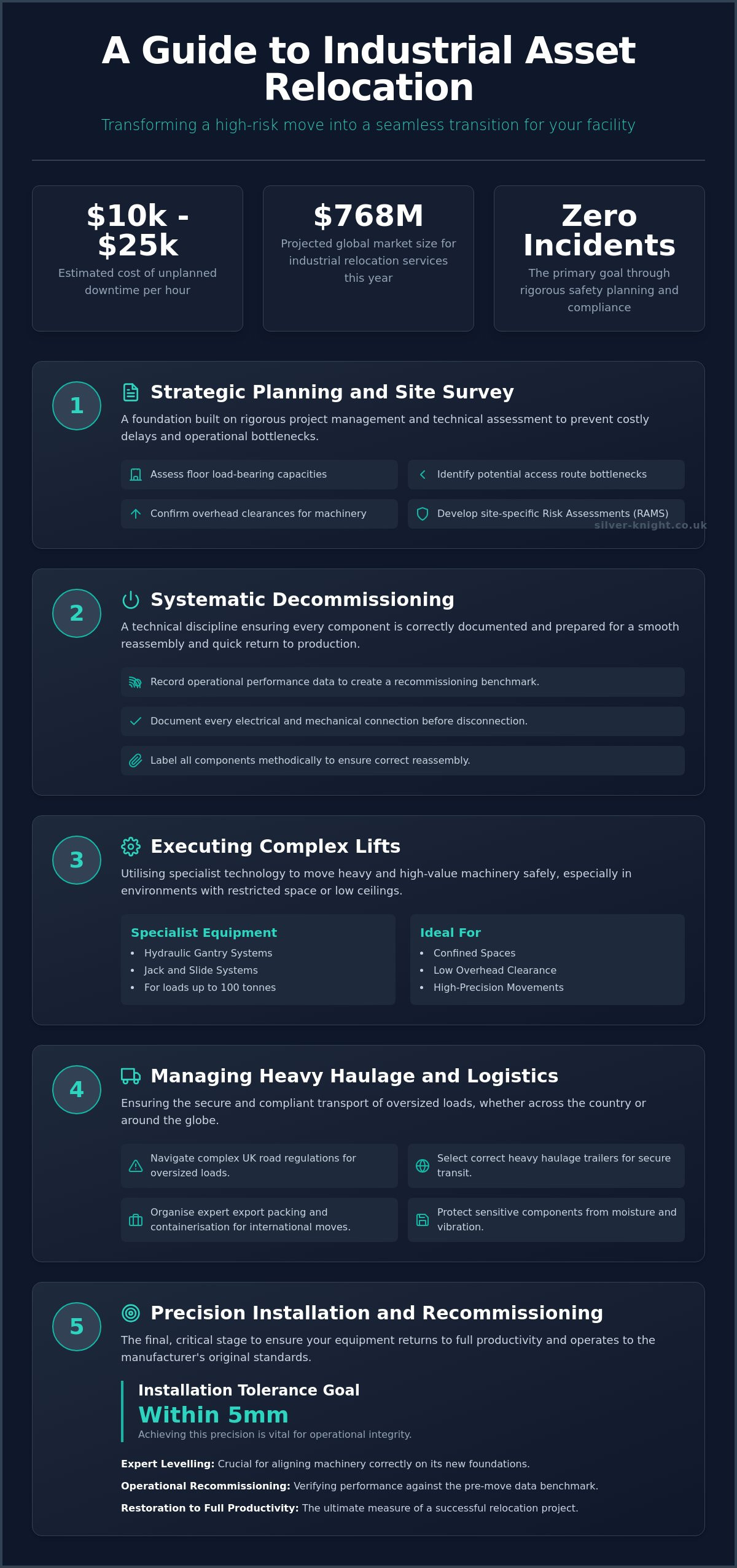
Did you know that unplanned downtime for a manufacturing facility can cost between $10,000 and $25,000 per hour in 2026? With the global industrial relocation services market projected to reach $768 million this year, the stakes for moving your production line have never been higher. It is understandable if you feel a sense of dread when tasked with an industrial asset relocation. You aren't just moving boxes; you are handling the heartbeat of your business. You likely worry about catastrophic equipment damage during transit or whether the floor load-bearing capacity at your new site is truly sufficient for your heaviest units.
We agree that managing complex electrical and mechanical disconnections is a daunting technical challenge that leaves no room for error. This professional guide helps you master the complexities of moving heavy machinery by providing a clear roadmap for planning, lifting, and installing your equipment. You will learn how to achieve zero safety incidents and ensure your machinery is restored to full operational precision quickly. We will explore the vital technical requirements and logistical strategies needed to transform a high-risk move into a seamless transition for your facility.
Key Takeaways
- Understand why a technical site survey is essential for assessing floor load-bearing capacities and identifying potential access route bottlenecks.
- Master the systematic decommissioning process to ensure every electrical and mechanical component is correctly documented for a smooth industrial asset relocation.
- Learn how to choose between specialist lifting technologies like hydraulic gantry systems or jack and slide systems for heavy loads in confined spaces.
- Discover how to navigate complex UK road regulations for oversized loads and select the right heavy haulage trailers for secure transport.
- Ensure your equipment returns to full productivity through precision installation techniques including expert levelling and operational recommissioning.
Key Takeaways
A successful industrial asset relocation is far more than a logistical challenge; it is a precision engineering project that requires meticulous preparation. The process must begin with a comprehensive technical site survey to evaluate the structural limits of both the origin and destination facilities. This includes a detailed analysis of floor load-bearing capacities and a review of access routes to ensure heavy machinery can be extracted safely. Professionals often look at the existing facility planning and layout to determine the most efficient path for moving assets without disrupting ongoing operations or damaging the building fabric.
Safety remains the absolute priority throughout the project. In the UK, all lifting and moving operations must comply with the Health and Safety at Work Act 1974. This compliance is demonstrated through the creation of site-specific Risk Assessments and Method Statements (RAMS). These documents outline the exact steps taken to protect workers and equipment, ensuring that every lift is planned and executed by competent persons. Without these rigorous safety protocols, the risk of catastrophic equipment failure or personal injury increases significantly.
To better understand the scale of these operations, watch this helpful video regarding engineered equipment relocation:
Decommissioning is a critical phase that demands a systematic approach. Engineers must document every electrical and mechanical connection before any disconnection occurs. This documentation serves as a vital map for the eventual reassembly. Recording performance data whilst the machine is still operational provides a benchmark for the recommissioning phase of your industrial asset relocation, allowing technicians to verify that the asset has been restored to its original precision once it reaches its new location.
Heavy lifts in confined spaces require specialised equipment that standard cranes cannot provide. Utilising hydraulic gantry systems or jack and slide systems allows for the movement of 100-tonne loads in environments with low ceilings or restricted floor space. For international moves, expert export packing and containerisation are essential to protect sensitive components from moisture and vibration during transit. The final installation must achieve a precision tolerance, often within 5mm, to ensure the machinery operates to the manufacturer's original standards.
Table of Contents
This guide provides a comprehensive roadmap for factory managers and logistics directors tasked with moving high-value machinery. As industrial leasing activity is forecast to reach nearly 1 billion square feet in 2026, the demand for structured relocation strategies has never been more pressing. We have broken down the process into five essential stages to ensure your project remains on schedule and within budget.
Strategic Planning for Industrial Asset Relocation
Success is built on a foundation of rigorous project management. This stage involves a technical site survey to identify potential operational bottlenecks before they disrupt your timeline. By assessing floor load-bearing capacities and overhead clearances early, you can avoid the costly delays associated with inadequate site preparation. Effective planning also accounts for the 5% year-over-year increase in industrial leasing activity, helping you secure the necessary resources in a competitive market.
Systematic Decommissioning and Asset Preparation
Decommissioning is a technical discipline that requires more than just unplugging equipment. It involves recording performance data whilst the machine is operational to create a benchmark for future recommissioning. Every electrical and mechanical component must be documented and labelled. This systematic approach is vital because unplanned downtime for a manufacturing facility can cost between $10,000 and $25,000 per hour, making a swift return to production essential.
Executing Complex Lifts with Specialist Technology
Moving heavy machinery often involves navigating tight spaces where traditional cranes cannot operate. This section explores the use of hydraulic gantry systems and jack and slide technology. These tools are indispensable for 100-tonne lifts in low-roof environments. With the global rigging gear market expected to reach $73.78 billion by 2033, staying informed about the latest lifting techniques is crucial for maintaining safety and efficiency during a move.
Managing Heavy Haulage and Global Logistics
Transporting oversized assets requires a deep understanding of transport regulations and permit requirements. This includes adhering to Federal oversize/overweight regulations when moving goods through different jurisdictions. You must also account for fluctuating fuel costs, such as the national average diesel price of $5.64 per gallon, and the specific permit fees that vary by state. Selecting the correct low-loader trailers ensures your industrial asset relocation proceeds without legal or physical hitches.
Precision Installation and Operational Recommissioning
The final stage is about restoring your machinery to full operational precision. This involves expert levelling and alignment to ensure long-term accuracy. Engineers must verify all connections against the documentation created during decommissioning. Achieving a precision tolerance is necessary to meet original manufacturer standards and prevent premature wear. If you require expert assistance with any of these stages, please speak with our technical team for tailored support.
To ensure your next project is handled with technical precision, you can explore the range of professional services offered by this specialist machinery moving firm.
Strategic Planning for Industrial Asset Relocation
Professional project management serves as the bedrock of any successful factory move. Without a central figure to coordinate engineers, hauliers, and site managers, the risk of miscommunication grows. This often leads to the very downtime manufacturers fear, which can reach costs of $25,000 per hour in high volume facilities. A structured approach ensures every phase of the industrial asset relocation is accounted for, from the initial audit to the final bolt tightening. A dedicated project manager acts as the single point of contact, bridging the gap between your internal production team and the external lifting specialists.
Global examples of large scale movements often involve government frameworks, such as the Industrial Relocation Promotion Law, which highlights how strategic planning impacts regional industrial health. On a facility level, this translates to developing a timeline that respects your production peaks. You shouldn't schedule a move during your busiest quarter; instead, plan for periods of lower activity to mitigate the impact on your customers. When designing this timeline, you must build in buffers for unforeseen challenges such as adverse weather or transport delays. A rigid schedule that leaves no room for error often results in rushed work, which is when safety incidents are most likely to occur.
By aligning the move with your existing maintenance windows, you can transform a disruptive event into an opportunity for facility upgrades. This period of transition is the ideal time to synchronise machinery updates with the physical move. It requires a high level of coordination to ensure the arrival of cranes, low loaders, and electrical contractors is perfectly timed. This level of organisation is the only way to avoid the standing time charges that can quickly inflate a project budget.
Technical Site Surveys and Load Assessment
Site surveys involve more than checking doorway widths. Engineers must evaluate floor load limits and the location of underground services like gas or high voltage cables. If a 50 tonne machine passes over a weak point in the slab, the consequences are catastrophic. Measuring access routes and doorway clearances ensures that oversized assets won't get stuck midway through the building. Technical site surveys are the primary safeguard against structural failure and equipment damage during the transit of heavy industrial assets.
Risk Management and Safety Standards
Adhering to the Health and Safety at Work Act 1974 is a legal obligation during any complex lift. This requires the creation of detailed Method Statements and Risk Assessments (RAMS) which are essential for insurance purposes. These documents provide a step by step guide on how to handle equipment safely. Working with professional machinery haulage and relocation services ensures that your project remains compliant with all UK safety legislation whilst protecting your high value investments. Insurers demand these documents to verify that every possible hazard has been identified and mitigated before any work begins.
If you are planning a complex factory move, you can find expert support and technical resources through the machinery relocation specialists at Silver Knight.
Systematic Decommissioning and Asset Preparation
Decommissioning is a technical discipline that requires far more than simply cutting power to a production line. It is the most critical phase of any industrial asset relocation, as mistakes made here often lead to weeks of delays during the reassembly stage. To ensure a smooth transition, engineers must follow a rigorous five step process that prioritises data accuracy and physical protection.
The first step is to perform a full operational test. You must record performance data and tolerances whilst the machine is still in its original position. This creates a baseline that proves the asset was functional before the move began. Step two involves the systematic mechanical and electrical decommissioning by qualified engineers. This is followed by step three, which is fluid management. You must safely drain all oils, coolants, and hydraulic fluids to prevent leaks during transit and to reduce the overall weight of the load. Step four requires the meticulous labelling and documenting of every cable, pipe, and component. Finally, step five is a comprehensive final inspection to ensure the asset is structurally sound and ready for the lifting phase.
Mechanical and Electrical Disconnection
Managing complex industrial control systems and high voltage power requirements is a task for specialists. You can't simply pull cables from a control cabinet and expect to remember their positions weeks later. Every connection must be tagged with a unique identifier that corresponds to a master wiring diagram or a detailed photographic log. This process includes the safe removal of ancillary equipment, such as conveyor systems or cooling units, which often require their own specific decommissioning protocols. For projects involving high value or complex production lines, utilising a professional machinery dismantle service ensures that all mechanical and electrical work meets current safety standards and manufacturer specifications.
Protecting Sensitive Industrial Components
Once disconnected, your machinery is at its most vulnerable. When assets are destined for international markets, standard preparation isn't sufficient. Salt air and extreme temperature fluctuations during sea transit can cause rapid oxidation on exposed metal surfaces. You must use specialised materials, such as vapour corrosion inhibitors and vacuum sealing, to prevent rust and physical impact damage. All moving parts, such as gantry arms or spindles, must be mechanically locked or braced to prevent internal mechanisms from shifting during transport. Protecting CNC controllers and delicate sensors is a non negotiable requirement, as even minor vibrations can misalign optical scales or damage internal circuitry. By taking these precautions, you ensure that the machine arrives at its new destination in the same condition it left the old facility.
To ensure your project benefits from the latest lifting technology and expert handling, you can access the professional services provided by Silver Knight.
Executing Complex Lifts with Specialist Technology
Selecting the correct lifting technology is a decision that depends entirely on your specific weight and space constraints. In modern manufacturing environments, you'll often find that the most valuable assets are tucked away in corners with very low head height or surrounded by other sensitive production lines. This is why a standard mobile crane is rarely the right choice for an indoor industrial asset relocation. Instead, engineers rely on a suite of specialist tools designed to operate in confined spaces whilst maintaining absolute control over the load. These tools allow for the movement of massive components without the need for expensive roof removals or building modifications.
Hydraulic gantry systems are the preferred solution for 100 tonne lifts in low roof environments. These systems use four or more telescopic legs to provide a stable, multi-point lift that minimises the risk of the load swinging or tilting. This stability is essential when moving machines with an offset centre of gravity, such as large stamping presses or CNC machining centres. When overhead space is so restricted that even a gantry won't fit, jack and slide systems provide an alternative. These systems use high capacity hydraulic jacks to lift the asset just enough to place it on a series of low friction tracks, allowing it to be slid into position with millimetre precision.
Hydraulic Gantry and Jack Systems
The technical specifications of modern gantry systems allow for incredibly complex manoeuvres. These systems can be synchronised to ensure that all lifting points move at the exact same speed, which is critical for protecting the structural integrity of the machine being moved. Ensuring load stability during horizontal and vertical movements requires a deep understanding of physics and rigging. For those who want to understand more about the differences between these systems, you can read this specialised lifting guide for a detailed comparison of equipment types and their specific use cases.
Compact Lifting with Versa-Lift
The Versa-Lift is widely considered the favourite tool for modern industrial movers because of its unique extendable frame. This feature allows the operator to increase the lifting capacity of the machine without increasing its width, making it ideal for navigating tight factory aisles. A major part of the planning process involves managing floor pressure whilst operating heavy lifting machinery. Because these units carry so much weight on a small footprint, engineers must often use steel plating to distribute the load and protect the factory floor. Many businesses choose heavy moving equipment hire with qualified operators to ensure these complex lifts are performed safely and efficiently.
To ensure your machinery is transported safely and in full compliance with current regulations, you can access the professional haulage services provided by Silver Knight.
Managing Heavy Haulage and Global Logistics
Navigating the road network with heavy machinery requires more than just a large lorry. It is a specialised branch of logistics that demands strict adherence to UK road regulations for oversized and heavy loads. When you are managing an industrial asset relocation, you must account for the physical dimensions of your equipment as much as its weight. Standard haulage often fails to address the unique structural stresses placed on a machine during transit, which is why specialised low-loader trailers are indispensable. These vehicles provide the necessary clearance for tall assets whilst offering multiple points for heavy duty securement to prevent any shifting during the journey.
International transit introduces another layer of complexity that goes beyond simple road transport. Moving assets to Europe, Asia, or the US requires a robust understanding of global shipping logistics and complex customs documentation. You can't simply load a machine onto a ship and hope for the best. Professional export packing is the only way to safeguard your investment against the harsh conditions of sea and air travel. This phase is about more than just physical protection; it is about ensuring your equipment remains operational and free from corrosion upon arrival at its final destination.
Oversized Load Transport and Road Safety
Successful transport of large machinery involves close coordination with local authorities and police forces for wide load escorts. Route planning is a technical task that identifies height restrictions, weight limited bridges, and narrow junctions that could halt your progress. Securing machinery involves more than just chains; it requires an engineered approach to prevent structural stress that could misalign internal components. You can find more detail on these requirements in the heavy haulage standards for industrial transport, which outline the safety expectations for 2026.
Export Packing and International Shipping
To protect sensitive machinery from moisture during long sea voyages, engineers use vacuum packing and advanced moisture barriers. This prevents the rapid oxidation and corrosion that can occur when salt air enters a container. Optimising shipping container packing is also vital to ensure that every square inch is used safely and that the load is perfectly balanced for the voyage. For those moving equipment across borders, managing the necessary customs paperwork is a critical part of international machinery transport to avoid the costly delays and storage fees often found at major ports.
If you need to arrange the transport of oversized industrial equipment, contact our logistics team for a technical consultation.
For expert assistance with the final stages of your facility transition, you can consult with the professional machinery moving team at Silver Knight.
Precision Installation and Operational Recommissioning
The final phase of an industrial asset relocation is where technical planning meets physical reality. Once your machinery has been successfully transported to the new facility, the focus shifts from protection to precision. Final positioning must adhere strictly to the new facility floor plan, ensuring that all auxiliary equipment, safety zones, and operator access points are correctly oriented. This stage is about more than just placing a machine on a slab; it is about integrating the asset into its new environment to facilitate a seamless return to production. Proper positioning at this stage prevents the need for costly adjustments later in the project timeline.
Reconnecting electrical and mechanical services is a meticulous task that relies on the documentation created during the decommissioning phase. Engineers must verify that the new site's utility capacities match the requirements of the asset, particularly regarding high voltage power and compressed air pressures. Every cable and pipe must be checked for integrity before reconnection to prevent short circuits or leaks. This systematic approach ensures that the machinery is ready for the final validation tests that precede the handover to your production team.
Precision Levelling and Alignment
Achieving long term accuracy requires the use of advanced laser alignment tools to ensure the machinery is perfectly level. Even a slight tilt can lead to uneven bearing wear and reduced product quality. Once the machine is level, it must be secured using professional anchoring and grouting techniques. This process is essential to prevent vibration and lateral movement during high speed operations. Precision installation reduces wear and tear on industrial components, extending the lifespan of your high value equipment. You can find more detail on these technical requirements in this machinery installation guide, which outlines the precision engineering standards expected in 2026.
Restoring Production through Recommissioning
Recommissioning is the process of bringing a machine back to life through a systematic power up sequence. This careful approach protects sensitive electronics from sudden surges and allows technicians to monitor the behaviour of the machine as it reaches operating temperature. A critical part of this phase is verifying all safety interlocks and emergency stop systems to ensure the environment is safe for operators. Final validation tests are performed to compare the current performance against the baseline data recorded before the move. Only when the machinery meets the original manufacturer standards is it officially handed back to the production department for full scale operations.
If you are looking for expert support for your next project, you can visit the Silver Knight website for further details.
Securing the Future of Your Production Line
Successfully managing an industrial asset relocation requires a blend of technical engineering, rigorous safety protocols, and specialist lifting technology. By prioritising comprehensive site surveys and systematic decommissioning, you protect your high-value equipment from the risks of transit damage and prolonged downtime. Utilising the right tools for the job, such as hydraulic gantries or high-capacity lifting units, ensures that even the most complex moves are executed with millimetre precision. These steps are the only way to transform a high-risk operation into a controlled, predictable transition.
Silver Knight brings over 180 years of collective industry experience to every project. Our specialised fleet includes 100-tonne capacity Versa-Lifts, enabling us to handle the most demanding lifts in restricted environments. Whether you require comprehensive nationwide support or global relocation services, our team is equipped to manage every technical detail of your move. You can find out more about our professional services and discuss your specific requirements by visiting the Silver Knight contact page. We look forward to helping you achieve a seamless transition for your facility.
Frequently Asked Questions
What is industrial asset relocation and how does it differ from standard haulage
Industrial asset relocation is a comprehensive engineering service that covers the entire lifecycle of moving equipment, from decommissioning to precision installation. Standard haulage only involves the physical transport of goods from one point to another. A relocation project requires specialist engineers to manage complex electrical disconnections and mechanical lifting before the transport phase even begins.
How much does it cost to relocate heavy industrial machinery
The total cost depends on various factors such as the machine weight, the distance travelled, and the complexity of the facility access. Variables like fuel prices, which reached a national average of $5.64 per gallon in May 2026, also influence the final transport rates. You should always request a bespoke technical survey to receive an accurate estimate based on your specific project requirements.
What technical documentation is required for a safe factory move
You'll need a comprehensive set of documents including Risk Assessments, Method Statements, and technical site surveys. It's also vital to have floor load-bearing assessments and electrical wiring diagrams ready for the recommissioning phase. If your move involves oversized assets, you'll also need specific road permits which can vary in cost depending on the state or region.
How long does a typical industrial asset relocation project take
Timelines vary significantly based on the number of assets and the distance of the move. A single machine relocation might be completed within 24 hours, whilst a full factory move can take several weeks of phased execution. Planning should start months in advance to account for the 5% year-over-year increase in industrial leasing activity seen in 2026.
Can machinery be moved whilst a factory remains operational
Yes, it's possible to move assets without a total plant shutdown by using a phased relocation strategy. Engineers create segregated work zones to ensure that lifting operations don't interfere with ongoing production staff. This approach helps manufacturers avoid the high costs of unplanned downtime, which can reach $25,000 per hour in some facilities.
What is a RAMS document and why is it essential for machinery moving
RAMS stands for Risk Assessment and Method Statement, and it is a legal requirement for safe industrial operations in the UK. This document identifies potential hazards and outlines the exact sequence of work to be followed by the moving team. It ensures that everyone on site understands the safety protocols and that the project complies with the Health and Safety at Work Act 1974.
How do you protect sensitive CNC machines during international transport
Protection involves locking all moving axes and using specialist export packing materials. Vacuum sealing and moisture barriers are essential to prevent corrosion during long sea voyages. For high-value CNC units, engineers often use shock-absorbent mounting and bespoke timber crating to ensure that internal sensors and controllers remain perfectly aligned throughout the journey.
Is insurance included in professional industrial relocation services
Most professional movers include standard Goods in Transit and Public Liability insurance in their service packages. However, you should always verify that the coverage limits are sufficient for the replacement value of your specific assets. In 2026, some businesses choose to take out additional per-shipment cargo insurance, which is typically priced between 0.1% and 2% of the declared cargo value.

Article by
David Ashby
I'm the Managing Director of Silver Knight Haulage & Machinery Ltd. Silver Knight Ltd is a family-run firm established in the West Midlands in 2005, with the aim of providing a cost-effective, yet professional, service to businesses for the removal, transportation, and installation of machinery, plant, and equipment here in the UK and worldwide. Between us, the Silver Knight workforce has over 50 years of experience with machinery and its operation.
Disclaimer
This article is intended for informational purposes only. Please ensure you seek expert advice or carry out your own research to confirm the information is suitable for your specific needs.