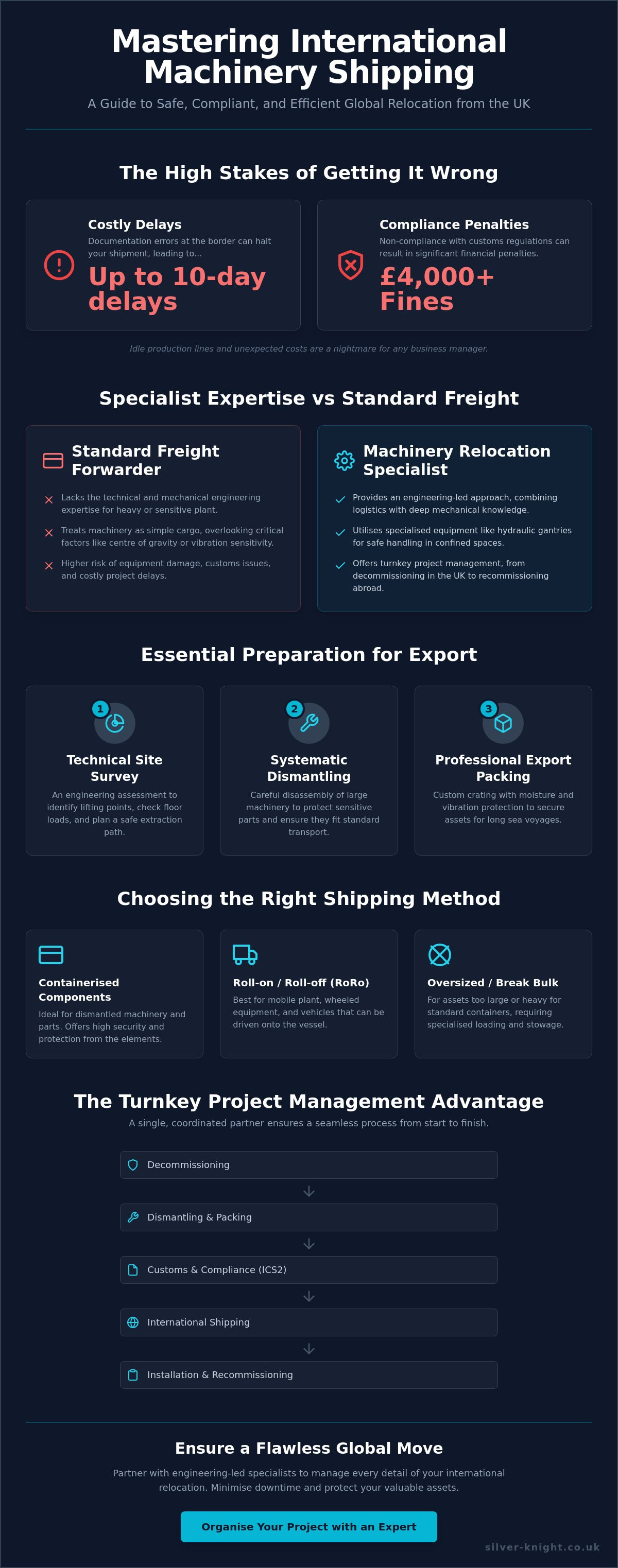
Did you know that documentation errors at the border can lead to delays of up to ten days and fines reaching $5,000 per violation? For any business manager, the thought of an entire production line sitting idle whilst equipment is stuck at a port is a genuine nightmare. Successfully managing international machinery shipping from UK ports requires more than just a sturdy crate; it demands a precise strategy that covers everything from decommissioning to final installation.
We understand that the risks of equipment damage during long sea voyages and the confusion over complex 2026 customs regulations can be overwhelming. You shouldn't have to juggle multiple contractors or worry about non-compliance penalties. This guide provides the expert advice you need to handle complex global industrial moves. We will explore how to secure your assets with professional export packing, navigate the latest ICS2 requirements, and coordinate specialised transport to ensure a damage-free relocation with minimal downtime for your business.
Key Takeaways
- Identify why moving heavy plant requires technical engineering expertise that goes beyond the capabilities of standard freight forwarders.
- Master the essential preparation steps, such as technical site surveys and systematic dismantling, to protect your equipment during transit.
- Evaluate the best transport methods for international machinery shipping from UK locations, from containerised components to Roll-on Roll-off mobile plant.
- Gain clarity on 2026 customs compliance and Incoterms to ensure your assets move across borders without legal hitches or unexpected costs.
- Realise the benefits of turnkey project management for coordinating every stage of a global relocation from decommissioning to recommissioning.
For businesses planning a major move, partnering with professional machinery transport services ensures every stage of the process is handled with precision.
Understanding the Complexity of International Machinery Shipping
Global industrial relocation projects in 2026 have become more sophisticated than ever. Moving a single production line or an entire factory from the UK to destinations in Europe, the US, or Asia involves a web of logistical challenges. It isn't just about moving a crate from point A to point B. It's about engineering a solution for assets that are often oversized, incredibly heavy, or sensitive to the slightest vibration. Successfully managing international machinery shipping from UK hubs requires a deep understanding of both mechanical engineering and global logistics. Whilst many firms claim to handle heavy loads, understanding various freight transport methods is just the first step in a much longer journey.
Standard freight forwarders often lack the technical expertise required for heavy plant. They might be experts at booking space on a vessel, but they don't always understand the centre of gravity for a bespoke hydraulic press or the decommissioning needs of a manufacturing cell. This is where 180 years of collective industry experience becomes invaluable. This level of heritage helps in mitigating risks that others might miss, ensuring that your high-value assets are protected against the rigours of transit. Whether you're moving equipment across the English Channel or to a new facility in Singapore, the technical requirements remain uncompromising.
To see the scale of costs and logistics involved in large-scale shipping, watch this helpful video:
The Difference Between General Freight and Machinery Relocation
Oversized loads can't simply be tossed into the back of a standard lorry. They require specialised trailers and low loaders designed to distribute weight safely. When loading these assets, traditional forklifts are often insufficient. Instead, specialists utilise hydraulic gantry systems and jack and slide systems to manoeuvre heavy items within tight factory spaces. These tools are essential for handling precision CNC machines or FMCG gear, where the equipment's internal alignment must be preserved at all costs. Unlike general cargo, these machines have unique handling requirements that demand a tailored engineering approach.
Strategic Planning for Global Asset Movement
A project-based approach is essential for any successful factory plant relocation. You can't treat a global move as a series of disconnected tasks. It requires a unified strategy. Managing tight timelines is vital to ensure minimal disruption to your production cycles; every day of delay represents lost revenue. Many organisations find that using a family-run specialist provides a level of personalised project oversight that larger, faceless corporations can't match. When you work with dedicated international machine movers, you gain a partner who treats your production schedule with the same urgency as you do.
Ensuring your equipment is ready for transit is a vital step in any relocation. You can learn more about how to organise your industrial move with expert support.
Essential Preparations for Exporting Heavy Equipment
Before a single bolt is turned, a technical site survey is mandatory. This isn't just a quick walk-around; it's a detailed engineering assessment used to identify critical lifting points and structural vulnerabilities. When planning international machinery shipping from UK facilities, you must account for the specific path the equipment will take through your building. Are the floors rated for the weight? Are the doorways wide enough? These details prevent costly surprises on moving day and ensure that the lifting equipment, such as heavy-duty forklifts or cranes, can operate safely within the environment.
Large units often require a systematic machinery dismantle service to be transportable. This involves more than just pulling apart components. Every wire, pipe, and bracket must be labelled and documented with precision. This documentation serves as the blueprint for reassembly at the destination. Fluid drainage is another critical step. Any residual oils, fuels, or coolants can lead to environmental fines or damage to other cargo during sea transit. Electrical disconnections must also be performed by qualified personnel to ensure internal circuits and sensitive control systems remain intact during the transition.
Professional Decommissioning Standards
Safely disconnecting industrial plant requires a methodical approach to avoid damaging internal sensors or delicate components. Creating a detailed inventory is not just helpful for your engineers; it's a requirement for the UK export process and customs declarations. Technical decommissioning forms the foundation of any international move. If it's done poorly, the machine might never run correctly again, leading to expensive downtime and repair costs at your new facility. Accuracy at this stage is the only way to guarantee a smooth recommissioning phase later.
Export Packing and Protective Crating
Once dismantled, assets need robust protection. A specialist shipping container packing service ensures that loads are secured against the constant motion and G-forces of ocean transit. Bespoke timber cases are often necessary for heavy items, whilst vacuum packing with desiccant prevents corrosion from salt air. You must also ensure all wood packaging is ISPM15 compliant. This international standard for heat-treated timber is strictly enforced at borders to prevent the spread of pests. Failing to meet these standards can lead to immediate customs delays or the rejection of your entire shipment. If you are unsure about the best way to secure your assets, it's worth exploring bespoke machinery transport options for your specific needs.
Navigating the complexities of global logistics is easier with the right partner. You can find comprehensive support for your move by visiting Silver Knight's specialist services.
Comparing Shipping Methods for Industrial Assets
Selecting the right transit method is a balance of cost, safety, and speed. For international machinery shipping from UK ports, several sea freight options are available:
- Containerised Shipping: This remains the gold standard for smaller components or equipment that has been dismantled. Standard 20ft or 40ft containers offer excellent protection from the elements.
- Roll-on Roll-off (RoRo): This is the most efficient choice for mobile plant or wheeled machinery. In 2026, RoRo costs for self-propelled units under 60 tonnes typically range between £1,200 and £3,500 per cubic metre.
- Flat Rack or Open Top: These are essential for out of gauge (OOG) cargo that is too wide or tall for a standard box.
When shipping to European destinations, dedicated heavy haulage is often the most direct route. From July 2026, all new trucks in the EU must feature Advanced Emergency Braking (AEB) systems. This reflects a broader trend towards stricter safety standards across the continent. Navigating these UK export regulations ensures your transport choice aligns with current legal requirements and avoids unnecessary border delays.
Choosing the Right Transport Mode for Your Asset
Cost is a major factor, but safety should never be compromised. Whilst sea freight is the most common choice, air freight is sometimes necessary for critical machine parts or urgent repairs. In 2026, rates for air freight average between $4.50 and $8.00 per kg. For most industrial moves, a hybrid approach works best. You can coordinate the delivery of various components to the port using a machinery haulage relocation transport moving service to ensure everything arrives in sync with the vessel's schedule.
Managing Out of Gauge and Heavy Lift Cargo
An out of gauge load is any cargo that cannot fit into a standard six-sided shipping container. Handling these massive units requires specialised equipment such as Versa-Lifts or heavy-duty cranes. Loading a 40ft flat-rack or breakbulk vessel for machinery over 60 tonnes or four metres high can cost between £2,500 and £5,500 per cubic metre of stow-out. This process demands close coordination with port authorities to manage specialised lifting operations and ensure the vessel's stability. Using the right heavy machine movers ensures these high-stakes lifts are executed without incident.
Managing the legal side of a move requires expert knowledge. You can find out more about professional machinery relocation services to help you stay compliant.
Navigating Customs and Compliance Standards
Moving industrial assets across borders is a high-stakes legal exercise. For companies involved in international machinery shipping from UK ports, the regulatory landscape in 2026 is more demanding than ever. One of the biggest changes is the full implementation of the EU Import Control System 2 (ICS2). By 3 February 2026, this became mandatory for road and rail freight, requiring an Entry Summary Declaration (ENS) before any goods arrive at the border. Failure to provide accurate data can lead to fines of up to €5,000 per shipment. This is on top of the general risk where documentation errors cause delays of five to ten days and additional penalties ranging from $500 to $5,000 per violation.
Understanding Incoterms is equally vital. These international rules define exactly where the seller's responsibility ends and the buyer's begins. Whether you are shipping under EXW (Ex Works) or DDP (Delivered Duty Paid), the choice impacts your liability and costs. You must also ensure your commodity codes are precise. These codes determine the VAT and duties applied to your shipment. Since the removal of the €150 de minimis exemption in 2026, all commercial shipments into the EU are now subject to duties and VAT, regardless of their value. When shipping to the US, India, or Asia, you must also account for specific local standards and import licenses that can vary significantly from European requirements.
Documentation and Legal Requirements
The Bill of Lading and Commercial Invoice are the primary documents for any global move. However, certain markets like India or various Asian nations often require a Certificate of Origin to prove where the machinery was manufactured. For equipment being sent abroad for repairs, you might need to manage temporary export paperwork to avoid paying duties twice. The shift towards the EU's electronic Freight Transport Information (eFTI) regulation from January 2026 is also moving the industry towards paperless systems, requiring businesses to modernise their record-keeping and move away from traditional paper-based documentation.
Insurance and Risk Management
Standard transit insurance is rarely enough for heavy plant. You should consider comprehensive marine cargo insurance to protect high-value assets against the specific risks of sea travel. Professional packing and secure loading do more than just protect the machine; they can also help reduce your insurance premiums by proving you have taken all necessary precautions. If you need help with the legalities of your move, contact our specialist team for a consultation regarding your specific compliance needs.
For a seamless transition from your current site to your new international facility, consider the benefits of expert machinery relocation management.
Why Professional Project Management is Vital for Global Moves
Managing a global relocation is a massive undertaking that involves hundreds of moving parts. Successfully executing international machinery shipping from UK sites depends on seamless communication between multiple parties. When you have a single point of contact through dedicated international machine movers, the risk of miscommunication between decommissioning crews and shipping agents disappears. This unified approach is the only way to ensure that the technical requirements identified during the initial site survey are respected through to the final installation.
Turnkey solutions provide a safety net for businesses. These services cover everything from the initial UK decommissioning to the final global installation. It's about more than just transport; it's about engineering the entire move. Safety is the top priority during technical lifts, especially when handling out of gauge assets. Using specialist equipment like hydraulic gantry systems ensures that both personnel and equipment remain safe during high-stakes manoeuvres. It's a level of oversight that standard logistics firms simply cannot provide.
For moves that aren't immediate, a secure warehousing storage service is vital. Staged relocations allow you to move equipment out of your UK facility ahead of schedule, freeing up space whilst the destination site is prepared. This flexibility prevents production bottlenecks and ensures your assets are kept in a climate-controlled, secure environment until the vessel is ready for loading. This middle step is often the key to keeping a complex project on track.
Managed Recommissioning at the Destination
The team that dismantled your machinery should ideally be the same team that oversees its reassembly. They already understand the specific quirks of your plant and the logic behind the labelling system. Precision levelling and alignment are critical during the installation phase. Even a few microns of misalignment can cause long-term mechanical issues or premature wear. By prioritising a managed recommissioning process, you can restore full operations quickly and maintain your production targets without the need for local troubleshooting.
The Silver Knight Advantage for Global Projects
Utilising 180 years of collective industry experience allows a team to solve unforeseen logistics hurdles before they impact your timeline. One major benefit is the use of owned specialised equipment. When a provider owns their gantry systems and Versa-Lifts, they have maximum control over availability and maintenance standards. This eliminates the uncertainty of third-party hire and ensures the right tools are always on hand. Family-run values also translate to better care for your industrial assets. You aren't just another booking; you're a partner whose business success depends on a flawless relocation.
If you are ready to begin your next project, you can find more information about our heavy machinery transport solutions.
Securing Your Industrial Future Abroad
Successfully managing international machinery shipping from UK ports is the final hurdle in your global expansion strategy. By applying the technical preparations and compliance knowledge discussed in this guide, you can transform a high-stakes move into a controlled engineering project. Whether you are shipping a single unit or an entire factory, the key is to integrate decommissioning, transport, and installation into one unified plan.
Silver Knight brings over 180 years of collective industry experience to every relocation. Our comprehensive fleet, featuring hydraulic gantries and Versa-Lifts, allows us to maintain total control over your assets throughout their journey. With a global reach that spans Europe, the US, India, and Asia, we ensure your equipment arrives safely and ready for recommissioning. Request a technical quote for your international machinery move today and take the first step towards a seamless relocation. We're here to support your growth with reliable, expert care.
Frequently Asked Questions
How long does it typically take to ship machinery from the UK to the US
Typically, ocean freight transit times for machinery moving from the UK to the US range between 20 and 40 days. This duration depends on the specific port of arrival and the shipping line used for the crossing. You should also account for additional time spent in customs at both ends and the initial heavy haulage transport to the UK port.
What is export packing and why is it necessary for sea freight
Export packing involves securing industrial equipment within bespoke timber cases or crates designed for the rigours of sea travel. It's necessary because machinery faces extreme G-forces and salt air during long voyages. Using vacuum packing and ISPM15 compliant wood prevents corrosion and ensures you meet international biosecurity standards at the destination port.
Do I need to dismantle my machinery before international shipping
Most large industrial units require systematic dismantling to fit into standard containers or to meet weight limits for specialised trailers. Dismantling makes the equipment easier to secure and often reduces the overall shipping costs. Every component must be carefully labelled and documented to ensure a smooth recommissioning process once the assets arrive at your new facility.
What are Incoterms and which ones should I use for machinery export
Incoterms are a set of international rules that define the responsibilities of buyers and sellers during global trade. For international machinery shipping from UK facilities, common terms include EXW (Ex Works) or DDP (Delivered Duty Paid). The right choice depends on how much of the logistics, insurance, and customs risk you wish to manage yourself.
Can you help with the customs clearance process in the destination country
Specialist movers coordinate with global partners to manage the customs clearance process in your destination country. This includes ensuring all Entry Summary Declarations and commercial invoices are accurate to avoid expensive fines. In 2026, documentation errors can lead to penalties reaching $5,000, making professional oversight a vital part of any successful relocation strategy.
Is my machinery insured during the entire international move
Standard transit insurance often has limitations for heavy plant, so it's best to arrange comprehensive marine cargo insurance for high-value industrial assets. This covers the equipment from the moment decommissioning begins in the UK until it's recommissioned at the destination. Professional packing and loading can often help in securing better insurance terms and reducing your overall risk.
What happens if my machinery is too large for a standard shipping container
Equipment that exceeds standard container dimensions is treated as out of gauge cargo. These units are typically shipped using flat rack containers, open top boxes, or Roll-on Roll-off vessels. Handling these massive items requires specialised lifting equipment like hydraulic gantry systems or Versa-Lifts to ensure they are loaded safely and securely at the port.
Why should I choose a specialised machinery mover over a general freight forwarder
A specialised mover provides the technical engineering expertise that general freight forwarders often lack. Whilst a forwarder might book the vessel, a specialist handles the decommissioning, contract lifting, and final installation. Choosing a dedicated expert for international machinery shipping from UK sites reduces the risk of equipment damage and ensures your production line returns to operation quickly.

Article by
David Ashby
I'm the Managing Director of Silver Knight Haulage & Machinery Ltd. Silver Knight Ltd is a family-run firm established in the West Midlands in 2005, with the aim of providing a cost-effective, yet professional, service to businesses for the removal, transportation, and installation of machinery, plant, and equipment here in the UK and worldwide. Between us, the Silver Knight workforce has over 50 years of experience with machinery and its operation.
Disclaimer
This article is intended for informational purposes only. Please ensure you seek expert advice or carry out your own research to confirm the information is suitable for your specific needs.