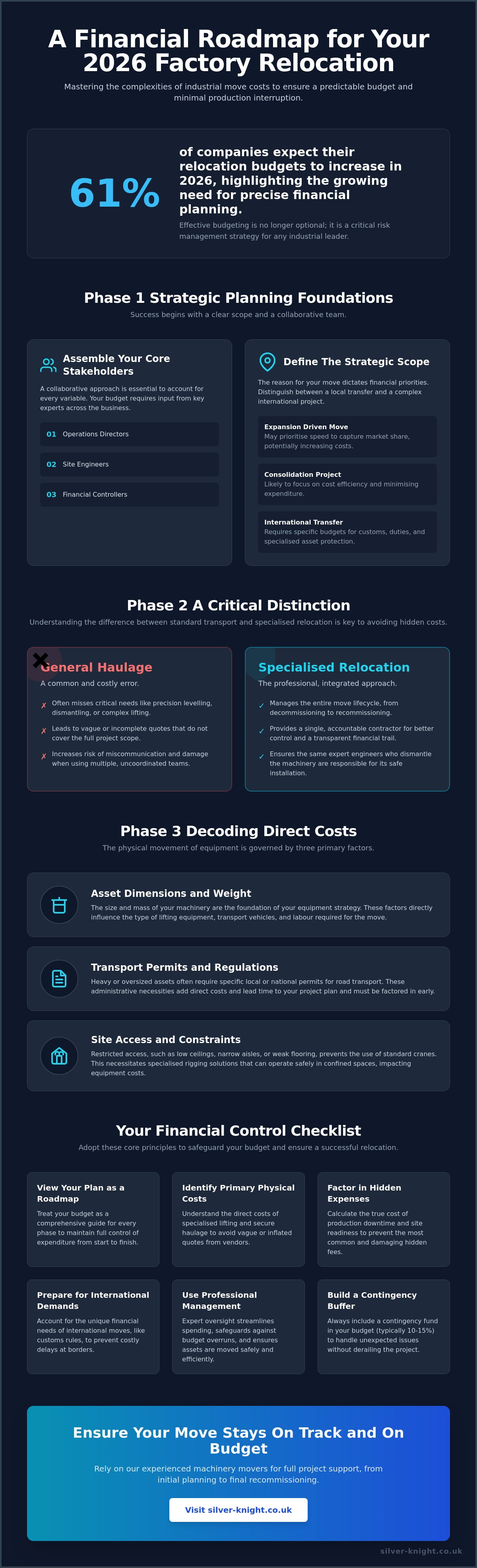
Did you know that 61% of companies expect their relocation budgets to increase in 2026? This statistic highlights a growing reality for industrial leaders. Effective budgeting for factory relocation is no longer just about getting quotes from movers; it's a vital risk management strategy. You likely already know that a single day of unexpected downtime or a misunderstood international regulation can cost your business thousands. It's frustrating to deal with a lack of transparency in rigging quotes or to worry if your heavy machinery will arrive safely at its new destination.
This comprehensive guide will help you master the complexities of industrial move costs. We promise to provide you with a predictable budget framework that ensures minimal production interruption and the safe delivery of all your industrial assets. You'll learn how to navigate the financial side of decommissioning, transport, and recommissioning whilst avoiding the hidden fees that often plague large-scale moves. From understanding 2026 fuel surcharges to planning for contingency buffers, we've outlined everything you need to manage your move with confidence.
Key Takeaways
- View your financial plan as a comprehensive roadmap that covers every phase of the move. This ensures you remain in control of your expenditure from start to finish.
- Identify the primary physical costs associated with heavy plant transport, including specialised lifting equipment and secure haulage. Understanding these components helps you avoid vague or inflated quotes.
- Factor in the true cost of production downtime and site readiness to prevent the most common hidden expenses. Effective budgeting for factory relocation requires a deep understanding of how idle machinery impacts your bottom line.
- Prepare for the unique financial demands of international moves, such as customs regulations and specialised asset protection. Proper planning here prevents costly delays at borders or ports.
- Learn how professional project management can streamline your spending and safeguard against budget overruns. Expert oversight ensures your assets are moved safely whilst keeping your financial targets on track.
If you are preparing for a major industrial transition, you can visit our machinery moving homepage for expert guidance.
Planning for success when budgeting for factory relocation
A robust factory relocation budget functions as a comprehensive financial roadmap for your business. In 2026, the need for technical precision has never been higher because modern production environments rely on interconnected robotics, high speed automation, and sensitive electronic systems. These assets require far more care than traditional mechanical plant. To ensure financial accuracy, you must gather input from core stakeholders such as operations directors, site engineers, and financial controllers. This collaborative approach ensures that every hidden variable is accounted for before the first machine is disconnected. Budgeting for factory relocation is a strategic risk mitigation process that safeguards your capital equipment from the moment it is powered down.
To see the level of coordination and precision required for a successful move, watch this overview of industrial project management:
Defining the strategic scope of your move
You must first distinguish between a local plant move and a complex international facility transfer. Whilst corporate relocation services typically handle the movement of staff, industrial projects focus on the heavy assets that drive your output. The specific reason for your move, such as reshoring to the UK or expanding into a larger facility, will dictate your financial priorities. For example, a move driven by expansion might prioritise speed to capture market share, whilst a consolidation project might focus on cost efficiency. Setting clear objectives for both the decommissioning and recommissioning phases prevents unexpected costs from surfacing during the final stages of the project.
Identifying the difference between haulage and relocation
It is a common error to treat industrial moves as standard transport. General haulage quotes often miss critical requirements like precision levelling, heavy lifting, or complex dismantling. True factory relocation involves specialised skills in machinery moving and installation. A dedicated partner manages the entire lifecycle of the move, which provides better accountability and reduces the risk of miscommunication between different teams. This integrated approach ensures that the engineers who dismantle your machinery are the same ones responsible for its safe recommissioning at the new site. By using a single contractor, you also simplify your administrative burden and create a more transparent financial trail.
To ensure your industrial move stays on track and within budget, you can rely on our experienced machinery movers for full project support.
Direct cost components for industrial machinery moving
The physical movement of equipment is the most visible part of your relocation plan. When you are budgeting for factory relocation, the dimensions and weight of your machinery dictate your entire equipment strategy. Heavy assets often require specific permits for transport. For instance, loads exceeding standard weight thresholds often trigger the need for federal or local permits, adding administrative costs to your plan. You should also consider the impact of restricted access. If your facility has low ceilings or narrow aisles, you can't simply bring in a standard mobile crane. Instead, you'll need specialised rigging solutions that can operate in confined spaces. Using specialised machinery dismantle services at the start of the project ensures that each asset is prepared correctly for transport, which reduces the risk of expensive damage during the lift.
When planning these expenses, it's helpful to look at official frameworks for allowable relocation costs to ensure your internal accounting is robust and includes all necessary line items.
Specialised lifting and dismantling fees
Choosing the right lifting method is a major budget driver. Hydraulic gantry systems are often more cost-effective for indoor lifts where space is limited, whilst mobile cranes are better for outdoor work with clear overhead access. For exceptionally tight spaces, Versa-Lift hire provides a compact solution that can handle heavy loads without the massive footprint of a traditional forklift. You'll also need to budget for skilled labour. This includes riggers and mechanical engineers who understand how to safely decommission and reassemble complex systems without voiding warranties or damaging sensitive electronics.
Transport and heavy haulage logistics
Once the machinery is ready to move, the focus shifts to the road. Low loaders and specialised trailers are essential for tall or heavy loads that won't fit on standard freight vehicles. If your machinery exceeds standard width or weight limits, you must account for pilot cars and wide load permits. In the UK, these escort vehicles are mandatory for certain dimensions to ensure public safety. Fuel surcharges are another factor to watch, as they can represent between 15% and 28% of the total shipping cost in 2026. Managing heavy equipment haulage requires careful coordination to avoid delays that can lead to expensive demurrage fees at the destination.
If you need a bespoke quote for these components, speak with our team to get a clear picture of your project requirements.
If you require expert assistance with your upcoming project, you can find more details on our factory relocation homepage.
Calculating the true impact of downtime and site readiness
Whilst physical transport costs are easy to quantify, production downtime is often the largest hidden expense in any move. When budgeting for factory relocation, you must look beyond the moving quote and model the actual cost of lost output. If your production line is idle for two weeks, what does that mean for your quarterly revenue? It isn't just about the machines being off; it's about the missed opportunities and potential late-delivery penalties. You can find more detailed planning tips in our factory relocation services guide, which explores the technical nuances of industrial removals in 2026.
Operational downtime and lost production yield
You must calculate the cost of idle labour during the transition period. If your staff cannot work because their equipment is in transit, their wages still need to be paid. This cost can escalate quickly if the move takes longer than expected. Additionally, you need to factor in the time required for rigorous machinery testing and recommissioning at the new site. Machines rarely run at 100% capacity the moment they are plugged in. To mitigate this, many companies plan for buffer stock production in the months leading up to the move. This ensures customer deliveries continue whilst your team focuses on getting the new facility up to speed.
Destination site preparation and utility alignment
Machinery cannot be moved into an empty shell without proper preparation. You may need to budget for floor reinforcement or specialised foundations, especially for heavy presses or CNC machines that require high stability. Utility alignment is another critical factor. The new site must have the correct electrical and pneumatic connections in place before the machines arrive. If the destination is not ready, you may face the unexpected need for secure industrial storage. Storing machines in a controlled environment prevents them from being left on a building site where they could be damaged by dust or weather. Proper site readiness is essential for a smooth handover and a predictable approach to budgeting for factory relocation.
If you are planning a global move, our specialists can provide a detailed quote for factory relocation across borders.
Managing international logistics and asset protection costs
Moving machinery overseas introduces a layer of complexity that domestic moves simply don't face. When budgeting for factory relocation, you must account for the fact that international transport involves multiple handling points, varying climate conditions, and complex legal frameworks. Hidden charges, such as brokerage fees and demurrage, can constitute 20% to 40% of your total logistics cost. Working with experienced international machine movers is essential to navigate these variables. They ensure that your assets are not only transported but protected throughout the journey. In 2026, fuel surcharges alone can represent between 15% and 28% of your total shipping invoice, making precise calculations vital for financial stability.
Asset protection and comprehensive insurance coverage
Insurance is a non-negotiable line item in your relocation budget. Standard carrier liability is often insufficient for high value industrial equipment, as it may only cover a small fraction of the actual worth. Instead, you should look for all risks insurance, which typically costs between 2% and 5% of the shipment's value. To support these claims and ensure safety, you should budget for specialised export packing. This often involves vacuum sealing and heat treated timber crates to prevent corrosion during long sea voyages. Technical surveys are also vital. Documenting the exact condition of a machine before it leaves the floor provides necessary evidence for insurance purposes and helps verify that the asset arrived in the same state it left.
Global logistics and customs requirements
International transfers require a deep understanding of customs duties and brokerage fees. These entries usually cost between £100 and £280 per entry, but the duties themselves vary significantly depending on the destination country. You must also budget for port handling charges and the use of specialised shipping containers, such as flat racks or open tops, for oversized equipment. A 40ft container can cost anywhere from £2,400 to £5,700 depending on the route and current demand. Finally, consider the costs of compliance with international safety and environmental standards. Ensuring your machinery meets the regulations of the receiving country prevents costly delays or even the refusal of entry at the border.
To ensure your international move is handled with the highest level of care, get in touch with our international transport team today.
To ensure your project is managed by experts, visit our factory relocation services page.
Streamlining relocation expenditure through professional management
Professional project management is the most effective way to keep your costs under control during a major industrial transition. When you are budgeting for factory relocation, the complexity of managing multiple contractors often leads to communication gaps and financial overruns. By appointing an experienced machinery moving partner, you consolidate accountability into a single, reliable stream. This approach ensures that the project timeline remains tight; every day saved is a day of production gained for your business. Appointing a specialist ensures your budgeting for factory relocation remains accurate and realistic by accounting for every technical detail from the outset. Integrating services like decommissioning, heavy haulage, and recommissioning into one contract reduces the risk of errors that occur when different firms handle different stages of the move.
The value of technical site surveys
A detailed technical site survey is the foundation of an accurate and transparent quote. These surveys identify potential access issues, such as narrow doorways or restricted floor load limits, before they become costly delays on moving day. By taking precise measurements of every asset and its intended path, surveyors ensure that the correct lifting equipment is booked the first time. This foresight reduces the need for emergency equipment hire, such as larger cranes or specialised hydraulic gantry systems, which can carry heavy surcharges. A thorough survey also facilitates more accurate scheduling for transport and labour. This ensures you aren't paying for a crew to stand idle whilst a machine is stuck in a doorway or waiting for a permit that was overlooked.
Integrated services from decommissioning to installation
Choosing a single team that handles everything from initial decommissioning to final positioning creates significant efficiency gains. Professional machinery installation ensures that your assets are levelled, aligned, and ready for recommissioning much faster than using a generalist crew. This seamless transition is vital for maintaining production schedules and meeting customer demands. The long term savings of a safe and compliant relocation cannot be overstated. Avoiding a single workplace accident or a piece of damaged machinery pays for the cost of professional management many times over. In the end, a well managed move isn't just about finding the lowest initial quote; it's about the lowest total cost of ownership for your relocated industrial assets.
To find out more about our full range of services, visit the Silver Knight homepage.
Securing your industrial future through strategic planning
Successful budgeting for factory relocation requires a shift in perspective. It is not just about moving equipment; it's about protecting your production capacity and ensuring a seamless transition. You now understand how to account for hidden downtime costs and why technical site surveys are vital for preventing expensive delays. By focusing on site readiness and professional decommissioning, you can turn a complex move into a predictable financial exercise that safeguards your business interests.
Silver Knight provides the expertise needed to manage these variables, backed by over 180 years of collective industry experience. Our specialised fleet, which includes Versa-Lifts and hydraulic gantries, allows us to navigate the most challenging industrial environments with ease. With comprehensive nationwide and international service coverage, we ensure your assets are protected at every stage of the journey, no matter the destination.
Don't leave your 2026 relocation to chance. Explore our specialised factory relocation services to start your project planning today. With the right roadmap and a dedicated partner, your move can be the catalyst for your business's next successful chapter.
Frequently Asked Questions
How do I start budgeting for a factory move?
Begin by defining your project objectives and conducting a comprehensive asset inventory. You must account for physical costs and production impact. Working with a specialist to conduct a technical site survey early in the process provides the most accurate foundation for your financial planning. This step ensures every piece of machinery is accounted for whilst identifying potential logistical hurdles that could affect your final spend.
What are the most common hidden costs in plant relocation?
The most significant hidden costs often involve production downtime and destination site preparation. Many businesses overlook the cost of utility reconnections or the need for floor reinforcements to support heavy machinery. Additionally, decommissioning sensitive equipment can reveal underlying repair requirements that must be addressed before the assets are recommissioned at the new facility. Identifying these factors early is a vital part of effective budgeting for factory relocation.
How does distance affect the overall relocation budget?
Whilst distance impacts fuel and driver time, the complexity of loading and unloading often represents a larger portion of the budget. For international moves, you must also factor in export packing, port fees, and customs duties. Domestic moves across the UK are generally more predictable but still require careful planning for wide load permits and route surveys. These logistical details ensure your assets travel safely without incurring unexpected fines or delays.
Should I include machinery decommissioning in the primary budget?
Yes, machinery decommissioning is a critical phase that ensures equipment is safely disconnected and prepared for transport. Budgeting for professional dismantling reduces the risk of damage and simplifies the eventual installation process. It's often more cost effective to have the same team handle both the decommissioning and the subsequent recommissioning. They'll understand exactly how to put your equipment back together.
What insurance is required for heavy machinery transport?
Standard haulage insurance is rarely sufficient for high value industrial machinery. You should budget for comprehensive all risks transit insurance that covers the full replacement value of your assets during the move. It's also essential to verify that your relocation partner holds adequate public and products liability insurance to protect against site incidents. This coverage provides peace of mind that your financial interests are protected if an accident occurs during transit.
How can I reduce the cost of factory downtime during a move?
Minimising downtime requires a phased relocation approach where production continues in one area whilst another is moved. Detailed scheduling and the use of specialised equipment like Versa-Lifts can significantly speed up the rigging process. Ensuring the new site is fully prepared with all utilities ready for connection is the best way to accelerate recommissioning. This proactive approach ensures your team can resume work as quickly as possible after the move.
Are international factory relocations significantly more expensive?
International moves involve additional layers of cost including sea or air freight, export crating, and regulatory compliance. However, these costs can be managed through efficient container packing and expert logistics coordination. The key is to work with a partner who understands global transport standards to avoid expensive delays at customs or ports. Proper budgeting for factory relocation on a global scale requires a deep understanding of international shipping routes and customs regulations.
Does specialised lifting equipment increase the project cost?
Whilst specialised equipment like hydraulic gantries or jack and slide systems have a higher hire cost, they often reduce the total project spend. They allow for faster moves in restricted spaces where traditional cranes would require expensive building modifications. Using the right tool for the job typically lowers labour costs and reduces the risk of expensive asset damage. This investment ensures a safer and more efficient move whilst protecting your machinery.

Article by
David Ashby
I'm the Managing Director of Silver Knight Haulage & Machinery Ltd. Silver Knight Ltd is a family-run firm established in the West Midlands in 2005, with the aim of providing a cost-effective, yet professional, service to businesses for the removal, transportation, and installation of machinery, plant, and equipment here in the UK and worldwide. Between us, the Silver Knight workforce has over 50 years of experience with machinery and its operation.
Disclaimer
This article is intended for informational purposes only. Please ensure you seek expert advice or carry out your own research to confirm the information is suitable for your specific needs.