Did you know that North America now accounts for 35 per cent of the global heavy equipment transport market? Despite this huge opportunity, exporting industrial machinery to USA remains a complex challenge for many British businesses. You might have world class equipment ready for the American market, but a single error in customs paperwork or a misunderstanding of US electrical standards can lead to costly delays and physical damage during transit.
We understand that the thought of your high value assets sitting in a shipping container for weeks is stressful. You want a process that is fast, compliant, and above all, safe. This guide provides a clear roadmap for your 2026 export strategy, covering recent tariff adjustments and essential logistics tips. We will show you how to minimise transit times and ensure your machinery arrives in perfect working order, ready to start its new life across the Atlantic.
Key Takeaways
- Discover why the American market is currently a prime destination for British manufacturers and how to capitalise on recent tariff changes.
- Learn why precise documentation is the most critical element when exporting industrial machinery to USA to prevent expensive border hold ups.
- Understand the vital connection between professional decommissioning in the UK and successful recommissioning at your American destination.
- Find out why standard carrier liability rarely covers the full value of heavy assets and how to secure proper marine insurance.
- Identify the essential qualities to look for in an international transport partner to ensure your high value machinery remains safe throughout its journey.
Reliable machinery transport begins with expert planning from Silver Knight.
The American market landscape for industrial equipment
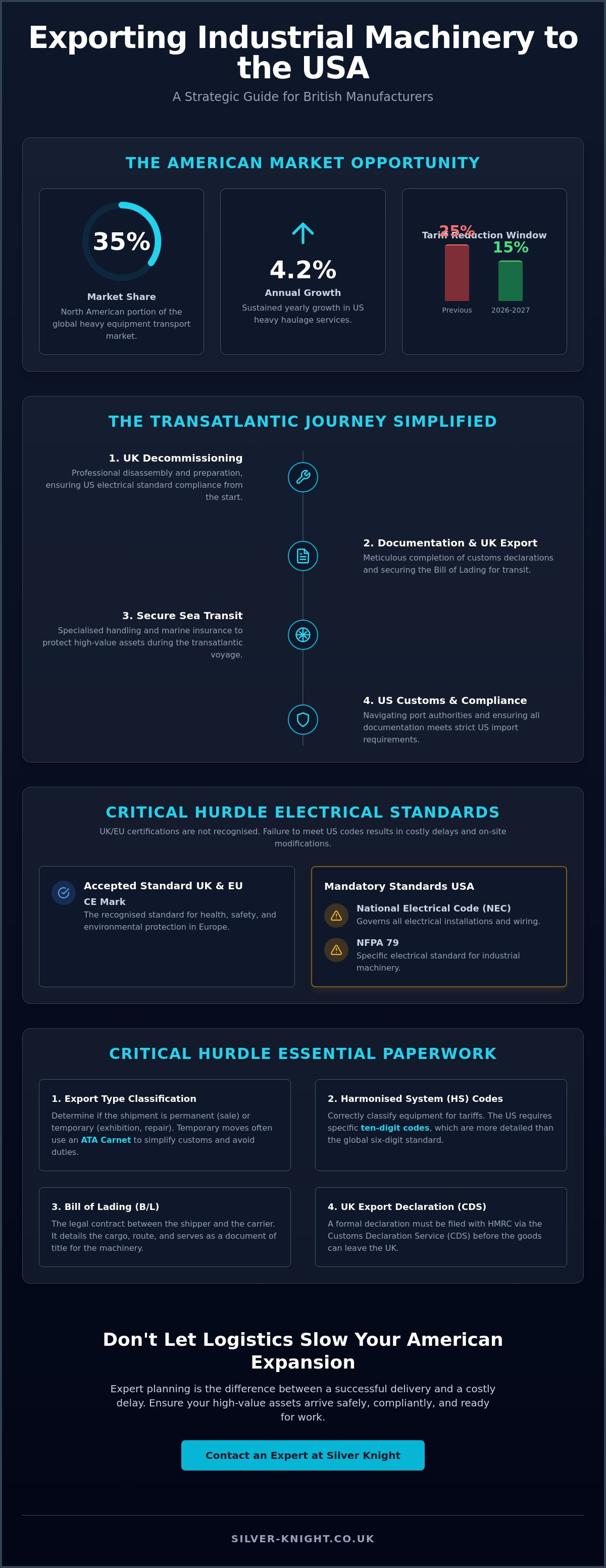
The United States represents a massive opportunity for British engineering firms. Currently, North America holds 35 per cent of the global heavy equipment shipping market. This demand is driven by a steady 4.2 per cent annual growth in heavy haulage services. When you apply basic international trade principles, it's clear that the scale of the American industrial sector makes it a primary target for UK exporters. British engineering is respected. American buyers want it.
British manufactured goods are highly regarded amongst American buyers for their precision and reliability. This is especially true in high growth sectors like renewable energy and advanced manufacturing. However, moving these assets isn't as simple as booking a standard shipping container. General freight companies often lack the specialised equipment or expertise needed for high value industrial assets.
To better understand this concept, watch this helpful video from experts in the field:
Recent changes in trade policy have made this an ideal time for exporting industrial machinery to USA. As of June 8, 2026, tariffs on industrial equipment were lowered from 25 per cent to 15 per cent. This temporary reduction, set to last until the end of 2027, provides a significant financial incentive for American firms to look towards the UK for their plant and machinery needs. It makes British products more competitive on the global stage.
Complex transatlantic projects require a level of coordination that goes beyond simple logistics. You need international machine movers who understand the physical risks of sea transit and the legal hurdles of American ports. They ensure your equipment doesn't just arrive, but arrives in a condition that allows for immediate use.
Understanding US safety standards and electrical codes
The CE mark is the standard for the UK and Europe, but it carries no legal weight in the United States. American inspectors look for compliance with the National Electrical Code and NFPA 79 standards. Local testing authorities have the final say on whether your machine can be powered up. If your equipment doesn't meet these specific US codes, it could sit idle for months whilst expensive modifications are made on site. It's better to address these standards during the design and decommissioning phase.
Market demand and economic opportunities for UK manufacturers
Identifying growth sectors such as automation and wind power technology is key when exporting industrial machinery to USA. British firms with expertise in these areas are finding a warm reception across the Atlantic. By establishing a robust supply chain now, UK manufacturers can secure long term contracts in a market that values high end engineering. This isn't just about a one off sale; it's about building a presence in the world's largest economy. The current economic climate favours those who can provide reliable, high tech solutions to American infrastructure challenges.
Ensure your export paperwork is handled correctly by visiting Silver Knight.
Essential documentation and compliance for US exports
Accurate paperwork is the single most important factor when you are exporting industrial machinery to USA. Even a minor clerical error in a customs declaration can lead to your equipment being impounded or hit with significant storage fees at an American port. You must first determine if your shipment is a permanent export or a temporary movement. Temporary moves, such as sending a machine for repair or a trade exhibition, often use an ATA Carnet to avoid paying duties twice. For permanent sales, you must classify your equipment using the correct Harmonised System (HS) codes. While the first six digits are standard globally, the US requires specific ten digit codes for precise tariff application. The Bill of Lading is the standard contract for international sea transport that outlines the terms of carriage and serves as a document of title.
Customs declarations and ISF requirements
Filing a full export declaration from the UK involves using the Customs Declaration Service (CDS) to notify HMRC of the goods leaving the country. For the American side, you must comply with the Importer Security Filing, commonly known as the 10 plus 2 rule. This requires ten specific data elements from the importer and two from the carrier to be submitted to US Customs at least 24 hours before the vessel is even loaded in the UK. Because the rules surrounding U.S. Export Regulations are so strict, many British firms find that using a professional customs agent is the most reliable way to manage high value industrial moves without facing border delays.
Navigating UL standards and OSHA regulations
While the CE mark is essential for the UK market, it holds no legal standing in North America. Most American buyers will insist on UL (Underwriters Laboratories) certification to ensure the electrical components meet local safety codes. This is often a requirement for their own corporate insurance policies. Additionally, your machinery must comply with OSHA regulations, which govern workplace safety and equipment guarding. It's vital to provide a comprehensive technical file and a detailed risk assessment that reflects these American standards. This documentation proves to the end user that the equipment is safe to operate within their specific regulatory framework.
Commercial invoices and packing lists
A machinery specific commercial invoice needs to be far more detailed than a standard sales receipt. It must clearly state the country of origin, the full value of the assets, and the agreed Incoterms, which define exactly where the risk transfers from you to the buyer. Alongside this, you need a technical packing list. This document shouldn't just list the boxes; it must include the precise weights and dimensions for every component, especially for oversized items that require specialised lifting gear. If you're feeling overwhelmed by these requirements, you can always speak with an export specialist to clarify the necessary steps for your project.
Professional machinery preparation services are available at Silver Knight.
Preparing heavy equipment for transatlantic transport
Moving a thirty tonne asset across the Atlantic is a massive undertaking that general hauliers often struggle to manage. Standard freight companies treat cargo like palletised goods, but exporting industrial machinery to USA requires a deep understanding of mechanical engineering. Your equipment will face two to eight weeks of constant motion on the high seas. Success depends on the critical link between decommissioning in the UK and recommissioning in America. If a machine isn't taken apart with the final installation in mind, your engineers in the US will face a nightmare of loose wires and mismatched components.
Using specialist machinery dismantle services ensures that every part is documented for its journey. Whilst many firms focus solely on the UK side, reviewing U.S. Government Export Resources can provide perspective on how the American side manages manufactured imports. Proper shipping container packing is the only way to guarantee stability when the vessel encounters rough weather in the mid Atlantic.
Technical dismantling and decommissioning for export
A systematic approach to dismantling is vital. Every cable, pipe, and bolt should be labelled clearly to ensure efficient recommissioning. You must drain all fluids, such as hydraulic oils and coolants, to prevent leaks and comply with environmental shipping regulations. Creating a detailed technical inventory for the receiving American engineers is not just helpful; it's essential for safety. This inventory should include wiring diagrams and assembly sequences to avoid guesswork during the installation phase at the destination plant.
Export packing and sea freight crating standards
International shipping crates must use ISPM 15 compliant timber to prevent the spread of pests. This treated wood is a legal requirement for entering American ports. To protect against the salty, humid sea air, you should use vapour barrier packaging and desiccant bags. This prevents corrosion on sensitive metal surfaces and electronic components. For precision gear, anti vibration mounting within the crate provides an extra layer of protection against the constant thrum of the ship's engines and the impact of loading procedures.
Loading and securing heavy loads
Calculating the centre of gravity is a critical safety step for oversized industrial units. If the weight isn't distributed correctly, the load could shift during transit, causing damage to the machine or the vessel. You must use specialised lashing and securing points on low loaders and within sea containers to keep the asset immobile. Safety protocols for loading heavy machinery into containers require high capacity forklifts or hydraulic systems. Every strap and chain must be rated for the specific weight of the load to ensure it survives the long journey to the American market.
Protect your industrial assets by consulting with Silver Knight.
Managing transit risks and marine insurance
Exporting industrial machinery to USA carries inherent dangers that go beyond simple logistics. When you're moving high value assets across the Atlantic, you must account for the physical forces of sea transit and the legal complexities of international shipping contracts. Standard carrier liability is rarely enough to cover the true cost of industrial gear. Most carriers limit their financial responsibility to a set amount per kilogramme, which might only be a fraction of the machine's actual worth. Marine cargo insurance covers sea transit to the USA and provides the necessary financial safety net for your investment.
Before the first bolt is turned, a technical site survey is essential. This process identifies potential hazards at both the UK dispatch point and the American destination. It ensures that the lifting equipment and transport routes are capable of handling the load. Without this foresight, you risk unexpected delays or physical damage that could have been avoided with professional planning. A survey allows you to map out the entire journey and prepare for the specific challenges of transatlantic transit.
Understanding Incoterms 2020 for US trade
Selecting the correct Incoterm is a vital part of exporting industrial machinery to USA, as it defines exactly when the risk of loss or damage passes from the UK seller to the American buyer. Under Ex Works (EXW), the buyer takes responsibility as soon as the machinery leaves your factory floor. Conversely, Delivered at Place (DAP) means you carry the risk until the equipment reaches the customer's site in the USA. Many UK exporters find Delivered Duty Paid (DDP) particularly challenging because it requires the seller to handle US import duties and taxes, which often necessitates a local tax presence or a specialised customs bond.
Comprehensive cargo insurance vs carrier liability
The difference between carrier liability and comprehensive cargo insurance is often the difference between business continuity and financial disaster. For complex factory relocations, an all risks cover policy is the only sensible choice. This type of cover protects against a wide range of perils, from heavy weather at sea to accidents during the loading process. Standard liability might only pay pennies on the pound if a machine is damaged, leaving you to cover the shortfall. To ensure a successful claim if something does go wrong, you must document the condition of every asset before it leaves the UK. High quality photographs and detailed condition reports serve as vital evidence that the equipment was in good working order prior to transit.
If you're concerned about the safety of your transatlantic shipment, contact our machinery moving experts for a risk assessment.
Work with the international relocation experts at Silver Knight.
Selecting an expert international machinery moving partner
Choosing the right partner is the final and most critical step when you are exporting industrial machinery to USA. You aren't just looking for a transport company; you are looking for an engineering partner that understands the high value of your assets. A team with 180 years of collective experience provides a depth of knowledge that general freight forwarders simply cannot match. They understand the intricacies of transatlantic logistics and the precise requirements of American safety standards. Amongst the many choices available, a single source provider offers the most security for your equipment.
When one firm manages the entire process, the risk of data being lost between different contractors disappears. This integrated approach is whilst many successful exporters prefer to work with specialists who can handle both the physical lift and the legal paperwork. This is where machinery movers UK play a vital role. They provide the essential site planning and technical surveys that ensure the entire project has a solid foundation from the very beginning.
Evaluating technical expertise and equipment
A significant advantage is choosing a partner that owns their own specialised lifting equipment. In many factory environments, standard cranes are too bulky and lack the necessary precision for delicate work. Hydraulic gantry systems and Versa Lifts are far better suited for indoor projects where headroom is limited. These tools allow for the safe and controlled movement of heavy assets without risking damage to the building or the machine itself. Your partner should also provide a dedicated project manager who acts as your single point of contact throughout the entire move. They ensure all safety accreditations are in place and that the timeline is strictly followed.
The benefits of a family run specialised service
Personal accountability is a hallmark of a family run service. Unlike large, impersonal corporations, a specialised firm often takes greater pride in the care of your machinery. They offer the flexibility to create bespoke logistics solutions that fit your specific schedule and budget. This personal touch is invaluable when solving complex customs problems or dealing with unexpected delays at the port. Long term industry experience means they have seen almost every possible scenario and know exactly how to keep your project moving forward. You don't want your machinery to be just another number in a spreadsheet; you want it handled with the respect it deserves.
Plan your next international project with the experts at Silver Knight.
Future proofing your American export strategy
The opportunities within the US industrial sector are vast, especially with the current tariff reductions making British engineering more competitive than ever. Success when exporting industrial machinery to USA depends on balancing rigorous customs compliance with high level technical logistics. You now understand how precise decommissioning and specialised sea freight packing are the only ways to protect your high value assets from the rigours of the Atlantic. Don't leave your international expansion to chance by using general hauliers who lack the necessary equipment or expertise.
Silver Knight provides a comprehensive international relocation service that covers the USA and beyond. With 180 years of collective industry experience and a specialised fleet including hydraulic gantries and Versa Lifts, we manage every aspect of your move from the initial site survey to the final recommissioning. We handle the heavy lifting and the complex paperwork so you can focus on growing your business in the American market.
Contact Silver Knight for a bespoke international machinery transport quote to start your journey today. Your equipment is in safe hands and ready for its new destination.
Frequently Asked Questions
Do I need an EORI number to export machinery to the USA
A UK Economic Operator Registration and Identification number is mandatory for moving goods out of Great Britain. This number, which starts with the prefix GB, is used by HMRC to track your shipments and is essential for completing your export declarations. Without a valid EORI number, your machinery will not be cleared to leave the UK port, leading to immediate delays in your shipping schedule.
What are the common Incoterms for US industrial equipment sales
When exporting industrial machinery to USA, businesses typically choose between EXW, DAP, or DDP. Many UK manufacturers prefer DAP because it allows them to manage the physical transport whilst leaving the complex US import taxes and duties to the American buyer. This reduces the administrative burden on the British side and ensures the buyer handles their own local customs bond requirements.
How does the UL standard affect UK machinery exports
The UL standard is the primary electrical safety benchmark across the United States and is often a non negotiable requirement for American buyers. Since the CE mark used in the UK has no legal standing there, US customers usually insist on UL certification for their own insurance purposes. If your machine is not compliant, it might require an expensive field evaluation by a testing laboratory before it can be powered up at the destination.
Is custom export packing necessary for sea freight transport
Custom packing is vital to protect your machinery from the corrosive effects of salty sea air and the constant physical vibrations of a transatlantic crossing. You must use ISPM 15 heat treated timber for all crates to comply with strict US agricultural regulations. Vapour barrier bags and desiccants are also used within the crates to prevent rust from forming on precision metal surfaces during the long journey.
What is the ISF 10 plus 2 rule for US imports
The Importer Security Filing is a mandatory US Customs requirement that must be completed at least 24 hours before the vessel departs from the UK port. It requires ten specific data points about the shipment and two from the shipping line to be filed electronically. Failing to file this on time can result in heavy fines and can lead to your machinery being held for intensive inspections upon arrival in the USA.
How long does it take to ship heavy machinery to the USA
You should expect a transit time of between 2 and 8 weeks for your machinery to reach an American port. Shipping to the East Coast is generally faster than the West Coast, which may require a longer journey through the Panama Canal or intermodal transport from an East Coast port. These timelines can vary based on whether you choose containerised shipping or roll on roll off services for oversized assets.
Can I export used machinery to the USA without UL certification
It is legally possible to export used machinery without prior UL certification, but it carries significant operational risks. Local US inspectors or the buyer's insurance company may demand a field evaluation by a Nationally Recognised Testing Laboratory once the machine arrives. This ensures the equipment meets American safety codes before it is commissioned in a factory environment, avoiding potential safety shutdowns.
What insurance cover is required for transatlantic machinery transport
All risks marine cargo insurance is the most reliable way to protect your investment when exporting industrial machinery to USA. Standard carrier liability is often based on the weight of the cargo rather than its actual value, which is almost always insufficient for expensive industrial plant. Comprehensive insurance covers the asset from the moment it leaves your UK site until it is safely delivered and positioned at the American destination.

Article by
David Ashby
I'm the Managing Director of Silver Knight Haulage & Machinery Ltd. Silver Knight Ltd is a family-run firm established in the West Midlands in 2005, with the aim of providing a cost-effective, yet professional, service to businesses for the removal, transportation, and installation of machinery, plant, and equipment here in the UK and worldwide. Between us, the Silver Knight workforce has over 50 years of experience with machinery and its operation.
Disclaimer
This article is intended for informational purposes only. Please ensure you seek expert advice or carry out your own research to confirm the information is suitable for your specific needs.