Did you know that simply bolting a new production line to your factory floor could legally classify your facility as a construction site? Many business owners and plant managers find themselves caught out because they don't realise that CDM regulations for machinery installation apply to almost every major equipment move or factory relocation. It is completely natural to feel overwhelmed by the prospect of HSE fines or confused about who is actually responsible for creating the necessary safety documentation.
We agree that the legal requirements surrounding the Construction (Design and Management) Regulations 2015 can feel like a burden. However, these rules are not just a hurdle to clear; they provide a vital safety framework that protects your staff, your assets, and your reputation. This guide will teach you how to navigate the regulations to ensure your machinery installation or factory move is fully compliant and safe. We will provide a clear roadmap for your project, explain your specific legal duties as a client, and help you choose a competent contractor with total confidence. With the HSE placing an increased focus on practical competence and robust management systems in 2026, getting your approach right from the start is essential.
Key Takeaways
- Understand how the HSE defines fixed plant as construction work to ensure you apply CDM regulations for machinery installation correctly from the start of your project.
- Identify your specific legal duties as a client and learn how to coordinate roles effectively when responsibilities overlap during a factory move.
- Determine if your project requires formal notification to the HSE by checking your project duration and workforce size against current 2026 thresholds.
- Recognise the vital role of a technical site survey in the pre-construction phase to identify risks and create a logical plan for a safe installation.
- Learn how to evaluate the competence of a machinery moving partner by prioritising specialised industrial experience over general construction knowledge.
Before starting any industrial project, you should consult with experts who specialise in professional machinery installation to ensure every safety standard is met.
Understanding CDM 2015 within the Manufacturing Sector
The Construction (Design and Management) Regulations 2015, often shortened to CDM 2015, are the primary legal framework for managing health and safety on construction projects in Great Britain. While many factory managers associate these rules with building sites and civil engineering, they are equally critical for the manufacturing sector. The Understanding CDM 2015 framework ensures that safety is considered from the initial design phase through to the final decommissioning of a project. When you are planning CDM regulations for machinery installation, you must treat the work with the same level of rigour as a traditional building project.
The Health and Safety Executive (HSE) has clearly stated that construction work includes the installation, commissioning, maintenance, and repair of mechanical and electrical services. This broad definition means that moving or installing heavy industrial equipment is rarely just a simple delivery task. It is a regulated activity that demands careful coordination between designers, contractors, and the client to prevent accidents and ensure the long term safety of the site.
To better understand this concept, watch this helpful video:
Defining Fixed Plant and Construction Work
Distinguishing between portable equipment and fixed plant is a common area of confusion for manufacturers. Fixed plant is any machinery that is permanently attached to a structure or site infrastructure. If you are installing a large CNC machine that requires dedicated power lines, floor anchoring, or ventilation ducting, the project almost certainly falls under construction work. These installations involve structural interfaces and high risk activities like heavy lifting, which is why the HSE mandates strict adherence to CDM standards for anything that becomes a permanent fixture of the building.
Why Compliance Matters for Factory Owners
Compliance is about more than just avoiding legal trouble; it is about protecting your workforce during the high risk installation phase. According to HSE data for 2024/25, the construction sector accounted for 35 worker fatalities, highlighting the inherent dangers of this type of work. By following CDM regulations for machinery installation, you create a robust health and safety file. This document is invaluable for future maintenance or when you eventually decide to sell or relocate the facility. Additionally, demonstrating professional due diligence through a clear audit trail makes your business more attractive to insurers and stakeholders who prioritise risk management.
Ignoring these regulations can lead to severe financial and legal repercussions. The HSE has the power to issue Fee for Intervention charges to recover their costs if they find a material breach of health and safety law. Beyond these immediate costs, a lack of compliance can lead to project delays, stop-work notices, and even criminal prosecution in the event of a serious accident. For factory owners, the cost of getting it right is always lower than the price of a failure in safety management.
If you are planning a complex site move, you can find expert support for safe factory relocation to ensure every legal duty is met.
Key Roles and Dutyholder Responsibilities under CDM
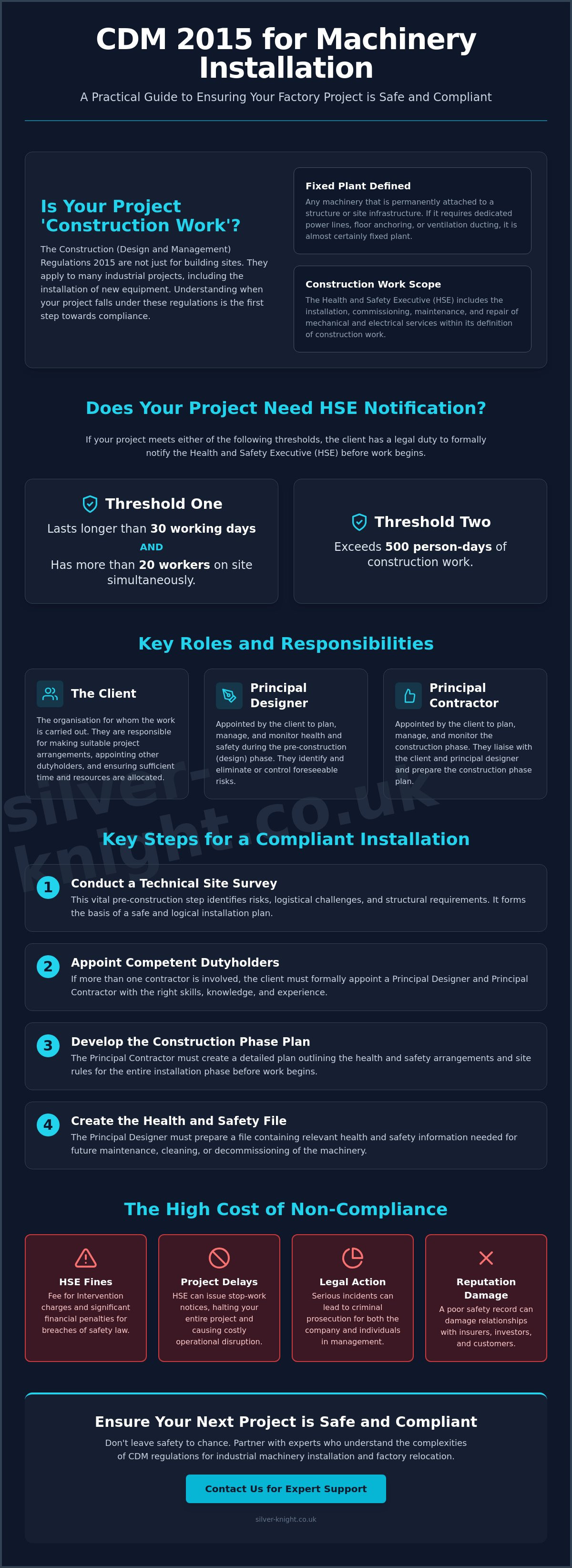
Identifying who is responsible for what is the first step in maintaining compliance. Under the official CDM 2015 regulations, there are five main dutyholders. These include the client, the designer, the principal designer, the principal contractor, and the contractors. In a machinery installation context, these roles often overlap. For instance, if you hire a single firm to both plan and execute the move, they might act as both the principal designer and the principal contractor. Understanding the CDM regulations for machinery installation is essential for any factory manager. Early appointment of these professionals is vital. Waiting until the machinery is on the back of a lorry is too late to start your safety coordination. Clear communication between all parties ensures that everyone understands the specific machinery installation technical standards required for the project.
The Role of the Commercial Client
As a factory owner, you are typically the commercial client. This role carries the most significant weight because you are responsible for making sure the whole project is managed safely. You must provide pre-construction information to every contractor involved. This includes details about the site, such as the location of underground services or structural floor load limits. You also have a legal duty to ensure that the project team has enough time and resources to work safely. Rushing a complex installation to meet a production deadline is a common cause of accidents. It can lead to serious legal trouble if the HSE investigates your site operations.
Principal Designers and Contractors in Machinery Projects
A principal designer must be appointed whenever there is more than one contractor involved in a project. Their job is to manage the health and safety risks during the planning phase. They look at the machinery layout to ensure it does not create new hazards, such as blocking fire exits or creating crush points. The principal contractor then takes over site management during the actual installation. They coordinate the work on the ground, manage site inductions, and ensure that everyone follows the agreed safety plan. A specialised moving company often takes on the role of principal contractor because they have the specific expertise needed to manage heavy lifts and technical rigging safely. If you are unsure about your specific responsibilities for an upcoming project, you can speak with our team for practical advice on managing your legal duties.
Before you begin any decommissioning work, it is wise to consult with a partner who provides a professional machinery moving service to ensure your project stays within legal boundaries.
Determining if Your Machinery Installation Requires CDM
Determining whether the CDM regulations for machinery installation apply to your specific project requires a careful look at the scope of work. It is a common trap to assume that if a project is small or fast, the rules don't apply. Whilst some projects are not notifiable to the HSE, the underlying safety duties exist for every single job. The HSE Guidance on CDM 2015, which was last updated on 12 February 2026, provides the definitive framework for these decisions. You must notify the HSE using an F10 form if your project meets specific thresholds. These include work lasting longer than 30 working days with more than 20 workers on site simultaneously, or any project exceeding 500 person days. Even if your installation falls below these numbers, you still need to appoint dutyholders and create a construction phase plan.
Minor moves and routine maintenance are often exempt, but the line is thinner than you might think. If the work involves significant risk, such as heavy lifting or altering the building's services, you should treat it as a CDM project. This ensures that you have a paper trail of competence and risk management that protects you if an inspector visits your site.
Criteria for Fixed Plant Installations
The complexity of the installation is a major factor in deciding if CDM applies. Large CNC machines, automated bottling lines, or industrial furnaces are rarely standalone items. They require permanent connections to power, compressed air, and water. When an installation involves anchoring equipment to the floor or modifying the factory infrastructure, it moves firmly into the category of construction. You should also consider the complexity of the lift. Using a gantry system or a specialised Versa-Lift to move assets through tight spaces introduces risks that the CDM framework is designed to manage. If the installation requires a bespoke lifting plan or structural modifications, you must ensure your project is fully compliant.
Machinery Dismantling and Structural Changes
A major gap in many safety plans is the failure to recognise that taking things apart is also construction work. When you embark on a machinery dismantle service, you are often reversing the original installation process. This carries unique risks, such as dealing with stored energy, hazardous residues, or weakened structural supports. A comprehensive factory clearance involves more than just clearing space; it requires managing the structural integrity of the building as heavy plant is removed. You might need a structural survey before moving massive industrial assets to ensure the floor or walls can handle the shifting loads. Decommissioning is a critical phase where the principal designer must identify hazards that could affect the contractors who follow, ensuring a safe transition for the next stage of the site's life.
To ensure your next project is handled by professionals who understand every legal requirement, consider partnering with a team experienced in safe machinery moving.
Practical Steps for CDM Compliant Machinery Projects
Turning legal theory into a safe site operation requires a logical sequence of events. Once you've appointed your dutyholders, the focus shifts to gathering data and creating a roadmap for the physical work. Following the correct CDM regulations for machinery installation prevents the "tick-box" approach that the HSE is currently scrutinising in 2026. Your project should begin with a thorough factory relocation service planning phase, which bridges the gap between engineering requirements and safety law. A robust Construction Phase Plan (CPP) must be developed before any equipment arrives on site. This document isn't just paperwork; it's the active guide that dictates how your contractors will manage risks during the move. Before the first heavy lift begins, every worker must undergo a site induction to ensure they understand the specific hazards of your facility and the specialised lifting methods being used.
Pre Construction Information and Site Surveys
The success of your installation depends on the quality of the information you provide at the start. As the client, you must share asbestos records, existing utility maps, and floor load limits. A technical site survey is the most effective way to identify hidden hazards like overhead power cables or restricted access points that could snag a high-mast forklift. This survey directly influences the choice of specialised moving equipment. For example, if a survey reveals that a ceiling is too low for a standard crane, the principal contractor might decide to use hydraulic gantry systems or jack and slide systems instead. Using the right tools for the job is a key part of demonstrating competence under the CDM regulations for machinery installation.
Managing Health and Safety Files for New Assets
The project doesn't end when the machine is switched on. You must compile a health and safety file that includes as-built drawings, operation manuals, and testing certificates for any new lifting points or structural changes. This file is an essential tool for your maintenance teams, allowing them to understand the risks involved in future repairs or eventual decommissioning. The health and safety file is a legal requirement for all CDM projects. By keeping this record updated, you ensure that your facility remains safe and compliant long after the moving team has left. If you need help organising your project documentation, you can contact our specialist team for expert guidance on site safety management.
To ensure your project is completed to the highest safety standards, you should work with an experienced machinery installation specialist.
Professional Machinery Installation and Relocation Services
Selecting the right partner is the most critical decision a factory manager will make when navigating CDM regulations for machinery installation. While many general construction firms understand building sites, they often lack the technical nuance required for precision engineering and heavy plant movement. A competent partner must demonstrate specific industrial experience rather than just broad construction knowledge. This distinction is vital because the risks associated with moving a 50 tonne press are fundamentally different from those found on a housing development. You should look for a turnkey service that manages every aspect of the project, including heavy haulage, contract lifting, and final recommissioning. This integrated approach simplifies your duties as a client by reducing the number of contractors you need to coordinate and supervise.
Using advanced equipment is another hallmark of a professional service. Specialised tools like hydraulic gantry systems and jack and slide systems allow for controlled, low profile movements that standard cranes cannot achieve. These systems are often safer in confined factory environments, directly supporting the CDM goal of reducing risk through better design and equipment choice. For a deeper look at the logistics of large scale moves, you can read our comprehensive industrial plant relocation guide.
Why Experienced Machinery Movers are Essential
Specialised teams often bring a wealth of knowledge to a project, sometimes offering over 180 years of collective experience in the field. This level of expertise is invaluable when things don't go exactly to plan on site. Experienced operators are essential for handling high capacity equipment like Versa-Lifts, which require a high degree of skill to manoeuvre safely amongst existing production lines. Professional movers don't just follow CDM regulations for machinery installation as an afterthought; they integrate compliance into their standard method statements and risk assessments. This ensures that safety is baked into the physical process of the move, rather than being a separate administrative task.
Safe Installation and Haulage Solutions
Moving machinery from international locations to a UK site adds another layer of complexity to your safety planning. It requires seamless coordination between heavy haulage providers and on site lifting teams to ensure that equipment is offloaded safely and efficiently. A professional machinery haulage relocation transport moving service handles the transition from the road to the factory floor without compromising safety standards. By choosing a partner that can manage both the transport and the final installation, you ensure that the health and safety file remains consistent throughout the entire journey of the asset. This continuity is essential for maintaining clear communication and fulfilling your legal obligations under the 2015 regulations.
For more information on how to manage your site safety effectively, explore our expert machinery moving solutions.
Secure Your Next Industrial Project
Navigating the legal landscape of a factory move doesn't have to be a source of stress for your management team. By identifying your dutyholder roles early and conducting thorough site surveys, you can transform safety compliance from a hurdle into a standard operational benefit. Understanding the CDM regulations for machinery installation is the first step toward a successful factory move that protects both your workforce and your long term business interests. It ensures that every heavy lift and equipment anchoring is handled with professional rigour.
If you are looking for a partner with the expertise to manage these complex requirements, Silver Knight Haulage & Machineries Ltd provides comprehensive support. With over 180 years of collective industry experience, we offer turnkey factory relocation and installation services. Our team utilises specialised equipment, including hydraulic gantries and Versa Lifts, to execute every move with precision. For expert advice on compliant industrial moves, contact our specialist team today. We look forward to helping you deliver a safe and efficient project that keeps your production lines moving forward.
Frequently Asked Questions
Do CDM regulations apply to the installation of a single machine
Yes, CDM applies to a single machine if it is fixed plant requiring structural attachment or permanent utility connections. If the work involves construction activities like floor anchoring, structural support modifications, or permanent electrical changes, the regulations are triggered. Even for a single unit, you must still create a construction phase plan and ensure all dutyholders are competent to manage the specific risks associated with that individual installation project.
Who is responsible for safety during a factory relocation
The commercial client, who is usually the factory owner, holds the ultimate legal responsibility for ensuring suitable management arrangements are in place. They must formally appoint a principal designer and a principal contractor to coordinate site health and safety. While these professionals manage the daily risks, the client is responsible for providing accurate pre-construction information and ensuring that the project team has enough time and resources to work safely.
What is the difference between a contractor and a principal contractor under CDM
A contractor is any business that carries out or manages construction work, whereas a principal contractor is a specific role appointed when multiple contractors are involved. The principal contractor is responsible for planning, managing, and monitoring the entire construction phase. They coordinate the activities of all other contractors on site to ensure everyone follows the construction phase plan and maintains a safe working environment throughout the duration of the project.
When must I notify the HSE about my machinery installation project
You must notify the HSE if the work is expected to last longer than 30 working days and have more than 20 workers on site at once. Notification is also required if the project exceeds 500 person days. This is done via an F10 form. Even for non-notifiable projects, you must still follow the core CDM regulations for machinery installation to ensure full legal compliance and worker safety at all times.
Does CDM apply to machinery dismantling and decommissioning
Yes, the HSE defines the removal, dismantling, and decommissioning of fixed plant as construction work. These activities carry unique risks such as dealing with stored energy, weakened structural supports, or hazardous residues. Because dismantling is essentially the reverse of the installation process, it requires the same level of rigorous planning, coordination, and documentation to protect workers from accidents during the factory clearance or plant relocation phase of your project.
What documentation is required for a CDM compliant machinery move
You are required to produce a construction phase plan, a health and safety file, and detailed method statements. The construction phase plan must be developed before work starts to explain how risks will be managed on the ground. The health and safety file is a permanent record of the project for future maintenance. For notifiable projects, you must also submit an F10 form to the HSE to ensure your project is officially registered.
Can a machinery moving company act as the principal contractor
Yes, a specialised machinery moving firm can take on the role of principal contractor if they have the necessary competence and resources. This is often the most practical solution for factory moves where the relocation is the main activity. By appointing a specialist, you ensure that the party with the most technical knowledge of the risks is the one responsible for coordinating safety across the entire project site for all involved parties.
What happens if I do not follow CDM regulations for my factory project
Failing to follow the CDM regulations for machinery installation can lead to severe legal and financial penalties for your business. The HSE has the authority to issue stop-work notices or Fee for Intervention charges to recover their investigation costs. In the event of a serious accident, a lack of compliance can result in criminal prosecution, unlimited fines, and even prison sentences for directors. It also leaves your company vulnerable to expensive civil claims.

Article by
David Ashby
I'm the Managing Director of Silver Knight Haulage & Machinery Ltd. Silver Knight Ltd is a family-run firm established in the West Midlands in 2005, with the aim of providing a cost-effective, yet professional, service to businesses for the removal, transportation, and installation of machinery, plant, and equipment here in the UK and worldwide. Between us, the Silver Knight workforce has over 50 years of experience with machinery and its operation.
Disclaimer
This article is intended for informational purposes only. Please ensure you seek expert advice or carry out your own research to confirm the information is suitable for your specific needs.