Can your business truly afford the cost of a single miscalculated lift during a multi-site factory consolidation? Merging several facilities into one central hub is a massive physical engineering challenge. It often feels like trying to solve a puzzle where the pieces weigh forty tonnes each. You likely recognise the immense pressure of keeping production running whilst trying to organise the clearance of multiple locations. The risk of damaging high-value assets or facing extended downtime is a constant worry for any project manager.
We understand these frustrations and have designed this guide to help you achieve a seamless transition. You will discover how to manage the physical complexities of moving heavy machinery and decommissioning old sites without compromising on safety or efficiency. We will walk through the strategic planning required to ensure zero damage to your equipment and a swift return to full operational capacity in your new facility.
Key Takeaways
- Understand how merging production lines into a single hub can significantly reduce overheads and centralise your logistics.
- Discover how to manage a multi-site factory consolidation by using systematic documentation to ensure every component is accounted for during decommissioning.
- Learn to navigate the logistical hurdles of the UK national road network with specialised transport solutions designed for heavy machinery.
- Prepare your new facility for success by evaluating industrial floor loading requirements and precision machinery installation techniques.
- Recognise why using specialised equipment such as hydraulic gantry systems and Versa Lifts is crucial for a safe and efficient relocation.
To ensure your industrial move is handled with precision, you can rely on the team at Silver Knight for professional support.
The physical challenges of multi-site factory consolidation
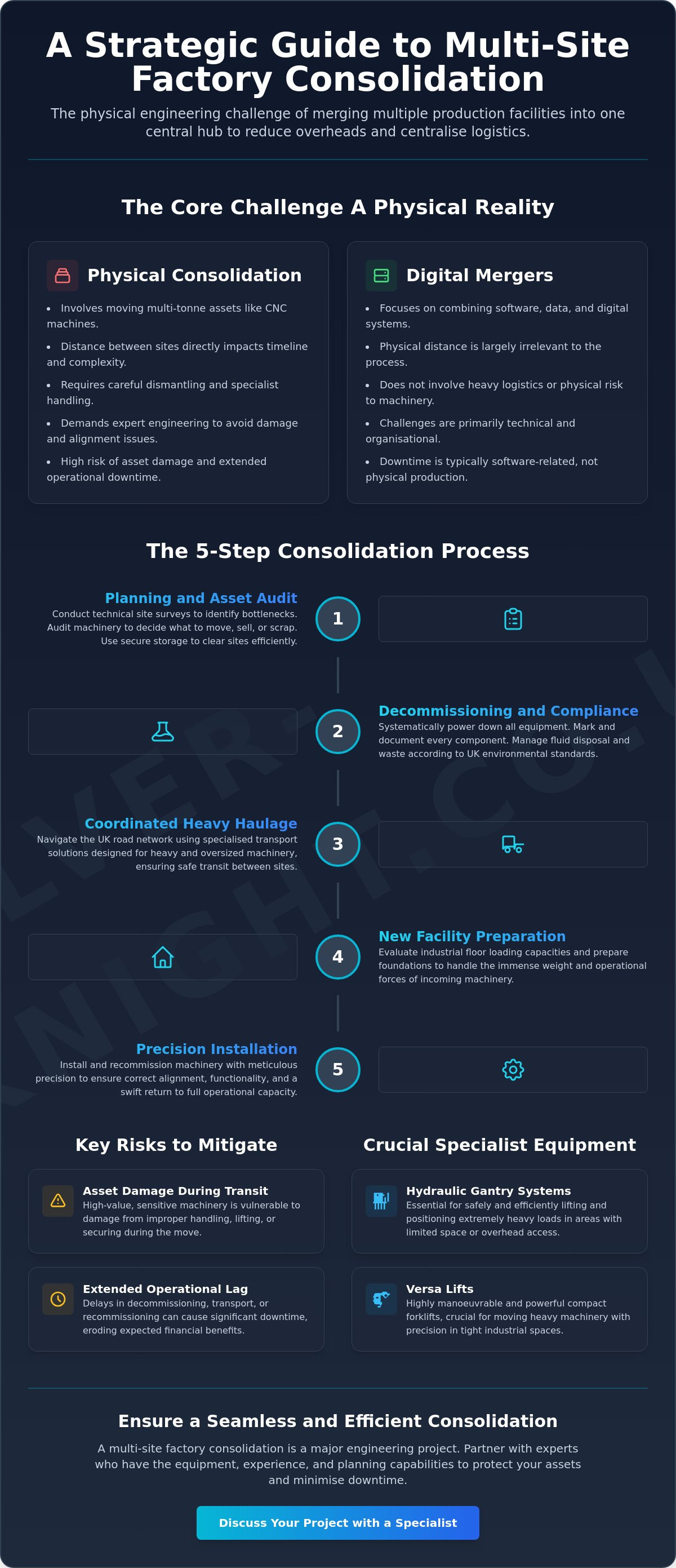
In the context of manufacturing, business consolidation refers to the physical merger of production lines into a central hub. This process is often driven by the need to reduce overheads and create a more efficient, centralised logistics network. By bringing multiple sites under one roof, companies can streamline their supply chain and improve communication between departments. A successful multi-site factory consolidation requires more than just a change of address; it is a physical engineering feat that demands meticulous planning.
However, the physical risks are significant. Asset damage during transit and operational lag during the transition period can quickly erode the expected financial benefits. To mitigate these risks, a comprehensive technical site survey is essential before any movement begins. This survey identifies potential bottlenecks, such as narrow access points or insufficient floor loading capacity, ensuring that the relocation plan is grounded in reality. To better understand this concept, watch this helpful video:
Why physical consolidation differs from digital mergers
Merging two software companies is complex, but it doesn't involve moving a thirty tonne CNC machine across the country. In a multi-site factory consolidation, the stakes are much higher because physical laws apply. Distance between sites directly impacts the relocation timeline and the complexity of the move. Unlike digital data, industrial machinery requires careful dismantling and specialist handling. Engaging professional factory relocation services is vital for strategic planning, as they provide the engineering expertise needed to move heavy assets without causing structural damage or long-term alignment issues.
Identifying redundant assets across multiple sites
Consolidation provides a unique opportunity to audit machinery across all locations. You might find duplicate production lines that are no longer necessary in a single hub. Decisions must be made on which assets to move, which to sell, and which to decommission for scrap. This audit prevents the new facility from becoming cluttered with inefficient equipment. During this transition, secure industrial storage plays a crucial role. It allows you to clear sites quickly whilst you finalise the layout of the new hub, keeping your high-value assets safe and out of the way of ongoing construction or installation work.
For expert assistance with your industrial relocation project, explore the services offered by Silver Knight.
Strategic decommissioning and industrial site clearance
Managing the shutdown of several facilities during a multi-site factory consolidation requires a disciplined approach. You can't simply flip a switch and walk away. A systematic process is needed to ensure every production line is powered down safely and according to manufacturer specifications. This begins with a comprehensive audit where every machine, cable, and pipe is marked and documented. Accurate labelling prevents confusion later and ensures that the reassembly phase in your new hub remains on schedule.
Environmental responsibility is a major part of this stage. As of 2026, new reporting rules regarding PFAS chemicals and hazardous waste mean that fluid disposal must be handled with extreme care. You must manage the drainage of hydraulic oils and coolants whilst adhering to the latest EPA and UK environmental standards. Safety protocols are equally vital. In high risk industrial environments, teams must manage risks like stored energy and heavy overhead loads. Adhering to these standards protects your staff and ensures your business remains compliant with current legislation.
The machinery dismantling process
Effective machinery dismantling involves more than just unscrewing bolts. It requires a technical sequence to maintain the integrity of delicate components. Electricians must safely isolate and disconnect power supplies, whilst mechanical engineers manage the drainage of hydraulic systems to prevent spills. Decommissioning is the safe removal of industrial assets from active service. By following a structured dismantling programme, you protect your investment and make the eventual recommissioning much faster.
Clearing redundant factory premises
Once the machinery has been removed, the old building needs to be prepared for handover or sale. This involves a thorough factory clearance to remove any remaining heavy plant equipment or scrap metal. You must ensure that all site clearance activities meet the latest UK health and safety standards, particularly regarding the removal of hazardous materials. A clean, empty site is much easier to sell or return to a landlord. If you need help managing these complex logistics, you can speak with an expert today to discuss your specific site requirements.
To coordinate your next industrial move with a team of experts, visit Silver Knight for more information.
Coordinating heavy haulage for complex factory moves
Moving heavy machinery across the UK national road network is far more complex than standard freight. When you are undertaking a multi-site factory consolidation, the logistical pressure increases exponentially. You aren't just moving one line; you're synchronising the arrival of oversized loads from various corners of the country to a single destination. This requires a high level of precision to ensure that the new hub doesn't become gridlocked with arriving trailers before the installation team is ready.
Specialised transport is a necessity for these projects. Standard flatbeds often aren't sufficient for the height and weight of modern industrial plant. You will frequently require low loaders to manage height restrictions under bridges or extendable trailers for particularly long production components. Professional machinery haulage ensures that these assets are transported on the correct equipment, reducing the risk of transit damage. With the load-to-truck ratio reaching 7.73 in March 2026, securing your transport partner early is more important than ever to avoid project delays.
Managing oversized and heavy loads
Large machines often exceed standard road widths, requiring meticulous route planning and, in many cases, escort vehicles. You must identify any low bridges, weight-restricted roads, or tight urban corners that could block the journey. Once on the trailer, securing the machinery is the next priority. Internal components can shift during transit if not properly braced, leading to mechanical failure upon arrival. For a deeper look at the engineering requirements, refer to this technical guide to industrial removals.
International consolidation considerations
If your project involves merging overseas sites into a UK facility, the complexity shifts to international logistics. Managing international machinery transport requires a solid understanding of customs documentation and import regulations. Your assets must be prepared for long journeys via sea or air freight. This involves professional shipping container packing to prevent corrosion from salt air or damage from the movement of the vessel. Navigating these borders effectively ensures your international assets arrive at the new hub without being held up at port.
If you want to ensure your machinery is installed with absolute precision, the team at Silver Knight can provide the technical expertise you need.
Precision installation and recommissioning in the new facility
Once the heavy haulage phase is finished, the focus shifts to the physical layout of your new hub. This is where the strategic planning of your multi-site factory consolidation pays off. You must verify that the industrial floor loading and foundations meet the specific requirements of each production line. Heavy CNC machines or presses often require reinforced concrete pads to prevent structural subsidence. If these technical details are overlooked, the building itself could suffer permanent damage. Protecting these high-value assets is more important than ever, especially since MSRPs for new equipment have risen by up to 5% in 2026.
Positioning is a delicate balance of power and precision. It involves moving assets into their final footprint whilst ensuring all utility connections are accessible. This stage requires a deep understanding of the floor plan and the operational flow of the business. You can't afford a centimetre of error when dealing with high speed production lines that rely on perfect synchronicity between different machines. Every millimetre counts when you are trying to recreate or improve upon existing production efficiencies.
Precision engineering and positioning
Moving large assets within a building requires specialised equipment like jack and slide systems. These are essential when working in tight spaces where a crane or forklift cannot reach. Following established precision engineering standards is vital for long term performance. High speed machinery requires exact calibration to avoid vibration issues. The use of laser levelling ensures machinery longevity by maintaining perfect alignment across the entire production line. This process minimises wear on bearings and drive systems, reducing the likelihood of early maintenance costs and unexpected downtime.
Final safety checks and testing
The recommissioning phase is the final hurdle. You must verify all safety guards and emergency stops are fully functional after the relocation. It's not enough to simply turn the power on. Conducting thorough test runs ensures that production quality matches pre move standards. Qualified operators should lead these initial runs to identify any minor calibration errors. You should also ensure that all machine guarding meets current OSHA and UK safety regulations to protect your workforce. This rigorous testing phase guarantees that your consolidated hub is ready for full scale operation and meets all necessary compliance standards.
Contact our machinery installation team to discuss your upcoming project requirements and ensure a precision transition for your assets.
To partner with a team that brings decades of industrial expertise to your project, explore the solutions at Silver Knight.
Choosing an experienced machinery moving partner for consolidation
The success of a multi-site factory consolidation depends entirely on the expertise of the team executing the physical move. It's a high-stakes operation where 180 years of collective experience becomes your greatest asset. You need a partner who understands the nuances of various industrial sectors, from automotive to food production. A family-run business often provides a level of dedicated project management that larger, impersonal corporations cannot match. This personal touch ensures that your specific operational goals are always the priority throughout the merger.
Using a single partner for factory clearance, heavy haulage, and machinery installation offers immense value. It eliminates the friction often found when coordinating multiple subcontractors who may have conflicting schedules or safety standards. By centralising these services, you ensure a consistent approach to safety and quality across every phase of the project. This continuity is vital when moving high-value assets that require specific handling instructions from the moment they are decommissioned to the second they are recommissioned at the new hub.
Evaluating equipment and technical capabilities
Industrial moves require more than just standard forklifts. You should look for heavy moving equipment hire that includes operated lifting by trained professionals. Specialised tools like Versa Lifts and hydraulic gantry systems are essential for lifting heavy loads in confined indoor spaces where traditional cranes cannot operate. Always verify that your chosen partner holds comprehensive insurance and the latest safety certifications. High-quality machinery moving equipment is only as good as the engineers operating it, so ensure the team has a proven track record with similar industrial mergers.
The benefit of a nationwide service provider
A provider with a nationwide reach can coordinate moves across the whole of the UK from a central project office. This is particularly useful for a multi-site factory consolidation involving facilities in different regions. Having a single point of contact simplifies communication and ensures that the project timeline remains synchronised. Professional project management significantly reduces the total cost of consolidation by preventing scheduling conflicts and minimising the time machinery spends in transit. This holistic approach allows you to focus on your core business whilst the physical transition is handled by experts who understand the complexities of the UK road network and industrial regulations.
To ensure your industrial move is handled with precision, you can rely on the team at Silver Knight for professional support.
Securing your industrial future through strategic relocation
Managing a multi-site factory consolidation is a massive physical undertaking that requires a blend of engineering precision and logistical foresight. You've seen how systematic decommissioning and specialised heavy haulage protect your high-value assets whilst minimising production downtime. The final installation in your new hub is just as critical. It requires exact levelling and rigorous safety testing to ensure long-term operational success and compliance with current UK standards.
Success in these complex projects often comes down to the partner you choose. Silver Knight brings over 180 years of collective industry experience to every move. As a family-owned business providing nationwide UK coverage, we offer a dedicated point of contact and a specialised fleet. Our equipment, including Versa-Lifts and hydraulic gantries, is designed to handle even the most challenging lifts in confined spaces. We're here to help you navigate every stage of your transition, from the initial site clearance to the final recommissioning of your machinery.
Contact Silver Knight for expert multi-site factory consolidation support. Your project deserves the care and expertise that only a dedicated machinery moving specialist can provide. We look forward to helping you build a more efficient and centralised production hub.
Frequently Asked Questions
How long does a multi-site factory consolidation typically take?
The duration of a multi-site factory consolidation depends on the scale of the facilities and the complexity of the production lines. A straightforward move might be completed in a few weeks, but larger projects often span several months. You should allow for a significant planning period, usually starting six months in advance, to manage the logistics of clearing multiple sites simultaneously without disrupting your total output.
Do I need to dismantle all my machinery for a factory merger?
Dismantling is only required when a machine exceeds the height or weight limits for safe transport in one piece. Many machines can be moved whole if the access points at both sites are wide enough. Your moving partner will evaluate each asset to decide if a full dismantle is necessary or if specialised lifting equipment can handle the unit as a single load.
What is the difference between factory clearance and decommissioning?
Decommissioning is the technical task of isolating machinery from utilities like electricity and hydraulics to make it safe for removal. Factory clearance is the broader process of emptying the entire building of assets, waste, and scrap metal. Both are vital for a successful multi-site factory consolidation, ensuring that old premises are ready for handover whilst all valuable machinery is safely prepared for transit.
Can you move heavy machinery whilst the rest of the factory is operational?
Yes, moving machinery in a live environment is a standard practice designed to keep production running. This requires a detailed safety plan and clearly defined work zones to prevent any risk to your staff. By phasing the move, you can maintain a level of production at one site whilst another is being cleared, significantly reducing the impact on your customers.
Is it possible to consolidate international sites into a UK hub?
Consolidating overseas facilities into a central UK location is entirely possible with the right logistics partner. This process involves professional export packing to protect machines from the elements during sea or air freight. You will also need to navigate complex customs documentation and import regulations, which is why using a specialist in international machinery transport is essential for a smooth transition.
What equipment is used to move heavy machinery in restricted spaces?
Specialist equipment such as Versa Lifts and hydraulic gantry systems are perfect for lifting heavy loads in areas with low headroom. If a machine needs to be moved through a narrow gap, a jack and slide system can be used to skid the asset into position with millimetre precision. These tools allow for safe movement in environments where standard cranes or large forklifts simply won't fit.
How do you ensure machinery precision is maintained after a move?
Maintaining precision requires a combination of careful handling during transit and expert recommissioning. Once a machine is in its new location, engineers use laser levelling to ensure it is perfectly aligned and stable. This is followed by a series of test runs and calibrations to verify that the output quality matches the standards achieved before the relocation began.
What are the main risks of using general hauliers for factory consolidation?
General hauliers often lack the specialised equipment and technical knowledge required for heavy industrial assets. The primary risks include structural damage to the machinery due to improper securing and delays caused by inadequate route planning for oversized loads. Specialist machinery movers provide a level of engineering expertise that ensures your equipment is protected from the unique stresses of heavy haulage.
Article by
David Ashby
I'm the Managing Director of Silver Knight Haulage & Machinery Ltd. Silver Knight Ltd is a family-run firm established in the West Midlands in 2005, with the aim of providing a cost-effective, yet professional, service to businesses for the removal, transportation, and installation of machinery, plant, and equipment here in the UK and worldwide. Between us, the Silver Knight workforce has over 50 years of experience with machinery and its operation.
Disclaimer
This article is intended for informational purposes only. Please ensure you seek expert advice or carry out your own research to confirm the information is suitable for your specific needs.