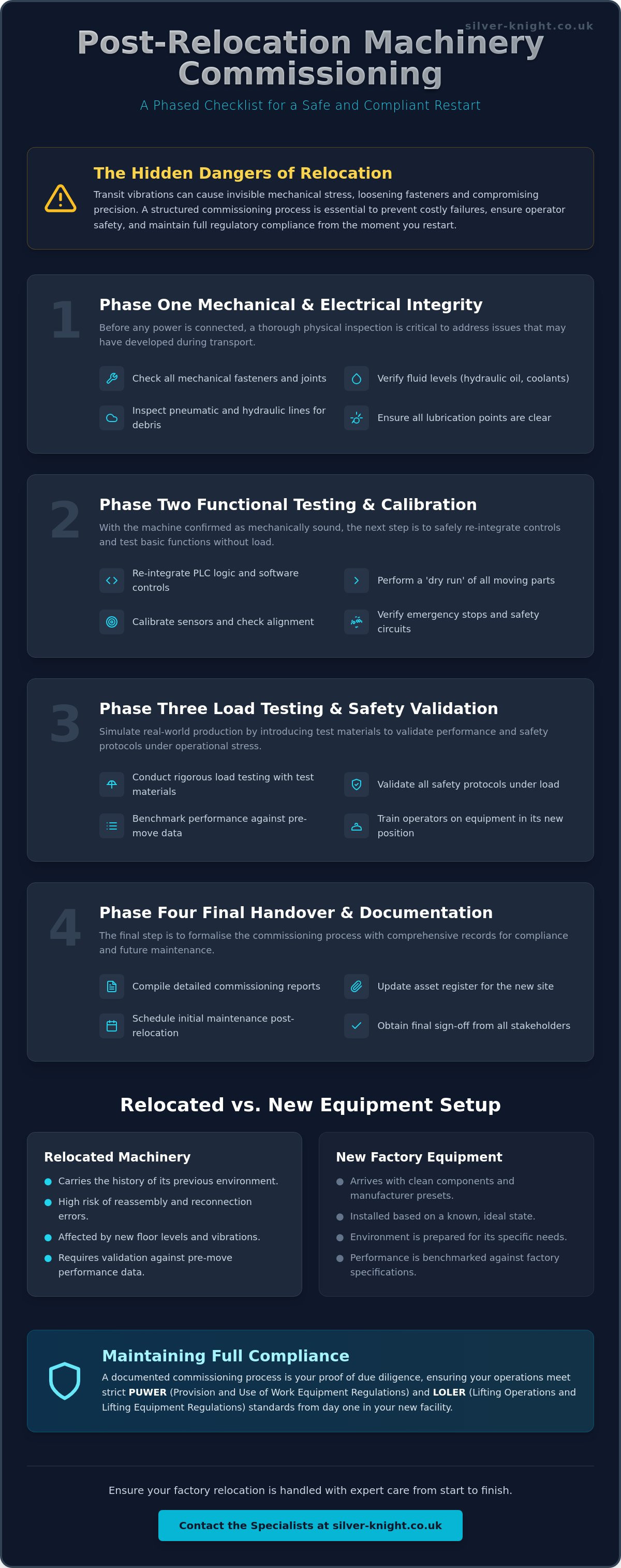
Post-relocation commissioning is not just a restart; it's a distinct engineering discipline that must account for the invisible mechanical stresses of transport and the unique variables of your new floor environment. You likely feel the pressure to resume production immediately, whilst worrying that transit vibrations have compromised your equipment's precision. It's a common concern for factory managers who need to balance speed with strict safety standards using a robust post-relocation machinery commissioning checklist. We understand that the fear of hidden damage can make the first flick of a switch feel incredibly high-risk.
This guide provides a comprehensive framework to help you safely restore industrial operations and verify that every machine meets its original calibration levels. We'll explore how to achieve zero accidents during the restart phase, maintain full PUWER and LOLER compliance, and ensure your systems are ready for the demands of 2026. By following these steps, you can move from a silent floor to full-scale production with total confidence in your equipment's safety and accuracy.
Key Takeaways
- Understand why checking mechanical fasteners and foundations is vital to counter the effects of transit vibrations.
- Learn how to re-integrate PLC logic and software controls safely during a dry run of all moving parts.
- Discover the essential steps for a post-relocation machinery commissioning checklist to ensure your plant remains compliant with PUWER and LOLER regulations.
- Validate your safety protocols through rigorous load testing with test materials before starting full production.
- Master the final handover process by compiling detailed reports and updating your asset register for the new site.
If you are planning a move, it is essential to partner with specialists in factory relocation to ensure every stage of the process is handled with care.
The Importance of a Post-Relocation Machinery Commissioning Checklist
Post-relocation commissioning acts as the vital bridge between the physical transport of assets and the resumption of full-scale production. It is a distinct engineering phase that goes far beyond simply plugging a machine back into the wall. During heavy haulage, even the most secure loads are subject to constant transit vibrations. These subtle but persistent movements can loosen internal fasteners, shift sensitive sensors, and compromise the tight tolerances required for high-precision manufacturing. You cannot assume a machine that worked perfectly on Friday will perform the same way on Monday after a hundred-mile journey.
To better understand this concept, watch this helpful video about the technical steps involved in system setup:
Rushing the restart process without a structured audit often leads to expensive mechanical failures or safety incidents. Professional machinery movers play a critical role here. They don't just move the weight; they understand the structural integrity of the equipment. Using a comprehensive post-relocation machinery commissioning checklist ensures that every bolt tightened and every circuit tested is documented. This provides a clear, audit-ready path from the loading bay to the production line.
Distinguishing Post-Relocation from New Equipment Setup
Setting up used machinery in a new location is significantly more complex than installing factory-new equipment. New machines arrive with manufacturer presets and clean components. In contrast, a relocated machine carries the history of its previous environment. Reassembly errors are common during complex factory removals where intricate wiring or hydraulic lines must be reconnected exactly as they were. The new floor environment also plays a massive role. Subtle differences in floor levels or vibrations from neighbouring equipment can throw off machine levelling. These environmental factors are often overlooked. This is why your pre-move performance data is your most valuable benchmark. Without it, you have no way to prove the machine is performing to its previous standards.
Avoiding Operational Lag and Safety Risks
Unplanned downtime is the enemy of any relocation project. If a machine fails a week after the move because a cooling line wasn't properly bled or a safety sensor was misaligned, the financial impact can be devastating. Beyond the immediate loss of production, there are serious legal implications. Equipment failure in a new facility can lead to investigations into PUWER compliance, potentially resulting in heavy fines. The checklist serves as more than just a technical guide. It is a vital tool for project management accountability. It ensures that safety and precision are never sacrificed for the sake of a quick restart. By verifying every step, you protect your staff and your bottom line.
If you are preparing for a complex move, you can find expert support through our professional machinery moving services to ensure a smooth transition.
Phase One Mechanical and Electrical Integrity Checks
The first stage of any post-relocation machinery commissioning checklist focuses on physical stability and basic power integrity. Heavy haulage involves constant vibration that can affect even the sturdiest industrial equipment. Before you even consider turning on the power, you must perform a deep inspection of the machine's physical state. This includes checking all mechanical fasteners and joints. It's common for bolts to loosen slightly during transit, which can lead to significant mechanical failure if not addressed. You also need to verify that all fluid levels, such as hydraulic oil and coolants, are topped up and that lubrication points are clear. Checking pneumatic and hydraulic lines for transit debris is equally important. Dust or small particles entering these lines during a move can cause internal blockages or seal damage. Following CDC Machine Safety Guidelines is a great way to ensure your initial inspections align with global safety standards.
Foundation and Levelling Verification
A machine is only as accurate as the floor it sits on. Even a slight floor gradient can severely impact the accuracy of high-speed CNC machines or complex robotic arms. You should use precision spirit levels and laser alignment tools to verify that the positioning is perfect. For heavy assets, using jack and slide systems allows for millimetre-perfect placement without putting undue stress on the machine frame. Once positioned, verify the integrity of the machine foundation and ensure all anchor points are secured to the manufacturer's specifications.
Electrical Connections and Re-wiring Audits
Before the first power-up, conduct a comprehensive electrical continuity and grounding audit. This is the time to verify that all temporary transport ties, blocks, and brackets used to secure internal components have been removed. Audit the control panel thoroughly for loose wires or circuit boards that might have been dislodged by road bumps. It's also vital to ensure the power supply at the new facility exactly matches the machine requirements, as voltage drops or incorrect phasing can damage sensitive electronics. If you have concerns about the technical state of your equipment after a move, you can speak with our technical team for advice on recommissioning.
To ensure your equipment is set up correctly in its new location, consider our expert machinery installation services to help you manage the technical transition.
Phase Two Functional Testing and Systems Calibration
Once the physical and electrical foundations are secure, the focus shifts to how the machine moves and communicates. This stage of the post-relocation machinery commissioning checklist is where you bridge the gap between a static asset and a working production unit. You must perform a comprehensive dry run of all moving parts without any material load. This allows you to verify that the transport process hasn't caused internal binding or structural shifts that were invisible during static checks. It's also the time to test auxiliary equipment, such as external conveyors, swarf extractors, or cooling units, ensuring they sync perfectly with the primary machine.
Calibration is a precision task that often requires significant time. Sensors and limit switches are particularly sensitive to the vibrations of heavy haulage and may have shifted by fractions of a millimetre. In a high-precision environment, these tiny deviations can lead to catastrophic tool crashes or failed quality audits. You should also verify the communication between the machine and your factory networks. In 2026, most industrial units are part of a wider digital ecosystem; therefore, ensuring the machine correctly talks to your internal servers is vital for data logging and production monitoring.
Dry Run and Static Testing
The dry run should begin by cycling the machine through its full range of motion at the lowest possible speed. This is a sensory task as much as a technical one. You need to listen for unusual noises, such as rhythmic clicking or grinding, which often indicate a slight misalignment in the drive train. Check that all manual overrides and jog functions operate correctly before attempting any automated sequences. If the machine feels or sounds different to its pre-move state, stop immediately to investigate the cause before increasing speed.
Software and Control System Re-Integration
Modern manufacturing relies heavily on software, and re-integrating PLC logic is a critical step. You must reload all machine parameters and verify they match your pre-move backups exactly. It's common for volatile memory to be affected if a machine has been without power for an extended period during storage or transport. Perform a systematic check of all Human Machine Interface (HMI) screens to ensure they are responsive and displaying accurate data. Finally, test the integration with local SCADA or ERP systems to confirm that your production reporting and scheduling tools are receiving the correct signals from the newly installed equipment.
For a managed transition that prioritises safety, you can rely on our comprehensive factory relocation service to oversee every stage of your move.
Phase Three Load Testing and Safety Protocol Validation
After completing dry runs, the next stage of your post-relocation machinery commissioning checklist involves introducing actual stress to the system. You should begin initial production runs using scrap or test material rather than live stock. This allows you to observe how the machine behaves under load without risking expensive raw materials. During these runs, it is vital to check for thermal stability. Machines often generate heat differently in a new environment, especially if ventilation or ambient temperatures have changed. You must monitor bearings, motors, and cooling systems over extended operational periods to ensure they remain within safe working limits.
In the UK, this phase is not just about production; it is about legal compliance. You must perform a formal PUWER (Provision and Use of Work Equipment Regulations) assessment before the machine is handed over to operators. This ensures that the equipment is safe for use in its new configuration. With safety standards like ANSI B11.26-2024 and various ISO robot safety standards evolving, your validation must be rigorous. If you need assistance ensuring your setup meets these strict requirements, you can contact our expert team for professional guidance.
Performance Baselines and Quality Checks
The goal of recommissioning is to return to or exceed your pre-move performance levels. You should compare current tolerances and cycle times directly against the data you recorded before the relocation. If you notice any deviations, such as increased vibration or a drop in part accuracy, it often suggests a need for further levelling or recalibration of the drive systems. Documenting your first successful production batch is a major commissioning milestone. It serves as proof that the machine is once again fit for purpose and ready for full-scale output.
Emergency Stop and Safety Guarding Audits
Safety systems are frequently the first things to be adjusted or removed during a move. You must verify that every guard removed during the machinery dismantle service phase has been correctly re-installed and secured. Testing emergency stops is a non-negotiable task; every single button and pull-cord must be triggered to confirm it halts the machine instantly. Additionally, verify that light curtains and pressure mats are fully functional and correctly aligned. These systems can be easily knocked out of position during transport, and their failure could lead to serious workplace accidents.
If you need a partner to manage your industrial move from start to finish, our specialists provide a comprehensive factory relocation solution.
Final Handover and Maintenance Scheduling for 2026
The final phase of the post-relocation machinery commissioning checklist ensures that the transition is sustainable and fully documented. Once the machine is running at pre-move precision, you must compile a complete commissioning report. This document acts as the final sign-off, containing all test results, calibration certificates, and safety validation records. It's also the correct time to update your asset register with the new location and operational status. Managing this data correctly is essential for insurance purposes and future maintenance planning. Clear documentation ensures that anyone stepping onto the floor understands the machine's current state and history.
Reviewing the site layout is another critical task that often gets overlooked in the rush to resume production. Even if the machine is identical to its previous state, its new surroundings may have changed significantly. You must assess operator access and ergonomic safety. Are there new trip hazards created by the floor layout? Is the lighting sufficient for precision work in this specific part of the factory? In 2026, many facilities are integrating more modular production lines, so you must ensure the machine has enough clearance for future adjustments. Addressing these factors now prevents long-term productivity drains and workplace injuries.
Documentation and Compliance Records
Proper record-keeping is the backbone of industrial safety and regulatory compliance. You should archive all electrical test results and calibration certificates where they can be easily retrieved for future audits. Ensure that machine manuals and updated safety signage are physically accessible to the operators at the new station. For those who require a professional UK factory relocation service, these administrative tasks are often integrated into the project closure phase. This ensures no detail is missed during the transition from transport to full-scale operation.
Operator Training and Preventive Maintenance
Operators must be briefed on any changes to the machine's surroundings or power isolation points. Even experienced staff can be caught out by a new floor layout or different emergency stop locations. You should also establish a post-move preventive maintenance schedule specifically for the first quarter. This is vital for monitoring 'infant mortality' failures, which are faults that appear shortly after a move due to the stress of transport or reassembly. Scheduling a follow-up inspection for 30 days after the initial post-relocation machinery commissioning checklist was completed allows you to catch these minor issues before they become major breakdowns. This proactive approach ensures your equipment remains as reliable as it was before the move.
If you are planning an upcoming transition, you can find expert support through our specialist machinery moving services to ensure every detail is managed professionally.
Restoring Production Confidence in 2026
Moving your factory is a complex project that only truly ends when your machines are producing at peak precision. By following a structured post-relocation machinery commissioning checklist, you bridge the gap between heavy haulage and profitable output. This process ensures that transit vibrations haven't compromised safety and that every component remains compliant with UK regulations like PUWER and LOLER.
Our team brings over 180 years of collective industry experience to every project, providing a comprehensive nationwide service across the entire United Kingdom. We utilise specialist equipment such as Versa-Lifts and hydraulic gantry systems to manage even the most demanding relocations with millimetre precision. Whether you are moving a single machine or an entire plant, we are here to support your technical transition from the first lift to the final handover.
Secure your next industrial move with our expert machinery installation services and get your production line back up and running with total peace of mind.
Frequently Asked Questions
What is the difference between machinery installation and commissioning
Installation is the physical process of placing and connecting equipment; commissioning is the technical verification that it works correctly. Whilst installation involves moving the asset and connecting power or fluids, commissioning follows this by ensuring the machine operates safely and to specified precision levels. It's the final bridge between a static machine and a live production unit.
How long does the commissioning process typically take after a factory move
The timeframe varies from a few hours to several weeks depending on the complexity of the equipment. A simple standalone unit might be ready in a single day. However, complex production lines involving integrated robotics and PLC logic often require a longer period to ensure all systems are calibrated and communicating correctly within the new facility's network.
Do I need to perform a new PUWER assessment after moving a machine
Yes, a new PUWER assessment is mandatory whenever a machine is relocated or its environment changes significantly. This ensures that the equipment remains safe for use in its new position. It also verifies that factors like operator access, lighting, and emergency stop visibility haven't been compromised by the new site layout or floor conditions.
What are the most common mechanical issues found during post-relocation testing
Loose fasteners and misaligned sensors are the most frequent problems discovered when using a post-relocation machinery commissioning checklist. Transit vibrations often cause bolts to back out slightly or sensitive limit switches to shift by millimetres. Other common issues include air leaks in pneumatic lines and subtle frame twisting if the new floor isn't perfectly level.
Can I use my own maintenance team for commissioning heavy industrial plant
You can use your own team, but partnering with specialist movers is often safer for complex recommissioning tasks. Whilst your team knows the machine's operational history, professional installers have the specific tools, such as laser alignment systems and heavy lifting gear, required for a move. They also provide an independent audit of the machine's safety and performance.
Why is levelling so critical for relocated CNC machinery
Correct levelling prevents the machine frame from twisting, which is essential for maintaining sub-micron accuracy. If a CNC machine is not perfectly level, the guideways can become distorted, leading to premature wear and inconsistent part quality. Even a tiny floor gradient can cause the machine to lose its calibration during high-speed operations in its new location.
What should be included in a final commissioning handover document
A comprehensive handover document should include all calibration certificates, electrical continuity test results, and a signed PUWER assessment. It should also feature a detailed record of the dry runs and load tests performed. This provides a clear audit trail that proves the machine was safe and accurate at the point of resuming production.
How do I verify that my machine has not suffered internal damage during haulage
Verification involves a combination of sensory checks and precision measurement. You should listen for unusual noises during low-speed dry runs and use vibration analysis tools to detect internal bearing or gear issues. Comparing the current output quality against your pre-move performance baseline is the most reliable way to confirm no internal shifting has occurred.

Article by
David Ashby
I'm the Managing Director of Silver Knight Haulage & Machinery Ltd. Silver Knight Ltd is a family-run firm established in the West Midlands in 2005, with the aim of providing a cost-effective, yet professional, service to businesses for the removal, transportation, and installation of machinery, plant, and equipment here in the UK and worldwide. Between us, the Silver Knight workforce has over 50 years of experience with machinery and its operation.
Disclaimer
This article is intended for informational purposes only. Please ensure you seek expert advice or carry out your own research to confirm the information is suitable for your specific needs.