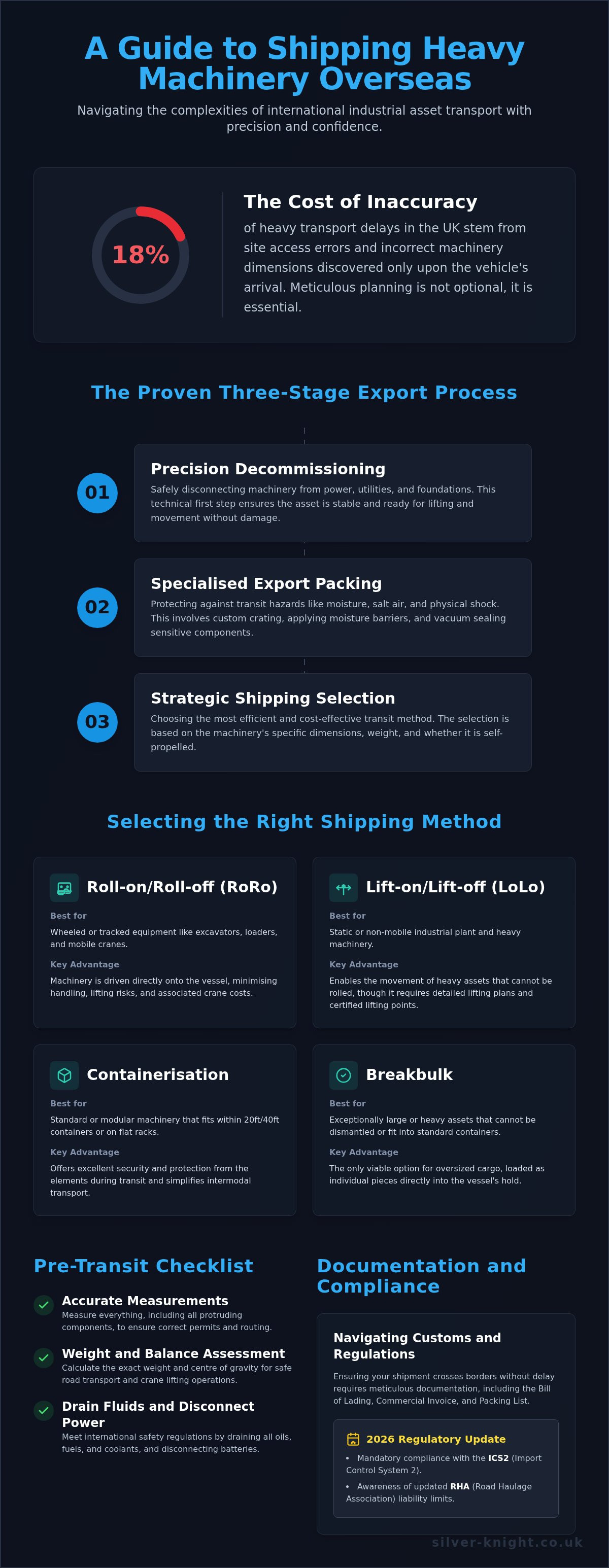
Did you know that 18% of heavy transport delays in the UK stem from site access errors that are only discovered when the vehicle arrives? When you're managing heavy machinery shipping overseas, a small oversight can quickly turn into a costly logistical nightmare. It's natural to feel anxious about your high value equipment facing the rigours of sea transit or getting caught in the tangle of international customs.
You want to ensure your assets arrive safely whilst keeping downtime to an absolute minimum. This guide provides a clear roadmap for transporting industrial equipment across borders with total confidence. We'll walk through the essential steps of precision decommissioning, specialised export packing, and selecting the right shipping method for your specific machinery. You'll also learn about the latest 2026 regulatory changes, including the mandatory ICS2 system and updated RHA liability limits, so your shipment stays compliant and protected.
Key Takeaways
- Learn why heavy machinery shipping overseas requires a technical three stage process including decommissioning and specialised packing.
- Understand how to choose the most efficient transit method, such as RoRo or containerisation, based on your equipment's specific dimensions and weight.
- Discover the essential preparation steps for global transit, including draining fluids and disconnecting batteries to meet international safety regulations.
- Identify the complex documentation and customs requirements needed to ensure your industrial assets cross borders without expensive delays.
- Find out how specialist equipment like hydraulic gantries and Versa-Lifts can safely move large machinery in confined factory environments.
For expert assistance with your industrial relocation, contact the team of specialist machinery movers.
The Challenges of Shipping Heavy Machinery Overseas
Moving industrial assets internationally is significantly more complex than standard haulage or vehicle shipping. It involves a technical discipline known as What is Project Cargo, where oversized and high value items require bespoke logistics. Large machinery often requires specialised lifting equipment such as hydraulic gantries or jack and slide systems to move safely from the factory floor. Using hydraulic gantry systems allows for precision lifting in tight spaces where a traditional crane cannot operate. This equipment is vital for maintaining the structural integrity of the machine whilst it is being transitioned from its foundations to a transport skid.
You must assess weight distribution carefully to prevent structural damage during the lifting and loading process. Standard lifting points might not be sufficient for older or modified equipment that has been altered over time. Environmental factors during sea transit, such as salt air and moisture, can also damage sensitive electronics or polished surfaces if they aren't properly protected. Protecting these surfaces often involves specialised coatings or vacuum sealing. Without these moisture barriers, the saline environment of a container ship can cause rapid oxidation on exposed metal parts, leading to costly repairs upon arrival.
Identifying Load Dimensions and Weight Constraints
Accurate measurements are the foundation of any successful export. You must include every protruding component, from control panels to handles, as these vital details dictate the required shipping permits and route planning. Incorrect data is a leading cause of delays. In fact, site access errors and incorrect dimensions account for 18% of heavy transport delays in the UK. For those moving assets from the UK to global destinations, international machine movers provide the necessary technical oversight.
Weight assessments determine whether a standard low loader or a specialised heavy haulage trailer is required for the UK leg of the journey. If the weight is underestimated, the transport vehicle may be turned away at the port, or worse, face safety risks on the road. Calculating the exact centre of gravity is essential to ensure a stable and safe crane lift during the loading phase at the docks.
Assessing Fragility and Specialist Handling Needs
Not all machinery is built to withstand the physical stresses of a long sea voyage. You should identify delicate components that may require removal or additional internal bracing before transit begins. High precision CNC machines often need moisture barriers or climate controlled storage to prevent rust and calibration issues caused by temperature fluctuations. Different industrial sectors, from food production to pharmaceutical manufacturing, require unique handling protocols for their specific plant equipment. This level of detail ensures the asset arrives in the same condition it left the factory, ready for recommissioning.
Before you commit to a carrier, it's vital to consult with experts who understand heavy machinery shipping overseas.
Selecting the Most Efficient International Shipping Methods
The choice of shipping method for heavy machinery shipping overseas depends on three primary factors: dimensions, weight, and whether the equipment is self propelled. Selecting the wrong method can lead to astronomical costs or, in some cases, the carrier refusing to load the asset at the quay. For wheeled or tracked equipment, such as excavators or mobile cranes, Roll on Roll off (RoRo) is often the most straightforward choice. It allows the machinery to be driven directly onto the vessel's deck, which minimises handling and reduces the risk of damage from lifting. While moving these industrial giants is a massive undertaking, those who appreciate their engineering on a smaller scale can find detailed 1:18 and 1:24 scale replicas at Diecast Cartel.
RoRo is generally more cost effective for rolling machinery because it avoids the need for heavy lift cranes at the port. However, for static plant, LoLo is necessary. This process involves crane lifting, which requires a detailed lifting plan and clearly certified lifting points on the machinery itself. All lifting operations in the UK must comply with UK Lifting Regulations (LOLER) to ensure safety and legal compliance. Understanding the specific port requirements for each method is essential to avoid unexpected handling fees or administrative delays.
Containerised Shipping and Flat Rack Solutions
Standard containers provide the highest level of protection against the elements, but they are limited by strict internal dimensions. When your machinery is slightly too wide or tall for a standard box, flat rack containers offer a solution. These have no sides or roof, allowing for oversized loads that exceed standard width or height. Open top containers are another alternative, allowing for overhead loading of heavy items that cannot be pushed through standard end doors. To ensure your asset is secured correctly within these units, utilising a professional shipping container packing service is highly recommended.
If you are unsure which method suits your specific equipment, you can speak with our logistics team for a tailored assessment.
Success in international machinery transport begins with meticulous preparation at the factory floor.
Preparing Industrial Equipment for Safe Global Transit
When you are organising heavy machinery shipping overseas, preparation begins with the professional decommissioning of the machinery to ensure it is safe for transport. This stage is often overlooked, yet it is the foundation of a successful move. All fluids, including hydraulic oils and coolants, must be drained. Batteries must be disconnected to comply with international maritime dangerous goods regulations. These steps prevent leaks and fire hazards whilst the vessel is at sea. Export packing provides the physical barrier against the harsh conditions of a long sea voyage, such as high humidity and salt spray. To maintain high standards, many firms look to resources like the Export Promotion for Construction Machinery for guidance on best practices in the global market.
With over 180 years of collective industry experience, specialist movers understand that sustainable and compliant timber must be used for all crating and stillages. If your packaging doesn't meet specific biosecurity standards, your entire shipment could be quarantined or returned at your expense. This preparation phase is where technical expertise becomes invaluable, as specialists handle the transition from an operational asset to a secured piece of freight.
Decommissioning and Dismantling for Transport
A systematic machinery dismantle service ensures that every part is labelled for easier recommissioning at the destination. This process isn't just about taking things apart. It involves mapping the electrical and mechanical connections so they can be put back together without error. Removing protruding parts can often reduce the overall shipping volume. By making the machine more compact, you can significantly lower transit costs and potentially fit the item into a standard shipping container. Proper isolation of electrical systems is required before the equipment is moved from its original position to prevent damage to sensitive internal circuits.
Professional Export Packing and ISPM 15 Compliance
Utilising professional shipping container packing services ensures that the load is balanced and secured within the container. An unbalanced load is a major safety risk during lifting and sea transit. To prevent corrosion, technicians use barrier foil and desiccants to create a vacuum sealed environment. This protects polished surfaces and electronics from the corrosive effects of salt air. All timber packaging must meet ISPM 15 standards. This international regulation requires timber to be heat treated or fumigated to prevent the spread of pests. Without the official mark of compliance, your heavy machinery shipping overseas could face significant delays at the border.
For professional guidance on international logistics and customs compliance, contact the heavy machine movers at Silver Knight.
Managing Documentation and Regulatory Requirements
Every international machinery move requires a comprehensive set of documents to clear customs without delay. Missing even a single form can result in your equipment being held at the port, leading to spiralling costs. In scenarios where missing paperwork or critical components must be delivered urgently to get a shipment moving again, SpeedLink Transport Limited provides the necessary express logistics support. Managing heavy machinery shipping overseas involves more than just physical transport; it's a paper-heavy process that demands precision. You must use the correct commodity codes for customs classification. These codes determine the exact duties and taxes you'll pay upon arrival. If you get this wrong, you risk heavy fines or seizure of the asset. Since 3 February 2026, the ICS2 system is fully mandatory for freight entering the EU, requiring an Entry Summary Declaration (ENS) before arrival. Incorrect data here can lead to fines of up to €5,000 per shipment.
Commercial invoices and packing lists must provide a detailed breakdown of every component in the shipment. This includes serial numbers, weights, and values for each part. Customs officers use these to verify that the physical cargo matches the declared data. Certificates of origin may be required depending on the trade agreements between the UK and the destination country. These documents prove where the machinery was manufactured, which can affect the tariff rate. The Bill of Lading acts as the contract of carriage and serves as the legal title to the goods during the journey.
Managing Customs Clearances and Duties
Understanding the local regulations at the destination port is vital to avoid expensive quay rent and demurrage charges. These fees accumulate daily if your machinery isn't cleared quickly. Working with an experienced agent helps in navigating the complexities of post-Brexit trade with Europe. Since the border regime changed, documentation must be perfect to avoid being turned away. You might also identify potential tax exemptions for temporary exports, such as equipment being moved for repair or display at a trade show. Identifying these early can save your business thousands in unnecessary tax payments.
If you need help navigating these complex regulations, request a consultation with our export team.
To ensure your industrial assets are handled with the highest level of care, trust the expert machinery moving team at Silver Knight.
Why Specialist Machinery Movers are Essential for Export
A specialist company provides the technical expertise required to handle the move from the factory floor to the destination. Unlike general hauliers, these professionals understand the intricate mechanical requirements of the assets they move. Utilising specialised equipment like Versa Lift hire allows for precision movement in restricted factory spaces where standard forklifts would fail. This capability is essential when you're coordinating heavy machinery shipping overseas, as the initial extraction is often the most critical part of the project. With over 180 years of collective industry experience, a family-run specialist brings a level of personal accountability that ensures your equipment is treated as a priority.
Full project management reduces the risk of communication errors between different contractors. When you have separate teams for lifting, packing, and shipping, important details often fall through the cracks. Specialists anticipate and mitigate potential logistical bottlenecks, such as restricted bridge heights or port congestion, before they occur. This proactive approach saves time and prevents the 18% of delays caused by site access errors identified in UK transport research.
The Advantage of Full Project Management
A single point of contact oversees the entire international machine movers project from start to finish. This accountability ensures that every phase aligns with your production timeline. Coordination of technical site surveys ensures that both the origin and destination sites are prepared for the weight and size of the equipment. Project managed moves include the provision of all necessary risk assessments and method statements for safety compliance. This documentation isn't just a formality; it's a vital part of ensuring a safe work environment for everyone on site.
Seamless Factory to Port Logistics
Integrating factory relocation services with international shipping ensures a smooth transition between land and sea. If these stages are handled by separate firms, the risk of missing a shipping window increases. Heavy haulage fleets are coordinated to match the sailing schedules of the selected shipping vessels. Reliable logistics partners ensure that machinery is delivered to the port within the strict receiving windows required by carriers. This synchronisation prevents expensive storage fees at the docks and keeps your relocation on track. By handling the entire turnkey solution, specialists remove the burden of coordination from your internal team.
Ensure your assets are moved safely by partnering with expert machine movers.
Secure Your Global Industrial Transition
Shipping heavy machinery overseas is a high-stakes logistical operation that leaves no room for error. You now understand how technical decommissioning, precise export packing, and selecting the correct transit method are essential for protecting your capital assets. Navigating the 2026 regulatory landscape requires more than just standard haulage; it demands a partner with technical knowledge and specialised lifting equipment.
Silver Knight Haulage & Machineries Ltd provides a full turnkey solution backed by over 180 years of collective industry experience. Whether you require hydraulic gantries for restricted spaces or Versa Lift hire for precision moving, we have the advanced tools to ensure your relocation is efficient. Our national UK coverage combined with global expertise means your equipment is in safe hands from the factory floor to its final destination.
Don't let logistical complexity stall your business growth. Contact Silver Knight Haulage & Machineries Ltd for a professional export quotation and take the first step towards a successful global relocation. We look forward to helping you move your business forward.
Frequently Asked Questions
What is the best way to ship heavy machinery overseas?
The most effective method depends on whether your equipment is wheeled or static. Rolling machinery is best suited for Roll on Roll off vessels, whereas static plant often requires containerisation or flat rack solutions. For exceptionally large assets, breakbulk shipping is the standard choice. A turnkey service that includes dismantling and export packing ensures the entire process remains seamless and safe from the factory floor to the destination port.
How much does it cost to ship industrial machinery internationally?
Total costs are determined by the weight, dimensions, and the specific route taken. Beyond the freight rate, you must account for hidden fees such as brokerage and documentation, which can constitute 20% to 40% of the total landed cost. Shipping carriers have applied general rate increases of between 4.9% and 5.9% for 2026. It's best to obtain a bespoke quote that includes all port handling and customs clearance charges to avoid surprises.
What is ISPM 15 and why is it important for machinery exports?
ISPM 15 is an international regulation requiring all wood packaging materials to be heat treated or fumigated. This prevents the spread of timber pests across international borders. If your machinery is secured with non-compliant timber, customs authorities at the destination may reject the entire shipment or demand expensive on-site treatment. Using certified heat treated crates and pallets is a mandatory requirement for any business involved in heavy machinery shipping overseas.
Can I ship machinery that is too large for a standard container?
Yes, oversized machinery can be transported using flat rack or open top containers which accommodate loads exceeding standard dimensions. If the asset is too large for any containerised solution, it is shipped as breakbulk. This involves securing the machinery directly to the vessel's deck. Handling these items requires specialist equipment like hydraulic gantry systems or jack and slide systems to ensure safe movement during the loading and unloading phases at the port.
How do I prepare my machine for international sea transport?
Preparation involves thorough decommissioning and protection against the maritime environment. You must drain all internal fluids and disconnect batteries to meet safety standards. Applying barrier foil and desiccants creates a vacuum sealed barrier against salt air and moisture, which prevents corrosion on sensitive electronic components. Securing the machine to a heavy duty transport skid or internal bracing within a crate is also vital to prevent movement during the long sea voyage.
Do I need marine insurance for my machinery shipment?
Specialist marine insurance is essential because standard haulage liability is often insufficient for high value industrial assets. For instance, the updated Road Haulage Association conditions limit standard liability to £1,300 per tonne. If your machinery is worth hundreds of thousands of pounds, this cover won't protect your investment in the event of a total loss. Marine insurance provides comprehensive protection against transit damage, theft, and environmental incidents during the journey.
How long does international machinery shipping take from the UK?
Transit times vary significantly based on the destination and the shipping method selected. Sea freight to European ports typically takes a few days, whilst journeys to Asia or the United States can take between three and six weeks. You should also factor in time for customs clearance and the initial decommissioning phase. Delays can occur due to port congestion or site access errors, so planning for a buffer in your relocation schedule is always recommended.
What documentation is required for exporting industrial equipment?
Exporting heavy machinery shipping overseas requires a commercial invoice, a detailed packing list, and a Bill of Lading. You may also need a Certificate of Origin to comply with specific trade agreements. Since February 2026, all freight entering the EU must have an Entry Summary Declaration submitted via the ICS2 system. Accuracy is vital, as incorrect data can lead to significant fines or the cargo being held at the border for inspection.

Article by
David Ashby
I'm the Managing Director of Silver Knight Haulage & Machinery Ltd. Silver Knight Ltd is a family-run firm established in the West Midlands in 2005, with the aim of providing a cost-effective, yet professional, service to businesses for the removal, transportation, and installation of machinery, plant, and equipment here in the UK and worldwide. Between us, the Silver Knight workforce has over 50 years of experience with machinery and its operation.
Disclaimer
This article is intended for informational purposes only. Please ensure you seek expert advice or carry out your own research to confirm the information is suitable for your specific needs.