Moving an entire production line rarely fails on the open road. It almost always fails on the factory floor weeks before a single transport vehicle even arrives. Treating factory machinery relocation as just a haulage job is the quickest route to damaged CNC equipment, blown budgets, and catastrophic operational downtime. If you are dreading the prospect of unbolting high-value assets whilst wrestling with strict LOLER lifting rules and tight customer deadlines, your concerns are completely justified. Production targets don't pause for a move, and even a minor miscalculation can stall an entire supply chain.
Fortunately, with rigorous engineering and thorough preparation, you don't have to risk your output or your compliance. In this comprehensive guide, you will learn how to plan, manage, and execute a seamless factory machinery relocation safely whilst keeping production downtime to an absolute minimum. We explore the essential stages of the process, from initial technical site surveys and statutory RAMS to specialised lifting solutions, secure transport, and final precision recommissioning.
Key Takeaways
- Master the essential stages of factory machinery relocation to coordinate mechanical disassembly, specialist transport, and precision recommissioning without unexpected downtime.
- Identify how thorough pre-move surveys uncover building constraints, including doorway thresholds, overhead clearances, and structural floor loading capacities.
- Learn how specialised lifting equipment such as hydraulic gantries and jack and slide systems manoeuvre heavy plant safely through confined factory spaces.
- Establish robust decommissioning protocols, using systematic energy isolation, photographic tagging, and match-marking to guarantee faultless reassembly.
- Understand the vital compliance standards, specialist moving capabilities, and transit insurance levels required when choosing an industrial relocation partner.
For expert engineering support with your upcoming move, explore our comprehensive range of turnkey machinery moving and plant relocation services.
Understanding the Fundamentals of Factory Machinery Relocation
Factory machinery relocation is the systematic, planned transfer of industrial production assets between operational facilities. It extends far beyond standard freight transport; an industrial move involves mechanical decommissioning, specialized rigging, transport logistics, and precision recommissioning. Without methodical planning, uncoordinated industrial transfers expose manufacturers to substantial revenue losses and prolonged operational downtime. Professional machine movers eliminate these hazards by engineering bespoke lifting methodologies and comprehensive risk mitigation strategies for every asset.
To see how specialised hydraulic tools help solve complex lifting challenges during an industrial plant move, watch this helpful video.
Single Machine Relocation versus Complete Plant Moving
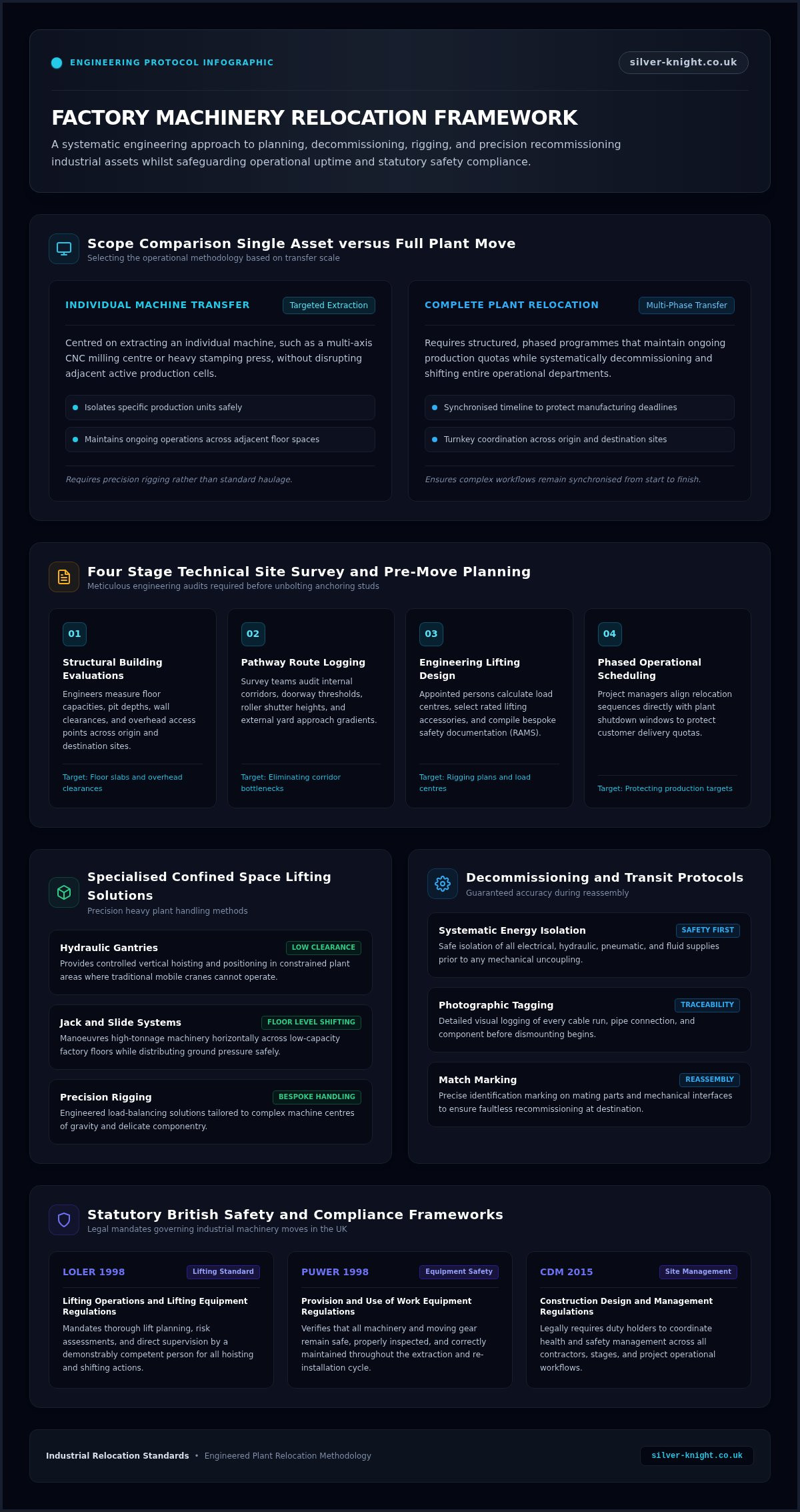
A single asset transfer centres on extracting an individual machine, such as a multi-axis CNC milling centre or heavy stamping press, without disrupting adjacent production cells. Conversely, full site moves require structured, phased programmes that maintain ongoing production quotas while decommissioning entire departments. Both scenarios demand precision rigging and heavy machine moving solutions rather than basic freight transport. For extensive manufacturing transfers, engaging a specialist factory relocation service guarantees that complex operational workflows remain synchronised from start to finish.
Key Compliance Frameworks Governing Industrial Lifting
Executing an industrial machinery shift safely requires total adherence to statutory British safety frameworks. Lifting operations must satisfy the Lifting Operations and Lifting Equipment Regulations 1998 (LOLER), which mandates thorough lift planning and supervision by a demonstrably competent person. Simultaneously, all machinery handling must comply with the Provision and Use of Work Equipment Regulations 1998 to verify that machines remain safe, properly inspected, and correctly maintained. Comprehensive site installations also fall under the Construction (Design and Management) Regulations 2015, which legally require duty holders to coordinate health and safety across every stage of the project.
To arrange a preliminary site assessment with experienced engineers, contact our team to discuss your tailored machinery moving solutions across the UK.
Step by Step Technical Site Surveys and Pre-Move Planning
Meticulous surveying sits at the core of any successful engineering transfer. Before unbolting a single anchoring stud, engineers must carry out detailed assessments across both origin and destination facilities. A comprehensive survey follows four distinct stages:
- Step 1: Structural building evaluations. Engineers measure floor capacities, pit depths, wall clearances, and overhead access points at both sites.
- Step 2: Pathway route logging. Survey teams audit internal transport corridors, doorway thresholds, roller shutter heights, and external yard approach gradients.
- Step 3: Engineering lifting design. Appointed persons calculate precise load centres, choose rated lifting accessories, and compile bespoke safety documentation.
- Step 4: Phased operational scheduling. Project managers align the relocation sequence with plant shutdown windows to protect customer production deadlines.
Skipping this legwork introduces major risks. Unexpected bottlenecks on the move day lead to stalled haulage and escalating labour costs.
Evaluating Floor Loadings and Overhead Restrictions
Industrial concrete slabs are easily cracked by concentrated ground pressure. During factory machinery relocation, heavy equipment sits on transport skates with tiny contact patches, multiplying the point loading exerted on the slab. Engineers calculate these exact ground bearing pressures against original building drawings. Where slab tolerances are low, thick steel spreader plates are laid along the transit route to disperse the mass safely. Surveyors also map out overhead service runs, identifying low-hanging busbars, pneumatic headers, gas lines, and overhead gantry cranes that could obstruct raised machine sections.
Developing Comprehensive Risk Assessment Method Statements
Every critical lift requires rigorous documentation. Comprehensive Risk Assessment Method Statements (RAMS) specify the exact mechanical rigging plan, certified machine lifting points, and slinging configurations. This planning must align with the statutory guidelines outlined in the Lifting Operations and Lifting Equipment Regulations (LOLER) to ensure safety throughout the lift. Method statements define site traffic routes, barricaded pedestrian exclusion zones, and environmental controls for draining hydraulic oils. Crucially, they assign clear roles across the rigging crew, confirming direct lines of command between appointed persons, lift supervisors, and qualified slingers. If you are preparing an industrial expansion or site consolidation, scheduling an early engineering review through our machinery moving team will help identify building constraints before they trigger expensive delays.
Discover how our specialist fleet solves complex site access challenges by visiting the Silver Knight machinery moving homepage.
Selecting the Best Lifting Equipment for Confined Factory Spaces
Moving industrial assets inside active plants brings unique spatial bottlenecks. Standard mobile cranes excel in open yards, but they cannot operate beneath low mezzanine floors or turn into narrow production aisles. Successful factory machinery relocation inside tight industrial facilities demands specialised equipment engineered to lift massive loads within constrained footprints. Selecting the correct plant machinery also ensures that equipment complies with statutory PUWER regulations, guaranteeing safety during every indoor manoeuvre. You can review the full range of engineering machinery we deploy by viewing our equipment options for complex projects.
Hydraulic Gantries versus Mobile Industrial Cranes
Hydraulic gantry systems provide the ideal solution when overhead clearance is severely restricted. Unlike conventional mobile cranes that need considerable boom elevation, telescopic hydraulic gantries lift loads weighing hundreds of tonnes straight up beneath low ceilings. Operating on heavy-duty tracks, these gantries distribute massive loads across broader sections of the floor slab, avoiding the severe point loading risks associated with wheeled mobile cranes.
Versa-Lift Hire and Precision Forklift Solutions
When moving heavy CNC centres or injection moulding machines down tight gangways, Versa-Lift units offer unmatched manoeuvrability. These specialist machines feature extendable counterweights, delivering tremendous lifting capacity within a remarkably compact chassis. Their hydrostatic drives enable smooth, inch-by-inch positioning around live production cells. Operators can manoeuvre high-value machine beds directly onto plinths and foundation bolts without jerky movements that could upset delicate machine alignments.
Jack and Slide Systems for Extreme Machinery Moves
In facilities where overhead height or gangway width rules out forklifts and gantries entirely, low-profile jack and slide systems step in. Hydraulic jacks carefully raise heavy machinery just enough to slip low-friction sliding tracks underneath. Integrated hydraulic push-pull cylinders then glide multi-tonne machines smoothly along the floor and through restricted doorways. This low-profile method overcomes severe access restrictions while keeping heavy machine moving operations completely stable and controlled.
To safely manage asset strip-down and equipment reassembly, explore our professional turnkey factory machinery relocation support across the UK.
Decommissioning Transit Preparation and Recommissioning Strategy
Safe factory machinery relocation depends on precise mechanical preparation long before equipment hits the road. Decommissioning begins with complete lockout-tagout procedures across electrical feeds, compressed air networks, process water lines, and hydraulic supplies. Stored kinetic, pneumatic, and gravitational energy must be neutralised before technicians loosen a single bolt. For intricate production lines, partnering with our dedicated machinery dismantle service ensures that sensitive assets are safely broken down without damaging precision sub-assemblies.
Mechanical Disassembly and Match-Marking Best Practices
Reassembly speed depends directly on disassembly discipline. Engineers label every electrical cable, terminal strip, and pneumatic line using durable alphanumeric tags matched against detailed schematics. High-resolution photographic records capture complex junction boxes and pipe runs before detachment. Counterweights, moving axes, and CNC tooling heads must be secured with bespoke transit locking brackets to prevent bearing deformation during transit. In addition, technicians drain all hydraulic reservoirs, coolants, and lubrication systems into certified containers to comply with environmental regulations and prevent transit leaks.
Heavy Transport Logistics and Weatherproof Asset Protection
Road transit introduces vibrations that can ruin sensitive machinery. Step-frame low-loaders and trailers fitted with air-ride suspension provide the cushioning needed to shield delicate optical scales, drive screws, and control cabinets. Machines moving on open flatbeds require robust weatherproofing, including multi-layer vapour barrier wrapping, desiccant packs, and heavy-duty shrink-wrap to prevent corrosion. In addition, when units exceed standard dimensional thresholds, transport coordinators manage notifications with police and highway authorities to clear the abnormal route.
Precision Alignment Levelling and Recommissioning
The job doesn't finish when the machine lands in its new bay. Recommissioning demands meticulous mechanical calibration:
- Optical and laser alignment: Aligning machine beds to within microns on pre-surveyed floor locations.
- Foundation anchoring: Setting holding-down bolts and applying non-shrink epoxy grout to manufacturer specifications.
- Reconnection and validation: Restoring service utilities, verifying phase rotation, and running dry-cycle tests to guarantee full production capability.
To plan your facility move with experienced decommissioning engineers, speak to our technical team today.
To partner with an established, family-owned contractor for your next project, discover how Silver Knight Haulage & Machineries Ltd delivers complete engineering peace of mind nationwide.
Choosing the Right Industrial Relocation Partner in the UK
Entrusting expensive manufacturing equipment to a general freight haulier is a huge operational gamble. Road transport operators move palletised freight from bay to bay; they do not have the rigging gear, engineering skills, or statutory qualifications to decommission and lift heavy plant. Successful factory machinery relocation demands a dedicated contractor with proven technical expertise, specialised lifting equipment, and comprehensive insurance. Choosing a partner founded in 1996 with over 180 years of collective industry experience across its engineering teams gives you confidence that every machine is handled with complete technical rigour.
Contract Lifting versus Basic Machine Transport
A critical distinction when hiring a contractor is the difference between standard plant hire and contract lifting. Under basic machine hire, the legal responsibility for lift planning, slinging, personnel safety, and site compliance remains entirely with your business. If equipment is damaged or safety standards are breached, your company carries the liability. In contrast, opting for turnkey contract lifting through an experienced machinery transport and relocation service transfers that responsibility. The contractor provides the appointed person, develops the lift plan and RAMS, supervises the rigging crew, and assumes full operational liability under British safety standards.
Essential Questions to Ask Before Awarding a Relocation Contract
Before signing an agreement, verify that your prospective industrial mover can meet your engineering requirements and delivery schedule. Ask these essential questions during procurement:
- Lifting equipment compliance: Can you provide valid thorough examination certificates for all spreader beams, hydraulic gantries, and slings scheduled for our site?
- Insurance thresholds: Does your goods in transit policy fully cover the new replacement value of our equipment, or is it capped at basic road haulage weight rates?
- Contingency management: What physical resources and backup tooling can you deploy if unrecorded pipes or slab irregularities stall work on site?
- Sector track record: Can you demonstrate proven project case studies involving similar production lines or high-value precision assets?
Insisting on direct answers to these questions protects your factory machinery relocation from unexpected delays, safety failures, and uncovered financial risks.
To plan your upcoming move with confidence, explore our complete range of turnkey factory machinery moving services.
Achieving Seamless Machinery Relocation Across Your Facilities
Executing a successful factory machinery relocation requires precise engineering, rigorous statutory compliance, and methodical scheduling. Moving heavy, high-value assets without costly disruption means you don't have to risk missed supply deadlines. Identifying access restrictions early, preparing thorough RAMS, and selecting the right lifting systems for restricted spaces protects both your workforce and your machinery investment.
At Silver Knight Haulage & Machineries Ltd, our family-owned business brings over 180 years of collective industry experience across specialist engineering teams. We deliver full nationwide turnkey project management from initial site survey to final precision reinstallation. Backed by an extensive owned fleet of Versa-Lifts, hydraulic gantries, and low-loaders, we eliminate operational bottlenecks and protect your production output. Request a professional machinery relocation survey today to get your next industrial transfer moving safely and efficiently.
Frequently Asked Questions
What is the difference between a machinery mover and a general haulier?
A machinery mover provides specialist engineering, technical rigging, and precision lifting rather than simple curb-to-curb road transport. While general hauliers only carry palletised freight between loading bays, specialist machine movers manage internal plant extraction, mechanical decommissioning, and precise positioning. They utilise specialist equipment like hydraulic gantries, Versa-Lifts, and heavy skates operated by qualified riggers who understand machine centre of gravity and floor loading dynamics.
How far in advance should factory machinery relocation be planned?
Most factory machinery relocation projects require between two and six months of advance planning depending on the move scale. Single machine transfers can often be arranged within several weeks, but comprehensive plant relocations demand extensive lead times to conduct engineering surveys, design RAMS, and schedule utility shutdowns. Early preparation also allows sufficient time to notify highway authorities for abnormal load transport and to build buffer stock ahead of decommissioning, ensuring that fulfilment partners like Pik Pak Logistics can keep customer dispatches running smoothly while assembly lines are offline.
What safety regulations govern industrial machinery moves across the United Kingdom?
Industrial moves across the UK are primarily governed by LOLER 1998, PUWER 1998, and CDM 2015 regulations under the Health and Safety at Work etc. Act 1974. LOLER mandates that all lifting operations are planned and supervised by a competent person using certified tackle. PUWER ensures all work equipment remains safe to operate throughout dismantling and reassembly. CDM regulations apply to overall site safety management during substantial plant installations and building modifications.
How do machinery movers protect factory floors from cracking under heavy point loads?
Movers protect concrete slabs by deploying heavy steel spreader plates and load-dispersing polyurethane skates along the transit route. Heavy machinery concentrates massive weight onto small skate wheels, which can quickly exceed floor slab shear limits. Surveying engineers calculate point loading pressures in advance against concrete thickness and sub-base data. Laying thick steel trackways distributes that mass over a wider surface area, preventing surface chipping and structural floor cracking.
Can sensitive CNC machinery be moved without losing alignment or manufacturer calibration?
Yes, sensitive CNC machinery can be moved safely by installing mechanical transit locks and using air-ride suspension transport. Technicians mechanically lock machine axes, spindles, and counterweights to prevent microscopic shock damage to precision linear guides and ball screws. After transport, movers use optical tooling and precision laser levels to restore the machine bed to its exact geometric tolerances before anchoring and torquing foundation fixings according to original manufacturer specifications.
What is included in a turnkey factory machinery relocation project?
A turnkey factory machinery relocation covers the entire process from initial site assessment to final operational handover. It encompasses dimensional surveys, bespoke RAMS creation, utility disconnection, mechanical dismantling, and specialist rigging. The contractor manages abnormal load transport, offloading at the new site, precise machine positioning, re-anchoring, and utility reconnection. This complete approach leaves your internal engineering team free to focus on core operations whilst shifting project liability to qualified relocation specialists.
What preparation must our internal plant maintenance team complete before the movers arrive?
Your internal team should back up all machine parameters, clear adjacent work areas, and isolate primary service feeds. Backing up CNC software programs and PLC memory prevents data loss during electrical disconnection. Maintenance staff should also remove loose tooling, drain perishable coolants or oils, clear clear transit paths for rigging equipment, and ensure destination foundations or utility drops are fully prepared and signed off before the machinery moving team arrives on site.

Article by
David Ashby
I'm the Managing Director of Silver Knight Haulage & Machinery Ltd. Silver Knight Ltd is a family-run firm established in the West Midlands in 2005, with the aim of providing a cost-effective, yet professional, service to businesses for the removal, transportation, and installation of machinery, plant, and equipment here in the UK and worldwide. Between us, the Silver Knight workforce has over 50 years of experience with machinery and its operation.
Disclaimer
This article is intended for informational purposes only. Please ensure you seek expert advice or carry out your own research to confirm the information is suitable for your specific needs.