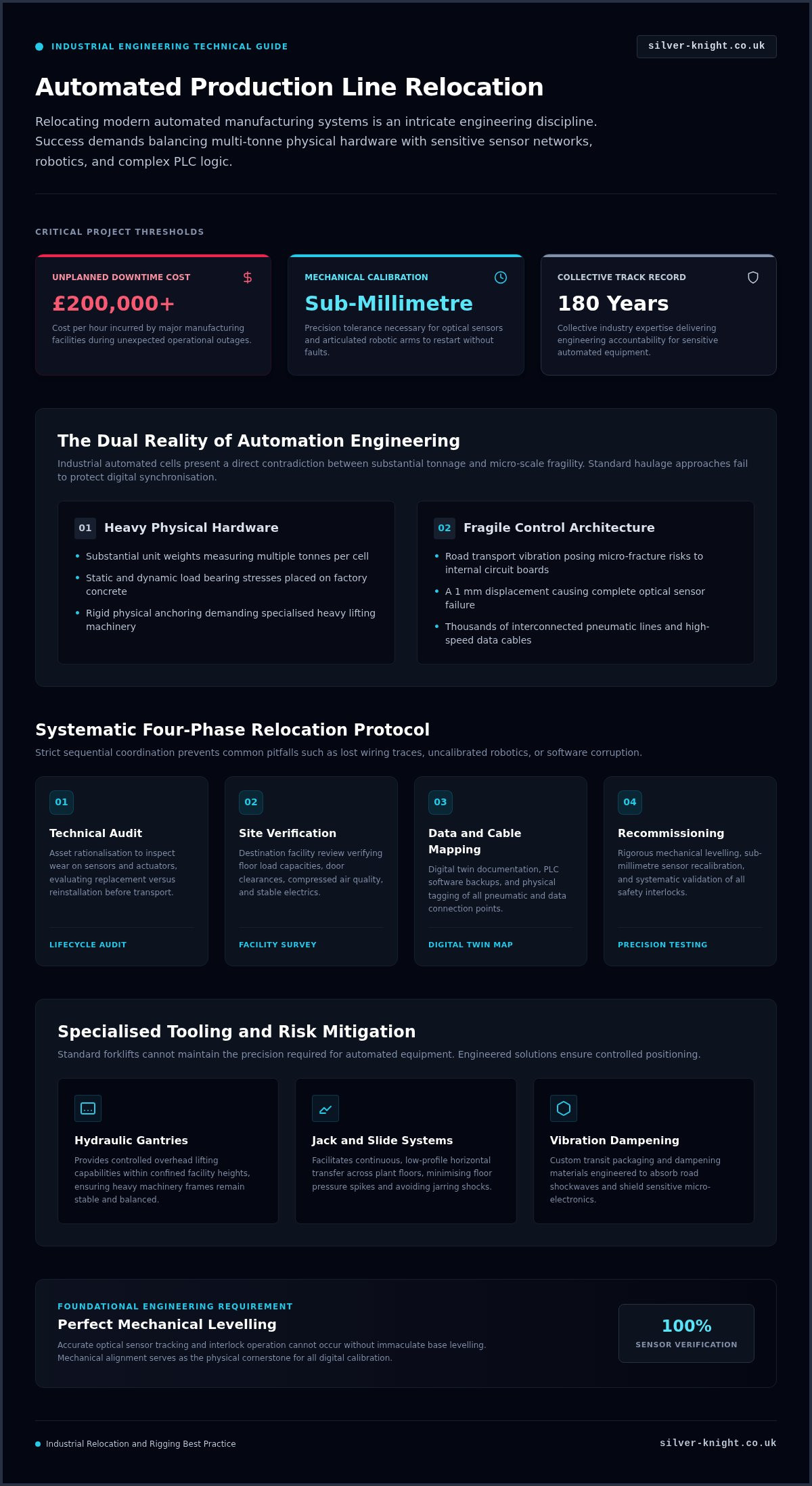
Did you know that unplanned downtime in a large manufacturing facility can cost upwards of £200,000 every single hour? When you are planning an automated production line relocation, the stakes are significantly higher than a standard machinery move. You aren't just shifting heavy iron. You are moving sensitive sensors, complex PLC logic, and delicate robotic arms that require sub-millimetre precision to function correctly. It's a high-pressure task where a single loose wire or a corrupted software backup can result in days of lost revenue.
It's understandable to feel anxious about the potential for extended delays or software glitches that could halt your operations for weeks. We know that protecting your investment is your top priority. This guide will show you how to manage the intricate complexities of moving your automated systems whilst protecting your digital assets and keeping downtime to an absolute minimum. We'll explore expert strategies for decommissioning, the importance of digital twin mapping, and the essential steps for a successful recommissioning process that ensures every sensor and safety interlock works perfectly from day one.
Key Takeaways
- Learn why an automated production line relocation is a complex engineering task that requires far more than just standard haulage methods.
- Discover how to protect sensitive digital assets and PLC software during the transition to prevent extended operational downtime.
- Understand why specialised tools like hydraulic gantries and jack and slide systems are essential for the precision placement of heavy machinery.
- See why perfect mechanical levelling is the foundation for successful recommissioning and sensor alignment in your new facility.
- Find out how 180 years of collective industry experience ensures personal accountability and care for your most delicate automated components.
To safeguard your production schedule during complex plant transitions, speak with the expert factory equipment movers at Silver Knight.
Understanding the Challenges of Moving Automated Systems
An automated production line relocation is far more than a simple logistics exercise. It is a highly complex engineering project that requires a deep understanding of how mechanical hardware interacts with digital control systems. Standard haulage methods often fail because they treat machinery as inert blocks of steel. In reality, modern production lines are living networks of sensors, programmable logic controllers (PLCs), and delicate robotic components that cannot withstand the rough handling typical of general freight.
The primary risk during a move involves the loss of synchronisation between the physical machine and its digital brain. If a sensor is bumped by just a millimetre or a PLC loses its grounding, the entire line may fail to restart correctly. This is why industrial machinery rigging is such a critical part of the process. It involves using specialised gear to ensure that every movement is controlled and that the equipment remains level and secure throughout the journey.
Balancing Mechanical Weight with Digital Precision
Automated machinery presents a unique contradiction. A single unit might weigh several tonnes, yet it contains internal components that are as fragile as a smartphone. Heavy vibration during road transport is a silent killer of precision equipment. It can cause micro-fractures in circuit boards or knock optical sensors out of alignment. To combat this, we use bespoke packing solutions and dampening materials that isolate the most sensitive electronics from the shocks of the road. It's not enough to just move the weight; you must protect the precision that makes the machine valuable.
Managing Interconnected Components and Complex Wiring
Modern lines often feature thousands of interconnected points, from pneumatic hoses to high-speed data cables. Simply cutting wires and hoping for the best is a recipe for disaster. Before any disconnection begins, every point must be digitally mapped and physically tagged. This level of detail is why professional machinery dismantle services are essential. Without a clear map of how the system fits together, the reassembly process can become a nightmare of troubleshooting and recalibration that eats into your production time. You don't want to spend weeks chasing wiring faults that could have been avoided with proper planning.
To ensure total safety compliance and minimise operational interruption, collaborate with the Silver Knight industrial engineering and relocation solutions.
Technical Planning for Automated Relocation Projects
The success of an automated production line relocation is decided long before the first piece of equipment is lifted. A rigorous pre-move technical audit is required to identify every potential bottleneck. This process includes asset rationalisation, where you evaluate the lifespan of your current components. It's often more cost-effective to replace ageing sensors or worn actuators during the move rather than reinstalling equipment that is near failure. A clear timeline is essential to keep downtime within tight margins, ensuring that production resumes exactly as scheduled.
A skilled project manager coordinates the dance between mechanical engineers and electrical technicians. They manage the sequence of events so that decommissioning doesn't hinder the rigging team. By synchronising these workflows, you avoid the common pitfall of operational lag where machines sit idle because a single electrical connection wasn't ready. This level of coordination is what separates a professional move from a chaotic one.
Conducting Comprehensive Site Surveys
A technical survey must look beyond the physical footprint of the machinery. You must verify that the destination facility can support the specific requirements of high-tech automation. This includes checking floor load capacities to ensure the concrete can handle the static and dynamic loads of articulated robots. Access points must be wide enough for specialised lifting gear, and power supplies must be stable enough for sensitive electronics. Reviewing a professional factory relocation service checklist helps ensure that no detail, from ceiling clearances to compressed air quality, is overlooked.
Systematic Decommissioning and Data Protection
Decommissioning is more than just pulling plugs. It begins with a comprehensive software backup of every PLC and human-machine interface (HMI). These digital assets are just as valuable as the hardware. During the physical teardown, PLCs require specialised protection from static discharge and physical impact. Every cable, hose, and terminal must be labelled with a unique identifier that matches a master digital map. Following safety protocols, such as those found in the OSHA industrial robot safety manual, ensures that the decommissioning process doesn't compromise the future safety of the line. If you are unsure where to start with your technical audit, you can contact our specialist team for advice.
To plan a seamless industrial move and protect high-value machinery, explore the professional machinery relocation services from Silver Knight.
Specialised Lifting and Transport for Sensitive Equipment
Moving heavy machinery usually brings to mind massive cranes and heavy chains. However, during an automated production line relocation, these traditional methods are often unsuitable. General mobile cranes require significant headroom and often lack the fine control needed for indoor factory environments. Instead, we use a modern fleet of specialised vehicles and lifting gear designed for national machinery transport. This ensures that even the heaviest assets are moved with the delicate touch required for high-tech components.
Experienced operators are the heart of a safe move. They understand that a sudden jolt can be just as damaging as a physical drop. Following strict standards for planning and organising lifting operations ensures that every variable, from floor stability to equipment capacity, is accounted for before the lift begins. This meticulous approach reduces the risk of structural damage to both the machinery and the facility itself. It is about using the right tool for the specific environment rather than forcing a standard solution.
Utilising Jack and Slide Systems for Precise Positioning
In many UK factories, space is at a premium. Jack and slide systems are invaluable here because they allow for horizontal movement in restricted spaces where a forklift or crane simply cannot fit. By lifting the machine slightly and sliding it along a track, we protect the delicate machine foundations and ensure the unit remains perfectly level throughout the move. This is vital for automated lines. Any tilt could shift internal calibrations or stress precision-aligned frames, leading to costly delays during the restart phase.
The Role of Hydraulic Gantries in Restricted Spaces
Hydraulic gantry systems provide a stable, vertical lift in low-headroom environments. Unlike traditional cranes that require a wide arc and high ceilings, gantries operate within a compact footprint. They are the preferred choice for indoor factory work because they offer superior stability and control. For projects requiring specific lifting capacities, our heavy moving equipment hire service provides access to the latest gantry technology. This equipment allows us to position multi-tonne robotic cells with millimetre accuracy, ensuring a seamless fit into the new production layout without risking the integrity of the building structure.
To safeguard your production schedule during complex plant transitions, speak with the industrial plant relocation specialists at Silver Knight.
Recommissioning and Testing the Production Line
Recommissioning is where the success of your automated production line relocation is truly measured. It is the phase where all the planning, dismantling, and transport efforts come together to restore operational flow. This stage is not a single event but a systematic process that begins with the physical foundation and ends with a fully synchronised digital network. Skipping steps here often leads to intermittent faults that can plague production for months. It is essential to treat the restart with the same level of engineering rigour as the initial installation.
A phased restart is the most effective way to identify potential issues without risking damage to the entire system. By powering up individual modules and testing them in isolation, technicians can verify that each section is functioning correctly before the line is fully integrated. This approach allows for small adjustments to be made early, preventing a domino effect of failures across the production floor. It also provides a clear window to verify that every safety circuit is active and responding correctly.
Mechanical Alignment and Precision Levelling
Mechanical levelling is the absolute foundation of a successful restart. In high-speed automated environments, even a millimetre of misalignment can lead to catastrophic failure. If a conveyor or robotic base is not perfectly level, it creates uneven wear on bearings and causes sensors to misread positioning data. We use precision laser levelling tools and optical alignment gear to ensure that every component sits exactly as the manufacturer intended. This precision prevents mechanical stress that could lead to premature component failure.
The quality of the floor at the new facility plays a major role in long-term stability. Even if a machine is levelled perfectly on day one, a settling floor can throw it out of alignment within weeks. It is vital to ensure the concrete has cured correctly and can support the vibration of active machinery. If the foundation is weak, the precision of the automation will inevitably suffer, leading to frequent downtime for recalibration.
Restoring Software Connectivity and Operational Flow
Once the physical structure is sound, the focus shifts to restoring the digital brain. This involves re-uploading software backups to PLCs and human-machine interfaces (HMIs) and verifying that sensor feedback loops are active. Migration teams must re-establish network topologies using protocols like PROFINET or EtherCAT to ensure all remote nodes are communicating. Dry runs, where the machine operates without material, are essential to check for mechanical interference or logic errors before full-scale production begins.
The original equipment manufacturer (OEM) often plays a vital role during this phase, especially for proprietary systems that require specific calibration codes or zero-point mastering. Coordinating with the OEM ensures that any software updates or hardware tweaks are handled by specialists who understand the machine's unique behaviour. To get your facility back to peak performance quickly, book a consultation with our recommissioning experts.
To ensure your project is handled with the highest level of care, speak with the industrial moving specialists at Silver Knight.
Selecting an Expert Partner for Automation Relocation
Choosing the right team for an automated production line relocation is the final piece of the puzzle. You need a partner that understands the delicate balance between heavy machinery and sensitive electronics. It's best to look for a firm that offers a complete end to end service. This includes everything from decommissioning and heavy haulage to final recommissioning. When one company manages the entire process, you eliminate the risk of miscommunication between different contractors, which is often where delays happen.
Our team brings over 180 years of collective industry experience to every project. This depth of knowledge means we've seen almost every challenge imaginable, from tight floor loadings to complex software re-integrations. As a family run business, we offer a level of personal accountability that larger corporations often struggle to match. We treat your delicate automated components with the same care we would our own, ensuring that your investment is protected at every stage of the journey. You aren't just a project number to us; you're a partner in British manufacturing.
Evaluating Experience in Heavy Haulage and Installation
Don't just take a company's word for it. It's vital to ask for case studies of similar automated projects to see how they've handled precision equipment in the past. You should also check if the mover owns their own specialised gear. Firms that rely on hired equipment may face delays or reliability issues that could stall your project. We maintain our own extensive fleet, including Versa-Lifts and hydraulic gantries. You can view the full range of specialised tools we use by checking our equipment list. Having the right tools on hand means we can adapt to site conditions instantly without waiting for third party hire companies.
Why Silver Knight is the Preferred Choice for National Moves
We've built our reputation on a commitment to safety and precision that defines everything we do. Our services cover the entire United Kingdom, supporting manufacturing hubs from the south coast to the north of Scotland. Whether you're moving a single robotic cell or an entire factory, we provide the same level of dedicated support. We don't just move machines; we provide engineering solutions that keep British industry moving forward. Before you start your next project, it's wise to consult with experts who understand the high stakes of automation. A quick conversation today can prevent a costly mistake tomorrow and ensure your transition is as smooth as possible.
To safeguard your production schedule during complex plant transitions, speak with the expert factory equipment movers at Silver Knight.
Securing Your Manufacturing Future with Precision Relocation
Successful automated production line relocation requires a dual-track strategy that treats mechanical components and digital software as a single, inseparable system. By prioritising technical audits and using specialised gear like hydraulic gantries, you can avoid the common pitfalls of extended downtime and sensor damage. It's about more than just moving heavy assets; it's about ensuring your facility returns to full operational capacity with its digital integrity intact.
Silver Knight Haulage & Machineries Ltd offers over 180 years of collective industry experience in machinery moving. As a family-run business, we provide personal project management that ensures your delicate equipment is treated with accountability. Our national and international coverage, supported by a specialised heavy haulage fleet, makes us the ideal partner for complex UK manufacturing projects. For a professional assessment of your industrial project, contact our expert team today to discuss your relocation requirements. We look forward to helping you achieve a seamless transition to your new facility.
Article by
David Ashby
I'm the Managing Director of Silver Knight Haulage & Machinery Ltd. Silver Knight Ltd is a family-run firm established in the West Midlands in 2005, with the aim of providing a cost-effective, yet professional, service to businesses for the removal, transportation, and installation of machinery, plant, and equipment here in the UK and worldwide. Between us, the Silver Knight workforce has over 50 years of experience with machinery and its operation.
Disclaimer
This article is intended for informational purposes only. Please ensure you seek expert advice or carry out your own research to confirm the information is suitable for your specific needs.