Industrial machinery longevity depends entirely on isolating dynamic vibrations through bespoke foundation engineering. You have likely felt the anxiety of watching a multi-tonne asset arrive, whilst wondering if your existing floor will hold or if it will start cracking under the pressure. It's a common concern for factory managers across the United Kingdom who face uncertainty regarding vibration risks and a lack of clear technical guidance. Understanding the specific foundation requirements for heavy machinery is the difference between a smooth installation and a costly structural failure that could halt your production.
This guide explores the essential engineering and structural criteria you need to prepare your site for a successful plant installation. You will discover the critical distinction between static and dynamic loads, ensuring your factory floor remains stable even under intense operational stress. We also cover current UK standards, such as BS EN 206-1;2026 for concrete quality, to help you achieve long term operational safety. From site preparation to maintaining machine precision, this article provides the technical roadmap needed before your machinery moving team arrives on site to begin the installation process.
Key Takeaways
- Differentiate between static and dynamic load requirements to prevent factory floor cracking and structural damage.
- Discover the essential foundation requirements for heavy machinery that maintain equipment precision and operational safety.
- Prepare your facility correctly by following a step by step assessment checklist for floor thickness and load bearing capacity.
- Ensure compliance with the latest British Standards for concrete and structural design to safeguard your industrial investment.
- Learn why professional site surveys are vital for successful machinery installation and long term plant performance.
If you are planning a new installation, you should Contact Silver Knight to book a technical site survey and ensure your floor is ready for the move.
Understanding the Importance of Machinery Foundations
Industrial machinery foundations are far more than simple concrete slabs. They represent a bespoke engineered structure specifically designed to withstand massive weights whilst maintaining structural integrity over decades. When considering the foundation requirements for heavy machinery, it's vital to recognise that standard commercial flooring is rarely sufficient for heavy plant operations. Most warehouse floors are designed for uniform loads, not the concentrated, point-specific pressure exerted by heavy industrial assets. During a factory relocation service, ensuring asset protection and operational safety starts beneath the surface. You must ensure the ground can support the static weight and the dynamic forces generated during peak production.
To better understand this concept, watch this helpful video:
These structures rely on fundamental structural engineering principles to distribute weight effectively across the subsoil. Without this rigorous engineering, the risk to your equipment and your facility increases significantly. A well designed foundation acts as the literal bedrock of your production line, preventing costly downtime caused by shifting floors or compromised machinery.
Prevent Structural Failure and Equipment Damage
Subfloor voiding or concrete cracking can quickly jeopardise multi million pound equipment. When a floor fails, it doesn't just look bad; it creates long term financial risks for the entire business. Even minor floor settling can throw machine components out of absolute alignment, leading to premature wear and increased maintenance costs. If the foundation requirements for heavy machinery aren't met, the resulting structural failure can lead to total machine failure or even dangerous building instability that requires expensive remedial work.
Operational Precision and Vibration Isolation
High precision tooling requires a stable environment to function at peak efficiency. Dampening structural vibrations is essential for keeping these tools accurate and preventing rejects. Uncontrolled kinetic energy doesn't just affect the machine itself; it ripples through the floor, impacting surrounding factory equipment and worker comfort. Proper foundations allow you to control the behaviour of heavy impact machinery, isolating the shock and protecting the rest of your facility from the constant rhythmic stress of industrial operations.
Before you begin any groundworks, it is wise to speak with logistics experts at Silver Knight to ensure your site plan aligns with your equipment needs.
Key Engineering Factors for Industrial Load Bearing
Engineering for heavy plant requires rigorous scientific calculations that go far beyond basic construction. Before a single drop of concrete is poured, structural engineers must determine the exact depth and reinforcement density needed to prevent long term failure. These calculations take into account the centre of gravity of the machine, the distribution of weight across its base, and the potential for fatigue in the concrete over time. It is vital that this structural engineering occurs whilst the machinery is being decommissioned at its original location. By synchronising these phases, you ensure the new foundation is ready for the precision placement required by specialised lifting equipment like hydraulic gantries or jack and slide systems.
Static and Dynamic Load Calculations
Static load refers to the dead weight of the machinery when it is at rest. Whilst this is a vital starting point, it only tells half the story of the stresses your floor will face. Dynamic load accounts for the forces exerted whilst the machine is operating, such as centrifugal force, reciprocating motion, or heavy impact shocks. Because these forces can be unpredictable and intense, engineers frequently apply ACI guidelines for dynamic equipment. These standards often suggest a safety factor multiplier of three or four times the static weight to account for vibration. This ensures the slab doesn't just hold the machine, but actively manages the kinetic energy it produces without cracking.
Soil Mechanics and Ground Bearing Capacity
The subgrade soil underneath the concrete is the ultimate load bearer for your facility. Even the thickest, most reinforced concrete will eventually fail if the ground beneath it is unstable or prone to settling. Soil mechanics determine how much pressure the site can actually take before it deforms. Engineers use specific soil compaction techniques to increase density and prevent shifting under heavy industrial weight. If ground conditions are poor, such as in areas with high clay content or loose fill, the foundation requirements for heavy machinery will change significantly. This often necessitates deeper excavations or the use of piling to reach more stable strata deep below the surface.
For a detailed review of your specific flooring needs, you can request a professional site survey from our technical team to avoid costly errors during installation.
If you need comprehensive project support to ensure your site is ready for new equipment, you can Contact Silver Knight to discuss your requirements.
Types of Foundations for Heavy Industrial Equipment
Selecting the correct structural design is the most critical decision in the site preparation phase. Different machines exert pressure in unique ways, and choosing the wrong type leads to catastrophic floor failure where the concrete can literally disintegrate under the strain. Understanding the foundation requirements for heavy machinery involves matching the design to the specific asset's footprint and operational behaviour. Our machinery haulage and transport service provides end to end capability, ensuring that once the right foundation is built, your asset is moved and placed with absolute precision.
Slab on Grade and Reinforced Concrete Blocks
Thick slab on grade designs are common for moderately heavy machinery that distributes weight evenly across a large area. However, for equipment that produces significant vibration or impact, engineers often specify independent reinforced concrete inertia blocks. These blocks act as a massive heat sink for kinetic energy. By using expansion joints to decouple the machine pad from the main factory floor, we prevent vibrations from travelling through the building. This isolation is crucial for protecting sensitive electronics and nearby high precision tooling from interference, whilst also improving the comfort and safety of the working environment for your staff.
Deep Pile Foundations for Extreme Loads
Some massive industrial assets require support that goes far beyond the surface level. When installing heavy forging presses, massive stamping lines, or large scale turbines, standard slabs are insufficient. In these cases, steel or concrete piles are driven deep into the earth to reach stable rock or denser soil strata. Once these piles are secured, heavy duty pile caps are cast on top to distribute massive concentrated loads safely across the cluster. This method ensures that the machine remains perfectly level, even when operating at maximum capacity, preventing the long term sinking that plagues poorly prepared sites. In the United Kingdom, these designs must adhere to updated standards like BS EN 206-1;2026 to ensure the concrete quality meets the necessary performance criteria for such extreme industrial applications.
To guarantee your floor meets all necessary safety standards, we recommend booking a professional site survey from Silver Knight before finalizing your layout.
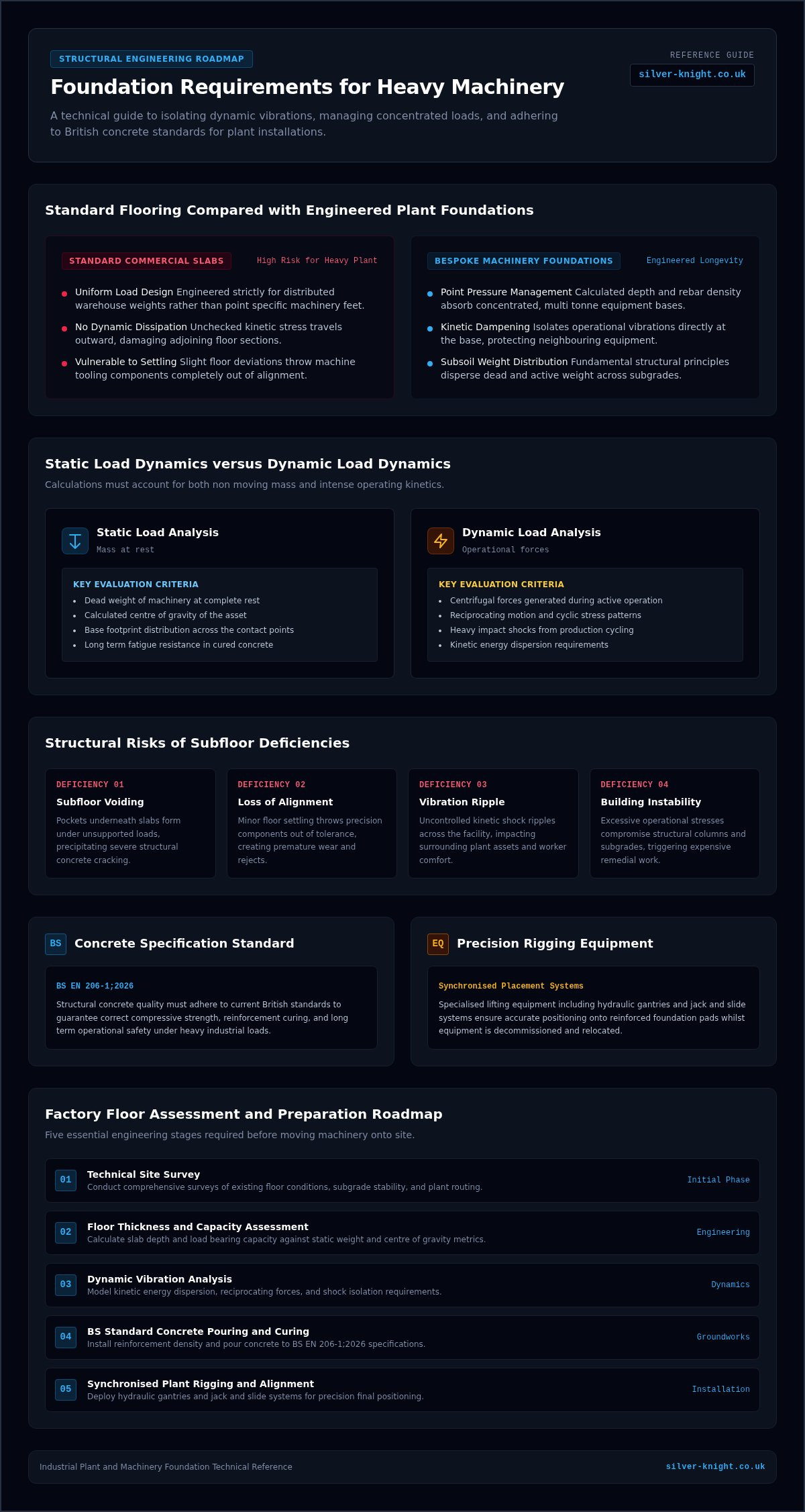
Assessment Checklist for Factory Floor Preparation
Operations managers need a practical framework to assess their current facility before moving heavy plant. This process begins with a thorough review of historical building blueprints, which helps identify original design limits before you organise new equipment layouts. However, paperwork alone isn't enough to verify structural integrity. Early collaboration between your structural engineers and the machinery moving company ensures that every physical constraint is accounted for well in advance. This teamwork prevents unexpected delays when the installation team arrives with your heavy assets.
Technical Site Surveys and Core Testing
A professional site survey is an absolute requirement for operational safety. Technicians use concrete core drilling to extract physical samples, which determines the exact floor thickness and compressive strength of the existing slab. Alongside drilling, ground penetrating radar surveys map out the subfloor, locating existing rebar reinforcement and uncovering hidden voids that could collapse under concentrated weight. Skipping these steps increases the risk of catastrophic floor cracking during installation. Relying on guesswork can lead to severe structural damage that halts your entire production line.
Managing Existing Factory Floor Limitations
When the current slab fails to meet the specific foundation requirements for heavy machinery, you have several options to consider. The most common solution involves cutting away the old, inadequate concrete to pour a bespoke machine bed that matches the manufacturer's exact specifications. This requires precise excavation and the installation of new reinforcement bars. Our equipment moving service provides expert advice on navigating tight spaces during this disruptive phase, ensuring your facility remains functional whilst the new foundations cure.
If you are unsure whether your current slab can handle an upcoming installation, you should book a technical site survey with Silver Knight to get clear, data driven answers about your floor capacity.
For expert installation advice and to ensure your site is fully prepared for your next project, you should contact Silver Knight to discuss your specific needs.
Professional Machinery Installation and Site Alignment
Once the concrete has cured and the site is ready, the installation team begins the critical task of interfacing the asset with its new home. Silver Knight brings over 180 years of collective industry experience to these precision placements, ensuring that every asset is handled with technical expertise. We understand that even the most robust slab is only as effective as the alignment achieved during the final move. Our teams utilise advanced equipment, including specialised lifting versa lift gantry and jack systems, to navigate the factory floor safely. By using jack and slide mechanisms, we can centre heavy loads perfectly over their anchor points, ensuring that the foundation requirements for heavy machinery are met through exact positioning and weight distribution.
Precision Leveling and Grouting Procedures
Absolute leveling is a non negotiable requirement for industrial plant. If a machine sits at even a slight angle, its weight will not distribute evenly across the foundation, which leads to uneven component wear and potential structural stress points. Once the machine is positioned, we use epoxy or cementitious grout to seal the machine base to the concrete. This grout layer is vital because it fills every microscopic gap between the machine bed and the slab. Proper grouting ensures that dynamic operational forces are transferred directly into the foundation rather than vibrating against the anchor bolts; this protects both the floor and the equipment from long term fatigue.
Coordinating Rigging and Logistics Teams
Moving a multi tonne asset onto a new foundation pad requires meticulous strategic planning and timing. It isn't just about the final placement, it involves protecting the surrounding factory floor during the entire transit phase. Specialised machinery movers use load spreading plates and specific path planning to prevent damage to areas not reinforced for high point loads. Managers must coordinate foundation curing times with the arrival of heavy haulage fleets to ensure the site is ready. If a machine is placed on concrete that hasn't reached full compressive strength, the foundation requirements for heavy machinery will be compromised, potentially leading to immediate settling. Effective communication between the groundworks crew and the rigging team is the only way to avoid these costly errors whilst maintaining your production schedule.
If you are preparing for a major plant relocation, you should partner with Silver Knight to ensure your site meets all technical specifications.
Secure Your Industrial Future Through Proper Site Preparation
Preparing your factory floor is the single most important step in protecting your high value assets. You now understand how static and dynamic load calculations prevent structural failure and how choosing the right foundation type isolates damaging vibrations. Meeting the foundation requirements for heavy machinery ensures your equipment operates with absolute precision for years to come whilst safeguarding your building. By taking a proactive approach to soil mechanics and reinforcement, you eliminate the uncertainty that often leads to costly repairs.
Silver Knight offers a comprehensive nationwide service across the United Kingdom, backed by over 180 years of collective industry experience. Our specialist fleet, which includes hydraulic gantry and jack and slide systems, allows us to manage even the most complex installations with ease. By prioritising technical site surveys and expert alignment, you protect your production line from the risks of floor cracking and machine misalignment. We handle the heavy lifting so you can focus on your operational goals.
Contact the experts at Silver Knight to plan your next heavy machinery installation project safely. Taking the time to get your subfloor right today ensures a stable, productive environment for the future of your business.

Article by
David Ashby
I'm the Managing Director of Silver Knight Haulage & Machinery Ltd. Silver Knight Ltd is a family-run firm established in the West Midlands in 2005, with the aim of providing a cost-effective, yet professional, service to businesses for the removal, transportation, and installation of machinery, plant, and equipment here in the UK and worldwide. Between us, the Silver Knight workforce has over 50 years of experience with machinery and its operation.
Disclaimer
This article is intended for informational purposes only. Please ensure you seek expert advice or carry out your own research to confirm the information is suitable for your specific needs.