The most expensive mistake in a manufacturing plant rarely happens during peak production; it happens the second someone powers up an uncalibrated machine for the first time. You already know how easily uncoordinated installation stages can lead to catastrophic downtime, damaged components, and costly uncertainty around statutory UK regulations such as PUWER and LOLER. Relying on guesswork or ad-hoc practices simply isn't an option when high-value plant assets are involved. Adopting a structured machinery installation checklist ensures your engineering team catches structural faults, foundation stresses, and alignment errors before they trigger expensive repairs.
Follow this comprehensive engineering checklist to install, align, and commission your heavy machinery safely whilst minimising downtime and preserving your manufacturer warranty. You'll learn how to safeguard against foundation cracking, avoid hydraulic contamination, and ensure complete regulatory compliance. Here is your step-by-step verification roadmap, taking your facility from initial offloading and precision positioning straight through to final production sign-off.
Key Takeaways
- Learn how to complete thorough technical surveys that verify slab load capacities and transit clearances before delivery vehicles arrive.
- Follow an engineering-led machinery installation checklist to manage precision offloading and floor movement whilst protecting factory surfaces.
- Understand critical utility integration steps, including strict energy isolation and incoming phase rotation testing.
- Discover preventative maintenance techniques to flush hydraulic systems and inspect precision guideways for transit settling damage.
- Achieve full PUWER compliance through structured cold commissioning, dry-run automation tests, and safety interlock sign-offs.
If you require expert support during complex plant upgrades, partner with the specialists at Silver Knight for complete industrial engineering solutions.
Pre-Installation Site Preparation and Engineering Verification
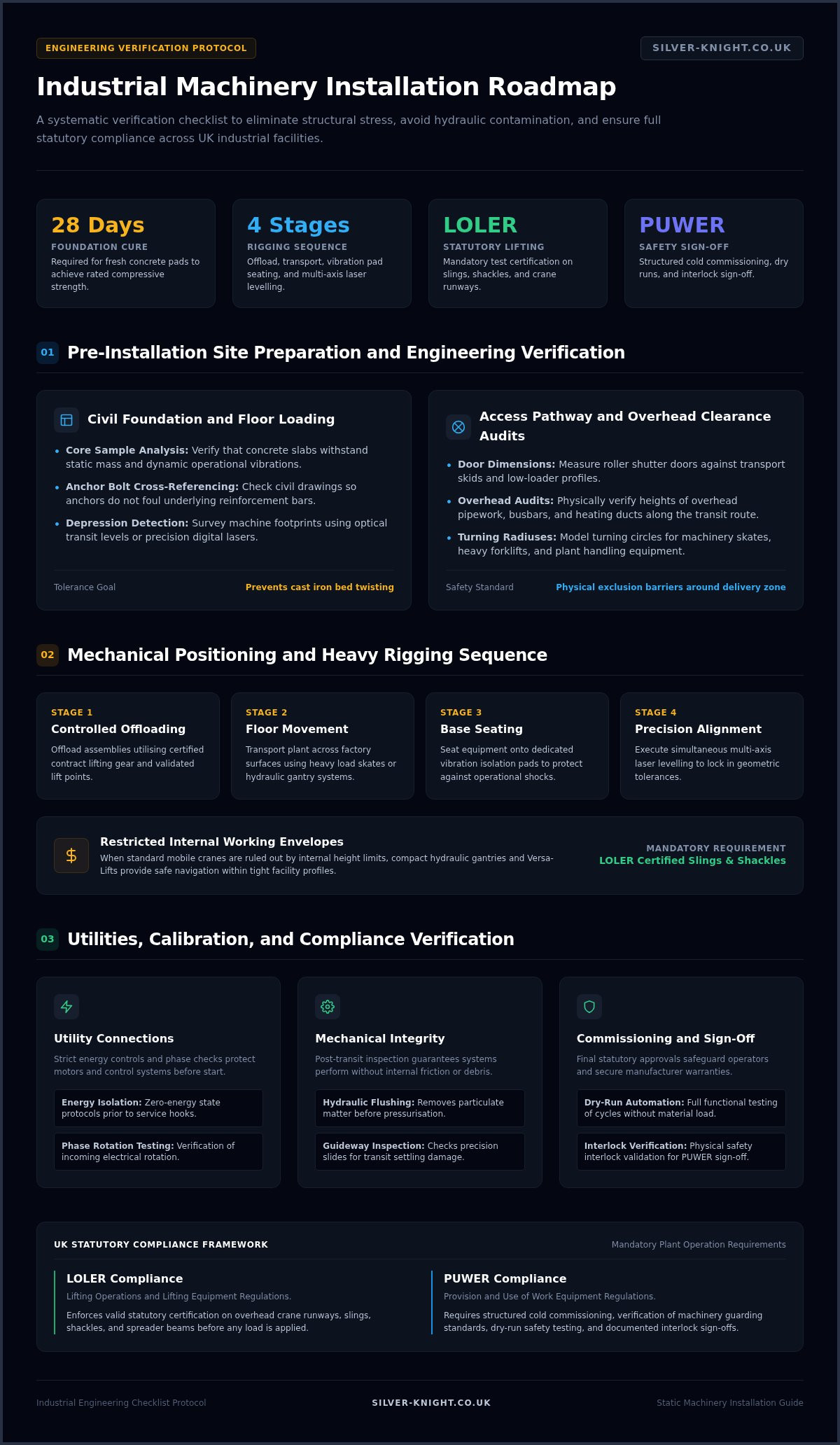
Every successful plant upgrade starts weeks before delivery vehicles arrive at the factory gates. Executing a technical site survey forms the first mandatory stage of your machinery installation checklist. Structural engineers must evaluate core sample data to confirm that concrete slabs can withstand both the static mass and dynamic operational vibrations of the incoming plant. Anchor bolt placements require physical cross-referencing against civil drawings, ensuring chemical or mechanical anchors do not foul underlying reinforcement bars. Setting physical exclusion barriers around the delivery zone also isolates rigging activities from live production lines, ensuring high safety standards across the facility floor.
To see practical verification protocols applied in the field, watch this helpful video walkthrough.
Civil Foundation and Floor Loading Checks
Poured concrete bases demand adequate curing periods before accepting heavy structural loads. Fresh foundation pads generally require twenty-eight days to attain their rated compressive strength, preventing micro-fractures under dynamic shock loading. Engineers must survey the machine footprint with optical transit levels or precision digital lasers, verifying levelness tolerances before offloading. Catching foundation depressions early prevents structural twisting across cast iron machine beds, keeping your project fully aligned with established machinery guarding standards and baseline operational limits.
Access Pathway and Overhead Clearance Audits
Moving large plant inside active manufacturing facilities demands rigorous pathway auditing. Riggers must verify roller shutter door dimensions against transport skids and low-loader profiles to avoid costly site delays. Overhead pipework, busbars, and heating ducts require physical height checks along the entire transit path. You also need to verify that overhead crane runways possess valid statutory test certification before using them for auxiliary rigging. Plant engineers should model turn radiuses along narrow aisles, confirming clear turning circles for machinery skates, heavy forklifts, and specialised machinery deployed via heavy moving equipment hire. Completing this stage within your machinery installation checklist ensures equipment glides into position without damaging shop floor surfaces.
For dependable plant handling and turnkey transport solutions across the United Kingdom, consult the certified engineering crew at Silver Knight.
Mechanical Positioning and Heavy Rigging Checklist
Executing physical machinery movement demands disciplined technical execution. Plant teams cannot rely on visual estimations when landing multi-tonne machinery onto finished production surfaces. Your machinery installation checklist must enforce four sequential stages during rigging operations: offload assemblies with certified contract lifting gear, transport plant across the floor using heavy load skates or gantries, seat the equipment onto vibration isolation pads, and conduct simultaneous multi-axis laser levelling. Establishing this strict sequence eliminates structural distortion and keeps production equipment within fine geometric tolerances.
Rigging Selection and Controlled Offloading
Restricted factory access often rules out mobile cranes, making compact hydraulic gantries and Versa-Lifts essential for tight internal working envelopes. Every sling, shackle, and spreader beam must hold valid statutory LOLER test certification before connecting to lifting lugs. Review our detailed specialised lifting guide to understand how low-headroom jack and slide systems navigate severe physical constraints safely. Sticking to tested hardware also ensures your installation methods reflect broader safety baselines like the OSHA general requirements for all machines, which mandate rigid mechanical stability before power is ever applied.
Precision Alignment and Grouting Protocols
Once resting on its foundation, the machine frame requires careful alignment to avoid premature mechanical wear:
- Turn levelling jackscrews in fractional, balanced increments to eliminate cast bed twist and protect precision linear guides.
- Torque every foundation bolt to manufacturer specifications using calibrated torque wrenches rather than pneumatic impact drivers.
- Pour high-strength, non-shrink engineering grout beneath the entire bedplate perimeter to absorb dynamic harmonic vibration and lock the unit in place.
Laser trackers should monitor XYZ coordinate axes simultaneously throughout grouting and curing. Even a microscopic shift during concrete anchoring will misalign driveshafts and gear trains. Incorporating these verification stages into your wider machinery installation checklist protects the machine frame from settling strains and saves thousands of pounds in future bearing replacements. If your project involves tight operational tolerances or restricted headroom, speak with our technical specialists to plan your mechanical positioning sequence.
When coordinating complex service hook-ups and factory moves, discover how our experienced engineering teams deliver complete machinery installation services across the UK.
Utility Connections and Services Integration
Rushing service hook-ups before verifying isolation is an easy route to blown inverter drives and damaged control systems. Every machinery installation checklist must mandate strict lock-out tag-out protocols on all primary electrical, pneumatic, and fluid drops before a single tool touches a terminal block. Once main supplies are securely isolated, technicians can terminate three-phase circuits, double-checking line-to-line voltage stability and confirming correct phase rotation. Reversing phase rotation can spin motor drives backwards, instantly destroying hydraulic pumps and mechanical screw compressors. Closed-loop cooling circuits also demand careful reconnection, checking fluid flow switches and heat exchangers before any thermal load is applied.
Electrical Power and Control Interfacing
Engineers must test earth bonding resistance across all structural bedplates, sub-panels, and control cabinets before primary energisation. High-resistance earthing paths invite intermittent digital noise, erratic PLC faults, and operator shock risks. Inspect main disconnect handles and verify that emergency stop trip loops drop out properly. Reconnect PLC input and output harnesses following original wire termination schedules. Taking time to verify these control loops mirrors strict industrial protocols, including the fundamental protections outlined in OSHA equipment safety regulations that require energy isolation during machine assembly.
Pneumatics and Process Piping
Particulates inside factory airlines can ruin sensitive directional valves and pneumatic slide cylinders within seconds of initial operation:
- Blow dry factory air through airline supply headers to purge pipe scale, swarf, and threading debris before coupling to the machine.
- Install dedicated inline coalescing filters and particulate traps directly upstream of the main service regulator.
- Pressure test all newly installed process pipe joints using inert nitrogen to detect micro-leaks safely.
- Set primary pressure regulators to the exact bar ratings specified by the manufacturer.
Locking down these mechanical checks within your machinery installation checklist prevents erratic cylinder speeds, reduces compressor load, and protects expensive pneumatic automation components from premature contamination wear.
For seamless factory transitions and precision technical positioning, rely on the nationwide specialists at Silver Knight to safeguard your capital assets.
Calibration and Post-Move Machinery Maintenance Verification
Road transport and rigging vibrations inevitably disrupt fine mechanical settings. Even minor road shocks during transit can shake loose internal sludge, disturb bearing seats, or misalign axis stops. That is why your machinery installation checklist must treat post-move maintenance as a core engineering phase rather than a routine oil top-up. Technicians must inspect linear guideways, ballscrews, and gearboxes for false brinelling or mechanical settling before turning drive motors. Spindle taper runout and table squareness require verification using calibrated dial test indicators, ensuring geometric accuracy matches factory assembly standards.
Fluid Systems and Lubrication Hygiene
Contaminated fluids cause a large proportion of early hydraulic component failures following a machine move. Hydraulic oil left in reservoirs during transport sloshes against tank walls, picking up dislodged scale, moisture, and oxidation flakes. Maintenance engineers should flush older reservoirs and refill systems with clean fluid that meets manufacturer cleanliness grades. Replace every consumable filter element across lubrication lines, return filters, and vacuum circuits before starting main pumps. Technicians must purge air pockets from automated greasing manifolds to ensure metering valves dispense lubricant evenly. Hydraulic hoses also require physical inspection to confirm they satisfy minimum bend radiuses and sustained no scuffing during transit.
Sensor Re-Zeroing and Axis Geometry
Physical relocation alters the exact spatial relationships across automated motion axes:
- Check physical over-travel limit switch mountings to make certain mechanical stops activate before slides crash into end stops.
- Re-zero absolute rotary encoders and linear optical scales across all servo-driven axes.
- Perform dynamic laser interferometer checks on multi-axis CNC machines to correct linear pitch errors and backlash values.
- Verify proximity sensor clearances on tool changers, index tables, and pallet shuttles.
Completing these geometric validations ensures precision machinery functions reliably from day one. When dealing with high-value manufacturing lines, partnering with expert machinery installation teams ensures delicate assemblies are recommissioned without risking component failure. If your team requires specialist support to align or verify relocated assets, request a site consultation to safeguard your operational tolerances.
To ensure total regulatory peace of mind across your site, collaborate with the experienced engineers at Silver Knight for professional plant commissioning and industrial machinery installation.
Cold Commissioning and PUWER Compliance Sign-Off
Cold commissioning acts as the final gatekeeper between physical installation and live manufacturing. Handing over equipment without systematic testing creates extreme operational hazards you simply can't afford to overlook. In Great Britain, employers hold strict legal duties under the Provision and Use of Work Equipment Regulations 1998 (PUWER) to ensure all machinery is safe, suitable, and properly guarded. A disciplined machinery installation checklist directs this transition through four essential steps: run dry cycles without raw materials to prove sequential PLC logic, test every safety interlock and perimeter barrier, conduct low-speed production runs under manual observation, and complete a formal PUWER risk assessment before commercial handover.
Safety Interlock and Guarding Validation
Guarding systems protect operators from high-speed tooling and crush hazards. Technicians must measure optical light curtain response times to verify that dangerous motions halt before an operator can reach the risk area. Interlocked gate switches require testing to confirm positive mechanical opening and anti-tamper compliance. Finally, test the emergency stop circuit from every local push button, mobile pendant, and perimeter trip wire to ensure the entire assembly cuts out reliably under fault conditions.
Documentation and Final Handover
A successful installation concludes with a transparent engineering paper trail. Collate electrical schematics, calibration reports, pressure vessel test certificates, and UKCA or CE declarations into the permanent plant safety file:
- Update maintenance databases with baseline vibration analysis figures and thermographic panel scans.
- Log all initial torque values and fluid cleanliness verification records for future auditing.
- Obtain signed commissioning sign-off sheets from both internal project engineers and machine technicians.
Embedding these strict verification criteria into your machinery installation checklist ensures your facility meets UK statutory obligations whilst keeping operator safety front and centre. If you manage complex production equipment and need turnkey engineering oversight, book professional support via the Silver Knight contact page to keep your capital installation on track.
When you need precision plant movement and turnkey commissioning, discover how Silver Knight delivers dependable engineering excellence across the country.
Safeguard Your Plant Investment with Structured Installation
Following an engineering-led machinery installation checklist protects your production schedule, your equipment, and your staff. Methodical verification across civil foundations, heavy rigging, service connections, and PUWER compliance ensures high-value assets perform reliably from day one. You don't have to navigate these complex installation phases alone.
With over 180 years of collective technical expertise, Silver Knight provides complete turnkey plant relocation and installation services nationwide across the United Kingdom. We deploy advanced handling equipment, including hydraulic gantry systems, jack and slide setups, and Versa-Lift machinery, ensuring precise positioning without damaging delicate factory floors.
Ready to streamline your upcoming equipment move? Request expert industrial installation support today and get your plant running with complete confidence.
Frequently Asked Questions
What is the difference between machinery installation and machinery recommissioning?
Machinery installation covers the physical placement, alignment, levelling, and mechanical securing of plant equipment onto its foundation. Recommissioning happens afterwards, focusing on testing electrical connections, recalibrating systems, replenishing fluids, and running safety checks to ensure the asset operates correctly under working load. While installation positions the hardware securely, recommissioning certifies operational readiness and production quality before plant staff restart daily manufacturing operations.
Why is laser levelling critical during the machinery installation checklist process?
Laser levelling establishes accurate horizontal and vertical baselines to prevent structural deflection, irregular tool wear, and premature bearing failure. Incorporating this step within your machinery installation checklist ensures plant engineers detect micro-variations across baseplates before torquing hold-down bolts. Precise geometric levelling preserves manufacturing tolerances across high-precision machine tools, prevents internal stress on welded machine beds, and reduces unwanted operational vibration during continuous, heavy-duty production cycles.
Who is legally responsible for PUWER compliance after an industrial machine move?
Under UK law, the dutyholder or employer operating the machinery carries final legal responsibility for Provision and Use of Work Equipment Regulations (PUWER) compliance. External machinery movers and installation contractors handle safe transport and technical positioning, but the employer must ensure the machine is properly inspected, safe to use, and maintained before workers operate it. Employers often commission formal post-installation PUWER assessments to document full compliance across all safeguarding systems.
How long should hydraulic oil settle before starting a relocated machine?
Hydraulic oil should settle for at least 24 hours before starting a relocated machine. Moving and refilling oil reservoirs agitates the fluid, introducing suspended air bubbles and disturbing microscopic sediment. Running pumps immediately can cause cavitation, internal pump damage, and unstable hydraulic pressure. Allowing the fluid adequate resting time lets entrained air escape to the surface, protecting sensitive proportional valves and high-pressure cylinders from premature wear.
Can existing concrete factory floors support high-tonnage production machinery?
Existing concrete floors cannot always support heavy plant without prior structural verification. Point loading from equipment footings often exceeds standard slab capacity, risking cracking, settlement, or sub-base failure. A structural engineer must assess slab thickness, compressive strength, rebar reinforcement, and ground compaction before placement. Where dynamic vibration or extreme point loads occur, plants often need dedicated isolated concrete foundations or load-spreading steel plates to safeguard floor integrity.
What safety documentation must be prepared before heavy machinery rigging begins?
Contractors must prepare a detailed Lift Plan alongside Risk Assessment and Method Statement (RAMS) documentation before rigging starts. Completing this documentation forms an essential part of the machinery installation checklist to verify that site risks are identified and controlled. Paperwork must include equipment inspection certificates under LOLER, sling load calculations, designated exclusion zones, and emergency procedures to ensure all lifting operations proceed safely on site.
How do optical transits and laser interferometers verify geometric axis alignment?
Optical transits and laser interferometers verify machine geometry by measuring straightness, parallelism, and pitch over long distances. Optical transits provide true line-of-sight references across machine guide rails to detect lateral deviation and twist. Laser interferometers split laser beams to measure sub-micron linear positioning errors and angular pitch or yaw. Comparing these optical and laser measurements against manufacturer tolerances allows engineers to shim and adjust machine axes precisely.

Article by
David Ashby
I'm the Managing Director of Silver Knight Haulage & Machinery Ltd. Silver Knight Ltd is a family-run firm established in the West Midlands in 2005, with the aim of providing a cost-effective, yet professional, service to businesses for the removal, transportation, and installation of machinery, plant, and equipment here in the UK and worldwide. Between us, the Silver Knight workforce has over 50 years of experience with machinery and its operation.
Disclaimer
This article is intended for informational purposes only. Please ensure you seek expert advice or carry out your own research to confirm the information is suitable for your specific needs.