What if the machine fits through the factory entrance, but can’t make the turn into its new position? Access, clearances and handling constraints can shape a move long before machinery is lifted. A site survey for machinery relocation helps reveal these details, so teams can plan around real site conditions rather than assumptions.
It’s understandable to worry that a missed measurement or unclear handover could lead to delays or damage. A useful survey considers both the collection and destination sites, including routes, doorways, turning space, overhead obstructions and floor or ground conditions. The findings can inform handling, lifting and transport arrangements, and identify what equipment options may need to be assessed.
This practical checklist explains what information to gather before a survey, what a specialist may need to assess, and how findings can shape a better-planned move. It also covers what to clarify with your site teams and relocation specialist, so everyone understands the scope, responsibilities and next steps.
Key Takeaways
- A site survey for machinery relocation helps uncover site constraints before detailed move planning begins.
- Gather available machine records and arrange access with the right site contacts to make the survey more useful.
- Separate confirmed measurements from estimates and open questions, so planning decisions are based on clear information.
- Use survey findings to compare possible handling and transport approaches rather than assuming one method will suit every move.
- Before agreeing the next planning stage, clarify responsibilities, outstanding questions and what the proposed scope includes.
Planning a machinery move? Explore Silver Knight’s machinery moving and relocation services.
Why a site survey matters before machinery relocation
A machine’s dimensions alone don’t show whether it can be moved through a building or positioned at its new site. A site survey for machinery relocation gathers and checks information about the machinery, the current and destination sites, and the route between them. This gives the people planning the move a clearer starting point before they develop a detailed approach.
The survey records what can be observed and identifies what still needs checking. It doesn’t, by itself, confirm the handling method, equipment or final move plan. The right scope depends on the machinery, route, sites and project requirements, so agree with the specialist which areas and stages need assessing.
A short video offers another perspective on relocation surveys:
What a machinery relocation site survey is designed to establish
A survey can help establish the machine’s relevant features and the physical conditions that may affect its movement. Both the current location and destination may need assessment, as the collection point can have different constraints from the place where the machinery will be installed. The route between them also matters, including internal access and transport considerations. For example, if the load may be oversized, the specialist can consider the route and requirements for transporting oversize loads.
Keep a clear distinction between observed facts, estimates and open questions. A recorded doorway measurement is different from an assumed clearance, and neither alone confirms the final method. Note information that still needs verification and who can provide it, so it can be followed up before decisions are made.
How early assessment supports better move planning
A site survey turns information about the machine and site into questions that can be checked before the relocation method is agreed. Access details can help a specialist assess suitable handling and transport options rather than relying on assumptions about what will fit or how the machinery can be moved.
Finding unknowns early also helps teams assign follow-up checks. If a measurement, machine detail or access arrangement hasn’t been confirmed, identify who will verify it and when it’s needed for planning. This gives site contacts and relocation specialists a shared basis for discussing next steps, while keeping the final method open until the relevant information has been reviewed.
Silver Knight’s machinery relocation services can be considered alongside the survey findings and project requirements.
What a site survey checks at the machine and both locations
A useful survey follows the move from the machine itself, through the collection site and route, to the final position. Checks depend on the project, so use the points below as prompts to discuss with the survey team, not as fixed requirements for every move.
Machine and handling information
Record the machine’s identity and gather available dimensions and weight information from reliable sources, such as machine records or manufacturer documentation. Note any known lifting points, detachable parts and handling instructions available to the site team. If information is missing or differs between records, flag it for confirmation rather than choosing one figure. These details can help a specialist assess handling options, but they don’t confirm a method on their own.
Origin site and route
At the collection site, note the machine’s position and the working space around it. Check relevant access dimensions, entrances, internal routes, turning areas, floor or ground conditions, and any obstructions or level changes. Record restrictions that could affect access, and identify what needs further review.
Follow the route through to the destination, including relevant sections outside the buildings that may affect transport planning. Survey findings can help shape discussions about suitable machinery moving and machinery haulage and transport. If the information raises questions about lifting equipment, ask the specialist to explain which options may suit the conditions. Equipment choice should follow a review of the specific machine and site, not assumptions based on a checklist.
Destination and final position
At the receiving site, assess the access route and intended installation position. Note available working space, nearby obstructions, relevant floor or ground conditions, and any access arrangements that need checking. The destination can present different constraints from the origin, even though the machine’s dimensions are unchanged.
For each item, label it clearly as a recorded fact, an estimate or an unresolved question. For example, distinguish a measured entrance from a clearance that still needs verification. This makes follow-up responsibilities clearer and helps the team avoid treating assumptions as confirmed information. A University of Vaasa thesis on factory relocation project management also considers the planning and scheduling involved in a factory move, a useful reminder that survey information needs to connect with wider project decisions.
Use these findings to frame a discussion about machinery moving options with Silver Knight.
How survey findings shape the relocation method
Survey findings help a specialist compare possible approaches against the machine and site conditions. They don’t automatically prescribe one method. Machinery weight and dimensions, access, working space and the intended position all need to be confirmed for the specific project before a relocation method is agreed.
A site survey for machinery relocation is most useful when it shows what is known, what is estimated and what still needs checking. For example, a tight access route may prompt a closer review of handling options, but it doesn’t establish which equipment is suitable.
| Observation | Planning question | Follow-up needed |
|---|---|---|
| Restricted access or limited working space | Which handling approaches could be considered within these conditions? | Confirm measurements and any access constraints that remain unclear. |
| Machine weight or dimensions from supplied records | Are the details reliable and complete enough to assess handling and transport? | Check against suitable machine documentation or confirm with the relevant party. |
| Unclear floor or ground conditions | Could these conditions affect the options being considered? | Agree what further assessment or information is needed before a decision. |
| Limited space at the final position | How might the machine be moved into place? | Verify positioning details and any outstanding site requirements. |
Matching access constraints to handling options
Silver Knight works with equipment categories including hydraulic gantries, cranes and jack and slide systems. These are options to assess, not automatic recommendations. A specialist needs to consider confirmed machine details and site conditions before discussing whether an approach may suit the project. You can explore the machinery moving equipment available from Silver Knight.
Separating confirmed facts from decisions still to make
Label information so everyone can see its status. Mark site measurements as recorded, machine details as supplied, and unverified values or assumptions as requiring confirmation. Then agree who will resolve each open point, whether that’s the customer, survey team or another relevant party.
Verify assumptions before finalising the move plan, so decisions reflect confirmed machine and site details. Useful questions include:
- Are the machine’s weight, dimensions and handling instructions confirmed?
- Have access and positioning details been checked at both locations?
- Who will follow up on outstanding site or machine information?
- What must be resolved before the relocation method is agreed?
These questions help turn survey observations into clear actions for the next planning stage.
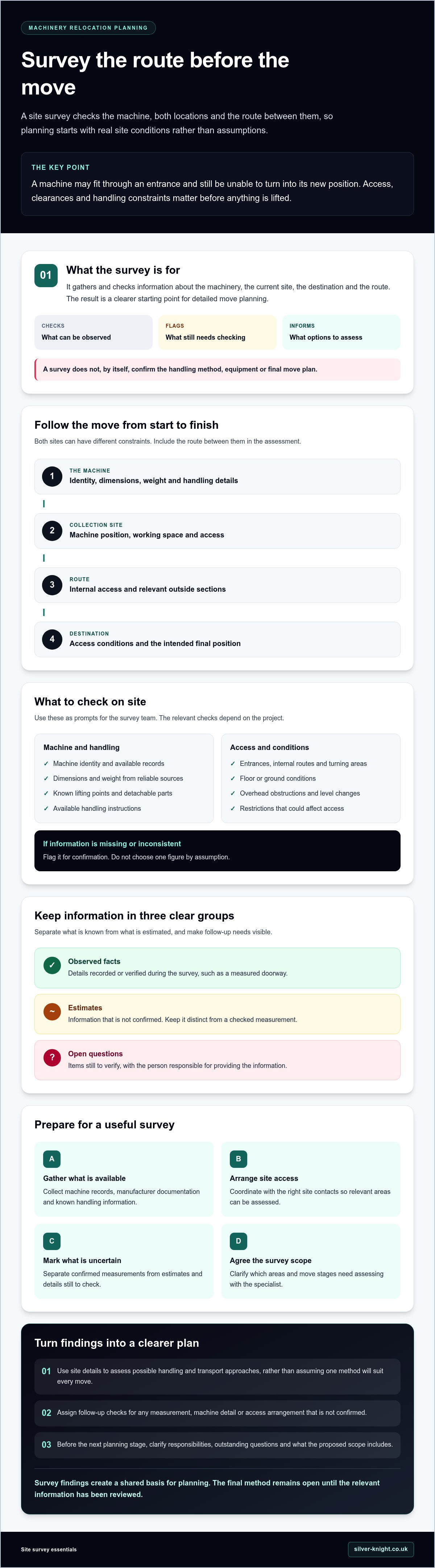
A practical checklist to prepare for a machinery relocation survey
A little preparation helps the survey team make useful observations and identify what still needs checking. Use this sequence to gather information and arrange access before the visit. You don’t need every answer in advance. Make any gaps clear so they can be discussed.
Before the site visit
- Gather machine information. Collect available records, dimensions, weight details and handling instructions. Note where each detail came from, and flag information that’s missing or may need confirmation.
- Identify the right contacts. Arrange a contact for both the collection and destination sites. Where possible, include people who know the machine and those familiar with site access and relevant restrictions.
- Plan access. Confirm how the survey team will enter each site and reach the machine and intended installation position. Raise access arrangements or restrictions in advance.
- List practical constraints. Write down operating requirements, site access limits and timing constraints that could affect the visit or move planning. Keep these as points for discussion, not assumed solutions.
- Share supporting material if available. Photographs, plans or layout drawings may provide useful context. Label dates, locations and any measurements that haven’t been verified, and don’t present an image or plan as proof of current conditions.
If the survey raises a question about whether part of the machine may need to be taken apart, record it for review rather than deciding on the spot. Silver Knight’s machinery dismantling service is relevant to discuss if dismantling forms part of the project scope.
During and after the survey
Use the visit to understand what has been assessed and what remains uncertain. Ask the survey team to distinguish observed or measured details from supplied information and assumptions. A clear record shows which points are ready to inform planning and which need follow-up.
- Which areas and stages were assessed, including collection, transit, positioning or installation planning?
- What details remain unconfirmed, and who should check each one?
- Is more machine information, a site check or a follow-up visit needed?
- What is included in the survey findings, and what sits outside the agreed scope?
Before the next planning stage, share the answers with relevant site contacts and agree who will resolve open items. If you’re preparing for a site survey for machinery relocation, use these questions to discuss the survey scope and relocation requirements with your specialist.
Make sure the survey findings and any open actions are shared with the people responsible for the next steps.
Turn survey findings into a clear machinery relocation plan
Before agreeing the next planning stage, review the survey record with the people responsible for the machine, the sites and the move. The aim is to turn observations into clear actions, not to treat every note as a confirmed instruction. A site survey for machinery relocation can only support sound planning when its limits and remaining questions are understood.
What to confirm in the survey handover
Check that the handover separates measured or otherwise confirmed findings from supplied information, estimates and assumptions. Open actions should name a responsible contact and explain what needs to be checked. Confirm which locations and route sections were assessed, and whether the findings cover collection, transit, positioning or installation planning. Don’t assume one survey covers every stage unless the scope says so.
Ask how new or changed information will be handled. For instance, if machine details or site access conditions change, clarify who should be told and how the effect on planning will be reviewed. Before proceeding, make sure unresolved items have an agreed owner and a clear next step.
Choosing a specialist for the next planning steps
Compare providers on the clarity of their survey scope, their experience with machinery moves, the equipment options they can consider and how they communicate findings. Ask how verified information will feed into handling, lifting, haulage and installation planning. If the project involves moving wider plant or site operations, explore whether a factory relocation service is relevant to the broader scope.
Silver Knight Haulage & Machineries Ltd provides machinery moving, installation and factory relocation, supported by specialist labour and equipment. Its stated collective industry experience is more than 180 years. Discuss how survey findings may connect to the work you need, and confirm the proposed scope and deliverables before relying on them as part of the plan.
Before you agree the next stage, check that responsibilities, outstanding questions and the boundaries of the proposed work are clear. Ask which details still need confirmation, who will provide them and how any changes may affect the plan. This gives your site team and specialist a shared basis for moving from survey findings to practical decisions.
Silver Knight’s machinery moving and relocation services can be considered as you define the work that follows the survey.
Plan your next move with confidence
A well-prepared site survey for machinery relocation helps turn information about the machine, access and both locations into useful planning questions. Check which details are confirmed, what still needs follow-up and who is responsible for each open item. Then make sure the proposed scope covers the stages you need, from collection and transport through to positioning or installation.
The right approach depends on the specific machine and site conditions. A specialist can use verified findings to assess suitable handling and equipment options rather than relying on assumptions.
Silver Knight is a family-run machinery moving specialist, founded in 1996, with more than 180 years of collective industry experience. Specialist lifting and moving equipment can be assessed against your project needs. The next step is to discuss your survey requirements and clarify what should happen next.
Start the conversation today. Discuss your machinery relocation survey with Silver Knight and take a clear, considered step towards planning your move.
Frequently Asked Questions
What is a site survey for machinery relocation?
A site survey for machinery relocation gathers and checks information about the machine, its current location, the route and its destination. The findings help the project team understand access conditions, handling questions and planning gaps. The scope depends on the machinery and project, so confirm which locations and stages are included. Don’t assume every survey covers the same checks or provides a final relocation method.
What does a machinery relocation site survey check?
A survey may review available machine details, site access, routes through each location, working space and the intended position at the destination. The team should make clear which details were observed and which still need confirmation. Checks depend on the machine and move. Ask the survey provider to explain the agreed scope and note any areas or stages that weren’t assessed.
When should a site survey take place before machinery is moved?
Arrange the survey early enough for its findings to inform planning and any follow-up checks. The right timing depends on project readiness, site access and the machine information available. If key details are still being gathered, ask the relocation team what can be assessed and what must wait. Tell them if machine or site conditions change after the survey, so they can review whether the assessment or plan needs updating.
Who should attend a machinery relocation site survey?
Include people who understand the machine, the site and access arrangements. This may mean an operations or facilities contact, someone familiar with the equipment, and a representative from the relocation team. Agree attendees in advance, along with access to relevant areas and records. If someone present can’t confirm a detail, identify who can provide the answer and how it will be followed up.
What information should I prepare for a machinery relocation survey?
Gather available machine records, dimensions, weight information and handling instructions. Site plans or photographs can also help if you have them. Identify contacts for both the current and destination locations, and note relevant access or timing constraints. Label estimates and unverified details clearly, and flag missing information. This gives the survey team a useful starting point and helps identify what needs checking.
Can a site survey confirm which equipment will move the machine?
A survey can help identify constraints that inform equipment selection, but it doesn’t confirm a suitable method from a checklist alone. The machine’s details, access and conditions at both sites need to be considered together. Ask the relocation specialist to explain which options may suit the assessed project and what information supports that view. Confirm any missing details before relying on an option in the move plan.
What happens if the site survey finds an access problem?
Ask the survey team to record the issue, explain which part of the move it may affect and identify what needs checking next. The project team may need more information or may assess alternative route or handling options. An observation isn’t a final solution. Confirm who is responsible for follow-up and what information is needed before agreeing how the move should proceed.

Article by
David Ashby
I'm the Managing Director of Silver Knight Haulage & Machinery Ltd. Silver Knight Ltd is a family-run firm established in the West Midlands in 2005, with the aim of providing a cost-effective, yet professional, service to businesses for the removal, transportation, and installation of machinery, plant, and equipment here in the UK and worldwide. Between us, the Silver Knight workforce has over 50 years of experience with machinery and its operation.
Disclaimer
This article is intended for informational purposes only. Please ensure you seek expert advice or carry out your own research to confirm the information is suitable for your specific needs.