Can a single millimetre of misalignment during transit turn a high-value spinning frame into an expensive piece of scrap metal? Most UK factory managers understand that textile machinery transport is far more than a simple haulage job. It is a delicate operation where heavy lifting must meet surgical precision. You likely worry about the potential for damaged components or the sheer cost of your production line sitting idle for a day longer than planned. It is a stressful balance between moving immense weight and protecting delicate mechanical parts.
At Silver Knight Haulage & Machineries Ltd, we agree that the risks are substantial when moving the precision-engineered equipment that forms the heart of your business. This article explains how to manage the complex logistics of moving your machinery whilst ensuring precision, safety, and minimal operational downtime. We will explore the essential role of specialised lifting gear like hydraulic gantries, the necessity of rigorous decommissioning, and the steps needed to achieve a seamless transition whether you are relocating nationally across the UK or to an overseas facility.
Key Takeaways
- Learn how to protect delicate mechanical components from damage during the heavy lifting and moving process.
- Discover why a technical site survey is vital for a seamless transition from decommissioning to recommissioning.
- Understand the role of specialised gear like hydraulic gantries in managing textile machinery transport within restricted spaces.
- Explore the logistics of international relocation to ensure your assets remain compliant with global shipping and safety regulations.
- Find out how professional installation services help your business achieve zero damage and minimal operational downtime.
Learn more about our professional machinery moving services before planning your next project.
Understanding the unique challenges of textile machinery transport
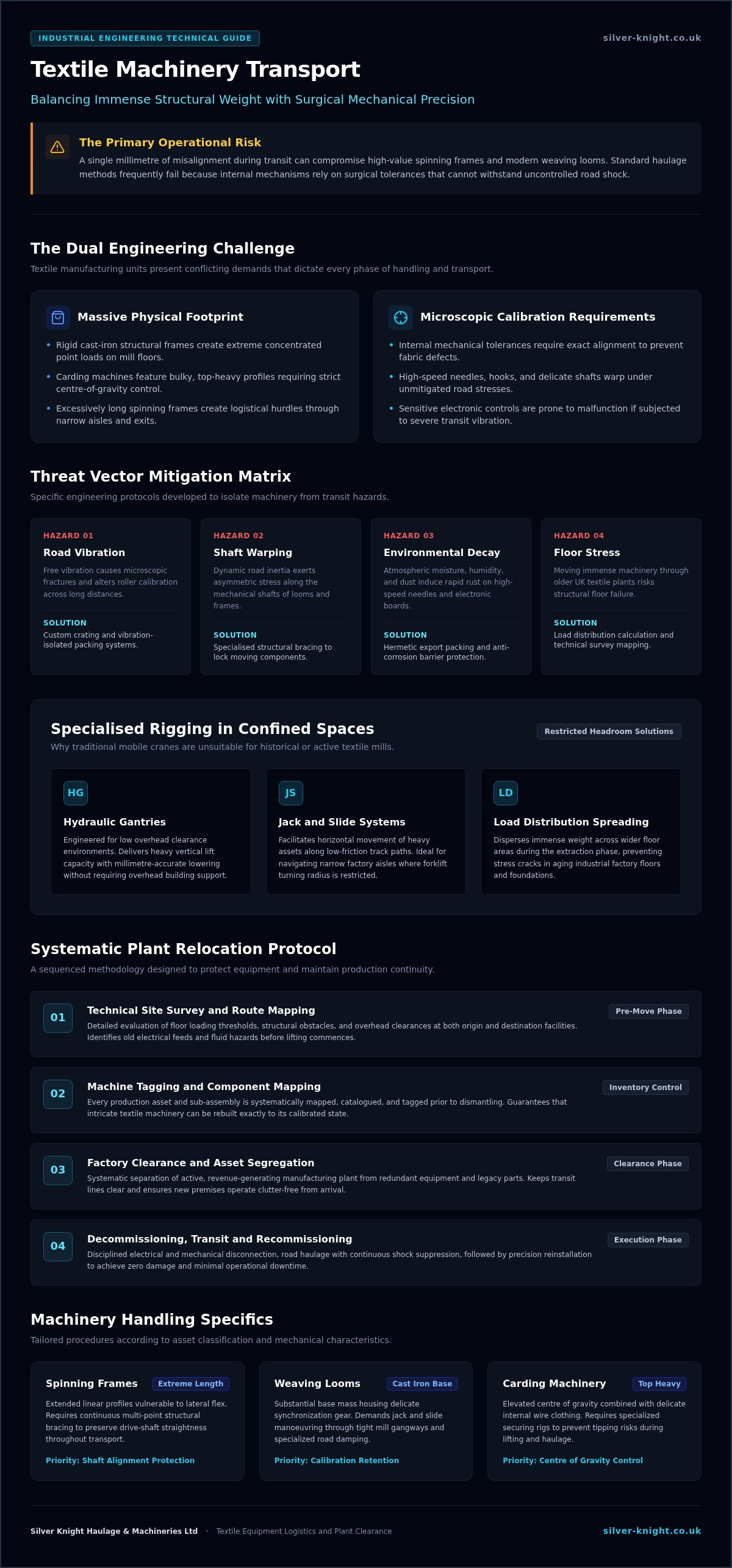
Moving industrial equipment is rarely simple. However, textile machinery transport presents a specific set of hurdles that standard haulage companies often overlook. These machines frequently combine immense physical weight with extremely delicate precision components. A loom might have a heavy cast iron frame, yet its internal mechanisms rely on perfect alignment to function. Any slight shift during transit can lead to a loss of calibration that takes weeks to rectify whilst causing significant financial losses.
Properly securing textile machinery involves understanding its engineering. Looms and spinning frames require specialised bracing to prevent misalignment. Without this, the internal stresses of a road journey can warp the delicate shafts or rollers. Environmental factors also play a huge role. Moisture and dust can quickly damage sensitive electronic controls or cause rust on high speed needles and hooks. Identifying the specific logistical needs of carding machines, which are often bulky and top heavy, versus finishing equipment is a critical part of the planning stage.
Protecting delicate spinning and weaving components
Securing moving parts that are susceptible to vibration damage requires more than just straps and chains. We use techniques that isolate these components from the shocks of the road. Custom crating and export packing are essential for high value textile assets, especially when they're being moved over long distances. General haulage methods often fail because they don't account for the precision mechanical tolerances required for modern textile production. If a component is allowed to vibrate freely, it can lead to microscopic damage that ruins the quality of the finished fabric.
Managing the physical footprint of oversized textile plant
Long spinning frames and wide weaving looms create significant spatial challenges. Navigating narrow factory aisles and restricted access points requires careful manoeuvring and the right equipment. Balancing load distribution is also vital. This protects both the machine's internal structure and the factory floor from damage. It's often necessary to use specialised tools like hydraulic gantries or jack and slide systems to manage these oversized loads safely in tight environments where traditional cranes cannot reach.
You can view our full range of machinery haulage and relocation services to see how we manage complex moves.
Strategic planning for textile plant relocation and clearance
A successful move begins long before the first lorry arrives at your gates. It starts with a comprehensive technical site survey of the existing facility. This process ensures that every variable is accounted for, from the physical weight of the machines to the specific route they will take out of the building. Without this level of detail, textile machinery transport risks becoming a chaotic and expensive ordeal that disrupts your business for weeks. We focus on creating a sequenced relocation plan to minimise the impact on your production schedules, moving your assets in stages so that your output remains as consistent as possible.
Organising factory clearance for redundant equipment whilst moving active assets is another critical element of a professional relocation. Many UK textile mills have decades of accumulated parts and older machinery that are no longer in use. We help separate your valuable production assets from the items that need clearing. This ensures your new site is efficient and clutter free from the very first day of operation. This hands on project management approach is why many family run businesses trust us to handle their most complex engineering transitions.
Technical site surveys and asset tagging
Every machine must be mapped and tagged before any dismantling begins. This isn't just about knowing where things are; it's about understanding exactly how they fit back together at the destination. During the technical survey, we assess floor loading capacities and overhead clearances at both the old and new sites. Textile factories often have unique architectural features that can obstruct large spinning frames or looms. Identifying potential hazards such as old electrical connections or fluid leaks at this stage prevents dangerous delays later in the project.
Systematic decommissioning and dismantling
Decommissioning must be handled by experts who understand the specific requirements of textile machine disconnections. We provide professional machinery dismantling services for complex textile lines, ensuring that every part is handled with care. Documenting electrical and mechanical connections is vital for accurate reassembly. We also manage the safe removal of oils and lubricants prior to the transport phase. This prevents leaks and environmental contamination during transit, keeping your equipment and the transport vehicles clean. If you are preparing for a move, you can speak with our project management team to discuss your requirements.
Discover how our expert team manages complex industrial relocations.
Specialised lifting equipment for textile manufacturing machinery
Standard lifting methods often fall short when faced with the unique architecture of British textile mills. Successful textile machinery transport requires a toolkit that balances raw power with extreme finesse. Explore our specialised lifting equipment designed for the most challenging industrial environments. We don't rely on one size fits all solutions. Instead, we select the right gear based on the technical site surveys mentioned earlier. This ensures that every piece of equipment is moved with the engineering precision it deserves.
Jack and slide systems are essential for moving massive textile assets through tight spaces where overhead clearance is non-existent. These systems allow us to move multi-tonne machines along a controlled track with millimetre accuracy. For internal moves, we often use air skates. These devices use compressed air to create a thin film between the load and the floor. This allows us to glide delicate machinery across the factory without risking damage to floor surfaces or the machine's internal calibration.
Advantages of hydraulic gantry systems in textile mills
Older textile mills often present the challenge of low ceilings and restricted overhead space. Traditional cranes are simply too tall to operate in these environments. Hydraulic gantry systems solve this problem by providing high capacity lifting from a much lower profile. They offer precision control for lifting and positioning heavy frames without any jarring or sudden movements. This level of control is vital for protecting the delicate mechanical tolerances of looms and spinning frames. For project specific needs, you can look into our heavy moving equipment hire service.
Versa-Lift and forklift solutions for restricted access
The Versa-Lift is often the favourite tool for our engineers during a relocation. These specialised forklifts offer high capacity lifting whilst maintaining a remarkably compact footprint. The secret lies in their telescopic frame, which can extend to handle larger loads or retract to navigate narrow aisles. This flexibility is perfect for moving heavy textile machinery through the tight corridors found in many historic manufacturing sites. We always provide operated lifting services with qualified engineers to ensure every move is conducted safely. Our team uses their collective experience to manage weight distribution perfectly, protecting both your valuable assets and the factory environment.
Our team provides a seamless service for businesses looking to manage their industrial transport needs across the globe.
Managing international textile machinery transport and logistics
Moving textile machinery across borders adds layers of complexity that domestic moves simply don't face. We provide comprehensive international machine moving services that cover every step from your UK site to facilities in Europe, the US, India, and Asia. This isn't just about haulage; it's about coordinating multi modal transport to ensure a door to door service. Whether your assets are moving by road, sea, or air, the goal remains the same: zero damage and full compliance with international shipping regulations. Our family run business takes a hands on approach to every global project, ensuring your high value assets are tracked and protected throughout their journey.
Oversized textile equipment often won't fit into standard dry van containers. We frequently utilise flat rack containers or open tops to accommodate the unique dimensions of wide weaving looms or long spinning frames. This flexibility allows us to secure your machinery safely whilst still making use of efficient maritime shipping routes. By choosing the right container type for each specific asset, we reduce the risk of structural stress and make the loading and unloading process far more efficient at both ends of the trip.
Export packing and containerisation for textile assets
Why shipping container packing services are critical for international moves becomes clear when you consider the harsh conditions of a long sea voyage. Sea air is notoriously corrosive and can ruin precision engineered needles or hooks in days. We use specialised vacuum packing and moisture barriers to protect sensitive mechanical parts from salt and humidity. Every machine is braced and secured to withstand the stresses of maritime transport and heavy weather. This prevents any internal movement that could ruin precision mechanical tolerances or damage delicate electronic control panels.
Navigating global logistics and customs requirements
Managing customs documentation is often the biggest headache for manufacturers moving to India or Asia. We handle the complex paperwork and compliance requirements to avoid costly delays at the border. Our team understands the specific regulations for machinery exports, ensuring that all duties and taxes are correctly accounted for before the equipment arrives. By working with trusted international partners, we ensure smooth crossings and clear communication at every stage of the process. We also manage the insurance and liability aspects of these high value industrial moves, giving you peace of mind that your investment is protected. If you are planning a global relocation, you can contact our international logistics experts to discuss your project.
Find out more about our specialist industrial relocation services.
Comprehensive installation and recommissioning of textile assets
Reaching the new destination is a major milestone, but the project is not finished until the first production run is successful. Professional installation involves far more than just placing a machine on the floor. It is about restoring the exact mechanical conditions required for high speed manufacturing. Our machinery installation services get your production line back online by focusing on the fine details that general hauliers ignore. This stage is the natural conclusion to the textile machinery transport process, ensuring that the care taken during transit is matched by precision on the factory floor.
We believe that a successful handover requires a deep understanding of the equipment's original calibration. By using the documentation created during the decommissioning phase, our engineers can replicate the exact setup of your machinery. This reduces the time spent on troubleshooting and allows your staff to resume work with confidence. Our family run team takes pride in this hands on approach, ensuring that every bolt and connection is double checked before the power is turned on.
Precision positioning and levelling techniques
We use advanced equipment to ensure spinning frames and looms are perfectly level. In the textile industry, even a minor deviation can lead to frequent thread breakage and accelerated machine wear. Older UK mills often have uneven floors, which makes this stage even more critical for maintaining calibration. If the frame is not perfectly true, the stress on high speed moving parts increases significantly. We also focus on anchoring machines securely. This prevents vibration during high speed operation, which is critical for maintaining the longevity of your assets and the quality of your output.
Recommissioning for immediate production readiness
Recommissioning is the vital final step that bridges the gap between a delivered machine and an active production asset. We perform a systematic reconnection of power, air, and data lines for your textile plant. Once these connections are secure, we carry out initial test runs to verify both mechanical and electrical integrity. This process identifies any issues that may have arisen during the move before they can cause a production delay. We stay on site to oversee these tests, handing over a fully operational production line to your team only when we are certain it is performing to the required standard.
Learn more about how we support UK manufacturing with professional machinery relocation services.
Securing the future of your textile production
Managing a factory move requires more than just moving boxes. It involves protecting precision engineered assets that are the lifeblood of your business. We have explored how technical site surveys, specialised lifting equipment, and international logistics combine to ensure a successful transition. Whether you are moving a single loom or an entire spinning mill, the right approach to textile machinery transport prevents damage and keeps downtime to a minimum.
Our family-run team brings over 180 years of collective industry experience to every project. We utilise advanced tools like hydraulic gantries and Versa-Lifts to navigate restricted spaces in older mills whilst offering global relocation services to Europe, the USA, India, and Asia. You don't have to face the complexities of decommissioning and recommissioning alone. Contact our specialist team for a textile machinery transport quote and let us handle the heavy lifting for you. We look forward to helping your business grow in its new location.
Article by
David Ashby
I'm the Managing Director of Silver Knight Haulage & Machinery Ltd. Silver Knight Ltd is a family-run firm established in the West Midlands in 2005, with the aim of providing a cost-effective, yet professional, service to businesses for the removal, transportation, and installation of machinery, plant, and equipment here in the UK and worldwide. Between us, the Silver Knight workforce has over 50 years of experience with machinery and its operation.
Disclaimer
This article is intended for informational purposes only. Please ensure you seek expert advice or carry out your own research to confirm the information is suitable for your specific needs.