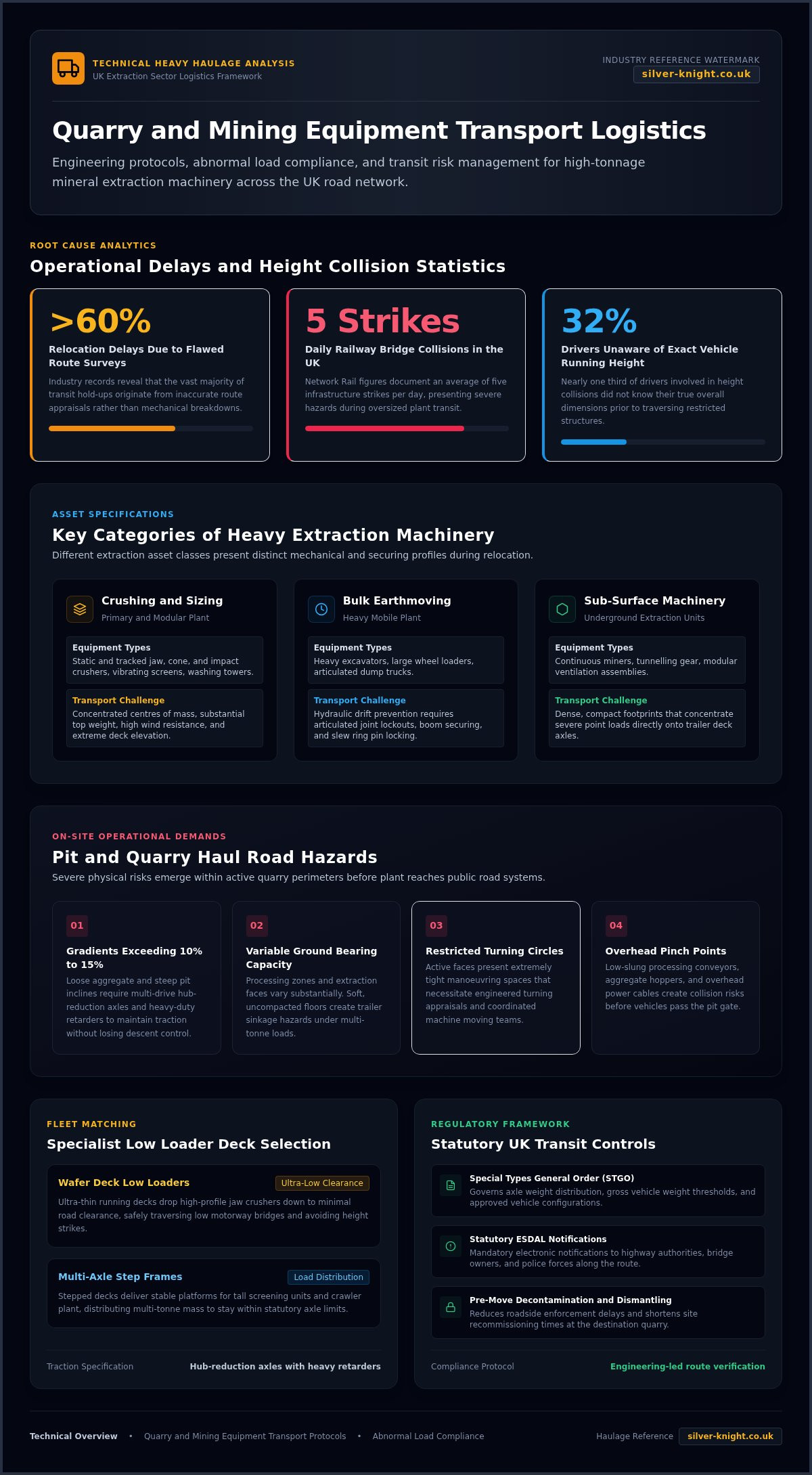
Industry data shows that over 60 percent of delays during heavy plant relocations stem directly from flawed route surveys rather than mechanical breakdowns. When arranging quarry and mining equipment transport, treating a multi-tonne jaw crusher or screening tower like standard road freight is a guaranteed recipe for costly operational disruption.
You already know the intense pressure that comes with moving high-value extraction assets across unpredictable ground. A single miscalculation on loose, steep haul roads can cause severe plant damage, whilst unravelling complex abnormal load regulations, statutory ESDAL notifications, and escort requirements creates crippling administrative headaches. Partnering with the wrong haulier leaves your site vulnerable to hidden costs and extended production downtime.
This comprehensive guide reveals how to evaluate specialist heavy haulage providers and safely move heavy extraction machinery across the UK. We'll walk you through statutory weight thresholds, essential route assessment protocols, and the practical steps needed to synchronise dismantling, haulage, and site positioning.
Key Takeaways
- Understand how extreme plant weights and awkward centres of gravity dictate bespoke securing methods on challenging extraction terrain.
- Master statutory notification periods and abnormal load thresholds essential for lawful quarry and mining equipment transport across the UK road network.
- Explore how matching specialist low-loader trailer configurations and contract lifting solutions mitigates bridge strike risks and infrastructure damage.
- Apply an engineering-led evaluation framework to select haulage partners with genuine heavy plant expertise rather than general freight brokers.
- Follow thorough pre-move decontamination and dismantling procedures to eliminate roadside enforcement delays and shorten site recommissioning times.
To safely navigate complex site conditions and plan heavy plant logistics across the UK, speak to the engineering team at Silver Knight heavy haulage specialists.
Technical Demands of Quarry and Mining Equipment Transport
Moving mineral extraction assets presents extreme mechanical challenges. Unlike standard industrial freight, heavy plant features high, irregular centres of gravity, abrasive surfaces, and sheer density. Successful quarry and mining equipment transport requires calculated load distribution, matched tie-down ratings, and tailored engineering long before a vehicle moves onto public roads.
Static processing machinery demands an entirely different logistical approach to tracked mobile plant. Mobile crushers and screeners can often walk directly onto low-bed trailers, whereas static primary jaw crushers or modular wash plants require mechanical separation. For oversized components requiring specialist permits, operators must plan transits around recognised guidelines for oversize load transport to maintain complete road safety and legal compliance.
Key Categories of Heavy Extraction Machinery
Quarry operations rely on several distinct equipment groups, each presenting specific handling challenges during transport:
- Crushing and sizing machinery: Static and tracked jaw, cone, and impact crushers feature concentrated centres of mass and high top-weight. Vibrating screens and washing towers add significant height and wind resistance.
- Bulk earthmoving plant: Heavy excavators, large wheel loaders, and articulated dump trucks require articulated joint lockouts, boom securing, and slew ring pins to prevent hydraulic drift during movement.
- Sub-surface extraction machinery: Underground continuous miners, tunnelling gear, and modular ventilation assemblies present dense, compact footprints that concentrate severe axle loads onto trailer beds.
The Hidden Hazards of Pit and Quarry Logistics
The greatest physical risks often arise inside the pit boundary rather than out on the highway. Haul roads inside active quarries feature loose aggregate and gradients regularly exceeding 10 to 15 percent. These steep inclines demand prime movers with multi-drive hub-reduction axles and heavy-duty retarders to maintain traction without losing control on descents.
Ground bearing capacity varies wildly between processing zones and extraction faces. Soft, uncompacted quarry floors risk sinkage under heavily laden trailers. Additionally, turning circles near active faces are tight, whilst low-slung processing conveyors, aggregate hoppers, and overhead power cables create hazardous overhead pinch points. Careful site surveys and experienced machine moving teams prevent costly structural impacts before machinery ever leaves the pit gate.
For specialist fleet logistics and nationwide heavy transport planning, consult the team at Silver Knight plant relocation engineers.
Assessing Specialist Fleet and Lifting Capabilities
Transporting heavy mineral extraction plant demands far more than booking a standard flatbed. Achieving safe quarry and mining equipment transport requires precision matching between heavy prime movers and specialist multi-axle trailers. Selecting an unsuitable configuration risks infrastructure strikes, axle overloads, and catastrophic chassis stress.
Every trailer setup must comply with the Special Types General Order regulations to ensure proper axle weight distribution. Network Rail records show an average of five railway bridge strikes every day across the UK network, with industry research noting that 32 percent of drivers involved in height-related collisions did not know their vehicle's precise running height. Experienced hauliers eliminate this hazard through accurate low-bed planning and dedicated machinery haulage and moving services.
Heavy Haulage Fleet Configurations and Low Loaders
Different extraction machinery profiles require specific deck designs to keep running heights and axle loads within safe limits:
- Wafer deck low loaders: Ultra-thin running decks drop high-profile jaw crushers down to minimal road clearance, safely traversing low motorway bridges.
- Multi-axle step frames: Stepped decks provide stable platforms for tall screening plants and medium-sized excavators whilst distributing weight evenly.
- Modular platform trailers: Heavy hydraulic platforms split concentrated multi-tonne loads across multiple hydraulic axles, preventing structural roadbed damage.
Jack and Slide Systems Alongside Hydraulic Gantries
Loading heavy machinery inside tight processing buildings or active pit workshops often rules out mobile cranes. Confined headroom, overhead conveyor gantries, and unstable edge conditions frequently make crane outrigger deployment impossible.
Engineering-led contractors overcome these constraints using specialist lifting technology. Telescopic hydraulic gantry systems lift heavy crusher bodies and industrial drivetrains vertically within low-clearance buildings. Where vertical lifting is restricted, jack and slide systems move dense equipment horizontally along low-profile tracks, smoothly manoeuvring machinery through narrow plant portals onto transport beds. When handling heavy drive motors or sub-assemblies in tight bays, compact Versa-Lift units provide exceptional lifting capacity without requiring extensive operating clearance.
If your extraction site features tight loading bays or restricted crane access, you can discuss your project with our engineering team to design a tailored lifting plan.
To ensure total regulatory compliance and smooth transit approvals across Great Britain, partner with the specialists at Silver Knight abnormal load planners.
Route Planning Compliance and Abnormal Load Regulations
Moving massive primary crushers and excavators quickly crosses standard highway thresholds. Under UK Construction and Use regulations, standard haulage limits vehicles to 44 tonnes gross weight, 2.9 metres in width, and 18.65 metres in rigid length. Because extraction machinery cannot be dismantled without significant expense or structural compromise, it travels as an Abnormal Indivisible Load. Conducting lawful quarry and mining equipment transport demands strict adherence to the Special Types General Order (STGO) framework.
Special Types General Order Rules and Escort Coordination
Abnormal load classification depends strictly on gross weight and axle configurations. STGO Category 2 accommodates gross weights up to 80 tonnes across at least six axles, whilst Category 3 covers weights up to 150 tonnes. When an equipment combination exceeds 150 tonnes or 6.1 metres in width, it requires a formal Department for Transport Special Order via National Highways, mandating a minimum lead time of ten weeks.
Statutory notifications using the Electronic Service Delivery for Abnormal Loads (ESDAL) system are legally binding. Moving equipment wider than 2.9 metres requires at least two clear working days of advance notice to regional police forces. Moving under Category 2 requires two clear working days of notice alongside indemnities to highway and bridge authorities, increasing to five clear working days for Category 3 loads over 80 tonnes. Submitting inaccurate dimensions risks immediate roadside prohibitions. Driver and Vehicle Standards Agency records show that approximately 1 in 10 heavy goods vehicles stopped during targeted checks committed overloading or Construction and Use violations.
Structural Surveys and Swept Path Route Audits
Moving extraction plant out of rural pits onto the strategic road network requires rigorous physical and digital surveying. Haulage teams conduct swept path computer simulations to verify that extended multi-axle trailers can safely negotiate tight roundabouts, sharp junctions, and narrow village streets without striking kerbs or street furniture.
Bridge structural assessments represent another vital requirement. Heavy hauliers analyse structural weight capacities across every bridge deck on the route, securing clearance from local highway councils. Loading and unloading procedures must also meet strict safety standards. Rigorous lift planning under the Lifting Operations and Lifting Equipment Regulations ensures cranes, lifting accessories, and ground-bearing mats comply with UK health and safety law before any component is lifted.
To arrange complete turnkey plant relocation managed by experienced heavy moving specialists, reach out to Silver Knight industrial relocation contractors.
Evaluation Framework for Selecting an Industrial Haulage Partner
Choosing a contractor based solely on the lowest price per mile introduces severe operational risks. Effective quarry and mining equipment transport requires an engineering-led machinery relocation specialist rather than a freight broker that subcontracts work to general hauliers. Plant managers should assess prospective partners against proven technical capabilities, rigorous lifting credentials, and comprehensive insurance cover.
Verifying Contractor Experience and Technical Competence
Safe extraction equipment relocations rely on certified personnel holding technical oversight. Under British Standard BS 7121 and LOLER regulations, lifting heavy machinery requires a qualified Appointed Person to formulate the Lift Plan, supported by dedicated Crane Supervisors and certified Slingers. Operators should scrutinise the provider's heavy rigging history and request site-specific Risk Assessment and Method Statements (RAMS) covering abrasive quarry environments.
A capable contractor maintains an extensive inventory of specialised trailers, hydraulic gantries, and specialist heavy moving equipment hire tools. Direct equipment ownership guarantees properly maintained machinery and avoids costly third-party hire delays on moving day.
Insurance Cover and Liability Management
Standard freight insurance rarely matches the high capital investment of modern mineral extraction systems. General hauliers often operate with restricted carriage policies that cover cargo only by gross weight rather than true replacement value. Clear insurance policies protect against equipment damage during tricky loading or road transit:
- Goods in transit policies: Must cover the full replacement cost of multi-tonne processing plant rather than standard freight weight limits.
- Public liability cover: Comprehensive cover shielding quarry structures and adjacent highway infrastructure from damage.
- Rigging and lifting cover: Specialist policies protecting high-value assets while suspended, jacked, or skidded during mechanical handling.
Turnkey Decommissioning and Site Reassembly Capabilities
Subcontracting dismantling, heavy haulage, and mechanical reassembly to separate vendors breeds logistical friction and extended plant downtime. Engaging a single turnkey partner with over 180 years of collective industry experience ensures seamless coordination from initial mechanical unbolting to final site recommissioning.
Professional movers employ skilled fitters to execute mechanical decoupling through dedicated professional machinery dismantle services. Once the convoy arrives at the receiving pit, the same engineering team manages final alignment, positioning, and mechanical securing on concrete footings.
Ready to ensure your extraction equipment arrives safely and on schedule? Contact our heavy machinery team today to plan your complete turnkey move.
To safely coordinate complex extraction machinery moves and plant decommissioning across the UK, consult the team at Silver Knight heavy transportation.
Preparing Your Extraction Plant for Seamless Equipment Relocation
Thorough preparation directly impacts the speed and safety of industrial plant moves. Neglecting pre-move checks causes unexpected roadside detentions, severe mechanical strain, and extended operational downtime. When orchestrating quarry and mining equipment transport, systematic site organisation ensures assets move smoothly from extraction faces to their new foundations.
Clear communication between quarry management and transport crews establishes a safe working environment. Designating a dedicated liaison officer helps coordinate loading windows around routine blasting schedules and daily aggregate dispatch traffic, keeping the loading area clear of secondary hazards.
Pre-Move Preparation and Asset Decontamination
Extraction machinery operates in harsh, abrasive environments that leave heavy build-ups of slurry, stone fragments, and dried aggregate. Before any equipment moves onto the public highway, quarry teams must execute comprehensive decontamination procedures:
- High-pressure aggregate washing: Blast away packed clay, mud, and loose stone from crawler tracks, undercarriages, and hopper side-wings to eliminate airborne road debris risks.
- Fluid containment and draining: Drain auxiliary diesel fuel cells, water separation systems, and coolant reservoirs, while plugging disconnected hydraulic lines to stop highway leaks.
- Mechanical component securing: Pin down articulating steering joints, lock excavator slew rings mechanically, and physically strap folding discharge conveyors against transport frames.
- Condition reporting: Photograph all mechanical assemblies and record baseline wear conditions prior to rigging to verify asset integrity upon arrival.
Seamless Handover and Precision Positioning
Staging areas inside extraction facilities require careful ground preparation. Heavy low-bed trailers and multi-axle platform transporters need firm, level ground away from active pit traffic. Allocating compacted gravel pads or concrete aprons prevents trailers from sinking when bearing high axle loads during winching or driven loading operations.
Receiving site preparation must finish before the haulage convoy departs the origin pit. Civil engineering teams must pour, cure, and core anchor holes in concrete equipment plinths well ahead of schedule. Incoming utility trenches, electrical conduits, and aggregate feeds should align perfectly with the machinery blueprint. Once transport crews position the plant, skilled millwrights can immediately commence anchor bolting, driveline alignment, and electrical hookups, speeding up final recommissioning tests and returning the plant to full aggregate production.
To partner with trusted heavy lift specialists for your next extraction plant project, explore the solutions at Silver Knight heavy machinery movers.
Safeguard Your Next Extraction Machinery Move
Executing successful quarry and mining equipment transport requires calculated engineering rather than straightforward road haulage. From navigating complex STGO notification windows and structural bridge clearances to managing awkward load centres of gravity, every stage demands specialist precision. Treating your extraction machinery with meticulous care protects your balance sheet and keeps your quarry on track.
Silver Knight Haulage & Machineries Ltd brings over 180 collective years of industrial machinery moving experience to your operation. Backed by nationwide UK service capability and a comprehensive specialist fleet including hydraulic gantries and jack and slide systems, we deliver full turnkey project handling from initial unbolting to final site recommissioning. You don't have to tackle complex abnormal haulage challenges alone. Request a technical site survey from Silver Knight Haulage & Machineries Ltd and ensure your high-value plant arrives securely, smoothly, and ready for immediate aggregate production.
Frequently Asked Questions
Can normal road hauliers transport heavy quarry and mining equipment?
No, standard road hauliers generally lack the specialist trailers, weight capacities, and routing knowledge needed for this sector. Safe quarry and mining equipment transport demands specialised heavy haulage assets such as low-loaders, alongside skilled crew trained in abnormal load movements. Heavy plant exceeds standard axle weights and dimensions, requiring engineering assessments, specific tie-down strategies, and legal compliance that general freight companies cannot provide.
What permits are mandatory for transporting oversized processing machinery across the UK?
Hauliers must submit abnormal load notifications to police forces, highway authorities, and bridge owners across the planned route. Depending on dimensions and gross vehicle weight, statutory notification windows apply before transit can legally commence. Movement orders or special orders from national transport agencies may also be required for severe dimensions. Professional movers complete route surveys in advance to identify structural limits and secure all statutory clearances.
How do specialist movers load heavy crushers when cranes cannot access the quarry?
Specialist movers use hydraulic gantry systems or jack and slide systems when crane access is restricted by narrow pit floors, soft ground, or low headroom. Crews place hydraulic jacks under the crusher, raise the machine systematically, and slide it onto low-loaders along heavy-duty tracks. This engineering approach eliminates reliance on mobile cranes while safely handling massive loads in confined extraction zones.
What happens if adverse weather compromises ground conditions during pit extraction?
Operations pause immediately while engineers evaluate ground stability, traction, and load-bearing capacity. Heavy rain or frost can quickly turn quarry ramps into slip hazards. Recovery teams deploy steel track mats, heavy winches, or tracked towing units to stabilise moving equipment. If conditions remain unsafe, haulage teams postpone pit extraction until ground improvements take place, ensuring personnel safety and protecting heavy assets from shifting.
Is it necessary to dismantle screening plants and conveyors prior to highway transport?
Yes, modular components like discharge conveyors, hoppers, and screen boxes often require decommissioning before highway transit. Stripping these ancillary sections reduces overall height and width, keeping the cargo within manageable transport dimensions and avoiding low bridge collisions. Turnkey machinery movers handle the mechanical dismantling on site, load the modules across dedicated low-loaders, and complete recommissioning after arrival at the destination.
How much advance notice is required to schedule abnormal load quarry transport?
You should typically provide several weeks of notice to organise quarry and mining equipment transport across the country. Complex abnormal loads require statutory notification periods for police forces and highway bodies, which can range from several days to weeks depending on weight and width. Extra planning time allows technical teams to complete route surveys, arrange escort vehicles, and design specific lifting plans.
What insurance coverage should a mining plant manager verify before transit?
Plant managers must verify goods in transit cover, public liability insurance, and comprehensive contract lifting protection. Standard freight policies rarely match the full replacement value of industrial processing machinery. Ensure your contractor provides bespoke cover matching the exact asset valuation, including rigging, jacking, loading, and road transit risks. Always request written policy documentation and check policy limits prior to moving any heavy equipment.

Article by
David Ashby
I'm the Managing Director of Silver Knight Haulage & Machinery Ltd. Silver Knight Ltd is a family-run firm established in the West Midlands in 2005, with the aim of providing a cost-effective, yet professional, service to businesses for the removal, transportation, and installation of machinery, plant, and equipment here in the UK and worldwide. Between us, the Silver Knight workforce has over 50 years of experience with machinery and its operation.
Disclaimer
This article is intended for informational purposes only. Please ensure you seek expert advice or carry out your own research to confirm the information is suitable for your specific needs.