Moving a multi-tonne industrial furnace is far more than a simple haulage task; it is a delicate engineering project where a single mistimed vibration can shatter thousands of pounds worth of specialist refractory brickwork. When you are planning industrial oven and furnace moving, you likely recognise that the stakes are incredibly high. Between the complexity of disconnecting high-voltage electrics and the threat of extended production downtime, the pressure to get everything right the first time is immense for any UK manufacturer.
This guide explains how to safely relocate your high-value assets whilst protecting thermal linings and ensuring operational compliance. You will discover the essential steps for safeguarding brittle components and managing the transition from decommissioning to final installation. We provide a clear roadmap to help you achieve a damage-free relocation and a safe restart. By following these professional protocols, which are championed by specialists like Silver Knight Haulage & Machineries Ltd, you can ensure your manufacturing schedule remains productive and your plant stays fully compliant with all necessary safety standards.
Key Takeaways
- Learn how professional industrial oven and furnace moving protects delicate refractory linings from vibrations and structural damage during transit.
- Understand why a technical site survey and a detailed lift plan are essential for managing the complexities of decommissioning thermal equipment.
- Discover how specialist tools like hydraulic gantry systems and jack and slide systems allow for precise movement in restricted factory spaces.
- Explore the importance of precision levelling and utility reconnection to ensure your equipment meets safety standards upon restart.
- Find out how partnering with an experienced specialist helps you manage project risks and minimise production downtime throughout the relocation.
If you need help with a complex project, consider hiring expert heavy machine movers to ensure a smooth transition.
Challenges of Industrial Oven and Furnace Relocation
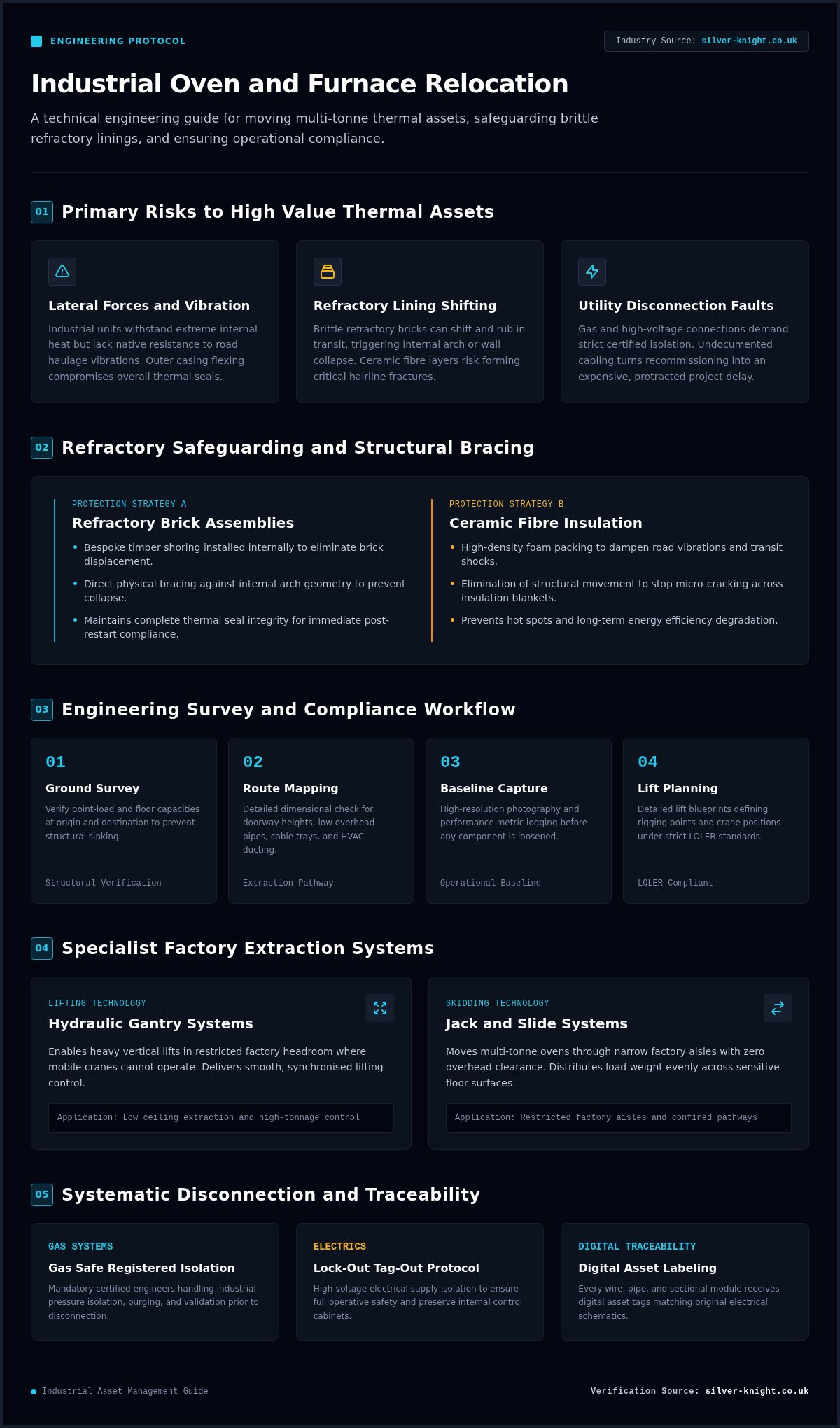
Relocating large industrial furnaces involves more than just physical lifting. These units are built to withstand intense heat, but they aren't designed for the lateral forces and vibrations of road transport. During industrial oven and furnace moving, the sheer size of the equipment often masks its internal fragility. If the outer casing flexes even slightly, it can compromise the entire thermal seal, leading to heat loss and safety failures when the unit is eventually restarted.
To better understand the scale and planning required for such projects, watch this helpful video:
Protecting Thermal Integrity and Internal Linings
The most significant risk during a move is damage to the refractory lining. These materials are often brittle and sensitive to impact. Vibrations during transit can cause refractory bricks to shift or rub together, potentially leading to a collapse of the internal arch or wall. Even modern ceramic fibre insulation isn't immune; hairline cracks can develop if the unit isn't properly braced. Securing these internal components usually involves bespoke timber shoring or foam packing to limit movement. Maintaining this thermal integrity is vital for meeting future operational compliance and energy efficiency standards.
Managing Large Scale Utility Disconnections
Disconnecting a furnace is a technical task that requires specific certifications. For gas fired units, you must use Gas Safe registered engineers who understand industrial pressures. High voltage electrical supplies also need safe isolation and lock out procedures to prevent accidents. Meticulous labelling of all control systems and wiring is essential during this phase. Without clear identification, the recommissioning process at the new site becomes a lengthy and expensive puzzle. Taking the time to document every connection ensures that the machinery dismantle service is handled correctly from the start.
If you want to ensure your thermal equipment is handled by professionals, you should speak to a team of heavy machine movers who understand the technical requirements of industrial relocations.
Technical Decommissioning and Site Preparation
Preparation is the foundation of any successful industrial oven and furnace moving project. It begins with a comprehensive technical site survey. This isn't just a quick walk around the factory floor. It involves measuring every doorway, checking for low hanging pipes, and verifying that the ground can support the weight of the equipment and the lifting gear. You must also document the current state of the oven in detail. Taking high resolution photographs and recording performance data before the move ensures you have a clear baseline for accurate recommissioning later. This documentation proves invaluable if technical issues arise during the restart phase.
The Site Survey and Risk Assessment Process
Engineers must identify floor load capacities at both the origin and destination sites to prevent structural damage or sinking. Mapping out the extraction route is equally important to avoid overhead obstructions like cable trays or HVAC ducting that might not be immediately obvious. All heavy lifting must comply with the Lifting Operations and Lifting Equipment Regulations (LOLER) to ensure safety throughout the project. A detailed lift plan serves as a technical blueprint that defines the rigging points and crane positions required to move the load safely.
Systematic Dismantling and Asset Tagging
For oversized units that cannot be moved in one piece, professional machinery dismantling is necessary. This process involves more than just unbolting sections; it requires a systematic approach to preserve the unit's integrity. We use digital tagging and meticulous labelling for all wiring and pipework to ensure every connection is perfectly matched during the rebuild. Control panels and sensitive sensors are removed and packed into secure, shock resistant crates. This level of detail prevents the common headache of lost wires or damaged electronics that often plagues less organised relocations.
Preparing the new site is the final piece of the industrial oven and furnace moving process. You need to verify that the new location has the correct floor loadings and utility connections ready before the equipment arrives. If the foundations aren't perfectly level or the gas pressure is insufficient, your production schedule will face immediate and costly delays. It's often helpful to have a technical partner review the new site's layout to ensure the workflow is optimised for the relocated assets. Since we provide national coverage for all industrial sectors, you can contact our specialists for advice on site readiness and total project management.
If you're looking for a technical partner to manage your next project, you can find more information about our heavy machine movers services online.
Specialist Lifting and Transport Solutions
Standard lifting methods often fall short when dealing with the unique dimensions and weight distribution of thermal plant. Because industrial oven and furnace moving requires extreme precision to protect delicate internal linings, specialist equipment is a necessity rather than an optional extra. Using the wrong tools can lead to structural flexing or, worse, a complete tip over that destroys the asset. Professional movers use a combination of hydraulic systems and compact lifting vehicles to navigate the constraints of a modern manufacturing facility safely.
Advanced Equipment for Precision Lifting
Choosing the right specialised machinery moving equipment is vital for maintaining the stability of the load throughout the lift. Hydraulic Gantry Systems are often the preferred choice for restricted access areas where a mobile crane simply won't fit. These systems provide a stable, vertical lift from four points, which is significantly more controlled than the single point lift of a crane. For moving massive furnaces horizontally without tilting them, Jack and Slide Systems offer high precision by gliding the load along a low profile track. We also frequently use Versa Lifts, which are high capacity forklifts with extendable counterweights. These machines allow us to carry heavy loads through tight factory aisles where space is at a premium, ensuring the asset remains level at all times whilst avoiding collisions with existing plant.
Secure Transport and Heavy Haulage Logistics
Once the equipment is safely outside the factory, the focus shifts to road logistics and national transport. Selecting the correct machinery haulage vehicles is based on the total weight and the specific height of the load. Low loader trailers are essential for oversized oven sections to ensure they clear motorway bridges and overhead cables across the UK road network. Every load requires custom bracing and specialised strapping to prevent any movement that could cause the refractory materials to crack or shift. Under the Provision and Use of Work Equipment Regulations (PUWER), it's a legal requirement to ensure that equipment is safe for use after it's been moved and reinstalled. This final transition from the trailer back onto the factory floor must be managed with the same level of technical care as the initial lift to ensure the industrial oven and furnace moving project meets all safety standards.
If you are planning a large scale project, you should contact a specialist team of heavy machine movers to manage the process from start to finish.
Recommissioning and Precision Installation
The final stage of industrial oven and furnace moving is arguably the most critical phase for your production schedule. Once the asset is positioned in its new location, the focus shifts to restoring its operational integrity. This isn't a simple plug and play process. It requires a deep technical understanding of how the unit was originally engineered. You must ensure that its performance at the new site matches its previous output to avoid batch failures or energy waste.
Levelling and Structural Alignment
For many UK manufacturers, precision levelling is the difference between a successful restart and a mechanical failure. This is particularly true for conveyorised oven systems where even a tiny amount of misalignment can cause belt tracking issues or premature wear on expensive bearings. Perfect levelling is also essential for maintaining the integrity of door seals. If the frame is twisted, heat will escape; this leads to energy waste and potential safety risks for your staff. Professional factory relocation services use advanced laser alignment tools to ensure the structure is perfectly square and level. This accuracy prevents the structural stress that often leads to refractory cracking during the first few heat cycles after the move.
Testing and Performance Validation
After the structural work is complete, the process of reconnecting utilities and control systems begins. This must be followed by a controlled initial heat up rather than jumping straight to maximum temperature. A gradual ramp up allows the refractory linings to expand naturally. It also helps you identify any hairline cracks that may have formed during the industrial oven and furnace moving process before they become major issues. Thermal profiling is then conducted using calibrated data loggers to verify that the heat distribution remains uniform across the chamber.
Recalibration of temperature controllers is a vital step in this phase. If your facility operates under strict industry standards such as Nadcap or AMS2750G, you must ensure the relocated unit still meets these specific requirements. We recommend a full system accuracy test before the final handover. This validation process ensures that your thermal equipment is not only operational but also fully compliant with UK safety and quality standards. The final handover should include a comprehensive pack of safety certifications and updated technical drawings. This ensures your maintenance teams have accurate information for future servicing and helps satisfy your insurance requirements. If you are ready to plan your next project, you can enquire about our technical installation services to ensure your plant is recommissioned correctly.
To ensure your project is managed by a team with extensive technical expertise, you can learn more about our heavy machine movers and factory relocation services.
Managing Risk Throughout the Relocation Process
The success of industrial oven and furnace moving depends on proactive risk management. It's not enough to simply move the asset from one floor to another; you must protect the financial and operational health of your business. Professional project management reduces the risk of extended downtime by anticipating challenges before they occur. By treating the relocation as a technical engineering project rather than a transport task, you ensure that every potential failure point is addressed. This includes everything from floor load failures to the subtle shift of internal thermal components during transit.
Insurance and Liability Considerations
One of the most overlooked aspects of industrial oven and furnace moving is the adequacy of insurance coverage. Standard haulage insurance often only covers goods based on their weight, which is wholly insufficient for high value thermal equipment. You need specific machinery moving cover that accounts for the total replacement value of the asset and its delicate internal linings. A professional partner will also conduct site specific liability assessments at both ends of the journey. These assessments identify risks to existing infrastructure and personnel, providing a level of financial protection that standard haulage companies simply cannot match. It's about ensuring that if the unexpected happens, your business isn't left with a massive repair bill and no recourse.
The Value of Industry Experience
Choosing a family run business with deep roots in the industry provides a level of care and accountability that's hard to find elsewhere. Our team offers over 180 years of collective industry experience, which means we've likely encountered and solved the exact challenges your project presents. Whether you're moving a single unit or an entire production line, this depth of knowledge is invaluable. We provide national UK coverage for all industrial sectors, allowing multi site manufacturers to maintain a consistent standard of safety and quality across their entire estate.
A fully managed contract lifting service provides the ultimate peace of mind. Under this arrangement, the moving specialist takes full responsibility for the planning, supervision, and execution of the lift. This removes the burden of complex RAMS (Risk Assessments and Method Statements) from your internal team and places it in the hands of experts. It's a comprehensive approach that ensures full compliance with all safety standards whilst keeping your manufacturing schedule on track. If you're ready to discuss the specifics of your next project, you should contact our specialist team for a detailed consultation and technical survey.
If you're looking for a technical partner to manage your next project, you can find more information about our heavy machine movers services online.
Secure Your Manufacturing Future with Expert Relocation
Successfully managing industrial oven and furnace moving requires a blend of technical decommissioning, precision lifting, and rigorous recommissioning. You've learned how protecting refractory linings and ensuring utility compliance are the foundations of a damage free restart. By prioritising a detailed site survey and using specialist tools like hydraulic gantries, you can eliminate the risks that lead to costly production downtime.
We bring over 180 years of collective machinery moving experience to every project. Our team uses advanced hydraulic gantry and jack and slide systems to handle even the most restricted factory layouts across the country. With full national coverage for all UK industrial sectors, we're ready to support your next facility upgrade. Request a technical survey for your furnace relocation to start your project with confidence. Your high value thermal assets are in safe hands when you partner with a specialist who understands the engineering behind the heat.
Frequently Asked Questions
Is it safe to move an industrial furnace with a refractory lining?
Yes, it's safe if you use a technical partner who understands the fragility of thermal materials. Refractory linings are brittle and prone to cracking under lateral stress or vibration. We use specialist lifting equipment and internal bracing to keep the furnace structure stable throughout the journey. This prevents the lining from shifting or collapsing, ensuring the unit remains operational and safe for use once reinstalled at your new manufacturing site.
How long does it take to move a large industrial oven?
The timeline depends on the scale of the decommissioning and the complexity of the utility disconnections. A standard industrial oven and furnace moving project might take anywhere from three days to two weeks. This includes the initial technical site survey, systematic dismantling, transport, and the final recommissioning phase. We focus on minimising production downtime by planning every stage in detail before the physical work begins on the factory floor across the UK.
Do I need to recalibrate my oven after a move?
You must recalibrate your temperature controllers and sensors after any relocation. Moving an oven can lead to subtle shifts in component alignment or damage to sensitive thermocouples. Recalibration ensures your thermal profiling remains accurate and that you meet all relevant manufacturing compliance standards. This process is a vital part of the recommissioning phase, helping you maintain batch quality and energy efficiency from the very first heat cycle at your new facility.
What equipment is used to move heavy industrial furnaces?
We use advanced engineering tools to handle heavy thermal plant safely. This includes hydraulic gantry systems for vertical lifting in restricted spaces and jack and slide systems for moving massive units with precision. For navigating tight factory layouts, we utilise Versa Lifts, which are high capacity forklifts with extendable counterweights. These tools ensure the furnace remains level and stable, protecting the internal refractory bricks from unnecessary structural stress or tilting during the move.
Can you move industrial ovens across international borders?
Yes, we provide a comprehensive international machinery transport service that covers Europe, the US, India, and Asia. This involves coordinating complex logistics, including secure packing in shipping containers and managing customs documentation. We ensure that your high value thermal assets are protected against the rigours of sea or air freight. Our team manages the entire process from decommissioning in the UK to final installation and recommissioning at your overseas manufacturing facility.
What are the risks of using general hauliers for furnace moves?
General hauliers often lack the technical expertise and specialist equipment required for industrial oven and furnace moving. They may not understand the sensitivity of refractory linings or the complexity of high voltage electrical disconnections. This increases the risk of structural damage and extended production downtime. Additionally, standard haulage insurance usually only covers goods by weight, which is often insufficient for the high replacement value of specialised industrial thermal equipment used in UK manufacturing.
What preparation is needed before the movers arrive?
You should start by ensuring all utilities like gas and electricity are safely isolated by certified engineers. It's helpful to provide technical drawings and performance data to help our team plan the decommissioning process. Clear the extraction route of any temporary obstacles and verify that the floor loading capacity at the destination is sufficient. A technical site survey will be conducted beforehand to identify any specific requirements for lifting points or access constraints at your site.
How do I ensure my oven move is compliant with health and safety?
Compliance is achieved by following strict UK regulations including LOLER for lifting operations and PUWER for equipment safety. We provide detailed Risk Assessments and Method Statements for every stage of the project. Choosing a fully managed contract lifting service ensures that a qualified professional takes responsibility for the planning and supervision of the move. This approach guarantees that your relocation meets all safety standards and satisfies your insurance requirements upon equipment restart.

Article by
David Ashby
I'm the Managing Director of Silver Knight Haulage & Machinery Ltd. Silver Knight Ltd is a family-run firm established in the West Midlands in 2005, with the aim of providing a cost-effective, yet professional, service to businesses for the removal, transportation, and installation of machinery, plant, and equipment here in the UK and worldwide. Between us, the Silver Knight workforce has over 50 years of experience with machinery and its operation.
Disclaimer
This article is intended for informational purposes only. Please ensure you seek expert advice or carry out your own research to confirm the information is suitable for your specific needs.