When relocating equipment, pipework or ducting can affect the move just as much as the machine itself. Machinery dismantling services and transport are only part of the plan: connections to power, air, water, extraction or other building services may need to be checked before equipment can be moved or restarted.
It can be unclear where the machinery mover’s work ends and a pipework or ducting specialist’s begins. Overlooked connections can disrupt the move, while unclear responsibilities make it harder to plan the work safely and in the right order.
This guide explains how to identify services connected to machinery, assess whether changes may be needed, and agree who is responsible for disconnecting, altering, testing and reconnecting them. It also covers what information to share with your machinery moving team and relevant specialists before work begins.
With a clear scope and sequence, each team can prepare for its part of the relocation, from service work through to moving and reinstalling the machinery.
Key Takeaways
- List the machinery’s service connections and gather available drawings before deciding what may need to change.
- Ask the relevant specialists to assess whether each pipework or ducting route can stay, needs altering, or could affect equipment placement.
- Agree who will prepare, disconnect, modify, test and reconnect services, and coordinate this work with the machinery move.
- When discussing machinery dismantling services, clarify the handling plan, lifting methods and exact scope of the moving team’s work.
- Share equipment details, site access information and connection records early so each team can plan its responsibilities and sequence.
Planning a machinery move? Speak with Silver Knight about machinery moving and relocation as part of your project plan.
Why pipework and ducting matter when machinery is relocated
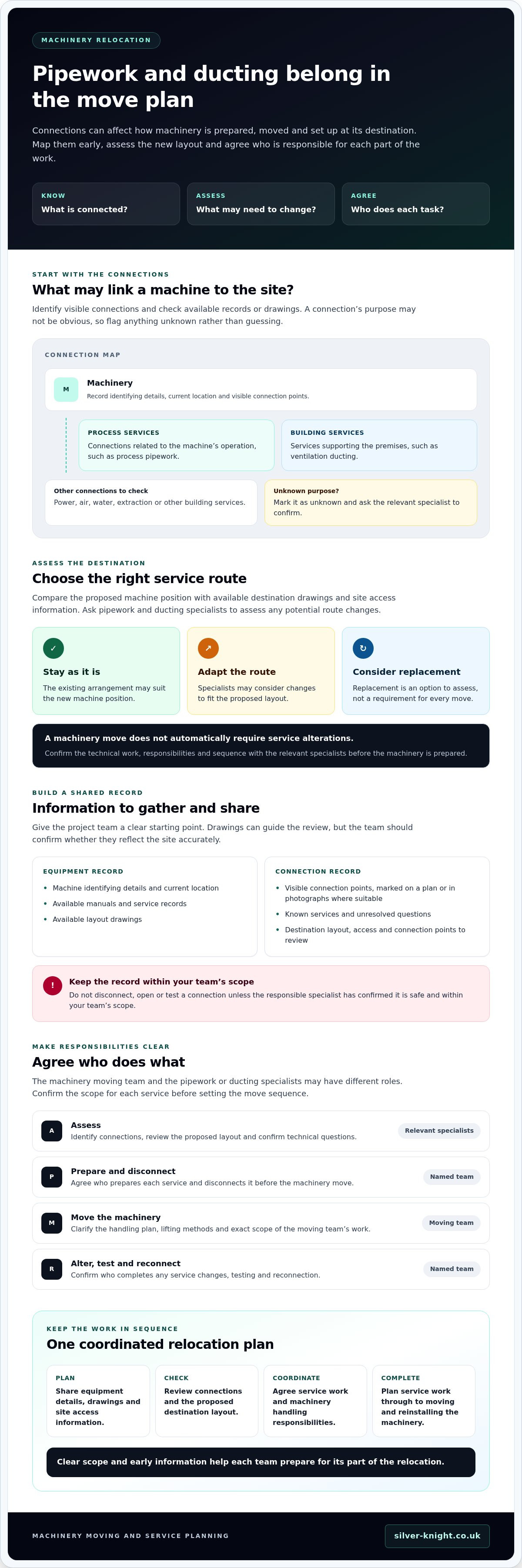
Machinery relocation involves more than preparing and moving equipment. A machine may connect to process pipework or ventilation ducting, as well as other services. These connections can affect how it is prepared, moved and set up at its destination. The work required depends on the machine, its connections and the new location. A machinery move doesn’t automatically require service alterations, so confirm the scope with the relevant specialists before work begins.
Keep responsibilities clear. The machinery moving team and the specialists responsible for pipework or ducting may have different roles. Before setting the move sequence, agree who will assess, disconnect, alter, test and reconnect each service.
Which connections may affect a machinery move
Start by identifying visible connections and checking available equipment records or drawings. A connection’s purpose may not be obvious from its appearance, so don’t assume what it carries or what it requires.
- Process services connect with the machine’s operation and may include process pipework.
- Building services support the wider premises and may include ventilation ducting.
These are broad categories, not a technical assessment. Ask the project team to confirm which connections serve the machine, which need to be disconnected and whether any must be altered before it can move. For background on piping as an engineering discipline, see the overview of piping systems and design.
What modification means in a relocation project
A different destination layout may lead specialists to consider whether a route should stay as it is, be adapted or be replaced. These are options to assess, not steps required for every move. The existing arrangement may suit the new position, or the machine’s placement may need reviewing alongside the service routes.
Ask the relevant specialists to check the proposed layout and confirm the technical work, responsibilities and sequence. Machinery dismantling services can form part of the moving plan, but don’t assume they include pipework or ducting changes. Confirm each contractor’s scope before the machinery is prepared.
How to assess pipework and ducting before machinery is moved
Start with what’s already known about the machine and its service connections. Collect equipment information and available drawings before deciding whether routes need to change. This gives the project team a shared starting point and helps specialists identify what to check on site.
“Recording service interfaces before moving equipment helps the project team spot questions early and agree who needs to answer them.”
Record the machine and its existing service connections
Note the machine’s current location, identifying details and any available manuals, service records or layout drawings. Record visible connection points and mark them on a plan or in photographs where suitable for the site. Don’t disconnect, open or test a connection as part of this record unless the responsible specialist has confirmed it’s safe and within your team’s scope.
If you don’t know what a pipe carries or what a duct serves, flag it as unknown. Guessing can lead to incorrect planning assumptions. Give the project team a clear list of known connections and unresolved questions, then ask the relevant specialist to confirm the details.
Check the destination layout and proposed routes
Compare the planned machine position with available destination drawings and site access information. Check whether the proposed location appears to align with existing service routes, and note anything needing closer review, such as access, clearances or connection points. Drawings can guide the review, but the project team should confirm whether they reflect the site accurately.
Ask qualified pipework and ducting specialists to assess potential route changes and confirm what falls within their scope. Ventilation can help manage air quality in workplaces. OSHA’s overview of ventilation as an engineering control offers general background, but it is US guidance, not a UK requirement. Have the responsible specialists verify the technical requirements for your site.
- Record open questions for the site survey rather than filling gaps with assumptions.
- Agree who will assess, disconnect, alter, test and reconnect each service.
- Share the findings with the machinery moving team so its work can be planned around service preparation.
This assessment doesn’t mean every connection needs altering. It helps the project team determine whether existing routes suit the proposed layout and what specialists need to confirm before machinery dismantling services and moving work are scheduled. To discuss the machinery moving part of your project, contact Silver Knight and clarify each team’s role.
Planning machinery moving or factory relocation? Explore Silver Knight’s machinery relocation services as part of a coordinated project.
Compare service modification with other relocation options
A new machine position doesn’t automatically mean its pipework or ducting must change. The team may be able to retain an existing route, ask specialists to adapt or replace it, or review the equipment position instead. The right option depends on the destination layout, access, connection condition and work sequence. Compare these factors with the relevant specialists before agreeing the scope.
| Option | What to assess | Question for the project team |
|---|---|---|
| Retain the route | Destination fit, access to connections and confirmed condition | Have specialists confirmed the route is suitable for the planned position? |
| Adapt or replace the route | Proposed changes, access for the work and timing alongside the move | Who will confirm the technical approach and carry out each agreed task? |
| Review equipment placement | Whether another position better fits the existing services and site layout | Can the machine be positioned differently without creating other access or moving issues? |
When retaining an existing route may be considered
Keeping a route may be an option if it suits the destination arrangement, but don’t assume an existing connection is suitable for reuse. Ask the responsible specialist to check its condition and compatibility with the planned equipment position. Confirm access needs and who will prepare and reconnect the service. Record the decision and responsible person in the project plan.
When a revised route or machine position needs review
A changed layout may make a service route awkward to reach or unsuitable for the proposed position. Ask the pipework or ducting specialist to assess possible route changes, while the machinery moving team considers whether an alternative equipment position is practical. Base the decision on access and work sequence as well as where the machine fits on a plan.
The International Mechanical Code standards for ductwork are a US reference, not a substitute for UK project advice. Ask the relevant specialists to confirm technical suitability and the limits of their agreed scope. Silver Knight’s factory relocation service may form part of the machinery moving plan, while service modifications should be assigned to the appropriate specialists. Clear boundaries matter, especially when machinery dismantling services are included in the wider move.
Planning a machinery move? Learn about Silver Knight’s machinery moving services and clarify how they could fit into your project plan.
How to coordinate service work with the machinery move
Service work and machinery handling need a shared sequence. If contractors make assumptions about who prepares a connection, moves the equipment or confirms it is ready to operate again, the handover can become unclear. List each task, its owner and the point at which the next team can begin. Confirm the plan with the responsible specialists before the move starts.
Agree responsibilities and work boundaries
Make a responsibility list naming the person or contractor responsible for each task. For example, the relevant service specialist confirms how connections will be prepared and who will reconnect them, while the machinery moving team handles the agreed equipment move. Record exclusions and open questions too. Agree who will tell the next contractor when the site or machine is ready for handover.
Sequence preparation, movement and recommissioning
Build the schedule around the agreed work sequence rather than treating service preparation as a separate job. Confirm site access, the planned movement route and when each contractor needs to be present. The responsible specialists should confirm when services are ready for machinery handling and who will carry out reconnection and checks at the destination.
Once the responsible specialists have prepared the connections, the machinery moving team can carry out its agreed work. The lifting approach should suit the equipment and move plan. Silver Knight lists hydraulic gantries, cranes and jack and slide systems among its specialist lifting equipment, but the appropriate method needs to be confirmed for each project.
- Before the move: confirm service preparation, access arrangements, scope boundaries and readiness handover.
- During the move: keep contractors informed if the agreed sequence or access plan changes.
- At the destination: agree who is responsible for reconnection, checks and confirming handover.
If equipment dismantling forms part of the agreed move, review the scope of machinery dismantling services alongside the service specialists’ responsibilities. Don’t assume pipework or ducting work is included. Discuss your machinery move with Silver Knight and clarify which tasks sit within each contractor’s agreed scope.
Planning a machinery move? Explore Silver Knight’s machinery moving and relocation services as part of your project discussions.
Choose a machinery relocation partner and prepare the next steps
A suitable relocation partner should be clear about the machinery work it can undertake, how it plans the move and where its responsibilities end. Pipework and ducting alterations should be discussed with the specialists responsible for those services. Agreeing boundaries early helps each contractor plan its part without assuming another team will handle a task.
Questions to ask before appointing a project team
Use your initial discussions to understand how machinery handling and specialist service work will fit together. Ask prospective partners:
- What machinery moving, dismantling, installation or lifting tasks are included in the proposed scope?
- What information or site survey may be needed to plan the move and assess access?
- How will the machinery movement be coordinated with service preparation and the work of other contractors?
- Who is responsible for disconnecting, modifying, testing and reconnecting pipework or ducting, and what falls outside each contractor’s scope?
- Who will confirm that services are ready before the equipment moves, and who will manage handover at the destination?
Ask for responsibilities and unresolved questions to be recorded in the project plan. Don’t treat machinery dismantling services as automatically including service alterations. Confirm exactly what the machinery contractor will do and which qualified specialist will handle each service task.
Information to prepare for an initial discussion
Useful project information helps the team understand the proposed move and identify what needs checking. Gather what you have, and mark gaps clearly rather than trying to fill them with assumptions.
- Machine details, its current location and proposed destination position.
- Available drawings, photographs and a record of known service connection points.
- Information about access to the machine and the planned movement route.
- Destination layout details, including questions about clearances or service routes.
- Your proposed sequence, known timing requirements and other contractors involved.
For a discussion about handling and transport, review the scope of machinery moving and haulage. Silver Knight provides machinery moving, dismantling and relocation services. Pipework or ducting alterations should be confirmed with the responsible service specialists, with their scope agreed as part of the project plan.
Have your project details ready and discuss your machinery relocation with Silver Knight.
Explore Silver Knight’s machinery moving services as you plan the next steps for your relocation.
Plan your next machinery move with clear responsibilities
Pipework and ducting shouldn’t be an afterthought in a machinery relocation. Record known connections, compare the machine’s proposed position with the destination layout, and ask the responsible specialists to confirm whether services can stay, need changing or require further checks.
Be clear about who prepares the services, who handles the machinery and who confirms reconnection. This helps you coordinate machinery dismantling services with the wider move without assuming service alterations are included in the machinery team’s scope.
Silver Knight is a family-run machinery moving and installation specialist with more than 180 years of collective industry experience. Its stated equipment capabilities include hydraulic gantries, cranes and jack and slide systems. Confirm pipework and ducting alterations with the relevant specialists.
To discuss your project, share the machine details, proposed move and known service connections with Silver Knight. Discuss your machinery relocation requirements and clarify the moving team’s scope.
Frequently Asked Questions
Does machinery relocation always require pipework or ducting modifications?
No. Some existing routes may suit the machine’s new position, so alterations aren’t automatically needed. The answer depends on the equipment, its connections and the destination layout. Ask the relevant pipework or ducting specialist to assess the proposed arrangement and confirm whether a route can remain, needs adapting or requires further work. Include the findings in the move plan before machinery preparation begins.
Who is responsible for modifying pipework and ducting during a machinery move?
Responsibility depends on the project scope and agreements between contractors. Ask the project team to name who will assess, disconnect, alter, test and reconnect each service. Don’t assume the machinery mover includes pipework or ducting work. Confirm the boundaries in writing, including who tells the moving team that services are ready and who confirms handover after reconnection.
How do I assess existing pipework and ducting before relocating machinery?
Start with machine details, available drawings and a record of visible service connection points. Add suitable photographs or mark-ups, and list anything you can’t identify rather than guessing what a pipe carries or a duct serves. Then ask the relevant specialists to compare existing routes with the proposed destination layout, check open access or clearance questions and confirm the work within their scope.
Can machinery be moved without changing its service connections?
Possibly, if the existing routes are compatible with the planned machine position and the responsible specialists confirm they can remain. Don’t rely on appearance or drawings alone to decide that a connection can be reused. Have its condition, access and destination arrangement assessed for the specific project. Record the decision and confirm how services will be prepared and reconnected.
What information should I provide before requesting a machinery relocation plan?
Share the machine’s details, current and proposed positions, available drawings, photographs and known service connection points. Include the destination layout, access constraints, planned movement route and any other contractors involved. Mark uncertainties clearly, especially around unidentified pipework or ducting. This gives the machinery moving team and service specialists useful context and helps them identify what needs a site review and who should answer outstanding questions.
When should pipework and ducting specialists be involved in a machinery move?
Involve them during planning, before the move sequence and responsibilities are fixed. Early input can help establish whether routes suit the destination, what preparation may be needed and how service work should align with machinery handling. Ask the specialists to confirm technical requirements and their agreed scope. Keep them involved through preparation and handover so the right people confirm readiness and reconnection.
Can a machinery moving company also modify process pipework or ventilation ducting?
Some providers may undertake other work, but check each company’s confirmed services and project scope rather than assuming. Silver Knight provides machinery moving, installation, dismantling and factory relocation. Pipework or ducting modifications should be confirmed with the relevant specialist. Agree who is responsible for those changes and how their work will coordinate with the machinery team.

Article by
David Ashby
I'm the Managing Director of Silver Knight Haulage & Machinery Ltd. Silver Knight Ltd is a family-run firm established in the West Midlands in 2005, with the aim of providing a cost-effective, yet professional, service to businesses for the removal, transportation, and installation of machinery, plant, and equipment here in the UK and worldwide. Between us, the Silver Knight workforce has over 50 years of experience with machinery and its operation.
Disclaimer
This article is intended for informational purposes only. Please ensure you seek expert advice or carry out your own research to confirm the information is suitable for your specific needs.