What if the most expensive part of your production line installation isn't the machinery itself, but the cost of every hour it sits idle during a botched setup? Transitioning to a new facility or upgrading your current floor is a high-stakes operation. You likely already know that even a tiny fraction of misalignment can lead to premature wear; similarly, an unforeseen floor load issue can halt progress for weeks. It's a stressful period where the risk of damage to high-value assets feels constant.
This guide shows you how to manage a successful production line installation whilst minimising downtime and ensuring precision mechanical alignment. We will look at why a project-based approach, involving technical site surveys and specialised lifting equipment, is essential for a smooth transition. You'll discover how to achieve a perfectly levelled line that's ready for immediate commissioning without compromising on health and safety standards. By the end, you'll have a clear roadmap for keeping your project on schedule and your budget intact.
Key Takeaways
- Learn why technical site surveys are vital to identify floor load limits and access issues that standard CAD drawings often miss.
- Discover how expert production line installation protects your capital investment by preventing mechanical stress and premature component wear.
- Understand the role of specialised tools like hydraulic gantry systems and jack and slide systems for moving heavy loads in restricted spaces.
- Find out how precision alignment and mechanical recommissioning ensure your equipment is perfectly levelled and ready for immediate operation.
- Identify the essential criteria for choosing an installation partner, including their specific industry experience and the quality of their lifting fleet.
Key Takeaways
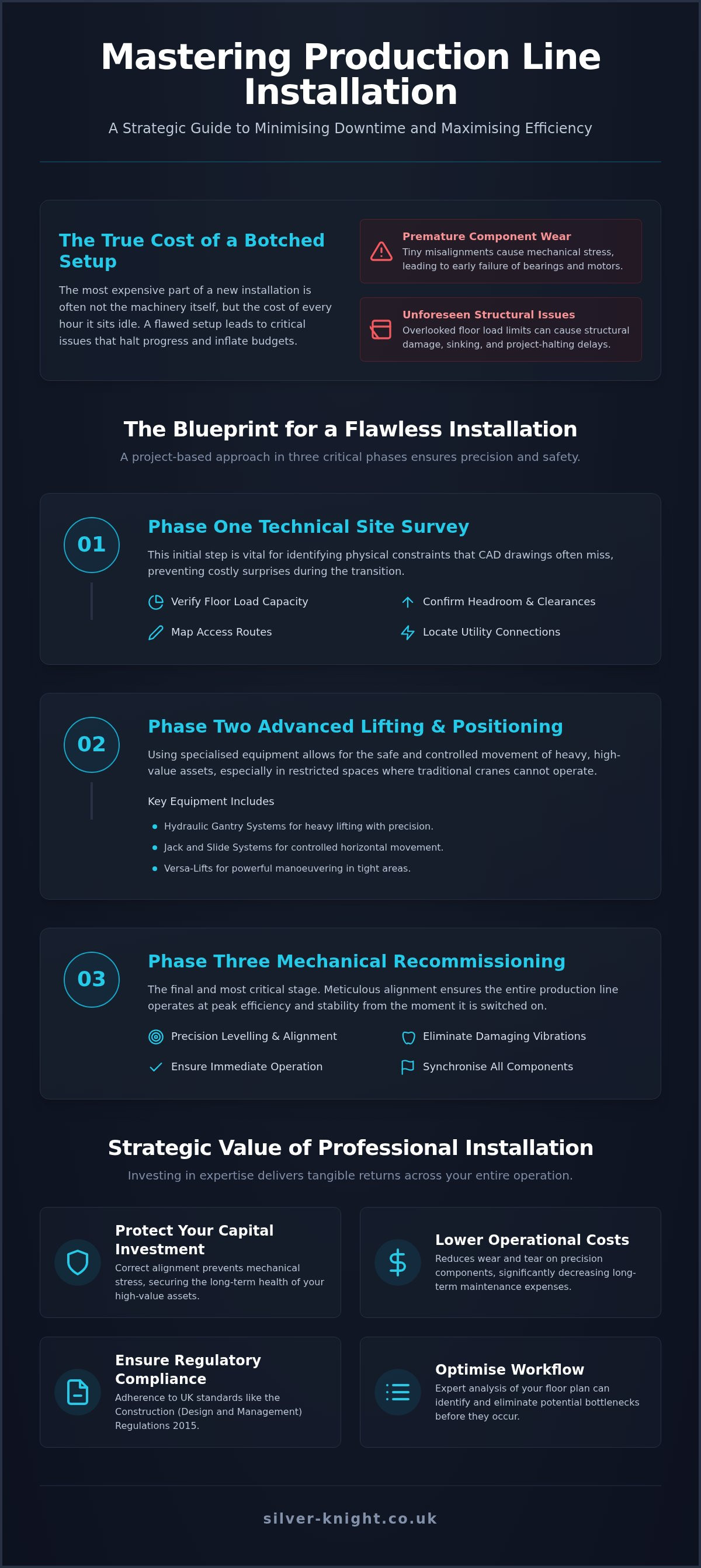
A professional production line serves as the foundation for efficient manufacturing, but its success depends entirely on the quality of the initial setup. Choosing a professional production line installation service helps to significantly reduce long-term maintenance costs. When machines are aligned correctly from day one, they experience less mechanical stress. This prevents the premature failure of bearings and motors that often plagues poorly installed systems. It's about more than just moving parts; it's about securing your capital investment for years to come.
Planning starts long before the equipment arrives on site. Technical site surveys are a non-negotiable part of the process, as they identify physical constraints that don't always appear on architectural drawings. These surveys ensure that the floor can handle the concentrated weight of the machinery and that there's enough clearance for the installation team to work safely. Without this foresight, you risk unexpected delays and potential damage to the facility floor.
To better understand this concept, watch this helpful video:
Managing Physical Constraints
Identifying floor load capacity and access routes early prevents expensive delays during the transition phase. Industrial floors aren't always uniform, and a heavy machine placed on a weak point can cause structural damage or sinking. By mapping out utility connections and entry points, engineers can create a clear path for the equipment. This project-based approach, backed by technical site surveys, ensures that the move happens without health and safety incidents. It also means you won't be surprised by low-hanging pipes or narrow doorways on the day of the move.
Precision Alignment Standards
High-speed production lines require extreme precision to operate at peak efficiency. Even a millimetre of misalignment can cause vibrations that damage sensitive components over time. Using specialised lifting equipment, such as hydraulic gantry systems or jack and slide systems, allows for controlled movement in tight spaces where traditional cranes can't reach. Once the machinery is in place, a thorough recommissioning process ensures every part is levelled and synchronised. This level of precision, often drawing on 180 years of collective industry experience amongst the team, ensures the line is ready for immediate operation once the power is switched on.
- Professional production line installation lowers operational costs by reducing wear and tear on precision components.
- Technical site surveys are vital for spotting floor load issues and physical obstacles that CAD drawings might miss.
- Specialised tools like Versa-Lifts and gantries allow for precision positioning in restricted areas with low headroom.
- Strict mechanical alignment during recommissioning is essential for high-speed operational stability and safety.
For expert assistance with your next project, visit the specialists at Silver Knight.
The Strategic Value of Professional Production Line Installation
Investing in high quality machinery is only half the battle for UK manufacturers. A successful production line installation ensures that those assets reach their operational potential without being compromised during the move. Beyond the physical placement of equipment, professional installers ensure your facility meets all current UK health and safety regulations. This includes adhering to the Construction (Design and Management) Regulations 2015, which regulators now treat as a practical framework for managing project safety rather than a simple paperwork exercise.
Skilled installers also bring a fresh perspective to your floor plan. They can identify potential workflow bottlenecks before the machinery is bolted down, suggesting adjustments that improve the movement of materials and personnel. This foresight prevents costly layout changes after the line has been commissioned. By integrating safety and efficiency at the earliest stage, you create a workspace that's both productive and compliant with the latest Health and Safety Executive standards.
Protecting Your Industrial Assets and Investment
Using general hauliers for precision machinery carries significant risks. Generalist movers often lack the specialised equipment, such as hydraulic gantries or Versa-Lifts, required for delicate handling. Without these tools, machinery can be subjected to sudden jolts or improper weight distribution. These stresses lead to micro-fractures in sensitive internal components. Whilst these fractures might not cause immediate failure, they certainly shorten the lifespan of the machine and lead to unexpected downtime later. Working with a team that possesses 180 years of collective experience ensures that every lift is calculated and controlled, protecting your equipment from the moment it leaves the transport vehicle.
Enhancing Long Term Manufacturing Efficiency
Precision levelling is a critical factor that determines the total units per hour your line can produce. When a line is perfectly balanced, it operates with minimal friction and vibration, allowing for higher speeds without the risk of mechanical failure. Correct alignment also has a direct link to reduced energy consumption, as motors and drives don't have to work as hard to overcome mechanical resistance. For businesses looking to improve their competitiveness, resources like the Manufacturing Advisory Service highlight how operational efficiencies drive growth. Silver Knight provides expert machinery installation services that prioritise this operational longevity and efficiency. If you're planning a new setup, you can contact us for a technical consultation to ensure your assets are installed correctly.
For expert assistance with your industrial layout, you can find out more by visiting Silver Knight.
Essential Planning and Technical Site Survey Procedures
Whilst CAD simulations are useful for conceptualising a layout, they often fail to account for the physical quirks of established UK industrial sites. A successful production line installation requires a hands-on technical site survey to bridge the gap between digital design and operational reality. These surveys identify physical obstacles like low-hanging structural beams, uneven floor gradients, or existing pipework that isn't documented on older architectural drawings. By catching these issues early, you avoid the chaos of discovering a machine won't fit through a designated doorway on the day of the move.
Mapping utility connections is another critical step in the pre-installation phase. Ensuring that power, compressed air, and water lines are exactly where they need to be allows for immediate hookup once the machinery is positioned. It's not just about the location of the sockets; it's about the volume of air or the voltage of the power required to run the line at peak capacity. This level of preparation is a key driver of manufacturing process efficiency, as it eliminates the need for last-minute electrical or plumbing modifications. When every connection point is pre-verified, the transition from installation to commissioning is seamless, keeping your project timeline on track.
Evaluating Floor Load Capacity and Structural Integrity
Heavy machinery exerts massive pressure on factory floors, often concentrated in small areas known as point loads. Our engineers calculate these loads to ensure the structural integrity of your facility isn't compromised. If the floor is deemed insufficient for the weight, we use spreader plates to distribute the load over a larger surface area. This prevents cracking or sinking, which could lead to long-term alignment issues. Silver Knight manages comprehensive technical site surveys for complex plant relocations, ensuring that every square inch of the path and the final position is safe and stable.
Mapping Access Routes and Obstruction Management
Many UK factories operate within older buildings where access is inherently restricted. Planning the delivery route is just as important as the installation itself. We assess every corner and corridor to ensure oversized components can reach their destination. Sometimes, this requires the temporary removal of doors, windows, or even non-load-bearing walls. Coordinating these efforts is essential for high-speed line integration, where multiple machines must be moved in a specific sequence. By managing these obstructions ahead of time, we ensure the installation team can work without interruption, maintaining a clear timeline and budget adherence.
If you're looking for a reliable partner for your next industrial move, you can find out more by visiting Silver Knight.
Advanced Lifting Equipment and Precision Positioning Methods
Traditional lifting methods often fall short when a production line installation occurs within a live factory environment. Space is usually at a premium. The presence of other operational lines means there's no room for error. This is where advanced engineering solutions become essential. By using specialised equipment, installers can navigate tight corners and low ceilings that would stop a standard construction crew in their tracks. It's about using the right tool for a very specific environment.
Utilising Hydraulic Gantries and Jack and Slide Systems
Hydraulic gantry systems provide a controlled lifting environment that's far safer than using mobile cranes indoors. Mobile cranes are hindered by their boom length; they need a massive amount of vertical space to operate effectively. In contrast, a gantry system can be assembled around the machine, lifting it vertically within the existing ceiling height. This is particularly useful for positioning heavy presses or CNC machines. Once the load is at the correct height, the jack and slide process allows for precise lateral movement. This method involves placing the machinery on a set of tracks, allowing it to be slid into position with millimetre accuracy. It's a slow and steady process that ensures the asset is never at risk of swinging or tipping. You can learn more about the technical specifications of these specialised lifting systems in our dedicated blog post.
Managing Restricted Access with Versa-Lift Technology
The Versa-Lift is a game changer for manufacturers with limited floor space. This machine manages heavy loads in narrow aisles by using an extendable counterweight, which allows it to lift far more than a standard forklift of the same size. For projects involving the production line installation of multiple smaller units, the Versa-Lift provides the agility needed to work quickly without compromising on safety. We always recommend using operated plant hire for these tasks. Having an expert operator who is familiar with the equipment's unique handling characteristics is vital for preventing accidents in crowded workshops. We offer a comprehensive fleet of specialised equipment for nationwide projects, ensuring your move is handled by the best tools available.
Precision positioning doesn't end when the machine touches the floor. The final levelling process is what truly defines a successful install. Using high-accuracy spirit levels and laser alignment tools, installers ensure that the machinery sits perfectly flat. This prevents the internal gears and belts from wearing unevenly, which is a common cause of early mechanical failure. With 180 years of collective industry experience, our team understands that these final millimetres are the difference between a line that runs smoothly and one that requires constant maintenance.
To ensure your project is handled with precision from start to finish, visit the experts at Silver Knight.
Mechanical Recommissioning and Final Alignment Standards
Once the physical production line installation is complete, the focus shifts to restoring the equipment to its full operational state. This phase, known as recommissioning, is where the technical skill of the engineers is most apparent. It's not enough for the machines to be in the right place. They must be perfectly synchronised to work as a cohesive unit. This involves reconnecting all mechanical and electrical interfaces and verifying that individual units communicate correctly with the central control system. Without this step, even the most expensive machinery cannot perform at its rated capacity.
Achieving Exact Tolerances for High Speed Production
High speed lines are particularly sensitive to even the slightest imbalance. Engineers use advanced laser alignment tools to ensure that long stretches of conveyors and processing units are perfectly straight. This precision is vital for machines that generate high centrifugal forces. A tiny deviation can lead to excessive vibration and premature bearing failure. The process of recommissioning machinery involves checking these tolerances at every stage of the setup. By achieving exact levelling, you ensure that the line operates smoothly at maximum throughput without the risk of mechanical fatigue.
Final Testing and Safety Handover Protocols
Before the line is handed back for full scale production, a series of dry runs must be performed. These tests allow the team to observe the machinery in motion without the stress of raw materials. They ensure that sensors, emergency stops, and interlocks are functioning correctly. This integration testing is the final bridge between a successful production line installation and daily operations. It provides a safe environment to identify any minor adjustments needed before the official handover. It's a critical period where potential faults are caught before they can cause a health and safety incident.
The final step is a formal safety handover, supported by comprehensive documentation. This includes all calibration reports, safety check certificates, and operational manuals. A successful installation often relies on how the project began. Using a professional machinery dismantle service ensures that parts were labelled and handled correctly from the outset. This careful preparation makes the final reinstallation and testing phase significantly more efficient. Once these protocols are complete, the line is ready for immediate commissioning, backed by the assurance of 180 years of collective industry experience.
If you need a partner for your next industrial project, you can find out more by visiting Silver Knight.
Criteria for Selecting an Industrial Installation Partner
Choosing a partner for a production line installation is a decision that impacts the long term health of your manufacturing facility. It's about finding a team that possesses the right combination of technical expertise, specialised equipment, and safety protocols. A reliable provider should offer a fully managed service that starts with a technical site survey and continues right through to final commissioning. By keeping the entire project under one roof, you eliminate the risk of miscommunication between different contractors. This unified approach is often the difference between a project that finishes on time and one that suffers from costly budget overruns.
A high quality partner will also demonstrate a clear commitment to safety and regulatory compliance. With the Health and Safety Executive placing a greater focus on organisational accountability in 2026, your chosen installer must provide transparent documentation for every phase of the move. This includes detailed risk assessments and method statements that reflect the physical reality of your site. Comprehensive insurance coverage is equally vital, as it provides peace of mind that your high value assets are protected against the unexpected.
Evaluating Experience and Specialised Equipment Fleet
When you are moving high value assets, 180 years of collective industry experience serves as a vital trust signal. It means the team has seen and solved almost every conceivable problem on a factory floor. This deep knowledge allows engineers to adapt to changing site conditions without causing delays. A key factor to verify is whether the company owns its own specialised lifting fleet. Relying on third party hire can lead to logistical failures if the equipment isn't available or arrives in poor condition. As a family run specialist, we maintain our own fleet to ensure nationwide reliability. This ownership means our operators are intimately familiar with their machines, which significantly improves safety and precision on site.
Managing Complex International Machinery Moves
Sometimes a production line installation involves moving assets across international borders. This adds layers of complexity, from customs documentation to the physical protection of machinery during long sea voyages. Professional shipping container packing is essential to prevent moisture damage and shifting during transit. Whether you are moving a single machine or an entire factory to the US or Asia, you need a partner with a proven track record in global logistics. We provide comprehensive international machine moving services, handling the entire process from decommissioning in the UK to reinstallation at your global destination. This managed approach ensures that your assets arrive in the same condition they left, regardless of the distance travelled. If you are ready to discuss your specific requirements, you can speak with our installation team today.
Frequently Asked Questions
Planning a complex industrial move often brings up specific technical and logistical questions. Below are some of the most common enquiries we receive regarding the setup and relocation of manufacturing assets.
What are the primary risks of a poorly managed installation?
The biggest risk is unexpected downtime. If a production line installation isn't planned correctly, you might find that utility connections don't match or that the floor cannot support the machinery's weight. This leads to delays that can cost thousands of pounds in lost production every hour. There is also a significant risk of mechanical damage. Precision components can suffer from micro-fractures if they are lifted without the correct specialised equipment. Finally, a lack of professional oversight can lead to health and safety incidents, which carry heavy legal and financial penalties under current UK regulations.
How do you handle floor load issues in older industrial buildings?
We begin every project with a technical site survey to assess the structural integrity of the facility. If we identify that a floor cannot handle the point loads of heavy machinery, we use spreader plates to distribute the weight across a larger area. This prevents the machinery from sinking or causing structural cracks. Our engineers calculate these loads before any equipment enters the building. This proactive approach is a core part of our factory relocation service, ensuring your facility remains safe and your equipment stays perfectly aligned.
Can you provide operated plant hire for specific lifts?
Yes, we offer a range of heavy moving equipment hire options that include experienced operators. Using an operated service is often safer and more efficient than dry hire. Our team is intimately familiar with the handling characteristics of our Versa-Lifts and hydraulic gantries. This expertise is vital when you are moving high value assets through narrow aisles or under low ceilings. It ensures that every lift is performed with the precision required for a successful production line installation, reducing the risk of accidents on your shop floor.
Do you manage both the dismantling and the reinstallation?
We provide a fully managed service that covers the entire lifecycle of the move. This starts with decommissioning and dismantling at the original site and ends with recommissioning at the new location. By managing both ends of the project, we ensure that every bolt, cable, and component is labelled and handled correctly. This continuity is essential for complex lines where individual units must communicate perfectly with each other. Our team also handles international machine moving, providing the same level of care and precision for projects that cross global borders.
What documentation is provided after the line is installed?
Once the installation is complete, we provide a comprehensive handover pack. This includes all relevant safety certificates, calibration reports, and technical documentation required for your records. We ensure that the project complies with the Construction (Design and Management) Regulations 2015. This documentation proves that the line has been installed to professional standards and is ready for safe operation. It also provides a vital reference for your maintenance teams, helping them keep the line running at peak efficiency for years to come.
For expert assistance with your industrial relocation, visit the specialists at Silver Knight.
Secure Your Manufacturing Future
A successful production line installation is the result of meticulous planning and technical precision. By prioritising site surveys and professional alignment, you protect your capital investment from mechanical stress and ensure immediate operational readiness. We've explored how specialised equipment like hydraulic gantries and Versa-Lifts allow for safe movement in restricted spaces, whilst thorough recommissioning prevents long term wear and tear. These steps are essential for any business looking to maintain a competitive edge in the UK manufacturing sector.
Silver Knight is a family-owned business delivering nationwide service backed by over 180 years of collective industry experience amongst our team. Our comprehensive fleet of specialised lifting machinery ensures that even the most complex transitions are handled with care and accuracy. Don't leave your machinery to chance; choose a partner that understands the physical reality of the factory floor. Contact Silver Knight for a professional production line installation quote today and take the first step towards a seamless facility upgrade.
Frequently Asked Questions
Planning a complex industrial move often brings up specific technical and logistical questions. Below are some of the most common enquiries we receive regarding the setup and relocation of manufacturing assets across the country.
How long does a typical production line installation take?
The duration of a production line installation depends on the complexity and scale of the machinery. A single machine might be positioned in a day, whereas a multi-stage line can take several weeks. We provide a clear timeline following a technical site survey, ensuring all utility connections are ready before the equipment arrives to minimise downtime.
What equipment is needed to install heavy manufacturing machinery?
Installing heavy manufacturing machinery requires specialised lifting equipment designed for precision. We utilise a fleet that includes hydraulic gantry systems for low-headroom areas, jack and slide systems for lateral movement, and Versa-Lifts for heavy lifting in narrow aisles. Using the right tools ensures that your assets are positioned safely without causing structural damage to the floor.
Do you provide production line installation services across the whole UK?
We provide comprehensive production line installation services across the entire United Kingdom. Our team operates nationwide to support manufacturers regardless of their location. This national reach allows us to handle factory relocations and plant moves with consistency. We bring our own specialised equipment and expert operators directly to your site to ensure a high quality service.
Can you manage the decommissioning of an old line before installing a new one?
We can manage the systematic decommissioning of your existing equipment before the new setup begins. Our factory clearance service includes the safe disconnection and removal of old plant machinery to create a clean workspace. By handling both the decommissioning and the subsequent reinstallation, we maintain project continuity and reduce the risk of miscommunication between different contractors.
Is insurance included when you install high value industrial machinery?
Comprehensive insurance coverage is a standard part of our service to protect your high value industrial assets. We understand that precision equipment represents a significant capital investment, so we ensure full protection throughout the move. Our team follows strict safety protocols and draws on 180 years of collective industry experience to prevent incidents and protect your property.
How do you manage floor load restrictions in older factory buildings?
Managing floor load restrictions starts with a technical site survey to calculate the specific point loads of your machinery. In older buildings, we often find that the floor requires reinforcement. We use heavy duty spreader plates to distribute the weight across a larger surface area. This proactive approach ensures that your setup is stable and the structural integrity remains intact.
What is the difference between a general haulier and a machinery installation specialist?
A machinery installation specialist provides technical expertise and specialised equipment that a general haulier cannot offer. Whilst a haulier might transport a load, a specialist manages the entire project from survey to final commissioning. We own and operate advanced tools like hydraulic gantries that allow for precision levelling and exact mechanical tolerances for long term efficiency.
Do you offer international production line relocation and installation?
We offer global relocation and installation services for production lines moving to Europe, the US, India, and Asia. Our international machinery transport service handles the entire logistics chain, including professional shipping container packing to protect assets. We coordinate the move from the initial decommissioning in the UK through to the final recommissioning at your global destination.
Article by
David Ashby
I'm the Managing Director of Silver Knight Haulage & Machinery Ltd. Silver Knight Ltd is a family-run firm established in the West Midlands in 2005, with the aim of providing a cost-effective, yet professional, service to businesses for the removal, transportation, and installation of machinery, plant, and equipment here in the UK and worldwide. Between us, the Silver Knight workforce has over 50 years of experience with machinery and its operation.
Disclaimer
This article is intended for informational purposes only. Please ensure you seek expert advice or carry out your own research to confirm the information is suitable for your specific needs.