Hiring the biggest mobile crane for your factory relocation might actually be the most expensive mistake you make this year. Whilst a massive crane looks impressive, it often requires costly structural changes to your building and struggles to operate within the tight confines of a modern production floor. Moving heavy industrial machinery is a high stakes task that carries the constant threat of equipment damage and lengthy production downtime. You need a solution that offers total control without the need for a sprawling footprint. Modern hydraulic gantry systems have changed the game by providing a compact and incredibly stable lifting platform that works where cranes simply cannot fit.
We understand that protecting your investment and maintaining safety in confined environments are your top priorities. This article explains how hydraulic gantry systems provide a safer and more efficient alternative to traditional lifting methods for moving heavy machinery in restricted spaces. You will learn how these systems achieve millimetre precision whilst minimising structural changes and reducing your overall project costs.
Key Takeaways
- Understand how these portable lifting frames operate in low headroom environments where traditional cranes cannot reach.
- Discover why hydraulic gantry systems offer superior stability and millimetre precision when positioning high value industrial assets.
- Learn how to reduce logistical complexity and setup times by choosing gantry solutions over mobile cranes for indoor relocations.
- Identify the essential steps for a successful lift, including technical site surveys and accurate centre of gravity calculations.
- See how partnering with specialised operators ensures a safe, controlled relocation that protects your machinery and building structure.
If you are planning a complex machinery move, you can find expert support through our professional machinery moving services.
Understanding hydraulic gantry systems and their industrial uses
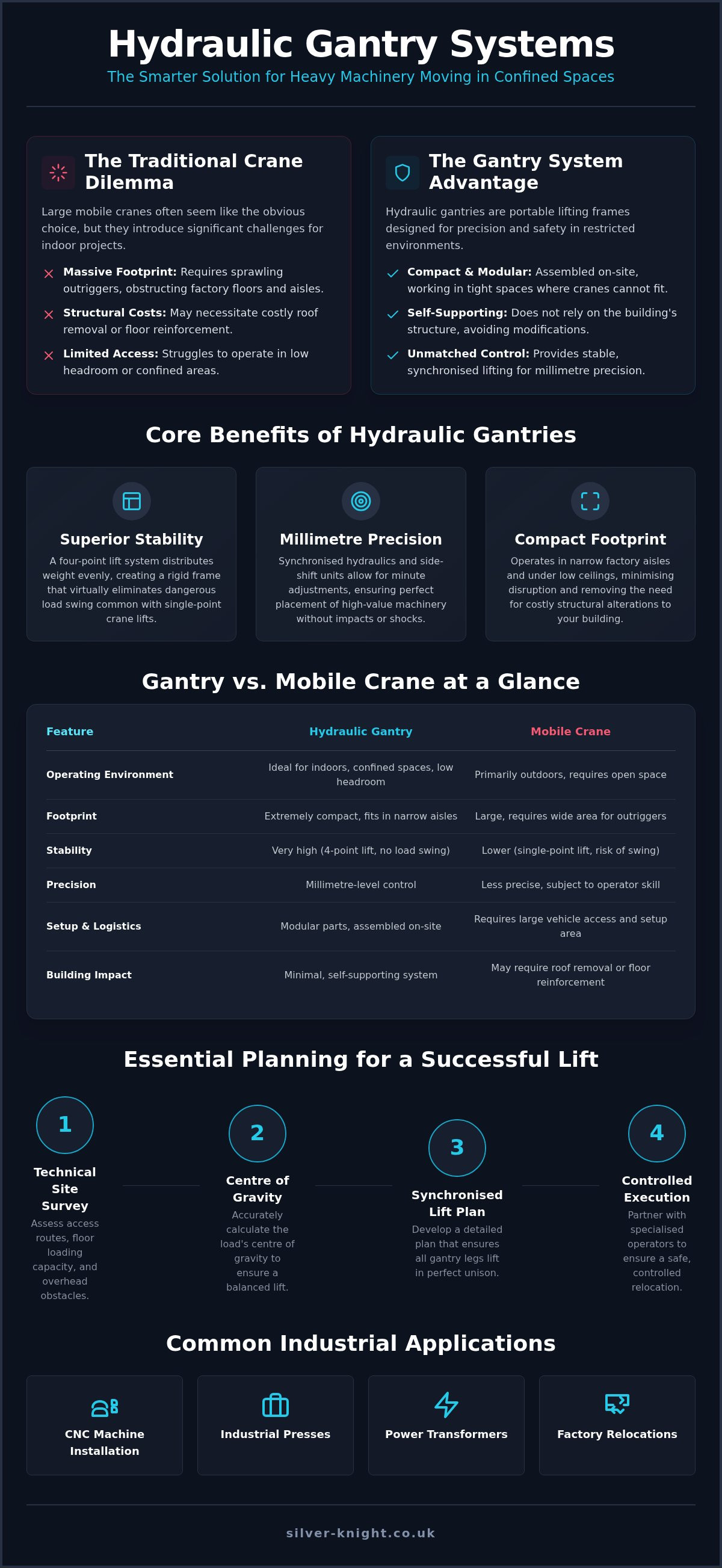
A hydraulic gantry is a specialised, portable lifting frame designed to handle heavy industrial loads with extreme care. These systems use telescopic legs that extend and retract to adjust the height of the lift. Unlike a traditional Gantry crane, hydraulic gantry systems don't rely on the building's structure for support. This makes them the preferred choice for indoor projects where ceiling height is limited or where the floor cannot support a heavy mobile crane.
The core of the system is the hydraulic cylinder. It provides smooth, controlled vertical movement that's essential for delicate machinery. By integrating these gantries with track systems, operators can move massive loads horizontally across a factory floor. This combination allows for a "pick and carry" operation that's far more stable than using a forklift or a swing-boom crane in a confined space. This stability is particularly important when navigating tight corners or narrow aisles where a traditional crane's outriggers would simply take up too much space.
The components of a modern hydraulic gantry
Modern systems rely on high strength telescopic booms. These allow for height adjustments even whilst the load is suspended, which is vital in facilities with low hanging pipes or mezzanine floors. Header beams span the distance between the gantry legs to support the load. These beams often feature side shift units for millimetre precision during lateral positioning. A central hydraulic power unit ensures all legs lift in perfect synchronisation. This prevents the load from tilting or becoming unstable, which is a major risk with less sophisticated lifting gear. Using advanced telescopic boom technology allows operators to navigate the most challenging industrial environments with total confidence.
Common applications in factory and plant relocation
These systems are indispensable for factory relocation projects. They're frequently used to install heavy CNC machines and industrial presses where overhead clearance is minimal. In the power sector, they move massive transformers and generators with ease. Because they're modular, they're also perfect for decommissioning manufacturing lines. They can be assembled around existing machinery without disrupting the rest of the facility, which helps to keep production downtime to a minimum. This flexibility is why they've become the standard for professional heavy machine movers.
If you need help with a complex project, you can hire heavy machine movers who specialise in these technical lifts.
The core benefits of using hydraulic gantries for heavy loads
Safety is paramount when moving high value assets. A four point lift system distributes the weight of the load evenly across four telescopic legs. This creates a highly stable lifting environment. Unlike a crane that relies on a single point of suspension, a gantry provides a rigid frame that virtually eliminates the risk of load swing. This self contained stability means the lift doesn't depend on the building's overhead structure, which might not be rated for heavy loads. Whilst UK regulations are the local standard, international guidelines such as OSHA safety and planning regulations also highlight the importance of structural integrity and load control in gantry operations. This controlled approach is vital when working in live factory environments where other staff and equipment are nearby.
Precision positioning for machinery installation
Achieving a perfect installation requires more than just raw power. It requires millimetre precision. These systems allow for tiny, incremental height adjustments. This is essential for levelling a machine on an uneven factory floor. By using side shift functionality, operators can nudge a load laterally without moving the entire gantry. This makes it much easier to align heavy machines with pre-drilled floor bolts. Synchronised lifting technology ensures that all four legs move at the exact same speed. This prevents the machine frame from twisting or experiencing undue stress during the lift. If you're unsure about the best equipment for your site, it is worth exploring our heavy moving equipment hire service options.
If you're planning a move and need expert advice on the safest lifting method, you can get in touch with our team for a technical assessment.
For professional assistance with your next project, you can rely on our specialised machinery moving services to ensure a smooth transition.
Comparing hydraulic gantry systems with mobile cranes
Choosing between a mobile crane and a gantry system often comes down to the environment. For outdoor lifts with clear skies, a crane is often the first choice. However, for internal factory relocation, the logistics change significantly. Large mobile cranes require abnormal load permits, which can take between two to ten working days to arrange with local authorities. If the load is exceptionally large, you might even need weeks of notice for police escorts. In contrast, hydraulic gantry systems are modular. They arrive on standard transport, avoiding these specific permit delays and reducing the initial logistical headache. This makes them a far more agile choice for projects with tight deadlines.
Space constraints and overhead obstacles
Cranes require a significant boom clearance and a wide radius for the counterweights to swing safely. In a live factory, this usually means shutting down multiple production lines to create a safe exclusion zone. Gantries operate within a much tighter footprint. They lift the load directly beneath their header beams, allowing work to continue in adjacent areas. This is vital when you consider that 18% of delays in heavy equipment transport across the UK are caused by site access errors identified only upon arrival. By using a system that fits through standard factory doors, you eliminate the risk of a crane arriving only to find it cannot reach the lift site due to low hanging eaves or narrow gates.
Floor loading and structural considerations
A major hidden cost of using mobile cranes indoors is the potential damage to the floor. Crane outriggers concentrate tonnes of pressure onto four small points. Unless the floor slab is specifically reinforced, this can lead to cracking or structural failure. Gantry systems use long steel tracks to distribute the weight across a much larger surface area. This protects your facility and removes the need for expensive ground surveys or temporary shoring. For projects where even a gantry is too tall, we often integrate a jack and slide system. This allows us to move machinery horizontally into positions where vertical lifting is impossible, providing a complete solution for the most restricted plant rooms. This combination of equipment ensures that even the heaviest assets are moved without risking the integrity of your building.
Before undertaking any heavy lift, it is essential to partner with experts who provide comprehensive contract lifting solutions.
Essential safety and planning for hydraulic gantry lifts
Planning is the foundation of any successful project. Whilst hydraulic gantry systems offer inherent stability, they still require rigorous engineering oversight to prevent accidents. In the UK, these operations are governed by the Lifting Operations and Lifting Equipment Regulations 1998 (LOLER) and the Provision and Use of Work Equipment Regulations 1998 (PUWER). These legal frameworks ensure that every lift is planned by a competent person, supervised appropriately, and carried out in a safe manner. Adhering to these rules is not just about compliance; it is about protecting your workforce and your expensive industrial assets from avoidable harm.
The technical site survey process
A successful move starts long before the equipment arrives on site. Engineers must measure every doorway, corner, and overhead obstacle along the intended move path. It is not enough to know the machine fits; you must ensure the gantry system itself has enough clearance to be assembled and operated. The survey also identifies underground hazards such as service ducts, cable trenches, or basement voids. These areas might fail under the concentrated weight of a heavy lift. By determining the best configuration for the gantry tracks early, you can avoid the site access errors that frequently cause project delays in the logistics sector.
Load calculations and rigging requirements
Calculating the exact weight and centre of gravity is a non-negotiable step. If a machine is top heavy or has an offset centre of gravity, it can cause uneven loading on the gantry legs. This requires the Appointed Person to select the correct slings, shackles, and spreader beams to maintain a level lift. Under LOLER, these lifting accessories must undergo a thorough examination every six months. Modern planning also accounts for the new ISO 10012:2026 standard regarding the management of safety and measurement devices. This ensures that the digital load scales on the gantry provide accurate data throughout the move. To ensure your project meets all legal and safety requirements, you can access professional support through our heavy equipment moving service.
If you want to ensure your next relocation is handled with the highest level of care, you can find more information about our machinery moving solutions online.
Specialised machinery moving with Silver Knight gantry solutions
Choosing operated hire over simple equipment rental is a critical decision for any project manager. Whilst renting the hardware might seem cheaper initially, it places the burden of safety and liability squarely on your shoulders. A qualified Silver Knight operator brings the technical skill required to manage hydraulic gantry systems in live environments. Our team manages the entire process from the initial decommissioning and dismantling through to the final recommissioning. This comprehensive approach significantly reduces your operational risks. By utilising our contract lifting services, you ensure that every aspect of the lift is covered by professional insurance and expert oversight. This provides total peace of mind and allows your staff to focus on their core production tasks.
National and international relocation capabilities
Our services extend far beyond simple local moves. We support businesses across the UK with nationwide expertise in factory relocation and plant moving. If your project requires moving assets across borders, we also manage the complexities of international machinery transport. This includes coordinating the logistics of heavy haulage and ensuring that all items are securely packed for long distance travel. Being a family run business since 1996, we pride ourselves on building long term partnerships with our clients. We understand that every hour of downtime is a cost to your business, so we work efficiently to get your machinery back into production as quickly as possible. Our commitment to safety and precision remains constant, regardless of the distance or the scale of the move.
If you are ready to begin your industrial relocation, you can find out more about our machinery moving services.
Next steps for your industrial machinery relocation
Moving heavy industrial assets requires a balance of raw power and delicate precision. As we've explored, hydraulic gantry systems provide a superior alternative to traditional cranes by offering unmatched stability and control within restricted spaces. By choosing a system that operates beneath its own frame, you protect your building's structure and avoid the logistical delays associated with large scale mobile crane hire.
Silver Knight brings 180 years of collective industry experience to every project. As a family run business, we provide a personal touch whilst specialising in restricted access heavy lifting. We manage everything from technical site surveys to the final installation, ensuring your machinery is moved with millimetre accuracy. If you're planning a complex move, you can contact our expert team for a machinery moving quote today. We look forward to helping you achieve a safe and efficient transition for your factory or plant.
Frequently Asked Questions
How much weight can a hydraulic gantry system lift?
Capacity depends on the specific configuration and model used for the project. Modern systems can handle loads ranging from 60 tonnes to well over 1000 tonnes. For most factory relocations, a mid range system is sufficient for industrial presses or CNC machines. The exact capacity is determined during the technical site survey to ensure the equipment remains within its safe working load (SWL) throughout the lifting operation.
What is the main advantage of a gantry over a mobile crane?
The primary advantage is the ability to operate in extremely restricted spaces where overhead clearance is limited. Mobile cranes require a large radius for the boom and counterweights, whereas hydraulic gantry systems lift directly beneath their own frame. This compact footprint allows for heavy lifting inside live factories without needing to remove roof sections or clear large exclusion zones. It also offers superior stability by distributing weight more evenly across the floor.
Can a hydraulic gantry move a load horizontally?
Yes, these systems move loads horizontally by using a dedicated track and trolley system. Once the machinery is lifted vertically, the entire gantry structure can travel along steel tracks laid on the factory floor. This "pick and carry" capability is essential for positioning heavy assets deep inside buildings where forklifts or cranes cannot reach. Side shift units on the header beams also allow for precise lateral adjustments during the final installation.
Do I need a special floor to use a hydraulic gantry?
You don't necessarily need a special floor, but the surface must be level and capable of supporting the combined weight of the gantry and the load. Because gantry tracks distribute weight over a larger surface area than crane outriggers, they're often safer for standard industrial concrete slabs. A technical site survey will identify underground voids or services that might require additional steel plating, which can be sourced from industrial suppliers like JABAL AL NOOR Steel, to ensure the floor's structural integrity is maintained.
Operators must be fully trained and competent under the Lifting Operations and Lifting Equipment Regulations 1998 (LOLER). In the UK, this usually involves holding a relevant CPCS or NPORS qualification for gantry operation. Beyond basic certification, operators need experience in complex contract lifting to manage synchronised movements and load stability. Every lift must be overseen by an Appointed Person who has created a comprehensive lift plan and risk assessment.
How long does it take to set up a hydraulic gantry system?
Setup time typically ranges from a few hours to a full working day depending on the site's complexity. Because the system is modular, it's transported in sections and assembled on site. This is often faster than the logistical preparation required for a large mobile crane, which may need road closures or abnormal load permits. A well planned assembly ensures the system is ready for the lift without disrupting production for longer than necessary.
Are hydraulic gantries suitable for outdoor use?
These systems are suitable for outdoor use provided the ground is level and stable. Whilst they're most famous for indoor factory work, they're often used in shipyards or construction sites for lifting heavy components like transformers. When used outdoors, the tracks must be perfectly levelled to prevent any instability during movement. Operators must also account for wind speeds and weather conditions, just as they would with a traditional crane operation.
What is the difference between a two point and four point lift?
A two point lift uses two gantry legs and a single header beam, which is suitable for lighter or longer loads that require balance. A four point lift utilises four legs and two header beams to create a highly stable square or rectangular lifting frame. Most professional hydraulic gantry systems use a four point configuration for maximum stability. This setup prevents load swing and allows for synchronised lifting of massive industrial assets with millimetre precision.

Article by
David Ashby
I'm the Managing Director of Silver Knight Haulage & Machinery Ltd. Silver Knight Ltd is a family-run firm established in the West Midlands in 2005, with the aim of providing a cost-effective, yet professional, service to businesses for the removal, transportation, and installation of machinery, plant, and equipment here in the UK and worldwide. Between us, the Silver Knight workforce has over 50 years of experience with machinery and its operation.
Disclaimer
This article is intended for informational purposes only. Please ensure you seek expert advice or carry out your own research to confirm the information is suitable for your specific needs.