Could a single oversight during your cardboard baler relocation lead to a permanent hydraulic failure and weeks of operational chaos? It's a risk many facility managers face when moving heavy waste equipment across a busy warehouse or to a completely new site. You likely understand that these machines are far more than just heavy metal; they're precise tools with sensitive internal systems that don't take kindly to being tilted, jolted, or handled by inexperienced teams.
We'll help you navigate this complex process without the stress of potential structural damage or fluid leaks. In this guide, you'll learn how to plan and execute a safe cardboard baler relocation whilst avoiding the common pitfalls that cause costly downtime. We'll also look at how to ensure your move aligns with the Simpler Recycling legislation taking effect on 31 March 2026. From professional decommissioning to the final recommissioning at your new facility, we'll preview the essential steps required to keep your waste management operations running smoothly and safely.
Key Takeaways
- Technical site surveys identify potential obstacles and allow for a precise timeline that minimises operational downtime.
- Specialised lifting gear such as hydraulic gantry systems is essential for moving heavy machinery safely through confined warehouse environments.
- You can maintain compliance with health and safety standards by ensuring all lifting operations are supported by professional risk assessments.
- A successful cardboard baler relocation depends on expert decommissioning to protect the integrity of the hydraulic frame and internal components.
- Expert machinery movers provide the necessary oversight and equipment to prevent structural damage during every stage of the transit.
If you are planning a facility move and require support from experienced professionals, you can rely on the expertise provided by Silver Knight Haulage & Machineries Ltd for all your equipment needs.
Preparing for Cardboard Baler Relocation
Moving an industrial baler is far more complex than simply shifting heavy furniture. These machines are engineered with strict tolerances and sensitive internal components. If you've ever asked What is a Baler? in a technical context, you'll know they rely on high pressure hydraulic systems and rigid frames. A successful cardboard baler relocation begins with a technical site survey to identify potential hazards before any lifting equipment arrives. Standard haulage firms often lack the specialised tools needed to handle the top heavy nature of these units, which can lead to structural warping if the frame isn't supported correctly during transit.
Technical surveys allow engineers to assess floor loading capacities and ceiling heights. This ensures the machine can be extracted without damaging the warehouse floor or striking overhead services like fire sprinklers or lighting rigs. Relying on general movers without this preparation often results in avoidable accidents and expensive repairs to the building infrastructure.
Assessing Weight and Dimensions
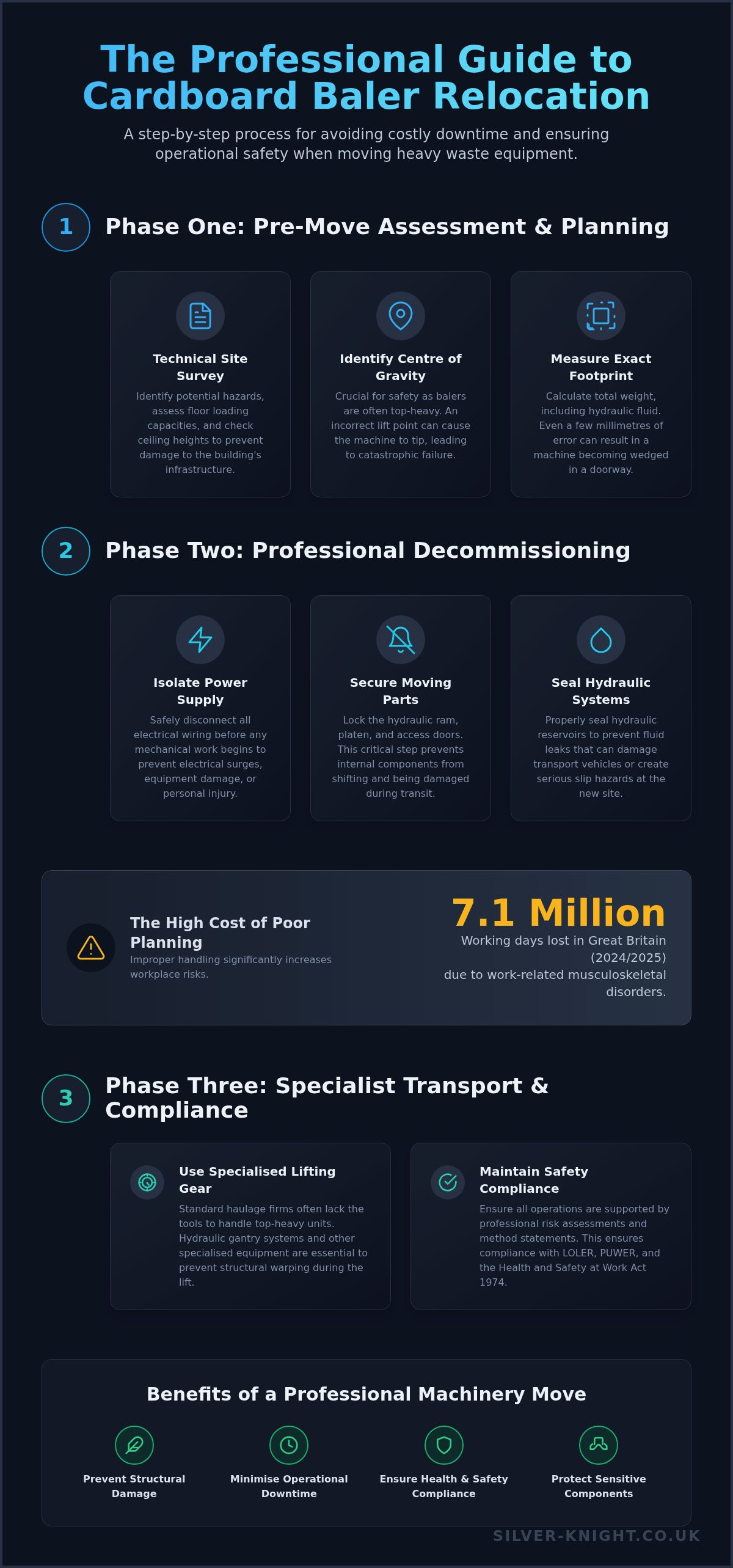
You must calculate the total weight of the unit, including the volume of hydraulic fluid stored in the reservoir. This total figure determines the specific lifting gear and transport vehicles required for the job. Measuring the exact footprint is equally vital; even a few millimetres of error can lead to a machine becoming wedged in a narrow corridor or doorway. Identifying the centre of gravity is the most critical step for safety. Because balers are often top heavy, an incorrect lift point can cause the machine to tip, leading to catastrophic mechanical failure or serious injury to the site team.
Site Access Requirements
The entire route to the new location must be scrutinised for floor gradients. Even a slight slope can destabilise a baler whilst it's being moved on skates. You also need to evaluate the strength of the concrete pad at the destination. Industrial balers exert significant point loads, and a weak floor will eventually crack or subside under the pressure. Finally, ensure that external loading bays can accommodate low loader trailers. These vehicles are necessary for transporting tall machinery whilst staying within legal height limits on UK roads, ensuring your equipment arrives without being damaged by low bridges or overhead cables.
If you are looking for a professional team to manage your machinery moving project, expert assistance can help you avoid operational downtime.
Essential Planning Steps for a Successful Move
Planning a cardboard baler relocation requires more than just picking a date on a calendar. You need a detailed timeline that accounts for every hour of lost production to keep your facility running. Coordinating with electrical engineers is vital; they must safely disconnect the power before any mechanical work begins to prevent electrical surges or injury. You should also organise all health and safety documentation, including method statements and permits, well in advance to avoid site access delays. This planning ensures compliance with the Health and Safety at Work etc. Act 1974 and the Provision and Use of Work Equipment Regulations (PUWER). If you don't have a robust plan, you risk musculoskeletal disorders amongst your staff, which accounted for 7.1 million lost working days in Great Britain in 2024/2025. Securing moving parts like the platen and access doors is a critical step that prevents internal damage whilst the machine is on the move.
Professional Decommissioning Procedures
This stage is where many projects fail. You must isolate the power supply and remove all electrical wiring to prevent damage during the lift. Securing the hydraulic ram is essential to prevent it from shifting whilst in transit. For very large units, using professional machinery dismantle services allows for safer transport of individual components. It's also a good time to review OSHA safety and compliance standards regarding the anchoring of fixed machinery to ensure your new installation meets international best practices. Proper decommissioning also involves sealing hydraulic reservoirs to prevent leaks that can damage the transport vehicle or create slip hazards at the new site, ensuring you remain compliant with the Lifting Operations and Lifting Equipment Regulations (LOLER).
Logistics and Route Planning
Once the machine is ready, the focus shifts to the road. Identifying the most efficient route across the UK network prevents delays caused by height restrictions or weight limits on rural bridges. You must determine if the baler's width qualifies it as a wide load, which requires specific police or local authority notifications. Scheduling the cardboard baler relocation during off peak hours helps reduce congestion at your loading bays and ensures the transport team has the space they need to work. Effective logistics also means ensuring the destination site is ready for immediate offloading with the correct power connections already in place. If you need help organising your next project, you can contact our specialist team for advice.
If you require specialist equipment for your next industrial project, Silver Knight Haulage & Machineries Ltd provides a comprehensive range of lifting and transport solutions.
Specialist Equipment Required for Baler Transport
Using a standard warehouse forklift for a cardboard baler relocation is a common mistake that often leads to accidents or equipment damage. These machines are incredibly heavy and have a high centre of gravity, meaning they require specialised lifting gear designed for industrial loads. Hydraulic gantry systems are indispensable when working in confined spaces with low ceilings where a mobile crane simply cannot fit. These systems allow for a vertical lift and controlled lateral movement, ensuring the baler remains level throughout the process. When precise positioning is required on a sensitive floor, jack and slide systems allow engineers to move the unit into place with millimetre accuracy. This approach is detailed further in this heavy machinery moving guide, which highlights the importance of using the right tool for the specific weight and shape of the asset.
Versa Lift and Forklift Hire
For many facilities, restricted access is the biggest hurdle. Opting for versa lift hire provides a versatile solution because these machines feature an extendable counterweight. This allows them to lift heavy industrial balers whilst maintaining a compact footprint that fits through standard factory aisles. Heavy duty forklifts are also used, but their capacity must be carefully matched to the machine's weight, including its hydraulic fluids. Having a qualified operator on site during a cardboard baler relocation is not just a recommendation; it's a legal necessity to ensure compliance with LOLER regulations and to prevent the risk of tipping during the lift.
Heavy Haulage and Transport Fleet
Once the machine is out of the building, the transport vehicle becomes the priority. Low loader trailers are superior to standard flatbeds because they sit closer to the road, providing the extra height clearance needed for tall baling equipment. This ensures the load can pass under bridges without issue. A dedicated machinery moving fleet often utilises air ride suspension. This technology absorbs the shocks and vibrations of the road, protecting the sensitive seals and valves within the hydraulic system. By using our equipment, you ensure that every stage of the transit is managed with the highest level of technical care, from the initial lift to the final offloading at the new site.
For expert support with your next industrial move, contact the specialists at Silver Knight Haulage & Machineries Ltd today.
Managing Safety Risks and Compliance Standards
Safety is the most critical element of any cardboard baler relocation. You cannot treat a move of this scale as a simple haulage task. It requires a detailed Method Statement and Risk Assessment (RAMS) to satisfy insurers and health and safety officers. These documents outline exactly how the lift will be performed, who is responsible for each stage, and what emergency procedures are in place. A dedicated project manager oversees this process, ensuring that the work stays on schedule without compromising on safety. They also verify that the machinery is covered by both public liability and transit insurance. Since standard haulage insurance often has limited liability, having specialist coverage is essential for protecting high value industrial assets like balers.
LOLER and PUWER Regulations
The Lifting Operations and Lifting Equipment Regulations 1998 (LOLER) are central to industrial moving. Every lift must be planned by a competent person and supervised appropriately. Similarly, the Provision and Use of Work Equipment Regulations (PUWER) ensure that any machinery used for the move is fit for purpose and safe to operate. You must ensure all lifting equipment has the correct certifications and has undergone regular inspections. This legal framework is designed to prevent accidents during complex manoeuvres. These regulations work alongside the Management of Health and Safety at Work Regulations 1999 to ensure that every risk is identified and mitigated before the equipment leaves its original position.
On Site Risk Mitigation
Practical safety starts with establishing clear exclusion zones. These areas must be cordoned off to prevent unauthorised staff from entering the lift path or the loading area. Before the first chain is attached, the team should conduct a tool box talk. This briefing ensures everyone understands their role and the specific hazards of the site, such as floor gradients or tight corners. You must also verify that all lifting tackle, including slings and shackles, is rated for the specific weight of the baler. Using equipment with a Safe Working Load (SWL) that exceeds the machine's weight provides a necessary safety margin. This approach reduces the risk of workplace injuries, which currently account for approximately one third of all reported incidents to the HSE in the UK. If you need a team that prioritises safety and compliance for your machinery move, you can book a technical site survey with our experts.
If you want to ensure your equipment is handled by a team with extensive industry expertise, discover the range of services offered by Silver Knight Haulage & Machineries Ltd.
Benefits of Professional Machinery Moving Services
Choosing a professional team for your cardboard baler relocation ensures that every technical detail is managed by experts. Industrial equipment is prone to costly errors when handled by general hauliers who don't understand the specific stresses placed on a baler's frame. With 180 years of collective industry experience, our team provides a turnkey relocation service that allows your business to focus on its core operations. Being a family owned and operated specialist since 1996, we offer a level of personal care and accountability that larger corporations often struggle to match. This managed approach minimises the risk of hydraulic failure or structural misalignment, which are common issues when machines are moved without proper engineering oversight.
Recommissioning and Testing
The relocation process doesn't end when the machine is offloaded. Recommissioning is a vital step where the machinery is levelled precisely at its new location. If a baler isn't perfectly level, the ram can exert uneven pressure; this leads to premature wear or catastrophic failure of the hydraulic seals. Our engineers reconnect all power and hydraulics according to original manufacturer specifications, ensuring the unit is safe for immediate use. Before the project is signed off, we perform a full operational test. This involves cycling the machine through its full range of movement to verify that all safety interlocks and hydraulic valves are functioning correctly, giving you total confidence in your new setup.
National Coverage and Reliability
Reliability is paramount when you're managing tight production schedules. A professional machinery haulage and relocation service with national reach ensures that you receive the same high standards whether you're moving a single item or requiring a full factory clear. We maintain a specialised fleet and a team of experts capable of navigating the logistics of any cardboard baler relocation across the UK. This nationwide capability means we can respond quickly to your requirements and provide the necessary equipment, such as Versa-Lifts or hydraulic gantries, at short notice. Whether you are expanding your recycling capacity or consolidating your warehouse space, having a reliable partner ensures your industrial assets are always in safe hands.
If you are ready to plan your next factory move with a team of experts, you can find out more about our heavy machine movers and the specialised equipment we use.
Securing Your Industrial Assets for the Future
A successful cardboard baler relocation requires a balance of technical engineering and strict safety compliance. Throughout this guide, we have explored how technical site surveys and specialised equipment like hydraulic gantries prevent structural damage and operational delays. By following professional decommissioning and recommissioning procedures, you ensure your machinery remains in peak condition whilst meeting the new recycling standards taking effect in 2026. These steps are essential for any business looking to move heavy assets without the risk of hydraulic failure or site accidents.
Silver Knight Haulage & Machineries Ltd offers 180 years of collective experience and a family run approach that guarantees personal accountability. We provide fully insured nationwide services, ensuring your equipment is protected from the initial lift to the final operational test. For a safe and efficient move, contact our expert machinery movers today for a technical survey. Our team is here to ensure your transition to a new site is handled with professional precision and care.
Frequently Asked Questions
How much does it cost to relocate a cardboard baler?
It is not possible to provide a fixed price for this service because costs depend on factors like the weight of the unit and site access. Every relocation is unique and requires a technical survey to determine the necessary lifting gear and transport vehicles. We recommend contacting a specialist for a bespoke quote based on your specific operational requirements and the distance of the move.
Do I need to empty the baler before it is moved?
Yes, you must ensure the chamber is completely empty and any finished bales are removed before the move begins. Leaving material inside the machine adds unnecessary weight and can cause internal blockages or damage to the pressing mechanism during transit. An empty chamber also makes it easier for our team to secure the platen and other moving parts for a safe cardboard baler relocation.
Can a standard forklift move a large industrial baler?
A standard warehouse forklift is usually unsuitable for moving large industrial balers due to their high centre of gravity and extreme weight. Attempting to use a standard lift often leads to the machine tipping or the forklift becoming unstable. Instead, we use specialised equipment like Versa-Lifts or hydraulic gantry systems which are designed to handle top heavy industrial assets safely in confined spaces.
How long does the relocation process usually take?
The duration of the move typically ranges from a single day for internal shifts to several days for complex long distance projects. The exact time depends on factors such as the complexity of the decommissioning and the distance between sites. We create a detailed timeline during the planning phase to ensure your machine is recommissioned as quickly as possible to avoid extended operational downtime.
What insurance cover do you provide during the move?
We provide comprehensive transit and public liability insurance for all machinery moving projects to protect your assets. Standard haulage insurance is often insufficient for high value industrial equipment, so we ensure our coverage is tailored to the specific value of your baler. This provides peace of mind that you are protected against any unforeseen issues from the moment we begin decommissioning until final installation.
Is it necessary to disconnect the power before you arrive?
You should arrange for a qualified electrician to disconnect the power supply and isolate the unit before the lifting team arrives. Our team focuses on the mechanical relocation, so having the electrical work finished in advance prevents delays and ensures a safe working environment. We can coordinate with your engineers to ensure the disconnection happens at the correct point in the project timeline.
Can you move a baler into a basement or upper floor?
Moving industrial equipment into basements or onto upper floors is possible but requires specialised contract lifting and technical planning. We assess the floor loading capacity and ceiling heights at the new location to ensure the structure can support the baler's weight. Using hydraulic gantries or jack and slide systems allows us to position heavy machinery in areas where traditional cranes or forklifts cannot operate.
Do you offer storage if our new site is not ready?
We provide secure machinery storage services if there is a delay in your new facility being ready for installation. Your cardboard baler relocation can still proceed as planned, with the machine held in a safe environment until the destination site is cleared. This flexibility helps you manage factory clearances or lease terminations without the pressure of immediate recommissioning at the new location.

Article by
David Ashby
I'm the Managing Director of Silver Knight Haulage & Machinery Ltd. Silver Knight Ltd is a family-run firm established in the West Midlands in 2005, with the aim of providing a cost-effective, yet professional, service to businesses for the removal, transportation, and installation of machinery, plant, and equipment here in the UK and worldwide. Between us, the Silver Knight workforce has over 50 years of experience with machinery and its operation.
Disclaimer
This article is intended for informational purposes only. Please ensure you seek expert advice or carry out your own research to confirm the information is suitable for your specific needs.