What if your next facility move didn't result in a single hour of unplanned downtime? For many UK manufacturers, the reality of factory relocation planning often feels more like a gamble than a strategy, especially with the 2026 RHA liability limits now set at £1,300 per tonne. You're likely worried about the safety of high-value CNC machinery or bespoke plant equipment, whilst trying to navigate the complexities of LOLER and CDM regulations. It's a significant undertaking for any business in a sector that currently contributes 8.9% to the UK's GDP.
We understand that you need a transition that's both seamless and secure. This guide offers a comprehensive strategic framework to help you organise, execute, and de-risk the movement of heavy machinery without compromising your production schedule. Drawing on 180 years of collective industry experience, we'll walk through the essential steps of technical site surveys, decommissioning, and the specialist lifting techniques required for a successful move. By the end of this article, you'll have a clear, reliable timeline to present to your stakeholders.
Key Takeaways
- Understand why robust factory relocation planning is the foundation for avoiding the financial pitfalls of extended operational downtime.
- Learn how to conduct thorough technical site surveys and asset audits to ensure every piece of machinery is accounted for before the move begins.
- Discover how to match specialist lifting equipment, such as hydraulic gantries and Versa-Lifts, to your specific industrial assets for maximum safety.
- Explore the process of creating a phased relocation timeline that prioritises critical production lines to maintain your customer supply chains.
- Find out how partnering with family-run industrial specialists and utilising factory clearance services can streamline the decommissioning and recommissioning process.
The Strategic Importance of Professional Factory Relocation Planning
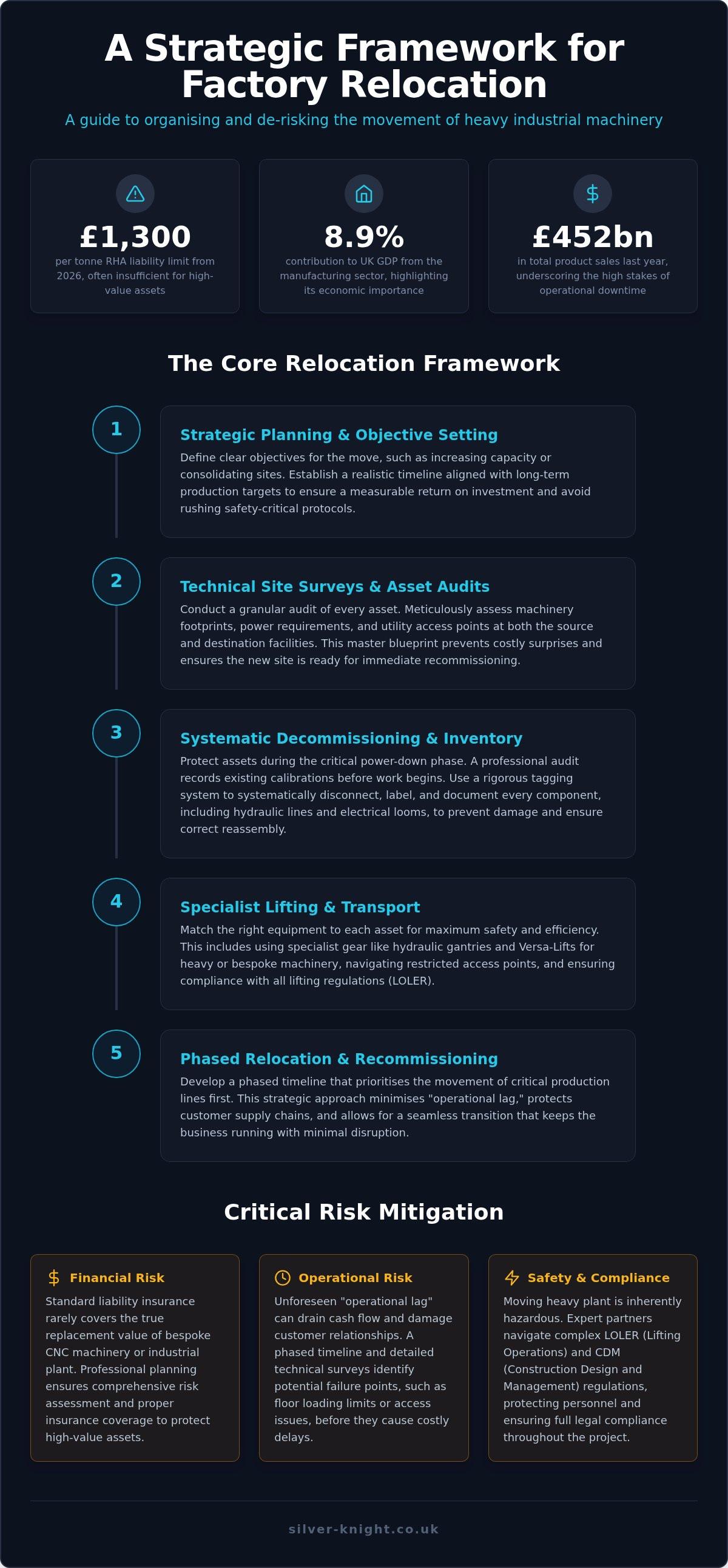
Strategic factory relocation planning is far more than a logistical exercise; it's a critical business pivot. Whether you're moving to increase capacity or shifting operations closer to key supply chains, the success of the project hinges on technical foresight. Many UK firms are currently re-evaluating their footprints, often driven by a deeper understanding of offshoring risks that have led to a surge in reshoring activities throughout 2025 and 2026. Failing to account for the physical risks to high-value assets can lead to catastrophic financial losses. This is particularly true when you consider that standard RHA liability is capped at £1,300 per tonne as of January 2026, which rarely covers the replacement value of bespoke industrial plant.
To better understand the high-level decisions involved in this process, watch this helpful video:
Identifying Primary Objectives for Your Move
Success begins by defining why the move is happening. You might be consolidating two sites into one to reduce energy overheads, or perhaps you're expanding to house new CNC lines. Setting a realistic timeline is vital. Rushing a factory relocation service often leads to overlooked safety protocols or missed production windows. Your objectives should align with long-term production targets, ensuring the new layout supports the AI-driven predictive maintenance and energy management trends becoming standard across the UK sector this year. Clear goals allow stakeholders to measure the return on investment beyond just the physical move.
Risk Mitigation in Industrial Plant Relocations
Risk is inherent when moving heavy plant, but it's manageable with the right expertise. Professional factory relocation planning identifies potential failure points, such as structural floor limits at the new facility or restricted access points, before a single bolt is turned. Our team relies on over 180 years of collective industry experience to protect your personnel and high-value machinery throughout the transition. A detailed technical survey is the most effective tool for reducing unforeseen costs; it ensures that every aspect of the move, from decommissioning to the final installation, is mapped out. This prevents the "operational lag" that can quickly drain a manufacturer's cash flow in a market where total product sales reached £452.0 billion last year.
Conducting Comprehensive Technical Site Surveys and Asset Audits
Precision is the bedrock of successful factory relocation planning. You cannot safely move what you haven't accurately measured. This technical phase involves a granular audit of every asset, from high-value CNC centres to ancillary storage units. A UK government report on relocation drivers highlights that operational efficiency is a primary motivator for moves, but this efficiency is only realised if the physical transition is flawless. We meticulously assess power requirements, utility access points, and the exact physical footprint of each unit to ensure the destination facility is ready for immediate recommissioning. This audit serves as your master blueprint, preventing the confusion that often plagues large-scale industrial moves.
Inventory Management and Machinery Decommissioning
Damage most often occurs during the critical window between power-down and transport. A professional audit records existing machine calibrations and settings before any work begins. This ensures that when we provide machinery dismantle services, every component is systematically disconnected, labelled, and documented. We use a rigorous tagging system for all hydraulic lines and electrical looms. For assets moving long distances or destined for international shipping, we employ specialist export packing techniques. These methods protect sensitive electronics and precision surfaces from vibration or moisture during transit. It's about maintaining the technical integrity of the machine so it performs exactly as it did before the relocation.
Evaluating Infrastructure Requirements at the New Site
Your new facility must be more than just a shell; it needs to be an engineered environment. We verify floor load capacities to ensure they can support the concentrated weight of heavy plant without structural failure or subsidence. Clearance is another vital factor. We check that there's sufficient height for hydraulic gantries and crane operations during the installation phase, accounting for overhead lighting and ventilation ductwork. Planning the layout for optimal production flow is a core part of this technical survey. We look at the proximity of power drops and compressed air lines to minimise long-term energy costs and maintenance access. If you're unsure about the structural suitability of a potential site, requesting a technical site survey early in the process can prevent expensive remedial works later.
Selecting Specialist Lifting and Transport Equipment for Heavy Assets
The physical execution of your move is where factory relocation planning meets engineering reality. Selecting the right lifting equipment isn't just about capacity; it's about the specific geometry of your facility and the sensitivity of the assets. A 50-tonne power press requires a completely different approach to a high-precision CNC centre. Our team utilises a fleet of specialised tools, including versa lift hire, to navigate the tightest industrial environments. These compact, high-capacity forklifts are essential for restricted access areas where traditional machinery is too cumbersome to operate safely.
Choosing Between Hydraulic Gantries and Mobile Cranes
Indoor lifting often presents height restrictions that make mobile cranes impractical. In these scenarios, hydraulic gantry systems are the superior choice. They provide a stable, overhead lifting platform that can manage massive weights within the confines of a standard factory ceiling. For external moves or loading onto heavy haulage trailers, mobile cranes offer the necessary reach and flexibility. Every lift we perform is conducted under strict contract lifting regulations, ensuring that a qualified person supervises the operation and that all insurance requirements are fully met. This methodical approach minimises risk to both your personnel and your high-value plant.
The Role of Jack and Slide Systems in Restricted Spaces
When overhead space is non-existent or narrow openings prevent the use of gantries, jack and slide systems become indispensable. These systems allow us to move machinery horizontally across a track with millimetre precision. It's a low-profile solution that manages massive loads without the need for overhead cranes or extensive structural modifications to your building. This technology is particularly useful for final installation, where machinery must be positioned exactly over pre-prepared foundations or utility drops. By using these systems, we can often avoid the cost and delay of removing sections of roofing or walls to gain access.
Once your machinery is safely extracted and prepared, the focus shifts to transit. We utilise a range of low loaders and specialised trailers for nationwide heavy haulage. These vehicles are designed to handle the specific weight distribution of industrial plant, ensuring a smooth journey to your new facility. Whether you are moving a single machine or an entire production line, matching the transport to the asset's dimensions is a critical step in avoiding damage during the haulage phase. Our 180 years of collective experience ensures that we select the most efficient and safest configuration for every journey.
Developing a Phased Relocation Timeline to Minimise Operational Lag
The master schedule is the heartbeat of any industrial transition. Effective factory relocation planning requires a phased approach that ensures your most profitable production lines remain active for as long as possible. By staggering the move, you avoid a total production blackout. This involves a detailed analysis of lead times for decommissioning, transport, and recommissioning each asset. Communication is equally vital. Keeping stakeholders and staff informed prevents the anxiety that can lead to reduced productivity during the transition period. Clear, reliable timelines build confidence amongst your clients, proving that their orders won't be compromised by your facility upgrade.
Coordinating Workforce Transition and Health and Safety
Your workforce is the engine of your factory. During a move, their roles change from operators to transition partners. It's essential to ensure every team member understands their specific responsibilities, whether it's clearing workstations or assisting with machine trials at the new site. Health and safety remains the top priority throughout this phase. Strict compliance with CDM (Construction Design and Management) and LOLER (Lifting Operations and Lifting Equipment Regulations) is non-negotiable. Training operators on the new facility layout before they start work ensures they're familiar with emergency exits, utility shut-offs, and revised equipment positions. This proactive approach reduces the risk of accidents during the often high-pressure first days of operation.
Managing International Logistics for Global Factory Moves
Relocating operations across borders introduces a layer of complexity many UK firms find daunting. When you partner with international machine movers, you gain access to expertise in navigating post-Brexit customs requirements and international trade regulations. Choosing the right shipping method is critical for oversized industrial loads. This might involve flat-rack containers for sea freight or chartered cargo planes for time-sensitive assets. Securing machinery for long-distance transit requires more than just standard haulage straps. We use advanced blocking, bracing, and anti-corrosion treatments to ensure your assets arrive in the same condition they left, regardless of the distance. If you're planning a move that spans borders, speak to our international logistics team to discuss your specific requirements and receive a tailored quote.
Executing a Seamless Move with Expert Industrial Partners
Moving a factory isn't just about shifting metal; it's about protecting a business's legacy and its future. As a family-run specialist, we bring a level of accountability and care that larger corporations often struggle to match. This personal investment is central to effective factory relocation planning. It's why we provide end-to-end support, including factory clearance services. Clearing out redundant equipment or scrap before the move simplifies the logistics at the new site. Obsolete machinery often clutters the new floor plan, hindering the lean layout you've worked so hard to design. A professional clearance ensures only the assets essential to your 2026 production goals make the journey.
Before the first machine is lifted, you've got to verify your partner's credentials. With the 2026 RHA liability limit fixed at £1,300 per tonne, ensuring your machinery moving specialist has adequate goods-in-transit and public liability insurance is non-negotiable. Don't assume a general haulier has the specific cover needed for high-value CNC centres or bespoke manufacturing plant. You need a partner who understands the legal and financial weight of your assets.
The Value of Collective Industry Experience
Our 180 years of collective industry experience isn't just a proud statistic. It's a database of solutions for every conceivable on-site challenge we've encountered across the UK. General hauliers often lack the technical depth to handle delicate decommissioning or complex lifting in restricted spaces. Specialists understand the centre of gravity for unusual loads and the specific requirements of complex hydraulic systems. This knowledge is the difference between a successful installation and a costly repair bill that stalls your production for weeks.
Recommissioning and Final Installation Procedures
The move isn't over until the first product comes off the line at the new facility. Recommissioning involves much more than simply plugging a machine in. We ensure every unit is perfectly levelled and secured to its new foundation to prevent long-term vibration damage. Our team tests every safety system, from light curtains to emergency stops, ensuring full compliance with UK health and safety standards. By honouring the original machine calibrations recorded during the audit phase, we aim for immediate operational readiness. Performance testing at the destination confirms that the relocation hasn't compromised the precision your customers rely on. This is the ultimate goal of professional factory relocation planning, allowing your facility to resume its contribution to the UK's £452.0 billion manufacturing output with zero delay.
Securing Your Manufacturing Future in 2026
Your next facility move represents a significant investment in your business's growth and operational resilience. Successful factory relocation planning isn't just about moving heavy plant from point A to point B. It requires a meticulous marriage of technical site audits, phased scheduling, and the precise application of specialist equipment. By prioritising safety and minimising downtime, you protect your production targets and maintain your reputation amongst your clients.
As a family-run business, we're dedicated to the precision and safety of every move we undertake. Our team leverages over 180 years of collective industry experience and advanced tools like hydraulic gantries and Versa-Lifts to ensure your assets are protected at every stage. We don't just move machinery; we provide the engineering expertise needed to get your facility back to full capacity without delay. Book your technical site survey and factory relocation consultation with our expert team today. Let's work together to make your relocation a seamless success.
Frequently Asked Questions
How long does a typical factory relocation project take to complete?
Timelines vary based on the scale and complexity of the facility. A single machine move might take a few days, whereas a full factory relocation often requires three to six months of meticulous planning and execution. This timeframe includes technical site surveys, decommissioning, transit, and recommissioning. Starting your factory relocation planning early ensures that all regulatory and logistical hurdles are cleared before the physical move begins.
What are the most common risks associated with moving heavy industrial machinery?
Physical damage to high-value assets and extended operational downtime are the primary risks. Precision equipment like CNC centres can lose calibration if not handled correctly during transit. There are also significant health and safety risks, such as structural floor failure or lifting accidents. Using specialist equipment like hydraulic gantries and jack and slide systems mitigates these dangers by providing controlled, stable movement for every asset.
Do I need to hire a specialist for machinery decommissioning and recommissioning?
Yes, hiring a specialist is essential to preserve the operational integrity of your equipment. General hauliers don't have the technical expertise to record calibrations, label complex hydraulic lines, or test safety systems during reinstallation. Specialists ensure that every machine is levelled and secured correctly at the new site. This technical approach guarantees that your production lines are ready for immediate use upon arrival.
How can I minimise production downtime during a factory move?
Minimising downtime is achieved through a phased relocation timeline. Instead of moving the entire facility at once, you should stagger the transition of production lines. This allows you to maintain customer supply from one part of the factory while another is being relocated. Detailed factory relocation planning ensures that utility drops and foundations at the new site are ready before the machinery arrives, preventing installation delays.
What is the difference between a general haulier and an industrial machinery mover?
A general haulier typically provides standard transport services from one point to another. In contrast, an industrial machinery mover offers an end-to-end engineering service. This includes technical site surveys, contract lifting, and the use of specialised equipment like Versa-Lifts. They manage the entire process from decommissioning to final installation, whereas a general haulier often lacks the equipment and expertise for complex machinery handling.
Does insurance cover my machinery whilst it is in transit to a new factory?
Standard RHA liability is limited to £1,300 per tonne as of January 2026, which rarely covers the full value of high-end machinery. You should always verify that your mover has specific goods-in-transit and public liability insurance. It's often necessary to arrange additional cover for bespoke or high-value assets to ensure you aren't left with a financial shortfall in the event of accidental damage.
What technical surveys are required before moving heavy equipment?
You must conduct floor load capacity assessments and access surveys at both the origin and destination. These surveys determine if the ground can support concentrated weights and if there's sufficient clearance for lifting equipment like cranes or gantries. We also evaluate utility access, ensuring that power, compressed air, and drainage are correctly positioned for the new layout. These technical steps prevent expensive remedial work after the move.
Can you manage international factory relocations to countries outside the UK?
Yes, we provide comprehensive international machinery transport services for global relocations. This includes navigating complex customs requirements, post-Brexit trade regulations, and arranging specialised export packing. Whether you're moving assets via sea or air freight, we manage the entire logistics chain. Our team ensures that your machinery is securely braced and treated for anti-corrosion, protecting its condition during long-distance transit to any international destination.

Article by
David Ashby
I'm the Managing Director of Silver Knight Haulage & Machinery Ltd. Silver Knight Ltd is a family-run firm established in the West Midlands in 2005, with the aim of providing a cost-effective, yet professional, service to businesses for the removal, transportation, and installation of machinery, plant, and equipment here in the UK and worldwide. Between us, the Silver Knight workforce has over 50 years of experience with machinery and its operation.
Disclaimer
This article is intended for informational purposes only. Please ensure you seek expert advice or carry out your own research to confirm the information is suitable for your specific needs.