A single mistake during a factory shutdown can turn a valuable asset into a pile of scrap metal in seconds. It's a stressful reality for facility managers across the UK who face the daunting task of clearing floor space without compromising safety or the bottom line. You likely feel the weight of responsibility when managing the industrial decommissioning process, worrying about hidden costs or regulatory hurdles that could stall your project. We understand that precision isn't just a goal, it's a necessity to protect your investment and your people.
This guide explores the systematic stages of decommissioning to ensure your machinery is retired or relocated with absolute precision and safety. By following a structured roadmap, you can eliminate the anxiety of unexpected delays and maintain full compliance with UK regulations. We'll walk you through the essential steps, from initial technical surveys and mechanical disconnections to heavy lifting and final asset management. You'll gain the clarity needed to manage your project with confidence whilst minimising risks to both your personnel and your equipment.
Key Takeaways
- Understand why a systematic shutdown is vital for maintaining safety and meeting UK environmental regulations.
- Learn how comprehensive site surveys and hazard identification form the foundation of a successful industrial decommissioning process.
- Discover the importance of meticulous labelling and documentation during mechanical disconnection to protect the future value of your assets.
- Explore how specialised equipment like hydraulic gantry systems can safely move heavy machinery through restricted factory spaces.
- Identify the best options for redundant equipment once the project is finished, including recycling or preparing machinery for resale.
To find out how our team can help with your next project, visit the experts at Silver Knight.
Understanding the industrial decommissioning process
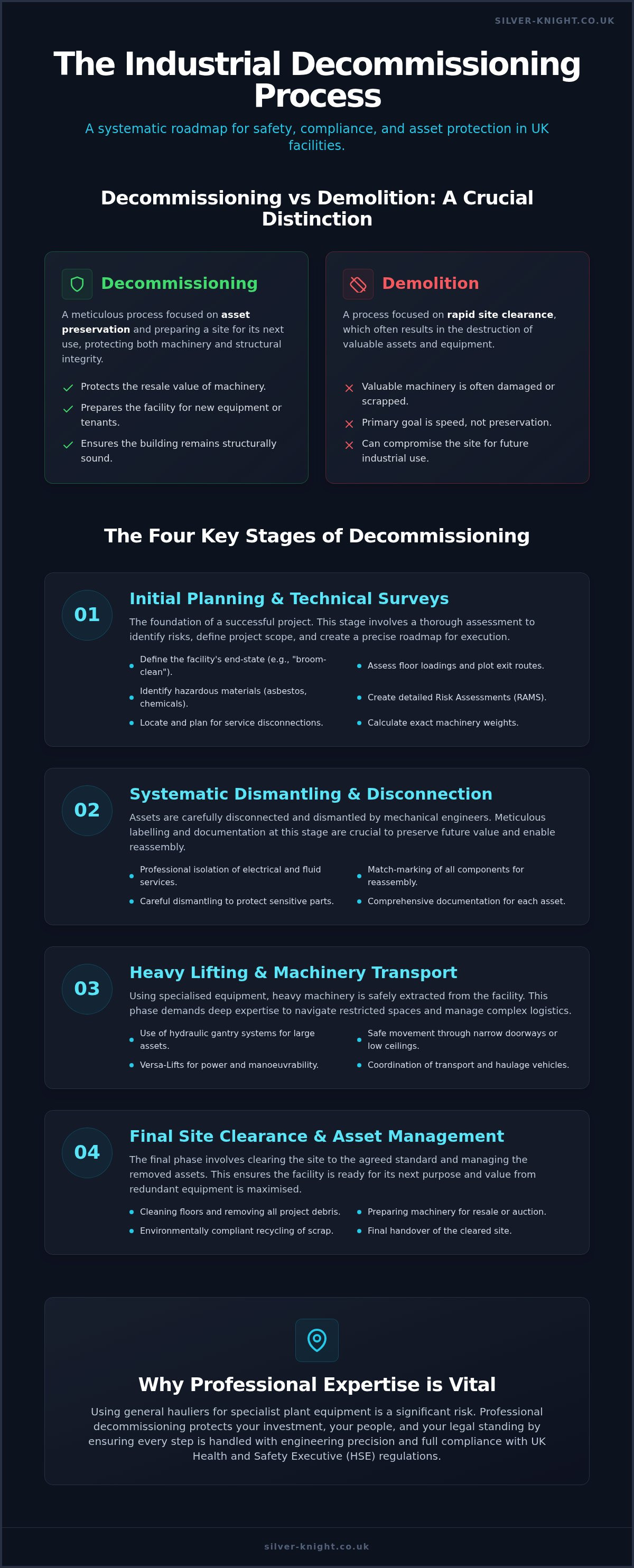
Decommissioning is the formal process of taking an industrial facility out of service. It isn't a simple case of switching off the lights and locking the doors. Instead, the industrial decommissioning process involves a highly structured series of steps designed to secure a site, remove hazardous materials, and prepare machinery for its next chapter. Whether a factory is closing permanently or moving to a new location, this systematic approach ensures that every asset is handled with care.
Safety remains the primary driver behind these projects. Following strict health and safety protocols helps prevent accidents whilst machinery is being dismantled. It also ensures that environmental regulations are met, particularly when dealing with oils, chemicals, or other industrial waste. By managing these risks professionally, a business can significantly reduce its legal and financial liabilities. A botched shutdown can lead to heavy fines from the Health and Safety Executive (HSE) or costly environmental damage that lingers for years.
The difference between decommissioning and demolition
Many people confuse decommissioning with demolition, but they serve very different purposes. Demolition is often about clearing a site as quickly as possible, which can lead to the destruction of valuable machinery. In contrast, decommissioning focuses on asset preservation. It prepares a site for its next use, whether that means selling the land or installing new equipment. By choosing a careful extraction over a blunt demolition, you protect the resale value of your machinery and ensure that the building remains structurally sound.
Why professional expertise is vital
Handling complex machinery requires more than just a standard lorry and a few tools. It demands a deep understanding of mechanical engineering and heavy lifting. At Silver Knight, our team brings 180 years of collective experience to every project. Using general hauliers for specialist plant equipment is a significant risk, as they often lack the technical knowledge to disconnect and move sensitive assets safely. Our machinery dismantle service provides a clear roadmap, ensuring that every stage of the industrial decommissioning process is completed on time and within budget.
To ensure your project starts on the right foot, speak with the specialists at Silver Knight.
Initial planning and technical site surveys
Every successful industrial decommissioning process begins long before a single bolt is turned. A comprehensive site survey is essential to identify the scope of the project and uncover potential pitfalls that could lead to expensive delays. It's vital to define the facility's end-state early in the planning phase. For instance, you might require a "broom-clean" floor for a new tenant or a complete strip-out ready for structural demolition. Defining these outcomes helps you organise a project timeline that minimises operational disruption to the rest of your site. During this initial phase, specialists identify hazardous materials such as asbestos, lead-based paints, or chemical residues. They also locate all service connection points for water, gas, and electricity to ensure they are safely capped or diverted.
Conducting a technical site survey
A technical survey involves mapping out machinery footprints and calculating exact weights with precision. Our team assesses floor loadings to ensure the concrete can withstand the pressure of heavy lifting gear like Versa-Lifts or hydraulic gantries. We also plot exit routes, checking for narrow doorways, low ceilings, or tight corners that might obstruct the removal of large assets. Identifying utilities that require professional isolation is critical to prevent accidents. Following Health and Safety Executive guidance ensures that all plant modifications and shutdowns are handled within the correct legal frameworks, protecting both the workers and the environment.
Risk assessments and safety planning
Safety planning requires the creation of detailed Method Statements and Risk Assessments (RAMS). These documents provide a step-by-step guide on how each piece of machinery will be dismantled and moved. Managing traffic and personnel during the extraction phase is often the most complex part of the industrial decommissioning process. You must keep active factory staff well away from the work zone whilst ensuring heavy haulage vehicles have clear, unobstructed access. Adhering to national safety regulations protects your business from legal liability and ensures the project remains on schedule. If you're unsure about the specific requirements for your facility, you can request a professional site assessment to clarify the necessary safety protocols.
For expert assistance with your project, contact Silver Knight today.
Systematic dismantling and mechanical disconnection
Once the planning is complete, the physical stage of the industrial decommissioning process begins. This phase requires a delicate touch to ensure that assets remain functional for future use. Engaging professional machinery dismantle services is often the difference between a successful relocation and an expensive write-off. Unlike simple scrap projects, precision dismantling treats every component as a valuable asset that must be preserved for recommissioning. Every part is handled with the assumption that it will need to be reinstalled and run at full capacity elsewhere.
Safe disconnection of industrial services
Disconnecting services is a high-risk task that demands strict adherence to isolation protocols. Engineers must ensure that electrical, gas, and water lines are completely dead before any dismantling starts. This often involves a "lock-out, tag-out" system to prevent accidental reactivation, which is a standard safety requirement in UK industrial environments. This phase is a critical component of the broader industrial decommissioning process. Hazardous fluids, such as hydraulic oils and coolants, are frequently found amongst the equipment. These must be drained and stored in bunded containers to prevent leaks that could contaminate the factory floor or enter the drainage system. Close coordination between on-site facility engineers and decommissioning specialists ensures that these connections are severed without damaging the building's permanent infrastructure.
Precision dismantling for asset preservation
If you plan to sell or relocate your machinery, the way it is taken apart is critical. Every wire, pipe, and bracket must be meticulously labelled and documented to avoid confusion during reassembly. We use high-resolution photography and detailed schematics to record the exact configuration of production lines before they are disturbed. This documentation serves as a vital roadmap for future installation, making the recommissioning process significantly faster and more cost-effective. Sensitive electronics and PLC units are removed first and packed into anti-static crates to prevent damage from vibrations, dust, or moisture. Using specialised tools like hydraulic nut splitters or precision saws allows our team to separate components without applying unnecessary stress to the machine's frame or internal bearings. This level of detail ensures that your equipment arrives at its next destination in the same condition it left the floor, ready to be put back to work.
To learn more about our specialised lifting solutions, visit the experts at Silver Knight.
Heavy lifting and machinery transport logistics
The extraction phase is the most visually impressive part of the industrial decommissioning process. It requires a fleet of specialised gear to move assets that weigh dozens of tonnes through narrow factory corridors. Standard forklifts often lack the capacity or the precision for these tasks. Instead, we use hydraulic gantry systems to lift heavy machinery where overhead space is limited. These systems allow for controlled vertical lifts and horizontal travel, making them perfect for removing large presses or CNC machines from the centre of a busy floor. When a load is too heavy for wheels or the ceiling is too low for a gantry, jack and slide systems provide a solution. They move massive assets along a low profile track, distributing the weight evenly and protecting the factory floor from damage.
Utilising advanced lifting technology
Access is often the biggest hurdle in any industrial decommissioning process. Versa-Lifts are a staple of our fleet because they offer high lifting capacities within a compact frame. These machines can extend their counterweights to handle heavier loads whilst remaining small enough to navigate tight aisles. For delicate positioning, heavy moving equipment like air skates or machine skates allows for frictionless movement over smooth surfaces. Choosing a contract lifting service also adds an extra layer of safety. It places the legal responsibility for the lift on the specialist provider, ensuring that all equipment is certified and every manoeuvre is supervised by a qualified person.
Transporting assets across the country and beyond
Once an asset is out of the building, the focus shifts to heavy haulage. Securing these loads on low loaders requires specialist knowledge of weight distribution and lashing points. If your project involves moving equipment overseas, the complexities increase significantly. Our international machine movers handle the entire journey, from customs documentation to final delivery. Preparing machinery for long distance sea or air freight involves more than just a sturdy crate. It requires vacuum packing and moisture barrier foils to prevent corrosion during transit. This meticulous preparation ensures your machinery arrives at its destination in perfect working order, regardless of the distance travelled.
If you are planning a complex machinery move, you can get a quote for your machinery transport project today.
To find out how we can assist with your final site handover, visit the specialists at Silver Knight.
Final site clearance and asset management
The final stage of the industrial decommissioning process is about more than just leaving an empty shell. Once the primary machinery has been lifted and transported, the focus shifts to restoring the facility to a safe and usable state. This phase ensures that the landlord or the new tenant receives a site that meets all contractual handover requirements. It is a meticulous wrap-up that addresses everything from leftover raw materials to the structural integrity of the floor. A successful clearance marks the official end of the project, allowing the business to move on without the lingering burden of an old facility.
Comprehensive site clearance services
After the heavy assets are gone, a thorough factory clearance is necessary to remove remaining plant infrastructure. This includes redundant racking, redundant pipework, ducting, and electrical trunking that are no longer needed. Leaving the floor surface safe and clean is a priority, as trip hazards or oil spills can lead to significant liabilities during the handover. We often find that years of heavy manufacturing leave behind debris hidden in pits or amongst overhead structures. A final walkthrough with the project manager ensures that every corner of the site is cleared and documented, providing peace of mind that the project is truly complete and the site is ready for its next purpose.
Managing redundant industrial assets
Not every piece of equipment will move to a new location. Managing redundant industrial assets is a key part of the industrial decommissioning process. Non-salvageable materials like scrap metal should be organised for disposal through certified recycling centres to ensure environmental compliance. For surplus gear that still has value, professional equipment buying services can help you recoup some of your initial investment. If your project is part of a phased relocation, secure warehousing provides a vital buffer. It allows you to store assets safely whilst the new facility is being prepared, preventing them from cluttering the old site or being damaged in a rushed move. This flexible approach to asset management ensures that you maintain the maximum value of your equipment throughout the transition.
To explore our full range of machinery moving and decommissioning services, visit Silver Knight.
Secure your industrial assets with expert decommissioning
Successfully managing an industrial decommissioning process requires a blend of technical expertise and logistical precision. By prioritising detailed site surveys and methodical dismantling, you protect the future value of your machinery whilst ensuring the safety of everyone involved. Whether you are clearing a site for handover or preparing equipment for international transport, a structured approach eliminates the risk of hidden costs and project delays. Every stage of the project must be handled with care to prevent damage to expensive assets and maintain full regulatory compliance.
Silver Knight provides a comprehensive national and international service, drawing on over 180 years of collective industry experience. Our family-run business utilises a specialised fleet of lifting and transport equipment to handle projects of any scale with absolute precision. We are here to support your transition, providing the equipment and knowledge needed for a seamless facility shutdown.
Contact our expert team today to discuss your industrial decommissioning requirements and ensure your project is completed safely and on time.
Frequently Asked Questions
What is the typical duration of an industrial decommissioning project?
The duration of an industrial decommissioning project varies significantly based on the scale of the facility and the complexity of the machinery. A small production line might take a few days to clear, whilst a full factory closure could span several months. Factors such as hazardous waste removal and complex structural requirements will influence the timeline. Detailed planning usually takes several weeks before any physical work begins.
Do I need to hire separate companies for dismantling and transport?
You don't need to hire separate companies if you choose a provider that offers a complete service. Many specialists handle everything from the initial dismantling to heavy haulage and international transport. Using one team ensures better coordination. This reduces the risk of project delays. It also simplifies the communication process since you'll only have one point of contact for the entire project.
How do you ensure the safety of workers during the decommissioning process?
Safety is managed through strict adherence to CDM 2015 regulations and comprehensive risk assessments. Every industrial decommissioning process requires a detailed Method Statement and Risk Assessment before work starts. Teams use specialised equipment like hydraulic gantries to move heavy loads safely. Constant monitoring and the use of correct personal protective equipment help to prevent accidents and maintain a secure working environment for everyone on site.
Can you decommission a single production line whilst the rest of the factory operates?
It's entirely possible to decommission a single production line while the rest of your facility remains operational. This requires careful planning to ensure that power isolation and physical barriers don't disrupt ongoing work. Engineers coordinate with your site management to schedule noisy or high impact tasks during quiet periods. This approach helps to maintain productivity whilst upgrading or removing specific assets from the floor.
What happens to the hazardous materials found during the process?
Hazardous materials are identified during the initial site survey and handled according to UK environmental laws. Specialist contractors remove substances like asbestos, oils, or chemicals and transport them to licensed disposal facilities. You'll receive consignment notes as proof that the waste was managed legally. Ensuring these materials are disposed of correctly is a vital part of the industrial decommissioning process to avoid heavy legal fines.
Is it possible to relocate the machinery internationally after it is decommissioned?
Machinery can be relocated internationally once it has been decommissioned and prepared for transport. The equipment is often dismantled into smaller sections, crated, and secured for sea or air freight. A specialist provider will manage the export documentation and logistics to ensure the assets arrive safely at their new destination. This allows businesses to move production capabilities to different global markets with minimal stress.
What insurance cover is required for industrial decommissioning?
A decommissioning project requires several types of insurance to protect all parties involved. This typically includes public liability, employers' liability, and specific goods in transit or marine cargo cover if machinery is being moved. You should also check if professional indemnity insurance is in place for the planning phase. Always verify that the contractor's policy limits are high enough to cover the total value of your assets.
How do you calculate the cost of a decommissioning project?
Costs are calculated based on the project's scope, the number of working hours required, and the specialised equipment needed. Factors like the volume of hazardous waste and the distance for heavy haulage also impact the final price. Every site is unique, so most providers will conduct a detailed survey before giving a quote. This ensures the estimate reflects the specific challenges and requirements of your factory environment.

Article by
David Ashby
I'm the Managing Director of Silver Knight Haulage & Machinery Ltd. Silver Knight Ltd is a family-run firm established in the West Midlands in 2005, with the aim of providing a cost-effective, yet professional, service to businesses for the removal, transportation, and installation of machinery, plant, and equipment here in the UK and worldwide. Between us, the Silver Knight workforce has over 50 years of experience with machinery and its operation.
Disclaimer
This article is intended for informational purposes only. Please ensure you seek expert advice or carry out your own research to confirm the information is suitable for your specific needs.