Factory decommissioning is a surgical engineering operation that requires precision rigging rather than brute force clearance. When you're tasked with closing a site, the stakes are incredibly high. You're likely worried about the risk of health and safety incidents during dismantling or the potential for hidden environmental liabilities to surface. Finding reliable factory decommissioning services is the only way to ensure the project stays on track and meets those punishingly tight handover deadlines.
It's natural to feel anxious about such a complex transition. You need to know that your machinery is handled with care and that the final site handover will be seamless. This article explains how to manage a successful closure whilst ensuring you maximise safety and asset value. We'll look at the essential steps for a compliant project, from initial planning to the final sweep, so you can achieve a clean site with zero incidents. Relying on nearly two centuries of collective industry experience makes this daunting process much more manageable.
Key Takeaways
- Learn why professional factory decommissioning services are a precision engineering task rather than just clearing out a redundant site.
- Understand the legal requirements of CDM 2015 and how detailed Method Statements keep your site safe during complex plant removal.
- Discover how to plan a project timeline that aligns with lease endings and maximises the financial value of your machinery assets.
- See how specialised equipment like Versa-Lift systems and hydraulic gantries allow for the safe dismantling of heavy industrial machinery.
- Find out how nearly two centuries of combined experience can help you navigate the complexities of both domestic and international site relocations.
If you are looking for expert support with an industrial site closure, the team at Silver Knight Haulage & Machineries Ltd provides comprehensive solutions for businesses across the country.
Understanding professional factory decommissioning services
Professional factory decommissioning services involve the systematic process of shutting down and clearing industrial facilities. This isn't just about moving a few pieces of equipment; it's a high level engineering operation that requires meticulous planning. Every pipe, wire, and heavy machine must be accounted for to ensure the building is left in a safe state. Whether you are closing a small workshop or a massive manufacturing plant, the goal remains the same. You want to exit the site without incidents or legal complications.
These services are essential for various facilities, including food processing plants, chemical laboratories, and automotive assembly lines. Each environment presents its own set of challenges, from handling hazardous residues to lifting multi-tonne presses. By using a structured approach, businesses can manage these risks effectively. The focus is always on maintaining safety whilst working to recover the maximum value from the assets being removed.
The difference between decommissioning and demolition
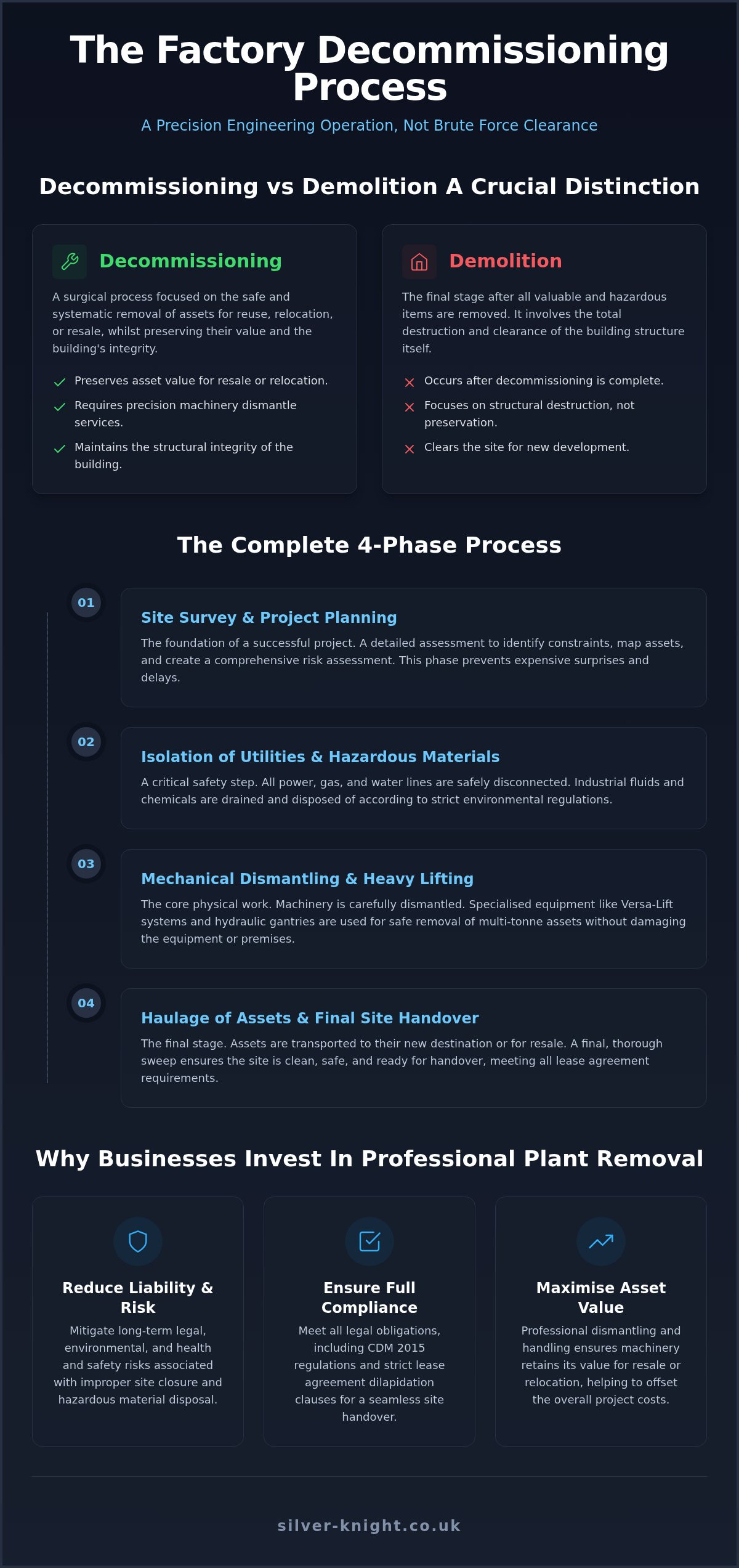
It is a common mistake to think that decommissioning and demolition are the same thing. In reality, they are distinct stages of a site's lifecycle. Decommissioning focuses on the safe removal of assets for reuse or resale. This requires a machinery dismantle service that preserves the mechanical and electrical integrity of the equipment. If a machine is destined for a new factory, it must be handled with surgical precision rather than brute force.
Demolition is often the final stage after decommissioning is complete. It involves the total destruction of the building structure once all valuable or dangerous components have been removed. During the decommissioning phase, preserving the structural integrity of the building is vital. This is especially true for leased properties where the landlord expects the unit to be returned in a reusable condition, free from damage caused by poor dismantling practices.
Why businesses invest in professional plant removal
Companies invest in professional plant removal to reduce long term liability and environmental risks. Leaving behind old machinery or contaminated infrastructure can lead to significant legal trouble and environmental fines. A professional team ensures that all utilities are isolated correctly and that any hazardous materials are disposed of according to UK regulations. This protects the company's reputation and its balance sheet.
Ensuring compliance with lease agreements for site handover is another major priority. Property owners often have strict dilapidation clauses that require a site to be cleared to a specific standard. Failing to meet these requirements can result in costly disputes. Asset recovery is a method to offset project costs.
Managing a site closure requires a high level of expertise to avoid costly delays. You can find out more about our professional approach by visiting the Silver Knight website.
The complete factory decommissioning process
Successful factory decommissioning services follow a logical, four-phase structure. It begins with a comprehensive site survey and risk assessment. This isn't just a box-ticking exercise; it's the foundation of the entire project. Engineers need to understand the physical constraints of the building and the specific requirements of every piece of plant. Without this data, you risk unexpected structural issues or delays during the move.
Phase two focuses on the isolation of utilities and hazardous materials. Before a single bolt is turned, all power, gas, and water lines must be safely disconnected. Any industrial fluids, such as hydraulic oil or chemical coolants, are drained and disposed of following environmental regulations. This clears the way for phase three; the mechanical dismantling and heavy lifting stage. Finally, phase four involves the haulage of assets and a final sweep to ensure the site is ready for handover. Professional factory decommissioning services ensure that every stage is documented for your compliance records.
Technical site surveys and project planning
Detailed planning prevents expensive surprises. During the survey, our team identifies floor load capacities to ensure the ground can support heavy lifting equipment. We also map out access points, checking door heights and turning circles for vehicles. A detailed inventory is created, categorising every asset. This allows for a clear plan on what stays, what goes, and what needs a machinery dismantle service to be moved safely. This level of detail ensures that nothing is missed and that assets are protected from the very start.
Mechanical dismantling and heavy lifting techniques
Moving heavy machinery in confined spaces requires more than just a standard forklift. We use specialised equipment like hydraulic gantries and jack and slide systems to lift and shift loads that weigh several tonnes. These tools allow for millimetre-perfect positioning without putting the building at risk. It's a process that demands precision rigging rather than brute force.
Protecting delicate components is a priority during this stage. Control panels, sensors, and fragile glass parts are often removed and packed separately. For projects where space is extremely limited, Versa-Lift hire provides the compact power needed to navigate tight factory aisles. If you need assistance with a complex move, you can speak to our specialists about your specific site requirements.
If you need expert guidance on site safety and compliance, you should visit our main service page for more information.
Essential safety and compliance standards for plant removal
Safety is the most critical element of any industrial project. When you hire factory decommissioning services, you aren't just paying for the moving of machines; you're paying for the management of risk. Every site carries unique dangers, from overhead hazards to underground utility lines. Ensuring that every member of the team follows strict protocols is the only way to prevent accidents whilst working on a live site. This involves more than just wearing the right gear. It requires a deep understanding of UK health and safety laws.
A core part of this process is the creation of Method Statements and Risk Assessments (RAMS). These documents outline exactly how each task will be performed and what steps will be taken to mitigate risks. They aren't generic templates. Each one must be site-specific, reflecting the actual conditions on your factory floor. Choosing an insured and experienced partner is vital because they have the expertise to spot hidden dangers before they become incidents. With over 180 years of collective industry experience, our team understands the nuances of complex site closures. This knowledge helps in maintaining a smooth workflow without compromising on the safety of the staff or the building.
Legal obligations and CDM 2015
The Construction (Design and Management) Regulations 2015, or CDM 2015, apply to most decommissioning projects in the UK. These rules define the roles and responsibilities of the client, the principal designer, and the contractors. Professional contractors manage health and safety on site by acting as the principal contractor, ensuring that all work is coordinated safely. They maintain the health and safety file and ensure that everyone on the project is properly briefed. Failing to comply with these regulations can lead to severe fines or even criminal prosecution for site managers.
Environmental protection and waste management
Handling hazardous industrial waste is a major part of the decommissioning process. Many industrial machines contain oils, coolants, or chemical residues that can damage the environment if they aren't handled correctly. The safe disposal of these substances is a legal requirement. Common materials handled during this process include:
- Hydraulic oils and lubricants
- Chemical coolants and cleaning agents
- Scrap metal and industrial plastics
As part of a factory clearance service, we also focus on the recycling of metals and other industrial materials to minimise the impact on landfill. This often involves sorting materials on site to ensure they reach the correct processing facilities. A clean environmental record is important for your company's reputation and helps avoid future liabilities. By following these strict waste management protocols, you ensure that the site is left in a condition that is ready for its next use.
To ensure your industrial site closure is handled by professionals with nearly two centuries of combined experience, explore the comprehensive solutions offered by Silver Knight.
How to plan a successful factory clearance project
Planning a factory clearance is a major logistical challenge that requires a balance between operational needs and legal deadlines. When you are looking for factory decommissioning services, the first step is to establish a clear timeline. This schedule must align perfectly with your property lease endings to avoid expensive holdover rent or legal disputes. You should identify which assets will be relocated to new premises and which are surplus to requirements. Identifying these early allows you to organise the flow of work more efficiently.
Budgeting for specialised lifting equipment and transport logistics is also vital. These costs can vary based on the scale of the machinery and the complexity of the dismantling required. Communicating with stakeholders and utility providers early in the process ensures that power and water disconnections happen exactly when they should. Early dialogue with utility companies is essential because disconnecting high voltage power or large scale gas lines often requires weeks of notice. Keeping your staff and local authorities informed prevents confusion and maintains your corporate reputation throughout the transition.
Managing timelines and site handovers
Overrunning a project can lead to heavy financial penalties from landlords. You must coordinate closely with site owners to understand their expectations for the final handover. This often includes specific requirements for floor cleaning or the removal of mezzanine structures. If you are moving to a new facility, a professional factory relocation service can help manage the transition between the old and new sites simultaneously. This ensures that your production downtime is kept to an absolute minimum.
Budgeting for industrial decommissioning
Several factors influence the total cost of your project. These include the size of the machinery, the volume of hazardous materials, and the distance for haulage. However, asset recovery can significantly help fund the decommissioning process. By identifying machines with resale value, you can offset much of the logistical expense. Our UK factory clearance service provides an asset buying option that turns redundant plant into capital for your business. This approach makes the entire project more cost effective whilst ensuring the site is cleared to a professional standard. If you need help coordinating these moving parts, you can contact our team today for expert planning advice.
If you are planning a complex site closure and need a partner you can trust, you should explore the professional services provided by the Silver Knight team.
Expert decommissioning with Silver Knight Haulage and Machineries
Silver Knight Haulage & Machineries Ltd is a family-run specialist that provides national coverage for the most challenging industrial projects. We understand that every factory has its own unique layout and set of obstacles. This is why we rely on our 180 years of collective industry experience to navigate every project with confidence. Our team has seen almost every type of machinery and site condition imaginable, allowing us to provide factory decommissioning services that are both efficient and safe whilst maintaining the highest standards.
Our end-to-end service is designed to take the pressure off your management team. We handle the entire lifecycle of the decommissioning process, from the first bolt removed to the final delivery of assets. By managing both the dismantling and the haulage, we ensure that there are no gaps in communication or safety protocols. This joined-up approach is what sets us apart as a reliable partner for UK businesses looking for a seamless transition.
Our specialised equipment and lifting solutions
To maintain our high standards, we invest in a vast range of specialised equipment suitable for any project size. This includes hydraulic gantry systems and heavy-duty forklifts that can handle loads of several tonnes with ease. You can view a full list of our capabilities by checking our equipment page. Having the right machinery at our disposal means we can tackle even the most restricted spaces without compromising on speed.
Using the right tool for the job is not just about efficiency; it's about the safety of both personnel and your valuable assets. Our equipment allows us to lift and move machinery in ways that minimise stress on the mechanical components. Whether it is a delicate laboratory instrument or a massive industrial press, we have the lifting solutions to move it without damage. This precision protects the resale value of your assets and ensures they are ready for recommissioning at their new destination.
National and international logistics expertise
Our expertise extends far beyond the factory floor. We have the capability to move decommissioned plant anywhere in the UK, using our own fleet of heavy haulage vehicles. For companies with a global reach, our international machine movers service provides a seamless transition for assets being sent overseas. We handle the packing, shipping, and customs requirements, so you don't have to worry about the complex logistics of global transport.
We encourage all site managers to get in touch for a bespoke technical site survey. This allows us to assess your specific requirements and provide a detailed plan that fits your timeline and budget. By choosing a partner with nearly two centuries of combined heritage, you are ensuring that your factory decommissioning project is in the safest possible hands.
For more information on how we can support your industrial project, explore our machinery moving and factory services online.
Secure a seamless transition for your industrial site
Successfully managing a site closure is a complex undertaking that requires more than just heavy lifting. It demands a deep understanding of CDM 2015 regulations and the mechanical precision required to protect your valuable industrial assets. By prioritising rigorous safety standards and strategic project planning, you can avoid the financial penalties of late handovers whilst ensuring your machinery remains in peak condition. Professional factory decommissioning services provide the structural and logistical support needed to turn a daunting site transition into a streamlined success.
Silver Knight offers a nationwide UK service supported by over 180 years of collective experience and a specialised heavy lifting fleet including hydraulic gantries and Versa-Lift systems. Whether you are moving across the country or relocating internationally, our family run team has the specific tools and knowledge to handle every detail of the process. Don't leave your site closure or relocation to chance when expert support is just a click away. We look forward to helping you achieve a clean, compliant, and safe site handover.
Contact our expert team today for a comprehensive factory decommissioning quote
Frequently Asked Questions
What is included in factory decommissioning services?
Factory decommissioning services involve the systematic process of shutting down and removing industrial assets safely. This includes disconnecting utilities like gas, water, and electricity whilst following strict protocols. We also handle the dismantling of heavy machinery, equipment cleaning, and waste management. Finally, the site is cleared and left in a condition ready for its next use, whether that's a commercial sale or a new installation.
How long does it take to decommission a medium sized factory?
The timeline for decommissioning a medium sized factory usually ranges from two to six weeks. This depends on the complexity of the machinery and the volume of equipment involved. A simple site clearance might be quicker, whilst a facility with hazardous materials or complex production lines requires more time. We'll provide a detailed schedule after an initial site survey to ensure your deadlines are met.
Do I need to hire a separate company for machinery haulage?
No, you don't need to hire a separate firm because we provide a comprehensive service that includes heavy haulage. Our team manages the entire process from dismantling to transporting your assets using our own specialised fleet. Whether you need to move equipment to another UK site or require international machinery transport, we handle the logistics to keep your project simple and efficient.
What are the main safety risks during industrial plant removal?
Safety risks during industrial plant removal include working at height, handling heavy loads, and dealing with hazardous substances. There are also risks associated with stored energy in electrical or hydraulic systems. We mitigate these dangers through rigorous risk assessments and by using specialised equipment like hydraulic gantry systems. Our experienced team follows strict safety protocols to protect both staff and your property throughout the project.
Can you help with the resale of decommissioned machinery?
We focus on the physical removal, transport, and storage of your equipment rather than acting as machinery brokers. However, we can move your assets to a storage facility or a buyer's location once you've agreed a sale. Our services ensure that your machinery is dismantled carefully to maintain its value for future use or resale by your chosen industrial equipment specialist.
Is factory decommissioning covered by CDM 2015 regulations?
Yes, factory decommissioning projects often fall under the Construction (Design and Management) Regulations 2015. These rules apply if the work involves dismantling or demolishing structures. As a professional service provider, we'll ensure that all work complies with these legal requirements. This includes maintaining a health and safety file and ensuring that all roles, such as the principal contractor, are clearly defined to maintain high safety standards.
Do you provide decommissioning services across the entire UK?
We provide factory decommissioning services to businesses across the entire UK. Our team has the equipment and logistics capability to reach any industrial hub, from the south coast to northern Scotland. With over 180 years of collective experience, we're well equipped to handle projects in any location. We also offer international transport if you need to relocate your machinery to a facility outside the country.

Article by
David Ashby
I'm the Managing Director of Silver Knight Haulage & Machinery Ltd. Silver Knight Ltd is a family-run firm established in the West Midlands in 2005, with the aim of providing a cost-effective, yet professional, service to businesses for the removal, transportation, and installation of machinery, plant, and equipment here in the UK and worldwide. Between us, the Silver Knight workforce has over 50 years of experience with machinery and its operation.
Disclaimer
This article is intended for informational purposes only. Please ensure you seek expert advice or carry out your own research to confirm the information is suitable for your specific needs.