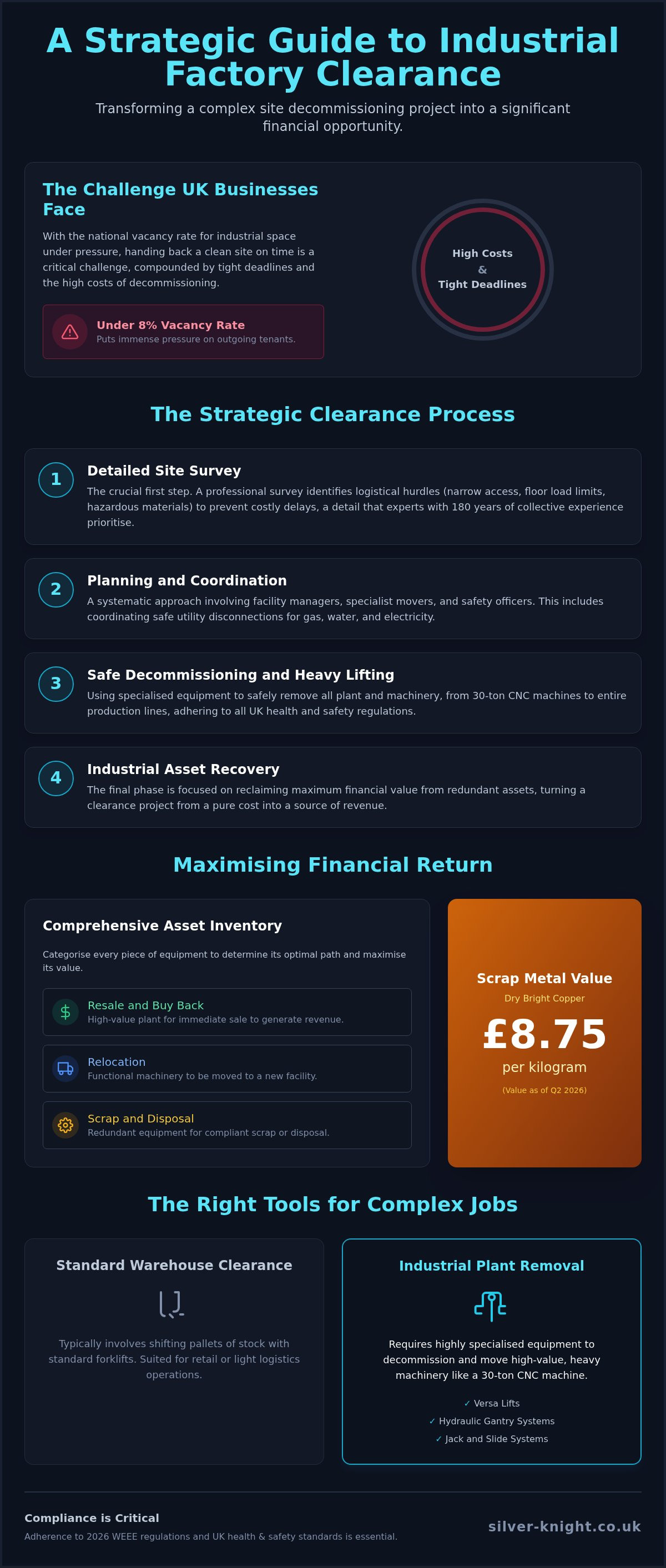
With the national vacancy rate for UK industrial space sitting just under 8% in Q2 2026, the pressure to hand back a clean site to landlords on time is immense. You likely feel the weight of tight deadlines and the high costs associated with professional decommissioning. It's a common worry that the expense of heavy lifting and removal will outweigh any potential gains from your industrial asset recovery efforts.
This guide demonstrates how a strategic approach to factory clearance can turn a complex project into a significant financial opportunity. You'll discover how to manage a safe and compliant industrial site clearance whilst maximising the financial return on your redundant machinery. We'll cover the latest scrap metal values, such as dry bright copper at £8.75 per kilogram, and explain how to navigate the 2026 WEEE regulations to ensure your business remains fully compliant throughout the process.
Key Takeaways
- Learn why a systematic approach to plant removal is essential for a clean site handover that satisfies landlord requirements.
- Discover how to maximise your financial return through professional industrial asset recovery and the cash buy back of redundant machinery.
- Understand your legal obligations regarding UK health and safety regulations and environmental compliance during the decommissioning process.
- Identify the specialised equipment and expertise needed to manage complex heavy lifting safely and within tight timeframes.
If you are looking for professional assistance with your site, you can find a UK factory clearance service that handles the entire process.
Understanding the Industrial Factory Clearance Process
Industrial factory clearance is the systematic decommissioning and removal of plant, machinery, and equipment from a site. It is far more complex than simply throwing away rubbish. This process focuses on Asset recovery, where the goal is to identify and reclaim the maximum value from your redundant equipment whilst ensuring the site is left in a safe condition. A professional approach ensures that industrial asset recovery is treated as a strategic project rather than a waste disposal task.
To better understand this concept, watch this helpful video:
Successful clearances require coordination between several key stakeholders. Facility managers must work closely with specialist movers and health and safety officers to ensure every stage of the project is documented. A detailed site survey is the first step. This identifies logistical hurdles like narrow access points, floor load limits, or the presence of hazardous materials before any heavy lifting begins. Experts with 180 years of collective industry experience know that missing these details early can lead to expensive delays later.
The Difference Between Stock Clearance and Industrial Plant Removal
Clearing a retail warehouse usually involves shifting pallets of stock with standard forklifts. In contrast, an industrial clearance might involve decommissioning a 30 ton CNC machine or a complex production line. This requires specialised equipment such as Versa Lifts, which offer the high lifting capacity and manoeuvrability needed for tight factory floors. You might also require hydraulic gantry systems or jack and slide systems for machines that cannot be lifted by traditional cranes. General hauliers often lack the rigging expertise and insurance required for such high value, heavy machinery.
When Your Business Might Require a Full Site Clearance
There are several reasons why a UK business might need to clear an entire facility. National site relocations often leave behind older plant that isn't worth moving to a new location. In other cases, companies might be upgrading to new technology and need to clear space for modern production lines. Industrial asset recovery is also vital when preparing a leased industrial unit for a final dilapidations survey. This ensures the property is returned to the landlord in the exact condition specified in the lease, avoiding costly legal disputes and ensuring a smooth handover.
For expert assistance with your industrial plant requirements, you can find further information on the Silver Knight website.
Planning Your Site Decommissioning and Asset Recovery
Planning a factory clearance requires more than just a date in the diary. Precision is everything. A systematic approach is vital to prevent operational delays that could lead to financial penalties from landlords or missed handover deadlines. You must start with a technical site survey to assess the structural integrity of the building and identify any hidden risks. This phase also involves coordinating with utility providers to ensure gas, water, and electricity disconnections are carried out safely and legally before any machinery is moved. Failing to manage these disconnections properly can lead to severe safety incidents or significant damage to the property.
Strategic industrial asset recovery serves as a financial pillar for the project. By identifying high value items early, you can often offset the costs of the entire decommissioning process. This ensures that industrial asset recovery isn't just an expense, but a method of reclaiming capital from surplus plant. This proactive planning allows you to budget more accurately and reduces the risk of unexpected costs surfacing during the physical removal phase.
Creating a Comprehensive Industrial Asset Inventory
To manage your assets effectively, you need a detailed inventory. Categorise your equipment into clear groups to determine the best course of action for each piece of plant:
- High value plant for immediate resale or cash buy back
- Functional machinery for relocation to a new facility
- Redundant equipment for scrap or environmental disposal
This clarity helps you decide which items are destined for relocation and which should be sold. For complex production lines, it's often safer and more efficient to utilise professional machinery dismantle services. This ensures that delicate components are protected and that the equipment retains its value for future buyers or for recommissioning elsewhere. Some machinery might also be better suited for secure storage if your new facility isn't ready for immediate installation.
Timelines and Project Management for Large Scale Moves
Setting realistic milestones is the only way to keep a large scale move on track. You should divide the project into clear decommissioning and removal phases. Managing the logistics of heavy haulage vehicles on restricted UK sites requires precision, especially when navigating narrow access roads or busy industrial estates. Adhering to international safety standards, such as OSHA safety requirements for lift trucks, provides a baseline for operational safety, though you must always comply with local HSE regulations.
A turnkey clearance benefits from a dedicated project manager who oversees every detail from the initial survey to the final sweep. This single point of contact reduces the risk of communication breakdowns between different contractors. If you're ready to begin your project, you can speak with a specialist to discuss your specific site requirements.
To learn more about how our specialists can manage your next project, visit the Silver Knight website.
Safety Standards and Regulatory Compliance
Safety is the most critical element of any industrial asset recovery project. As a site owner or facility manager, you have a legal obligation to ensure that all work carried out on your premises complies with the Health and Safety at Work etc. Act 1974. This duty of care extends to the decommissioning and removal of heavy plant. For companies requiring expert oversight on high-risk sites, DL Safety offers specialised health and safety consultancy to ensure full regulatory compliance. If an incident occurs during a clearance, the liability can often rest with the business that contracted the work. This is why verifying the credentials of your chosen partner is essential before the first machine is disconnected.
A professional clearance firm must hold substantial public liability insurance to protect against unforeseen accidents. Silver Knight maintains five million pounds in public liability insurance, providing peace of mind for complex industrial projects. This level of cover is necessary when moving heavy loads that could potentially damage the building structure or cause injury if not handled correctly. Working with an Environment Agency Licensed Carrier ensures that all waste is processed through legal channels. This protects your business from the heavy fines associated with illegal disposal or improper waste handling.
Before any physical work starts, your contractor must provide detailed Risk Assessments and Method Statements, commonly known as RAMS. These documents are mandatory for every lift and outline exactly how hazards will be managed. Professional movers conduct a thorough walkthrough to identify risks such as overhead power lines, fragile floor sections, or underground service ducts. By using specialised lifting equipment like hydraulic gantries or Versa-Lifts, teams can execute complex moves with precision, significantly reducing the chance of site damage.
Environmental Responsibilities and Waste Management Licences
Dismantling industrial machinery often involves handling hazardous fluids like coolants, hydraulic oils, or lubricants. You must ensure these are drained and stored correctly to avoid soil or water contamination. Every item that leaves your site for disposal must be accompanied by a waste transfer note. This document tracks the journey of the waste and proves your compliance with environmental laws. Implementing smart surplus asset disposition strategies helps you distinguish between what is genuine waste and what can be salvaged. This approach supports your sustainability goals whilst potentially improving the financial outcome of your industrial asset recovery efforts.
If you are looking for professional machinery solutions, please visit the Silver Knight website for more details.
Maximising the Financial Value of Redundant Machinery
Industrial asset recovery is not just about clearing floor space; it's about reclaiming capital that is currently locked in your machinery. Professional clearance companies evaluate your assets by looking at their age, condition, and current market demand. This assessment often focuses on high value items like CNC machines, lathes, and complete production lines. Instead of viewing the clearance as a pure expense, many UK businesses use the value of their redundant plant to fund the entire project.
Cash buy back options provide an immediate injection of capital. This is particularly useful for businesses undergoing restructuring or those needing to liquidate assets quickly. When the value of the machinery exceeds the cost of decommissioning and removal, you can achieve a cost neutral clearance. In some cases, the return on your assets might even result in a net profit for your business. This financial offset changes the nature of the project from a logistical burden into a strategic financial move.
Options for Asset Buy Back and Cost Neutral Clearances
Specialists assess equipment by examining service histories and operational hours to determine a fair market price. High demand machinery such as metalworking or plastic injection moulding equipment often retains significant value. You can explore the UK factory clearance service to see how assets are valued and how removal costs are calculated. By offsetting these expenses against the purchase price of your surplus machinery, you simplify your accounting and reduce the need for upfront capital expenditure.
Preparing Machinery for Resale or International Transport
The UK has a strong reputation for engineering quality, which creates a global market for used manufacturing equipment. To fetch the best price, machinery must be prepared correctly for its next owner. This involves professional cleaning and securing moving parts to prevent damage during transit. If your assets are sold to overseas buyers, expert shipping container packing is essential. This ensures that the equipment remains stable during sea freight and arrives in the same condition it left your site.
Coordinating with international machinery transport experts allows you to reach buyers in emerging markets where UK plant is highly sought after. For businesses relocating temperature-sensitive equipment to the UAE, Amjad Khan Transport offers specialised refrigerated logistics to ensure assets are handled correctly upon arrival. If you want to find out how much your redundant machinery is worth, you can request an asset valuation today. This step ensures you don't leave money on the table during your factory clearance.
You can find a complete range of industrial moving services on the Silver Knight website.
Choosing a Professional Factory Clearance Partner
Selecting the right partner is the difference between a smooth site handover and a logistical nightmare. You need a team that possesses both the technical rigging skills and the commercial knowledge to manage industrial asset recovery effectively. Experience and specialised equipment are the primary criteria you should look for. National coverage is also essential for multi site operations, as it ensures consistent safety standards and procedures across all your UK facilities, regardless of where they are located.
A family run business, such as Silver Knight founded in 1996, often provides a more personal and accountable service than large corporations. This long industry history means the team understands the pressures of landlord deadlines and the importance of maintaining the value of your machinery. When you choose a partner with deep roots in the sector, you're hiring a team that treats your project as a partnership rather than just another job.
Essential Qualifications and Insurance Requirements
Don't overlook the paperwork when vetting contractors. You must verify that your chosen partner holds at least five million pounds in public liability insurance before any work begins. This isn't just a box ticking exercise; it's vital protection for your business assets and the building itself. Collective experience is just as important as insurance. With 180 years of collective industry experience, a specialist team has likely encountered every possible challenge, from restricted access points to fragile flooring. You should also confirm they are an Environment Agency Licensed Carrier to ensure all waste is handled legally and responsibly.
The Benefits of a Turnkey Industrial Relocation Service
A turnkey service provides a complete solution from A to Z. This means one company handles the decommissioning, dismantling, heavy haulage, and asset purchasing. By reducing the number of different contractors on your site, you improve safety and speed up the entire project. Communication becomes simpler because you have a single point of contact for every stage of the clearance.
If your site has unique logistical challenges, you might need to utilise heavy moving equipment hire for specific project needs. This could include specialised forklifts or gantry systems that aren't part of a standard toolkit. Ultimately, you should seek a partner who understands the true value of your plant and equipment. A partner who prioritises industrial asset recovery will help you exit your premises with your schedule, budget, and capital intact.
To learn more about our comprehensive range of services, visit the Silver Knight website for further information.
Secure Your Site Handover and Capital Return
Successfully clearing an industrial site is a complex undertaking that requires precision and foresight. By prioritising a systematic planning phase and adhering to strict safety standards, you protect your business from the risks of health and safety incidents and legal disputes with landlords. It's clear that industrial asset recovery transforms a logistical challenge into a strategic financial gain, allowing you to reclaim significant capital from redundant machinery.
Partnering with a specialist ensures your project is handled with the highest level of care. Silver Knight brings over 180 years of collective industry experience to every site, backed by 5 million pounds public liability insurance. As an Environment Agency Licensed Carrier, we manage your environmental obligations whilst you focus on your next operational move.
If you're ready to clear your premises and maximise your returns, request a professional factory clearance assessment from Silver Knight. We look forward to helping you achieve a clean site handover and a successful capital recovery.
Frequently Asked Questions
What does a professional factory clearance service actually include?
It covers the total removal of all items from a site, including machinery, scrap metal, and general waste. A turnkey service involves decommissioning equipment, dismantling large structures, and heavy haulage to transport items away. Professionals manage the entire process from initial site assessment to final loading. This ensures the building is left in a clean state, ready for its next use or for the landlord to inspect.
How long does it typically take to clear a medium sized industrial unit?
The duration of a clearance project depends on the scale of the facility and the amount of equipment that needs moving. A professional team will evaluate the site to create a bespoke schedule that covers decommissioning, dismantling, and haulage. Larger units with complex machinery require more time than smaller warehouses with pallet racking. Every project is unique, so the team provides a specific timeline after the initial assessment to ensure minimal disruption.
Can I get money back for my old or redundant manufacturing machinery?
Yes, you can often receive a cash payment for surplus equipment through industrial asset recovery programmes. Many clearance companies offer a buy back service where they purchase redundant machinery to offset the total cost of the clearance. This process helps businesses recover value from assets that are no longer needed. The amount you receive depends on the age, condition, and market demand for your specific manufacturing equipment.
Is it necessary to decommission machines before they are moved?
It is essential to decommission machines properly to ensure safety and prevent damage during transport. This process involves safely disconnecting power, air, and fluid lines before any heavy lifting begins. Professional teams handle this as part of a turnkey package, ensuring all services are isolated according to UK safety standards. Skipping this step can lead to environmental hazards or expensive repairs. It's much safer to let experienced technicians manage the entire mechanical and electrical disconnection.
What happens to the industrial equipment that cannot be sold or relocated?
Equipment that has no resale value is typically broken down for scrap metal or recycled through authorised channels. A professional clearance firm acts as an Environment Agency Licensed Carrier to ensure all waste is disposed of legally. They prioritise recycling as much material as possible to reduce the environmental impact. Items that cannot be recycled are taken to licensed waste management facilities. This ensures your business remains compliant with all current UK environmental regulations and waste duties.
Do I need to provide my own lifting equipment for the clearance?
No, you don't need to provide your own equipment because a professional service includes all necessary lifting gear. This typically involves a range of tools like Versa-Lifts, forklifts, and hydraulic gantry systems. For very heavy loads, the company might also provide crane hire or jack and slide systems. They bring everything required to move your machinery safely. This means you don't have to worry about the logistics or costs of hiring separate lifting machinery yourself.
Are factory clearance services available across the whole of the UK?
Professional factory clearance and industrial asset recovery services are available on a national basis across the entire UK. Whether your facility is in a major city or a remote industrial park, teams can travel to your location. They provide the same level of expertise and equipment regardless of where your site is situated. This national coverage is ideal for businesses with multiple sites that need a consistent approach to clearing out redundant manufacturing plants or warehouses.
What insurance cover should a professional factory clearance company have?
A reputable company should hold at least £5 million in public liability insurance to cover any potential incidents on site. They should also have specific transit insurance to protect your machinery while it's being moved. This level of cover provides peace of mind that your property and the building are protected during complex lifting operations. Always ask to see valid insurance certificates before work begins. This ensures the company operates to high safety standards.
Article by
David Ashby
I'm the Managing Director of Silver Knight Haulage & Machinery Ltd. Silver Knight Ltd is a family-run firm established in the West Midlands in 2005, with the aim of providing a cost-effective, yet professional, service to businesses for the removal, transportation, and installation of machinery, plant, and equipment here in the UK and worldwide. Between us, the Silver Knight workforce has over 50 years of experience with machinery and its operation.
Disclaimer
This article is intended for informational purposes only. Please ensure you seek expert advice or carry out your own research to confirm the information is suitable for your specific needs.