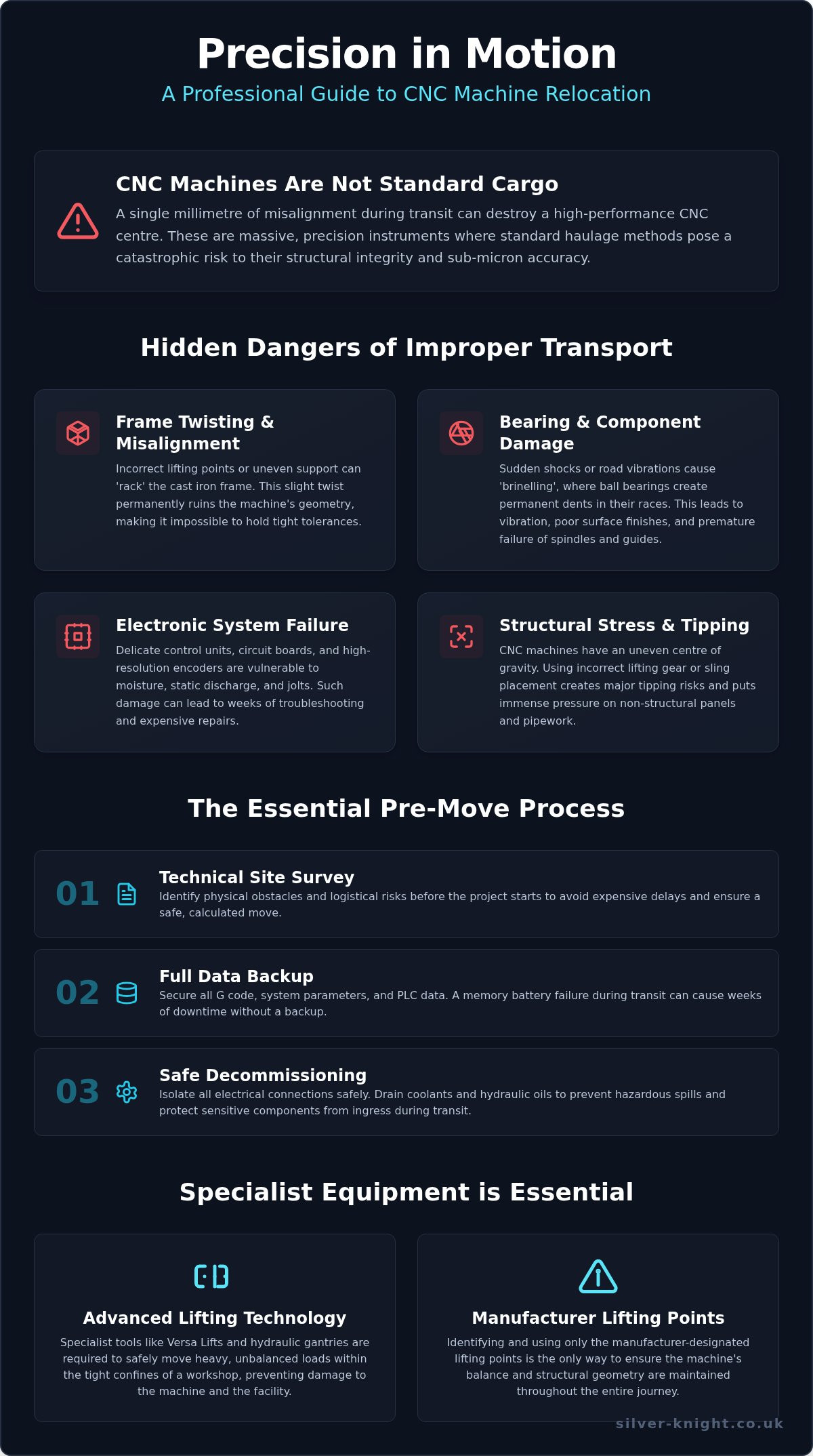
A single millimetre of misalignment during transit can transform a high-performance CNC centre into a very expensive piece of scrap metal. When you're dealing with equipment that relies on sub-micron accuracy, you can't treat CNC machine transport like a standard haulage job. Most site managers rightly worry about the high cost of downtime or the risk of shattering sensitive electronic control units whilst the machine is on the road. It's a valid concern; even a minor jolt can lead to weeks of recalibration and lost revenue.
We understand that your primary goal is a damage-free move that gets your workshop back into production as quickly as possible. This guide explains how to manage a professional relocation project from start to finish. You'll learn how to prepare your machinery for the journey, the importance of using specialist equipment like hydraulic gantries, and how to stay fully compliant with UK safety regulations. We'll also cover the essential steps for decommissioning and recommissioning to ensure your equipment maintains its precision the moment it's powered up in its new home.
Key Takeaways
- Professional CNC machine transport is a precision engineering task that prevents frame twisting and bed misalignment during the move.
- Always back up G code and system parameters before decommissioning to ensure your equipment is ready for production immediately after relocation.
- Specialist lifting equipment like Versa Lifts and hydraulic gantries are essential for moving heavy loads safely within tight factory environments.
- A technical site survey identifies physical obstacles and logistical risks before the project begins to avoid expensive delays.
If you are planning a workshop move, you can rely on our expert team for professional machinery haulage and relocation services across the country.
Understanding the complexities of CNC machine transport
CNC machines are marvels of modern engineering, but their robust appearance is deceptive. Unlike a standard pallet of goods, Computer numerical control (CNC) equipment consists of highly sensitive electronic and mechanical systems that require extreme care. Standard hauliers often treat heavy loads with a one-size-fits-all approach. This is dangerous for precision assets. Without the right expertise, you risk irreversible damage to the machine's structural integrity. Specialist movers understand that these machines are essentially massive scientific instruments wrapped in steel.
Standard haulage firms often lack the specialised equipment needed for these tasks. They might use basic straps that crush delicate panelling or fail to account for the impact of road vibration on high-resolution encoders. A professional relocation partner brings more than just a lorry; they bring the technical knowledge required to protect your investment. This expertise is vital for preventing frame twisting or bed misalignment that can occur during improper lifting.
Fragility of precision components
Precision is the lifeblood of manufacturing. Components such as ball screws, spindles, and linear guides are designed for high-speed operation within micron-level tolerances. Sudden shocks during CNC machine transport can cause "brinelling" in bearings. This happens when a shock load forces the ball bearings into the race, creating permanent indentations. Even a tiny dent will lead to vibration and poor surface finishes once the machine is back in service.
Internal sensors and delicate control units are equally vulnerable. Moisture ingress or static discharge during transit can fry expensive circuit boards. This often leads to weeks of troubleshooting and costly repairs. Maintaining factory tolerances during the move is non-negotiable. If the machine isn't levelled and secured perfectly, the internal geometry can shift. This makes it impossible to hold tight tolerances for future jobs.
Weight distribution and structural balance
One of the biggest challenges in moving these machines is their uneven centre of gravity. A vertical machining centre or a large lathe might look symmetrical, but the internal motor placement often means the weight is concentrated in one specific corner. Identifying the correct lifting points designated by the manufacturer is the only way to ensure a safe move. If you lift from the wrong spot, you risk "racking" the frame. This slight twist in the cast iron bed can ruin the machine's accuracy forever.
- Structural stress. Incorrect sling placement can put thousands of pounds of pressure on non-structural covers or sensitive coolant pipework.
- Tipping risks. Using the wrong grade of lifting gear increases the risk of the machine shifting mid-air. This is a major safety hazard for your workshop staff.
- Manufacturer compliance. Following specific lifting protocols ensures that the machine remains structurally sound and maintains its precision.
Specialist movers use technical site surveys to identify these risks long before the machine leaves the floor. They ensure that every lift is calculated to maintain the machine's balance and structural geometry throughout the journey.
Expert support is essential when handling complex manufacturing assets, so please visit our website to learn more about our specialist machinery moving services.
Essential steps for decommissioning and preparing machinery
Before any physical lifting begins, the digital brain of your machine needs protection. It's critical to back up all G code, system parameters, and PLC data to an external drive. Batteries that maintain memory can fail during the vibration of CNC machine transport; if this happens without a backup, you could face weeks of downtime trying to restore factory settings. Once the data is secure, you should clean the machine thoroughly. Removing swarf and debris prevents metal chips from migrating into sensitive bearings or optical scales whilst the machine is being moved. Even tiny particles can cause significant scoring if they get trapped in the linear guides during transit.
Mechanical decommissioning and fluid removal
Properly disconnecting the power and air lines is the first physical step. You must ensure all electrical connections are safely isolated according to UK safety standards. Draining coolants and hydraulic oils is equally vital; industrial fluids are often hazardous and can cause environmental issues if they leak during transit. Following OSHA safety regulations for heavy equipment provides a solid framework for managing these risks, even though UK sites follow specific HSE guidelines. You should also purge pneumatic lines of all moisture to prevent internal corrosion. Labelling every cable and pipe might seem tedious, but it saves days of work during the recommissioning phase.
Securing internal moving parts
The internal components of a CNC machine are designed to move freely, which is exactly what you don't want during haulage. You must use original manufacturer shipping brackets to lock the X, Y, and Z axes in place. This prevents the heavy table or spindle head from sliding and slamming into the ends of the travel zones during sudden braking. The spindle itself should be supported by wooden blocks or dedicated fixtures to take the weight off the precision bearings. Finally, the control cabinet needs protection. Use anti-static bubble wrap or specialised films to shield the electronics from static build-up and dust whilst in the back of a lorry.
If you are unsure about the best way to prep your specific model, our machinery dismantle service can handle the entire technical process for you.
If you need technical assistance with your next move, get in touch with our specialist machinery transport experts for a comprehensive quote.
Advanced lifting technology for precision industrial equipment
Moving a 20-tonne milling centre requires more than just brute force; it's a technical challenge that demands specialised tools. Standard forklifts often lack the capacity or the precision required for CNC machine transport in confined spaces. Using operated lifting equipment isn't just about ease, it's a matter of strict safety compliance. Professional movers utilise a range of advanced technology to ensure that the machine's weight is managed safely without putting stress on the workshop floor or the machine's frame. Our team brings decades of experience to every project, ensuring that the right tool is selected for the specific weight and dimensions of your equipment.
Versa Lift hire for restricted access
The Versa Lift is a game changer for modern factories. It features an extendable counterweight system that allows it to lift massive loads whilst maintaining a compact footprint. This makes it ideal for navigating narrow aisles and low ceilings where a standard crane simply wouldn't fit. You can find more details about our specialised lifting equipment and how it handles these tight environments. These machines can carry heavy loads in some configurations, providing the muscle needed for the heaviest CNC tools without requiring the massive overhead clearance of a mobile crane. By using an extendable frame, the operator can increase the lifting capacity as needed, which is vital when moving machines with offset centres of gravity.
Hydraulic gantry and jack systems
When overhead space is extremely limited, a hydraulic gantry system is the preferred choice. These systems provide vertical lifting capabilities in areas where mobile cranes cannot reach. They allow for the precision positioning of machines onto their new foundations with millimetre accuracy. This is particularly useful when following a guide on how to transport CNC machines that emphasises the importance of stability. For moves across delicate floors or mezzanine levels, jack and slide systems are used. These tools use low-profile hydraulic jacks to lift the machine just enough to place it on high-capacity tracks. The machine then glides along the rails, spreading the load across a wider surface area using load spreading plates. This method ensures that the factory floor remains undamaged whilst the heavy machinery is moved into position. It's a much safer and more controlled alternative to traditional skating methods.
For reliable and secure machinery haulage across the UK, our family run team offers over 180 years of collective industry experience.
Managing the logistics of national machinery haulage
Moving a heavy asset from one side of the country to the other requires meticulous planning. CNC machine transport is a logistical puzzle where every piece must fit perfectly. You need to select the correct vehicle based on the machine's height and weight. For example, a tall vertical machining centre might require a low loader to clear UK motorway bridges safely. Using the wrong trailer can lead to expensive delays or even legal issues if height limits are exceeded. Comprehensive goods in transit insurance is also non-negotiable. It provides peace of mind that your manufacturing asset is protected throughout the journey.
Route planning is another critical factor. Many UK roads have weight restrictions or narrow lanes that are unsuitable for heavy haulage vehicles. Professional movers use advanced route planning software to calculate legal paths that account for bridge heights and seasonal limitations. This prevents the lorry from being diverted or stuck, which would cause the kind of production downtime every site manager wants to avoid.
Technical site surveys and access routes
A successful move starts weeks before the lorry arrives. A technical site survey is essential to identify physical obstacles at both the collection and delivery points. We measure door widths and heights to ensure the machine can actually leave the building without being dismantled more than necessary. Floor loading capacities are checked to see if the concrete can handle the weight of the machine plus the lifting equipment like Versa Lifts. We also look for temporary needs such as ramps or floor reinforcement. Overhead ducting, lighting, and power lines must be mapped out to avoid collisions during the lift.
Risk assessments and safety compliance
Safety is the priority in any industrial relocation. We produce detailed Method Statements and Risk Assessments (RAMS) for every project. These documents outline exactly how the move will be performed and how risks will be managed. It's a legal requirement that ensures all staff are fully qualified and wearing the correct PPE, including high-visibility gear and steel-toed boots. Adhering to the latest health and safety regulations ensures that the move is compliant and that everyone on site remains safe. This documentation is also vital for your own company's safety records and insurance compliance.
If you're planning a complex move and need professional support, contact our logistics team to arrange a site survey and get a detailed relocation plan.
If you are looking for a reliable partner to handle your next industrial move, you can explore our full range of machinery relocation services today.
Selecting a specialist partner for CNC relocation projects
When you are moving multi-million pound manufacturing assets, experience isn't just a bonus; it's a requirement. A single error in CNC machine transport can result in catastrophic financial losses and prolonged production delays. Choosing a partner with a long track record ensures they understand the nuances of different machine brands and the specific vulnerabilities of their control systems. A family run business often provides a higher level of accountability and personal service compared to large, impersonal corporations. With over 180 years of collective industry experience, our team treats every machine with the care it deserves.
One major benefit of working with a specialist is the ability to handle both the physical transport and the technical installation. Hiring separate contractors for haulage and commissioning often leads to finger-pointing if a machine doesn't perform correctly at the new site. A single point of contact simplifies communication and ensures that the same team responsible for the move is also responsible for getting the machine back into production. This continuity is vital for maintaining the precision of delicate spindles and ball screws.
Nationwide haulage and installation
The advantage of a turnkey service cannot be overstated. By using our machinery haulage services, you ensure that the decommissioning, transport, and recommissioning phases are perfectly synchronised. Professional recommissioning involves more than just plugging the machine in; it requires precise levelling and alignment to restore factory tolerances. This comprehensive approach gets your production lines running again with minimal fuss, as the engineers who moved the machine already know its specific requirements. It's the most efficient way to reduce downtime and ensure your workshop returns to full capacity quickly.
International transport and export packing
If your relocation project extends beyond the UK, you need a partner with global logistics expertise. Moving CNC machines abroad involves complex sea or air freight arrangements and strict customs documentation. We provide specialised export packing for machinery, using moisture resistant barriers and custom built crates to protect against the harsh conditions of international transit. Whether you are moving a single lathe or an entire factory floor to another continent, managing the international logistics through a single experienced provider reduces the risk of damage and administrative errors. We handle the technical side of sea freight packing so your equipment arrives in the same condition it left the factory.
If you need expert help with your next factory move, contact our professional machinery movers for a tailored solution.
Securing your manufacturing future with precision relocation
A successful relocation relies on a combination of technical preparation and the right lifting technology. By prioritising data security and mechanical decommissioning, you protect the heart of your production line. Utilizing advanced tools like Versa Lifts and hydraulic gantries ensures that even the heaviest assets are moved without compromising their micron-level accuracy. It's not just about the haulage; it's about maintaining the integrity of your equipment from one floor to the next.
Choosing a partner with over 180 years of collective industry experience gives you the confidence that your move is in safe hands. Our team provides nationwide UK coverage and global relocation options for complex projects. We are specialists in restricted access and heavy lifting, managing every detail from technical site surveys to final recommissioning. Don't leave your precision assets to chance when planning your next CNC machine transport project.
Request a professional CNC transport quote today to begin planning your next successful relocation. Your machinery is the lifeblood of your business, and we're here to help you move it with the care it deserves.
Frequently Asked Questions
How do you transport a CNC machine safely?
Safe CNC machine transport involves securing internal components like the spindle and tool changer with dedicated shipping brackets. We use specialised equipment such as hydraulic gantries or Versa Lifts to lift the unit onto a heavy goods vehicle. Once loaded, the machine is strapped down and covered to prevent any movement or exposure to the elements whilst in transit across the UK. This approach protects sensitive electronics from vibration.
Do I need to decommission my CNC machine before moving?
Yes, you must fully decommission your CNC machine to prevent damage during the move. This process includes draining fluids, disconnecting electrical supplies, and locking moving parts to keep them stable. Our team provides professional decommissioning services to ensure every component is ready for travel. Proper preparation is the most effective way to avoid expensive repairs when the machine reaches its new location in the workshop.
What equipment is used for lifting heavy CNC tools?
We use a range of advanced lifting technology including hydraulic gantry systems and Versa Lift forklifts. For areas where space is limited, jack and slide systems allow us to move heavy machines with high precision. These tools ensure that even the heaviest CNC lathe or milling centre is handled safely without putting undue stress on the factory floor or the machine frame itself during the lift.
Is insurance included in CNC machine transport services?
Specialist machinery movers typically provide Goods in Transit and Public Liability insurance as part of their standard service. It's important to check the specific coverage limits for your CNC machine transport to ensure they match the total value of your equipment. We recommend reviewing the policy details before the move begins to confirm that your assets are fully protected against any accidents during the relocation process.
How long does a typical CNC machine relocation take?
A standard relocation for a single machine usually takes between one and two days depending on the travel distance. This timeframe includes the initial decommissioning, loading, transport, and the final installation at the new site. Larger factory relocations involving multiple machines will naturally take longer. We always conduct a site survey first to provide a realistic schedule that helps you manage your production downtime effectively.
Can you move CNC machines through narrow factory doors?
We can move large machines through tight spaces by using specialised equipment like skates and low profile jacks. If a door is too narrow, our team can often partially dismantle the machine or use a jack and slide system to navigate difficult corners. We plan these manoeuvres during our technical site survey to ensure the machine fits through every opening without causing any structural damage.
Do you provide international CNC machine transport?
We provide comprehensive international machinery transport services for clients moving equipment outside the UK. This includes managing the logistics of sea or road freight and ensuring all customs documentation is handled correctly. Our team organises the entire process from the initial lift at your UK facility to the final positioning and installation at your international destination, providing a seamless door to door relocation service.
What is the cost of moving a large CNC lathe?
The cost of moving a large CNC lathe depends on several factors like the weight of the machine, the distance of the journey, and the complexity of the lift. Because every project has unique requirements, we provide bespoke quotes rather than fixed prices. This ensures you only pay for the specific equipment and personnel needed for your move. Contact us for a detailed estimate based on your site.

Article by
David Ashby
I'm the Managing Director of Silver Knight Haulage & Machinery Ltd. Silver Knight Ltd is a family-run firm established in the West Midlands in 2005, with the aim of providing a cost-effective, yet professional, service to businesses for the removal, transportation, and installation of machinery, plant, and equipment here in the UK and worldwide. Between us, the Silver Knight workforce has over 50 years of experience with machinery and its operation.
Disclaimer
This article is intended for informational purposes only. Please ensure you seek expert advice or carry out your own research to confirm the information is suitable for your specific needs.