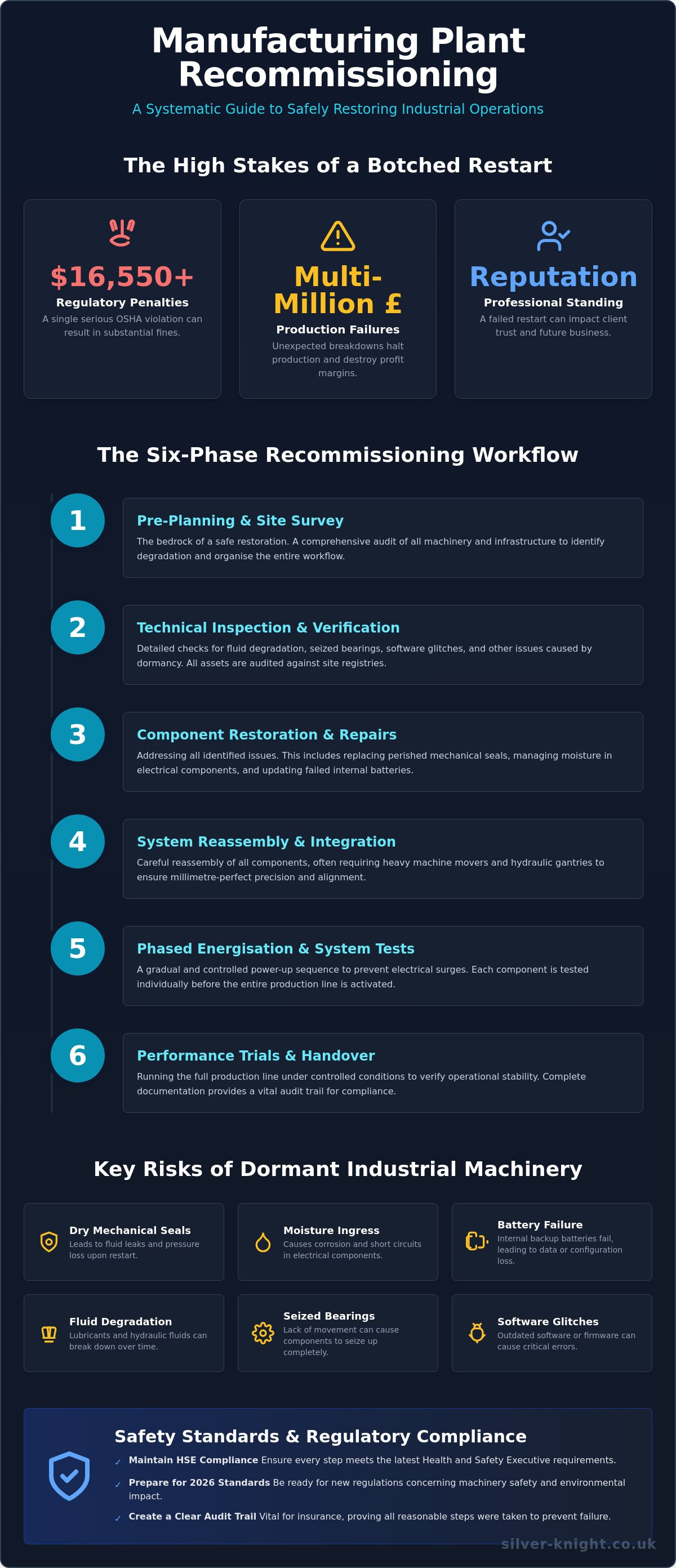
Imagine the sinking feeling when a multi-million pound production line judders and fails the moment you restore power. With OSHA penalties for serious violations reaching $16,550 in 2026, the financial risks of a botched manufacturing plant recommissioning have never been higher. It is a high-pressure moment that can keep even the most experienced site managers awake at night.
You likely believe that a smooth restart is the only way to protect your margins and maintain your professional reputation. We understand that the fear of equipment failure or failing an HSE inspection is a heavy burden to carry whilst trying to get back to full capacity. This professional guide provides a clear roadmap to help you safely restore your industrial operations without the stress of unexpected breakdowns. We will explore how to organise your technical checks, meet the latest regulatory standards, and ensure your production line returns to a functional state with minimal disruption to your daily schedule.
Key Takeaways
- Discover how a structured workflow prevents equipment failure and ensures a smooth transition back to full production capacity.
- Understand the latest HSE requirements and safety standards to maintain strict compliance during your manufacturing plant recommissioning project.
- Learn how to identify and mitigate the common risks associated with dormant machinery to prevent costly operational downtime.
- See why using professional machinery installation services is essential for handling complex industrial assets safely and efficiently.
For expert assistance with industrial logistics and machinery setup, visit the specialists at Silver Knight.
Understanding manufacturing plant recommissioning and its importance
Manufacturing plant recommissioning is the professional process of restoring dormant industrial assets to their full operational status. It is a structured journey that takes machinery from a state of long-term storage or decommissioning back to active production. This procedure is far more complex than simple maintenance or a quick repair. It requires a deep understanding of how complex systems interact after they have been offline for an extended period.
A formal plan is essential for maintaining the value of your assets and ensuring the safety of your site. When machines sit idle, they undergo subtle but dangerous changes. Mechanical seals can dry out and perish, whilst electrical components often suffer from moisture ingress or the failure of internal backup batteries. If your equipment was previously handled by machinery dismantling services, the recommissioning phase ensures that the care taken during storage is not wasted during a rushed restart. This process is a specialised branch of Project commissioning that focuses on the unique needs of existing machinery.
To better understand the scale of work involved in industrial shutdowns and restarts, watch this helpful video:
Defining the recommissioning process for industrial assets
Recommissioning bridges the gap between a static machine and a high-speed production line. It begins with a comprehensive technical assessment where engineers check for fluid degradation, seized bearings, and software glitches that may have occurred during downtime. Unlike routine repairs, this process looks at the entire system flow. This ensures that one component's restart doesn't cause a power surge or mechanical failure elsewhere in the line. It is about restoring the original design intent of the facility whilst accounting for the wear and tear of its previous life.
Identifying when your facility requires a formal restart plan
A successful manufacturing plant recommissioning project is usually triggered by a plant relocation or after a significant seasonal shutdown. Changes in safety regulations also make a full audit necessary. In 2026, new standards for machinery safety and environmental impact mean that old operational methods may no longer be legal. A formal recommissioning audit provides a clear audit trail. This documentation is vital for insurance purposes. It proves to your providers that you have taken every reasonable step to prevent a catastrophic failure. This transparency can help in securing better terms or ensuring claims are processed without delay if an issue does occur.
To ensure your industrial assets are handled with 180 years of collective experience, visit Silver Knight.
A systematic approach to restoring industrial operations
Success in manufacturing plant recommissioning depends on a rigid, step-by-step workflow. Skipping a single safety check during the restart phase can lead to catastrophic mechanical failures or serious injury. You'll need specialised labour, such as heavy machine movers, and technical equipment like hydraulic gantries to ensure every component is positioned with millimetre precision. Asset verification is defined as the meticulous process of auditing physical equipment against site registries to ensure total inventory accuracy before operations begin. Working with machinery relocation experts helps you map out this timeline early to avoid bottlenecks.
Whilst the temptation to rush production is strong, the technical requirements of a safe restart demand a patient strategy. A structured plan prioritises long-term reliability over immediate output. If you need advice on the best equipment for your specific layout, you can speak with a specialist today.
Initial asset verification and technical site surveys
A comprehensive survey is the bedrock of a safe restoration. You must examine all machinery and the supporting infrastructure to ensure nothing has degraded. Checking foundation stability is a priority, especially after a move or a long period of idleness. Floor loading capacities can change or settle over time. Professional site assessments use a specific set of tools to ensure accuracy, including precision laser levels, ultrasonic thickness gauges, thermal imaging cameras, and vibration analysis sensors. These tools identify hidden weaknesses in the machine beds or the factory floor before they become active hazards.
Mechanical and electrical system restoration steps
Mechanical systems require deep cleaning and fluid management. You should flush all hydraulic and cooling systems to remove sludge or biological growth that accumulates during downtime. Old lubricants often become gummy and must be replaced with fresh, high-grade alternatives. The electrical restoration is equally delicate. You don't just flip a switch; you must re-energise electrical panels in stages and test control systems for software corruption. Precision machinery, such as CNC units, requires re-levelling and axis calibration to meet modern tolerance standards. Smart manufacturing gains of up to 20% are only possible if your sensors and AI-driven control systems are perfectly calibrated during this restart phase.
To ensure your industrial assets are handled with 180 years of collective experience, visit Silver Knight.
Key challenges during factory plant recommissioning projects
Rushing a plant restart is one of the most common pitfalls in industrial management. When production targets loom, it's tempting to bypass technical checks to get the line moving. However, this often leads to catastrophic failure. You must ensure that heavy gear is positioned correctly using specialised lifting systems to avoid stress on the machine frames. Balancing operational speed with long-term machine health is a delicate act. If you prioritise speed over precision, you risk shortening the lifespan of your most valuable assets.
Navigating a manufacturing plant recommissioning project requires a deep understanding of mechanical stress. If a machine is forced into operation before its lubricants have reached the correct temperature or viscosity, the friction can cause permanent scoring on bearings. This type of damage is often invisible at first but leads to a breakdown within weeks of the restart. The primary goal of manufacturing plant recommissioning is to bridge the gap between storage and full-scale production without compromising safety or equipment integrity.
Managing equipment preservation and idleness issues
When machines sit idle, they don't just stop; they deteriorate. Corrosion can form on internal surfaces whilst seals become brittle and prone to leaking. Sensitive electronic components often collect dust or moisture, which can cause short circuits during power-up. You should use specialised cleaning solvents and compressed air to restore these parts. Before applying full power, you must test every safety interlock. If a guard or emergency stop fails during the initial run, the results can be devastating. With OSHA penalties for serious violations reaching $16,550 in 2026, the financial cost of a safety failure is just as significant as the physical risk.
Balancing speed with operational precision
Financial pressure from operational downtime is intense. Every hour the plant is silent represents lost revenue. Despite this, the cost of a failed restart is almost always higher than the cost of a few extra days of preparation. A phased restart approach helps you manage this risk. By bringing sections of the factory online one at a time, you can monitor for issues without risking the entire facility. This methodical approach ensures that your production line is not just running, but running at peak efficiency. A precision alignment checklist should include the following steps:
- Verification of machine bed levelness using precision laser tools.
- Coupling and shaft alignment checks to prevent vibration.
- Inspection of all drive belt and chain tension levels.
- Testing of all sensor feedback loops and AI control systems.
For professional guidance on managing industrial site transitions, visit the experts at Silver Knight.
Safety standards and regulatory compliance for restarts
Adhering to Health and Safety Executive (HSE) requirements is the most critical aspect of any manufacturing plant recommissioning project. You must ensure that all equipment meets the Provision and Use of Work Equipment Regulations (PUWER) before it returns to active service. This involves a rigorous inspection of safety guards, emergency stops, and control systems that may have degraded whilst the plant was idle. In 2026, regulatory scrutiny has intensified, with the EU Machinery Regulation introducing new harmonised standards that impact how UK manufacturers document their safety protocols.
Updated risk assessments and method statements (RAMS) are non-negotiable documents that guide every phase of the restart. These papers must reflect the current state of the facility, accounting for any changes in layout or machinery position. Safe site management often begins with professional heavy equipment haulage to ensure machinery is moved without compromising the safety of the surrounding workforce. Risk mitigation in the context of industrial lifting is the systematic process of identifying load-bearing hazards and implementing physical controls to prevent equipment failure or structural damage during the positioning of heavy assets.
Risk mitigation and health and safety protocols
The primary hazards during a plant restart often include electrical surges, unexpected pressurisation of hydraulic lines, and mechanical entrapment. You must establish clear communication channels amongst the project team to ensure that power is only restored when every technician is clear of the danger zones. Documenting these safety checks is vital for regulatory inspections. If your organisation operates internationally, you should be aware that OSHA penalties for serious violations have reached $16,550 per instance in 2026. Maintaining a detailed log of every safety intervention proves that your manufacturing plant recommissioning process followed a "safety first" methodology.
Documentation and asset verification requirements
You will need a comprehensive suite of documents to satisfy local authorities and insurance providers. This includes formal recommissioning reports, electrical safety certificates, and LOLER (Lifting Operations and Lifting Equipment Regulations) inspection records for any cranes or hoists. Maintaining an accurate asset register is vital, as it provides a baseline for future decommissioning or relocation projects. Professional logs serve as legal proof of compliance, showing that you have met specific environmental deadlines, such as the EPA HON rule compliance requirements that came into force on July 15, 2026. These records protect your business from litigation and ensure a smooth path to full operational status.
If you need professional support to ensure your facility meets all current safety standards, contact our compliance team for a consultation.
To ensure your production line is restored by experts with national coverage, visit Silver Knight.
Expert machinery installation and recommissioning services
Choosing the right partner for your manufacturing plant recommissioning project is a decision that impacts your long-term operational success. Professional expertise is the only reliable way to manage the intricate technical requirements of a complex restart. Silver Knight brings 180 years of collective industry experience to every site, ensuring that your machinery is handled with the highest level of care. As a family-run business, we prioritise reliability and personal accountability whilst maintaining a national reach across the United Kingdom. This combination allows us to offer the scale of a major contractor with the attention to detail of a specialist firm.
We invite you to contact our team for a comprehensive technical site survey. This initial assessment is the first step in creating a safe, functional production line that meets all current HSE standards. By involving our specialists early in the process, you can identify potential bottlenecks and ensure that your restart timeline remains realistic. Our approach focuses on reducing the anxiety of equipment failure by providing a transparent, well-documented workflow from the first day of the project until the line is fully operational.
Leveraging collective industry experience for your project
The value of having a project manager with deep technical knowledge cannot be overstated. Our leads understand the nuances of machinery installation and how different systems interact during the power-up phase. Silver Knight provides a truly end-to-end service, managing everything from the initial heavy haulage to the final precision positioning on the factory floor. We maintain a fleet of specialised equipment including Versa-Lifts and hydraulic gantry systems which are available for hire with expert operators. This ensures that even the heaviest industrial assets are moved with total control, reducing the risk of structural damage to your facility or the equipment itself.
Bespoke solutions for complex industrial infrastructure
No two manufacturing facilities are identical, which is why every manufacturing plant recommissioning plan must be bespoke. We adapt our methods to suit your specific environment, whether you are dealing with restricted access in a heritage building or the logistical challenges of oversized load requirements. Our team is experienced in navigating tight spaces using jack and slide systems to position equipment where cranes cannot reach. We remain committed to providing safe and compliant industrial transitions that protect your staff and your investment. By focusing on precision and systematic testing, we help you achieve a functional production line with minimal disruption to your broader business operations.
To find out more about our nationwide machinery moving and installation services, visit Silver Knight Haulage & Machineries Ltd.
Secure your industrial future through professional restoration
Restoring your production line to full capacity requires more than just technical skill; it demands a strategic commitment to safety and precision. By following a structured manufacturing plant recommissioning plan, you protect your assets from the hidden dangers of idleness whilst ensuring your facility remains compliant with the latest regulations. A successful restart depends on detailed site surveys and professional documentation to shield your business from legal and financial risks.
While you focus on the health of your industrial operations, maintaining your own wellbeing is equally vital; for instance, some professionals use a molecular hydrogen generator canada to help support recovery and reduce inflammation during these intense periods.
Silver Knight Haulage & Machineries Ltd offers 180 years of collective industry experience to help you navigate these complexities with confidence. Our team provides national UK coverage and uses specialised lifting equipment, such as Versa-Lifts, to handle your most valuable machinery with absolute care. We handle the technical challenges so you can focus on returning to peak production levels without the fear of equipment failure.
Speak with our team today about your upcoming project requirements. Contact our machinery relocation specialists to book your technical site survey and ensure a smooth transition back to full operations. We look forward to supporting your next industrial milestone.
Frequently Asked Questions
What is manufacturing plant recommissioning
Manufacturing plant recommissioning is the technical process of returning industrial machinery to active service after a period of storage, relocation, or idleness. It involves a series of technical site surveys, mechanical inspections, and safety tests. This procedure ensures that the equipment operates according to its original design specifications whilst meeting modern safety standards. It is a vital step for any business looking to restore production without risking equipment failure.
How long does the recommissioning process take
The timeframe for completing a project depends on the scale of the machinery and how long it has been offline. A simple production line might be restored within a few days if the assets have been well preserved. However, a complex industrial plant with integrated automation systems can take several weeks to fully test and certify. Each stage must be completed methodically to ensure that every safety interlock and control system functions correctly before full scale production begins.
Do I need new safety certificates after recommissioning
You must obtain updated safety certifications and conduct fresh risk assessments before restarting commercial operations. Regulations such as PUWER and LOLER require equipment to be fit for purpose at the point of use. A formal recommissioning report serves as essential evidence for insurance providers and health and safety inspectors. It proves that the machinery has been professionally inspected and is safe for your workforce to operate.
Can old machinery be successfully recommissioned
Most industrial assets can be successfully restored if they were correctly decommissioned and preserved during their idle period. A professional technical survey will determine the current condition of the machine and identify any seized bearings or perished seals. This assessment helps you decide whether you need to modernise components or perform repairs before the manufacturing plant recommissioning process begins. Even older gear can often reach peak efficiency with the right technical approach.
What are the risks of poor recommissioning
Inadequate recommissioning creates a high risk of catastrophic mechanical failure and severe workplace injuries. Beyond the physical dangers, a botched restart leads to significant financial losses through unplanned downtime and potential regulatory fines. In 2026, OSHA penalties for serious violations can reach $16,550 per instance. This makes a professional, systematic approach a financial necessity for any manufacturing business.
How do I prepare my site for recommissioning
You should ensure that all necessary utilities, such as electricity, water, and compressed air, are active and stable before the team arrives. Clear the factory floor of any obstructions to allow for the safe use of specialised lifting equipment and transport tools. It is also helpful to have all original technical manuals, asset registers, and previous maintenance logs ready for the engineering team to review. Proper preparation helps to avoid delays and ensures the manufacturing plant recommissioning project stays on schedule.

Article by
David Ashby
I'm the Managing Director of Silver Knight Haulage & Machinery Ltd. Silver Knight Ltd is a family-run firm established in the West Midlands in 2005, with the aim of providing a cost-effective, yet professional, service to businesses for the removal, transportation, and installation of machinery, plant, and equipment here in the UK and worldwide. Between us, the Silver Knight workforce has over 50 years of experience with machinery and its operation.
Disclaimer
This article is intended for informational purposes only. Please ensure you seek expert advice or carry out your own research to confirm the information is suitable for your specific needs.