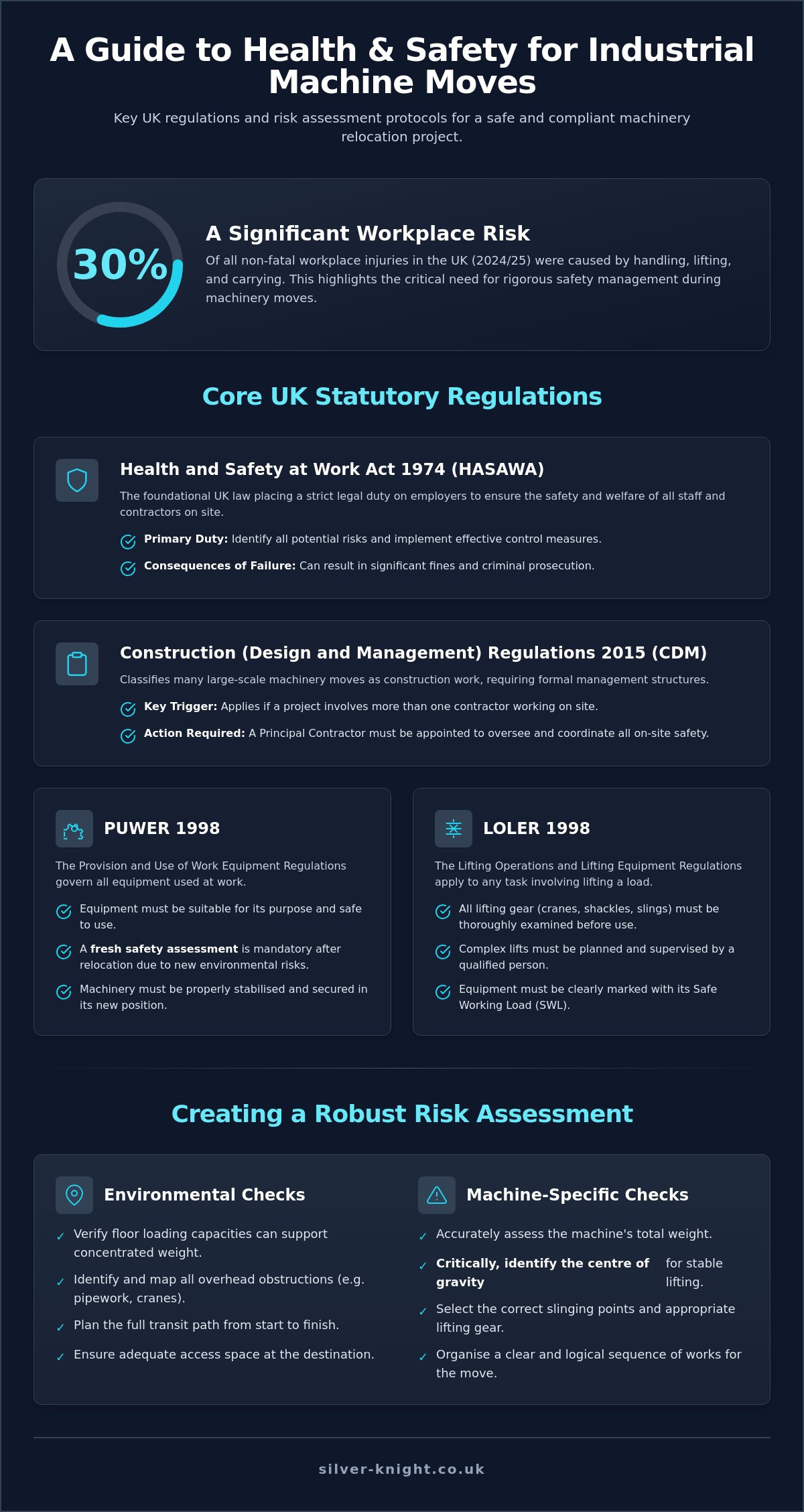
Did you know that handling, lifting, and carrying caused 30% of all non-fatal workplace injuries in the UK during the 2024/25 period? When you're planning an industrial relocation, the stakes are incredibly high. Managing the health and safety for machine moves isn't just about ticking boxes; it's about protecting your people and your most expensive assets from avoidable harm. It's natural to feel anxious about the threat of HSE fines or the legal fallout of a project gone wrong, especially with the 2026 updates to machinery safety regulations on the horizon.
We understand that the complexity of UK legislation can feel overwhelming. You want to ensure your project is compliant without getting bogged down in confusing jargon. This guide offers a professional look at how to navigate these challenges whilst minimising risk at every stage. We'll provide a clear framework for managing LOLER and PUWER requirements, show you how to build a robust Method Statement, and give you the confidence to meet every UK safety standard during your next move.
Key Takeaways
- Learn how to remain fully compliant with PUWER and LOLER regulations to protect your workforce and avoid legal action.
- Discover the essential steps for creating a robust risk assessment that accounts for floor loading and the centre of gravity of every asset.
- Understand why using specialised equipment like hydraulic gantry systems is vital for maintaining health and safety for machine moves.
- Master the safety protocols for decommissioning and installation, including the correct use of lock out tag out procedures for utilities.
- Identify the critical insurance and experience criteria you must verify before choosing an industrial relocation partner to handle your machinery.
Before you begin any industrial project, it is vital to partner with a team that prioritises legal compliance and operational rigour; you can explore our comprehensive machinery moving solutions to see how we manage these complex requirements.
Statutory regulations governing industrial machinery moves
The Health and Safety at Work Act 1974 serves as the primary legislation for all workplace activities in the United Kingdom. It places a strict legal duty on employers to ensure the safety and welfare of their staff and any contractors on site. When you are managing the health and safety for machine moves, this act requires you to demonstrate that you have identified all potential risks and implemented measures to control them. Failing to uphold these duties can result in significant fines or even criminal prosecution if an accident occurs during the move.
Under the Construction (Design and Management) Regulations 2015, often called CDM 2015, many large scale machinery projects are classified as construction work. If your project involves more than one contractor, you must appoint a Principal Contractor to oversee the safety of the entire site. This role is essential for coordinating material handling safety and ensuring that different teams don't create hazards for one another. The Principal Contractor is responsible for the health and safety file and must ensure that all decommissioning and installation work is carried out according to a unified safety plan.
To better understand the practical side of these regulations, watch this helpful video on moving and handling training.
The impact of PUWER on machinery relocation
The Provision and Use of Work Equipment Regulations 1998, known as PUWER, require that all work equipment is suitable for its intended purpose and safe for use. Moving a machine from one location to another automatically triggers the need for a fresh safety assessment. You can't rely on old inspections because the new environment might introduce different risks, such as changes in floor stability or access space. The regulations demand that all machinery is properly stabilised and secured in its new position to prevent any movement that could cause injury to operators or bystanders.
Managing LOLER for heavy lifting projects
The Lifting Operations and Lifting Equipment Regulations 1998, or LOLER, govern any task that involves lifting or lowering a load. Every piece of lifting gear, from heavy cranes to small shackles, must undergo a thorough examination by a competent person before use. When planning a factory relocation service, you must ensure that a qualified supervisor manages every complex lift. LOLER also mandates that all equipment is clearly marked with its safe working load. Ignoring these details during the health and safety for machine moves can lead to equipment failure, putting both your staff and your expensive industrial assets at great risk.
For expert assistance in planning your next project, you can rely on the experienced team at Silver Knight to provide professional guidance for every move.
Creating a robust risk assessment and method statement
A successful move relies on more than just heavy lifting. It requires a detailed plan that addresses every potential danger on your site. When planning the health and safety for machine moves, you must look beyond the machine itself. You need to consider the environment where it currently sits and the path it will take to its new location. This means examining floor loading capacities to ensure the ground can support concentrated weights and checking for overhead obstructions like gantry cranes or pipework that could snag during transit.
Every individual machine has its own quirks. Assessing the weight is the first step, but understanding the centre of gravity is even more critical for stability. An unbalanced load can cause a forklift to tip or a crane to swing unexpectedly. By documenting these details in your risk assessment, you provide the moving team with the data they need to select the right slinging points and lifting gear. You should also organise a clear sequence of works. This ensures that lift zones are properly cordoned off to prevent unauthorised access by other employees whilst the project is underway.
Step by step guide to the RAMS process
The process begins with a comprehensive site survey. This isn't just a quick walk through. It involves identifying hidden service lines, such as underground electrical cables or gas pipes, that could be crushed by heavy machinery. Once you have these facts, you can draft a step by step method statement. This document should detail the exact order of operations, from the first bolt removed to the final commissioning check. Before any work starts, a site induction is mandatory. This ensures every crew member understands the specific risks of the project and the Provision and Use of Work Equipment Regulations (PUWER) that apply to their tools.
Identifying and mitigating common moving hazards
Hydraulic systems often contain trapped energy that can cause serious injury if a hose is disconnected without proper depressurisation. During the dismantling phase, manual handling risks are also high, as workers often reach into awkward spaces to unbolt heavy components. To keep everyone safe, you must enforce strict pedestrian and vehicle segregation. Use physical barriers and clear signage to keep site staff away from moving plant equipment. PPE is the final line of defence. Your documentation must specify exactly what is required, from steel toe cap boots and hard hats to high-visibility vests and gloves. If you need help developing these detailed safety documents, you can speak with our safety consultants today.
Choosing the right partner means gaining access to the most advanced technology in the industry; you can explore our specialised machinery moving equipment to see the tools we use to maintain a secure site.
Safety benefits of specialised lifting and haulage equipment
Standard transport equipment often fails to meet the rigorous demands of a factory environment. When you prioritise the health and safety for machine moves, you must look for equipment designed specifically for industrial weight and restricted space. A Versa-Lift forklift, for instance, uses a telescoping frame to extend its wheelbase. This provides superior stability whilst handling heavy loads in confined aisles where a standard forklift might struggle or tip. Similarly, hydraulic gantry systems offer a massive safety advantage over mobile cranes. They operate within a compact footprint and don't require the large boom radius that often leads to collisions with factory ceilings or overhead services.
Jack and slide systems are another critical tool for reducing risk. These systems allow heavy assets to be moved horizontally across a floor with minimal vertical lifting. This significantly reduces the need for working at height and eliminates the dangers associated with suspended loads. By keeping the machine close to the ground, the risk of a catastrophic drop is almost entirely removed. When managing the health and safety for machine moves, the choice of kit determines the level of residual risk left on the site. Modern operators also benefit from wireless remote controls. These devices allow the technician to move around the machine to find the best vantage point, ensuring they can spot potential hazards that would be invisible from a fixed driving position.
Engineering safety into heavy lifting gear
Modern hydraulic gantries are equipped with load monitoring sensors that provide real-time data on weight distribution. This technology ensures that no single leg of the gantry is overloaded, which is a vital component of OSHA general requirements for machines regarding stability and guarding. For the transport phase, low loaders are much safer than standard flatbeds. Their lower deck height reduces the centre of gravity for the load and makes loading and unloading much simpler. You can view the full technical specifications of these tools on our Silver Knight equipment page.
Reducing human error with advanced machinery movers
Hydraulic systems provide a level of precision that manual jacking simply cannot match. With a hydraulic system, the movement is smooth and controlled, preventing the sudden jolts that can damage sensitive internal components. This specialised kit also protects your staff. By letting the machines do the heavy work, you reduce the physical strain on your workforce and lower the risk of musculoskeletal injuries. Of course, even the best equipment is only safe if it is well kept. Regular maintenance schedules are non negotiable to ensure every valve, sensor, and cable is in perfect working order before the project begins.
Ensuring your production line is handled with technical precision is vital for a smooth transition; you can find out more about our expert industrial relocation services to see how we manage these phases safely.
Safety protocols for decommissioning and installation
The physical move is only part of the project. Effective health and safety for machine moves starts long before the equipment leaves the floor and continues until the final bolt is tightened at the new site. Decommissioning is a high risk phase where stored energy and complex connections can lead to accidents if not managed with care. You must implement a strict lock out tag out (LOTO) procedure for all utilities, including electricity, gas, and compressed air. This ensures that no machine can be accidentally powered up whilst engineers are working on it.
Dismantling complex production lines introduces risks that aren't present during normal operation. As components are removed, the structural integrity of the remaining machine can change, potentially leading to a collapse if the sequence of work is incorrect. Every step must be planned to maintain balance and stability. Once the machine is moved, the recommissioning phase serves as the final safety gate. This involves a rigorous series of checks to verify that every safety feature, from emergency stops to interlocking guards, is functioning perfectly before the machine returns to service.
Safe dismantling and decommissioning services
Proper fluid disposal is essential for environmental safety; you must drain and contain all hydraulic oils and coolants to prevent slips and contamination. Using professional machinery dismantle services ensures that the equipment is taken apart safely without damaging sensitive internal parts. Proper labelling of every component and cable is also vital. This simple step prevents assembly errors at the new site that could lead to dangerous mechanical failures during the initial power up.
Precision positioning and final installation safety
Once the machinery arrives at its destination, floor preparation is the first priority. This is a critical element of health and safety for machine moves, as an unstable base can lead to mechanical failure or operator injury. Precision levelling prevents operational vibrations that could loosen fixings over time. Anchoring systems must also be tested to ensure they can withstand the forces generated by the machine during peak production. For a deeper look at the technical requirements, you can refer to these machinery installation standards. If you are ready to plan your next factory move, contact our technical team for a detailed consultation.
Finding a partner who understands the intricacies of heavy plant movement is the final step in securing your project; you can explore how our team maintains the highest standards in machinery moving to ensure a safe transition.
Criteria for selecting a safe machinery moving partner
Choosing the right contractor is the final piece of the puzzle. When you are responsible for the health and safety for machine moves, you cannot afford to take a chance on an unproven team. A reputable partner should demonstrate a solid track record with industrial assets similar to your own. This isn't just about moving weight; it's about understanding the specific vulnerabilities of your equipment. Always ask to see valid insurance certificates. You must ensure they carry adequate public and product liability insurance to cover any potential incidents during the relocation process.
Qualifications are equally important. Every operator on your site should hold current CPCS or NPORS certifications. These schemes ensure that the person behind the controls of a forklift or gantry system has undergone rigorous training and assessment. Reviewing a company's safety record and recent project case studies will give you a clear picture of their commitment to site welfare. If a firm is reluctant to share their recent performance data, it may be a sign that their protocols are not as robust as they claim.
Assessing experience and industry reputation
There is significant value in partnering with a family run business that employs long term staff. In an industry where precision is everything, having a team that has worked together for years creates a safer working environment. Our team draws on 180 years of collective experience, which drastically reduces project risk by ensuring that every potential hurdle has been seen and overcome before. For more detailed insights on what to look for, you can read our professional guide to industrial relocation.
Final safety checklist for the project manager
Before any work begins on your site, you should request a specific set of documents to ensure the health and safety for machine moves is maintained. This checklist serves as your final verification that the project is ready to proceed safely.
- Site-specific Risk Assessment and Method Statement (RAMS)
- Training records and competency cards for all on-site personnel
- Thorough Examination reports (LOLER) for all lifting tackle and machinery
- A clear project timeline with defined communication channels
The role of the site manager is to oversee the moving team and ensure that the agreed RAMS are followed to the letter. Clear communication is the key to preventing accidents. You should establish a direct line of contact between your internal staff and the lead moving engineer to ensure that any changes in the site environment are communicated immediately. This collaborative approach ensures that the project meets all UK safety standards whilst protecting your employees and your investments.
If you are ready to begin your next project, you can find out more about our professional machine moving services to ensure a smooth transition.
Securing your industrial future with expert relocation
Managing the health and safety for machine moves requires a meticulous blend of legal knowledge, technical skill, and the right equipment. We've explored how strict adherence to PUWER and LOLER protects your business from legal risk, whilst specialised tools like hydraulic gantries and Versa-Lifts ensure your assets remain stable throughout the transition. A robust Method Statement is not just paperwork; it is the essential blueprint that keeps your staff safe during the high pressure phases of decommissioning and installation.
When you partner with a specialist, you gain the peace of mind that every hazard has been anticipated and mitigated. Our team brings over 180 years of collective industry experience to every project, providing comprehensive RAMS and fully trained, qualified lifting operators to manage the most complex shifts. We're here to help you navigate the shifting regulatory landscape and ensure your relocation is handled with the highest level of professional care.
Contact our expert team for a safe and compliant machinery move and let us help you plan a successful project today.
Frequently Asked Questions
What are the main risks when moving heavy machinery
The main risks include crushing injuries, entrapment, and falls from height. You must also account for structural collapse if floor loading isn't checked or if the machine's centre of gravity shifts during a lift. Contact with moving machinery remains a top cause of workplace fatalities, with 13 deaths in the manufacturing sector during the 2024/2025 period. These risks are best mitigated through detailed planning and the use of specialised moving equipment.
Do I need a specific risk assessment for moving a CNC machine
Yes, you need a site-specific risk assessment for every asset, including CNC machines. These units often have sensitive electronics and precision components that require specialised handling to prevent internal damage. A generic assessment won't cover specific hazards like trapped hydraulic energy or the stability of the machine's internal bed during transit. You must document the exact sequence of dismantling and the specific lifting points required for that individual model.
What is the difference between LOLER and PUWER during a move
PUWER focuses on the safety and suitability of the work equipment itself, whilst LOLER specifically governs the lifting operations. When managing the health and safety for machine moves, PUWER ensures the machine is stable and safe for use in its new location. LOLER mandates that all cranes, slings, and shackles are thoroughly examined and used by competent personnel. Both regulations work together to ensure the entire lifting process is legally compliant and safe.
Can I use my own factory staff to move heavy equipment
It is advisable to use specialist contractors rather than factory staff for heavy lifting and complex rigging tasks. Your internal team may lack the specific training and experience needed to handle multi-tonne assets safely. Using unqualified personnel significantly increases the risk of accidents and can invalidate your insurance policies. Professional movers hold specific CPCS or NPORS qualifications, ensuring they have the technical expertise to manage heavy industrial assets without compromising site safety.
What insurance should a machinery moving company have
A machinery moving company must hold valid public liability and product liability insurance as a minimum. You should also verify they have specific goods in transit or machinery movement cover that reflects the true replacement value of your equipment. Standard haulage insurance is often limited to £1,300 per tonne under RHA conditions, which is rarely enough for high-value precision machinery. Always ask for a copy of their current insurance certificates before work begins.
How does CDM 2015 apply to a factory relocation project
CDM 2015 applies if the relocation involves multiple contractors and is classified as construction work. Under these regulations, you are required to appoint a Principal Contractor to coordinate the health and safety for machine moves across the whole project. This ensures that different teams, such as electricians and mechanical engineers, don't create hazards for one another. The Principal Contractor is responsible for maintaining the health and safety file and ensuring a unified safety plan.
What safety equipment is needed for an internal machine move
You will need specialised equipment such as hydraulic jacks, machine skates, and load-monitoring sensors to move equipment internally. Personal protective equipment like hard hats, steel toe cap boots, and high-visibility vests is mandatory for everyone in the lift zone. Using the right kit, such as a Versa-Lift or a hydraulic gantry, provides the stability needed to navigate tight factory aisles safely. These tools are designed to keep the load low and controlled.
How do I ensure the floor can handle the weight of the move
You should conduct a professional floor loading survey to calculate point loads and ensure the weight is distributed correctly. This often involves using steel plates or timber spreaders to increase the surface area and protect the floor from cracking. Never assume a factory floor has a uniform capacity. You must also identify sub-surface voids, service trenches, or drainage lines that could create hidden weak points and lead to a structural failure during the move.
Article by
David Ashby
I'm the Managing Director of Silver Knight Haulage & Machinery Ltd. Silver Knight Ltd is a family-run firm established in the West Midlands in 2005, with the aim of providing a cost-effective, yet professional, service to businesses for the removal, transportation, and installation of machinery, plant, and equipment here in the UK and worldwide. Between us, the Silver Knight workforce has over 50 years of experience with machinery and its operation.
Disclaimer
This article is intended for informational purposes only. Please ensure you seek expert advice or carry out your own research to confirm the information is suitable for your specific needs.