A factory move can involve relocating a single machine or an entire site. Professional machinery movers operate nationwide across the UK, offering services that may include equipment delivery and installation, or decommissioning and removal as part of a relocation, for projects in areas such as Walsall and beyond.
It’s helpful to understand the work and cost before planning a move. The price depends on the project and is provided after a quote request. Factors include the machinery, the distance and the work required at each site.
This guide explains how to plan factory moves, processing-line relocations, machinery removal and site access across the UK. You’ll learn what to consider, how transport and installation fit into the process, and what information helps define the next steps.
Explore machinery moving support from Silver Knight Haulage & Machineries Ltd for factory and plant projects.
Key Takeaways
- Plan a factory move around the machinery, transport route and requirements at both sites.
- Map out how processing lines will be disconnected, moved and reinstalled to support an organised transition.
- Consider the equipment, access and removal sequence when dismantling machinery.
- Plan handling and site arrangements together so the move suits the conditions at each location.
- For projects across Walsall and the West Midlands, explore machinery moving, installation, factory relocation and plant relocation support.
For machinery moves involving international transport, explore international machinery moving arrangements.
Factory relocation and machinery haulage
A factory relocation can mean moving one machine or an entire production site. The plan connects removal, transport and installation with the destination’s layout and operating needs.
The price depends on the project and is provided after a quote request. Machine size and weight, site access, route, lifting requirements and work at each location all affect the cost. Machinery movers Walsall businesses can use include services for machinery transport and installation, factory and plant relocation, heavy haulage and international transport.
Turnkey relocation projects
A coordinated relocation brings the stages of a move together, from planning and machinery removal through haulage and installation. The scope can cover one machine or a complete factory, depending on the equipment and destination.
Before work begins, list the machines to be moved, their new positions and the sequence needed for restart. Link each machine’s removal and delivery to its intended location, rather than treating transport as a separate task.
Machinery removal and relocation
Machine removal and relocation can involve preparing equipment for movement, transporting it and positioning it at its destination. The work can also include decommissioning and installation, so the required scope depends on whether a machine is moving within Walsall or to another site.
Start by listing the equipment and its current and destination locations. Then consider access at both sites, the route through each building and the order of removal. For example, a production machine’s route may need clearing before lifting and loading can begin.
Relocation services offered
Machinery-moving services can include moving and heavy haulage, installation, factory relocation and plant relocation. A project may also involve machinery storage or international transport, depending on the destination and how the move is organised.
Case studies can show how a relocation was scoped. Look for the project’s starting point, machinery involved, destination and work completed. These details help distinguish a single machine move from a wider factory project. For businesses comparing machinery movers in Walsall, a relevant example can clarify the type of work involved without assuming every relocation follows the same plan.
For a factory relocation, break the project into connected stages: identify the equipment, plan its removal, arrange haulage and prepare for installation. This sequence highlights dependencies, such as clearing a route before machinery can be moved.
Moves can cover equipment travelling across the UK or overseas. The destination and route shape the transport plan. If delivery and installation are required, coordinate arrival with positioning. Recording each machine’s intended location makes the plan more practical.
A clear processing-line plan can work alongside machinery moving support as you organise the project.
Machinery Movers undertakes moves ranging from a single machine to an entire factory, so the required scope can be matched to the equipment and destination. Machinery Movers can schedule machinery relocations outside normal working hours and at weekends. This may help businesses coordinate access, site preparation and the sequence of work around their operating schedule.
Decommissioning and reinstallation of processing lines
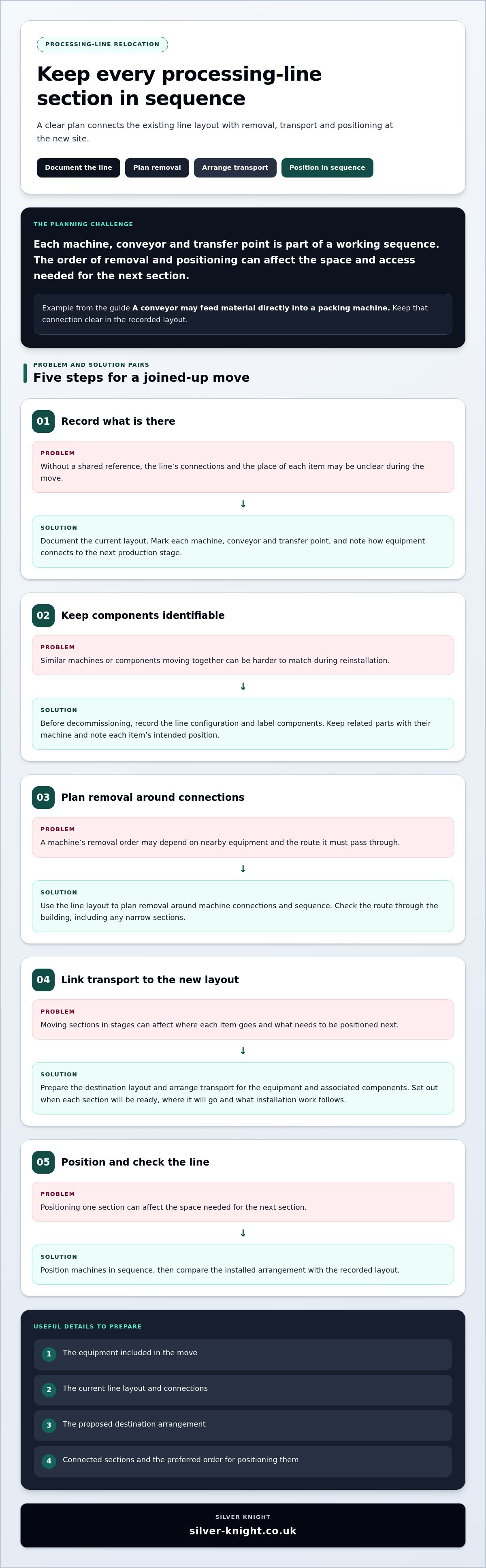
A processing line links machines in a working sequence, so relocating it requires planning how each section fits together. The plan should show how the equipment will be removed, transported and positioned at the new site.
Start with a layout of the existing line. Mark each machine, conveyor and transfer point, and note how the equipment connects to the next production stage. For example, a conveyor may feed material directly into a packing machine. Keeping these relationships clear helps determine where each item belongs in the new layout.
Before decommissioning, record the line’s configuration and label components so they can be matched during reinstallation. Keep related parts together with their machine and note each item’s intended position. These records are particularly useful when similar machines or components move together.
A project plan can set out the work in sequence:
- Document the current line layout and list the equipment included.
- Plan removal around the connections and order of the machines.
- Arrange transport for the equipment and associated components.
- Prepare the destination layout and position machines in sequence.
- Compare the installed arrangement with the recorded layout.
Each stage affects the next. If a machine must pass through a narrow route, its removal order may depend on nearby equipment. At the destination, positioning one section can affect the space needed for the next. A shared layout gives everyone involved a clear reference before work starts.
Set out when each section will be ready for transport, where it will go and what installation work follows. This matters when line sections are moved or positioned in stages. For example, the plan can show which machine must arrive before its connected conveyor is positioned.
Machinery movers in Walsall can support businesses planning processing-line moves by coordinating decommissioning and reinstallation around the equipment layout. The project scope depends on the machines involved, their arrangement and the work required at each location.
Before discussing a move, prepare the equipment list, current layout and proposed destination arrangement. Machinery movers in Walsall can use these practical details to understand how the line is organised and what needs to happen at each stage. Include notes about connected sections and the preferred order for positioning them.
Planning machinery moving support around the equipment’s route can help organise removal and transport.
Industrial machinery removal and dismantling
Industrial machinery removal starts by defining what will move, what will be dismantled and what will remain. A standalone press, for example, may move intact, while a connected production unit may need to be separated into sections. The machine’s size, shape, layout and route through the building all influence the removal plan.
Begin with an equipment list identifying each machine and its location. Include related components, such as control cabinets, guards or feed sections, so they remain associated with the correct equipment. Mark each item’s destination or disposal route. Clear records help prevent confusion when similar machines are removed from the same premises.
Next, map the route from each machine’s position to the loading point. Note doorways, corners, floor changes and obstructions. A machine beside a production line may need a different removal sequence from equipment near an external access point. The route also helps identify where dismantled sections can be staged before loading.
If machinery needs dismantling, plan the work around its construction and how its sections fit together. Record connections and label components before moving them. Keep associated parts together and note which sections need reassembling at the destination. This makes the removal plan useful beyond the loading stage.
A clear sequence can help organise the work:
- Identify the machinery and list its associated components.
- Record the current position and planned destination of each item.
- Map an accessible route from the equipment to the loading point.
- Set out which machinery moves intact and which sections require dismantling.
- Label separated parts and keep related components together for transport.
Choose handling arrangements to suit the machine and available working space. Heavy machine movers may use hydraulic gantries, cranes or jack and slide systems. The right method depends on the load, access and machinery position. For example, a cramped production area can affect how equipment is lifted and moved towards the exit.
Before work starts, bring together the equipment list, route plan and intended destination for every item. These details give the removal team a shared reference, from dismantling the first machine to loading the last component. Clear planning connects removal decisions with the next stage of each machine’s journey.
Good machinery-moving planning starts with the equipment, site access and route.
Machinery handling and site planning
Coordinate site entry, a clear internal route and a loading area at both premises. Identify any permit or access requirements arising from the route and site conditions before setting the move sequence.
Machinery handling arrangements
Match the handling method to the machine’s weight, shape, position and available space. Depending on the equipment and site conditions, a hydraulic gantry, crane or jack and slide system can support different lifting and movement tasks.
For example, machinery in a confined production area needs a route planned around nearby equipment and obstacles. Record the machine’s position, route to the exit and loading point before deciding the handling sequence.
Site planning and access needs
Walk through both sites before the move. Note entrances, doorways, corners, floor changes, overhead obstructions and space for loading. These details can reveal where access may affect moving or positioning the machinery.
Coordinate entry and working areas with the people responsible for each site. Identify any access restrictions and the relevant permissions or arrangements early, then include the agreed details in the move plan.
A practical site plan links the machine’s starting point to its final position. Mark the route on a layout, including turns, thresholds and areas to clear. For instance, a machine leaving a production bay may need a clear passage through a shared workshop to reach the loading point.
At the destination, identify where each machine will sit and how handling equipment will reach it. Keeping the floor area near the planned position clear can prevent obstacles delaying delivery. Confirm that the route through the building suits the equipment’s dimensions and intended orientation.
Agree the sequence of site activities with the people managing both premises. Cover access, route preparation, machinery movement and when the loading area is needed. If several machines share a route, set their order so one does not block access for another.
Keep one plan for both locations, with a separate note of each machine’s position and route. Include access contacts, the loading area and any restricted zones. This gives the move team a consistent reference and helps address practical issues before machinery arrives or leaves.
Handling equipment should suit the machinery and available access, rather than being chosen in isolation. Connecting the site walk-through, route plan and final positions makes the handling sequence clear from entry to placement.
For machinery moves across the area, explore machinery moving support.
Service coverage in Walsall and the West Midlands
For a project involving Walsall, match the move plan to the locations involved. A machine moving between nearby sites has different transport needs from equipment travelling farther afield. Record the collection and delivery addresses, then map the route between them.
The route matters even when both premises are nearby. Collection-site access, loading arrangements and the destination layout all affect how machinery can be moved. For example, a machine leaving a workshop may need a planned route through the building before it reaches the loading area.
Machinery-moving services can cover one machine or a larger factory relocation. Depending on the project, work may include moving, installation, decommissioning and removal. Define the work required at each site, not just the distance between them.
Machinery transport can cover destinations throughout the UK and overseas. A collection point in Walsall can be part of a longer journey. The destination, route and work required on arrival shape how the move is organised.
For a move involving multiple locations, list each site and the equipment assigned to it. A simple project record can include:
- The address where each machine is collected.
- The destination site and intended placement area.
- Whether machinery needs moving, installation or removal.
- Any access details that affect loading or delivery.
- The order in which equipment needs to travel.
This list helps distinguish a local transfer from a multi-site relocation. For instance, equipment going to a nearby premises needs a different destination plan from machinery travelling elsewhere in the UK. For international transport, consider the longer route alongside handling and delivery arrangements.
Businesses planning a project involving Walsall can use the same approach for one machine or a wider plant move. Identify the equipment, collection point, destination and work required at both ends. Then decide whether the project needs transport alone or a coordinated scope that includes removal and installation.
When comparing the scope of a move, focus on practical coverage rather than a broad area label. Ask whether the collection and destination are included in the plan, how machinery will reach its final position and which stages need coordination. These details connect the service to the actual project.
Prepare the site addresses and equipment list to discuss a machinery move across Walsall or the wider West Midlands.
Tie the move plan to the work at each location: identify where the machinery will be collected, where it is going and whether it needs moving, installation or removal. This makes the required coverage clear without assuming every site has the same needs.
Machinery movers provide services throughout the UK and overseas. For a project starting in Walsall and travelling farther afield, set out the route and work expected on arrival alongside the collection details. A clear scope connects transport, handling and final placement, whether the move involves one machine or equipment across several sites.
Silver Knight Haulage & Machineries Machinery Moving
Silver Knight Haulage & Machineries can support Walsall businesses planning machinery moves, machinery installation, factory relocation or plant relocation. Turn to the team when equipment needs moving between sites, positioning at a new premises or planning as part of a wider factory change. The work can be scoped around the machinery and the tasks required at each location, helping connect removal, transport and installation in one project plan.
To discuss a machinery move, share the equipment involved, its current location and its intended destination. This helps define the next steps for your project.
Contact Silver Knight Haulage & Machineries to discuss your requirements.
Explore machinery-moving support as you plan your next project.
Plan your next machinery move
A move is easier to scope when the equipment and intended outcome are clear. Before requesting an estimate, list the machinery, its current location and its destination. Note whether the project involves moving equipment, installing it at a new site or relocating a factory. These details turn an initial requirement into a practical project discussion.
Silver Knight Haulage & Machineries offers Machinery Moving, Machinery Installation and Factory Relocation. If your plans are still developing, outline what needs to change and which sites are involved. Discuss the work with the team and request an estimate for your project.
Request an estimate from Silver Knight Haulage & Machineries and take the next step with your Walsall move.
Explore machinery moving services for industrial projects.
Frequently Asked Questions
Need a free estimate?
Request an estimate for your machinery move, but don’t assume a site survey is free. Silver Knight Haulage & Machineries describes technical site surveys as part of project-based relocation and installation fees. For a useful estimate, outline the machinery and the work you need, such as moving a machine, installing it at another site or relocating a plant. The project scope helps shape the quote.
What information is needed to get a machinery moving quote?
Share the machine’s make and model, approximate dimensions, collection and delivery addresses, and the work required at each site. Photos can help show the equipment and any access constraints. If several machines are involved, list each one separately and note which need installation or storage. Include your preferred timing and a site-access contact so the project details can be discussed clearly.

Article by
David Ashby
I'm the Managing Director of Silver Knight Haulage & Machinery Ltd. Silver Knight Ltd is a family-run firm established in the West Midlands in 2005, with the aim of providing a cost-effective, yet professional, service to businesses for the removal, transportation, and installation of machinery, plant, and equipment here in the UK and worldwide. Between us, the Silver Knight workforce has over 50 years of experience with machinery and its operation.
Disclaimer
This article is intended for informational purposes only. Please ensure you seek expert advice or carry out your own research to confirm the information is suitable for your specific needs.