A factory usually moves because its current site no longer fits the business’s operational needs, capacity or plans for growth. In one UK example, machinery, equipment and operations moved more than 300 miles to another factory. Factory relocation case studies in the UK show that the destination is only part of the decision: the scope and coordination of the move shape how the business gets back to work.
It’s natural to focus on the disruption a move could cause, especially when machinery, stock and production all need to be considered. The practical answer is to plan around what must move, what can keep running and what the new site needs to accommodate.
This article explores why businesses relocate factories and what UK examples reveal about choosing a destination, defining the project scope and coordinating the move. You’ll see how these decisions affect equipment preparation, downtime and the return to operations at the new site.
Use these takeaways to frame your relocation decisions, and explore how factory relocation support can fit into your plans.
Key Takeaways
- Build an asset list that separates machinery, stock and supporting equipment, then map each item to a move sequence.
- Shape the project plan around site access, floor capacity, available space and the tasks each team is responsible for.
- Protect customer orders by coordinating production schedules, stock movements and delivery arrangements with the relocation timeline.
- Match the destination and project scope to the operation’s needs, including the preparation required to install and recommission machinery.
- Use case studies to spot practical planning choices that can help a factory move with less disruption.
Matching the new site to operational needs is central to factory relocation planning.
Why would a business need to relocate its factory?
A factory move can make sense when the current site limits production, storage or access and expansion there cannot solve the problem. The decision is not simply about finding a larger building. Compare the disruption of moving with the operational limits of the existing premises and the practical demands of relocating the assets.
UK factory relocation case studies show that production downtime can drive the plan. One filter manufacturing company could not have any machine turned off for longer than 24 hours during its move. That constraint shaped the sequence: the team had to plan machine transfers around production, rather than treat the whole factory as a single shutdown.
Expanding or upgrading the existing site may avoid moving assets, but it only works if the building can support the space, access and production changes required. Relocation becomes a stronger option when those limits cannot be addressed on site, or when another destination better suits the operation.
An asset list turns the decision into a workable move plan. Record each machine, its location, dependencies, dismantling needs and destination, along with supporting assets such as stock, racking and raw materials. In the filter manufacturer’s case, the scope also included a smoking shed. Listing these items helps prevent smaller but essential assets from being left behind or separated from the equipment they support.
Next, connect each asset to a production window. Group machines by their role in the process, then set transfer and restart sequences that protect essential output. Storage can temporarily hold items that cannot go straight into the new layout, but it should fit the sequence rather than become an unplanned holding point.
Risks include extended machine downtime, damage during handling, access constraints and delays that affect customer orders. The filter manufacturer’s 24-hour shutdown limit made downtime the central constraint; phased transfers and close scheduling helped manage that risk.
For each machine, record its shutdown window, disconnection and removal steps, transport timing, installation sequence and restart checks. A timeline linked to the asset list gives production and relocation teams a shared view of what happens next. It also highlights dependencies: a machine cannot restart until its destination, access route and supporting equipment are ready. This makes the move a controlled operational change, not simply a transport task.
A clear factory relocation plan connects site readiness with the work teams need to deliver.
Factory relocation planning and consultation
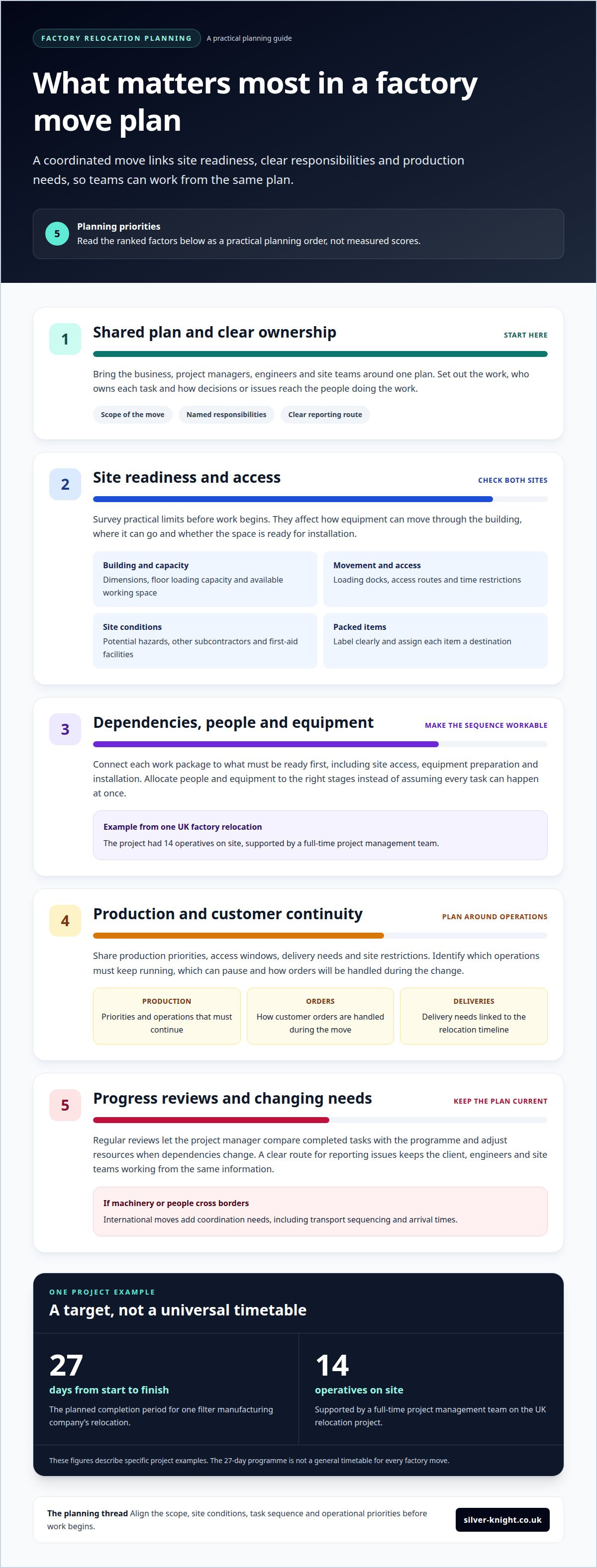
A workable factory move begins with a shared plan between the business, project managers, engineers and site teams. The plan sets out what the move includes, who owns each task and how decisions reach the people doing the work. For a UK factory relocation project, 14 operatives were on site, supported by a full-time project management team. That structure gave the project a clear route for coordinating resources and resolving issues.
One filter manufacturing company planned its relocation for completion in 27 days from start to finish. That was a project target, not a general timetable for every factory. To make a short programme manageable, the team needs to connect each work package to its dependencies, such as site readiness, access, equipment preparation and installation. It must also allocate people and equipment to the right stages, rather than assume every task can happen at once.
Consultation turns the timetable into an operational plan. Share production priorities, access windows, delivery needs and any site restrictions. A written scope should describe each part of the move, the steps involved and who is responsible. To maintain business continuity, identify which operations must keep running, which can pause and how orders will be handled during the change.
Site surveys reveal practical limits before work begins. Record time restrictions, loading docks, building dimensions, potential hazards, other subcontractors on site and first-aid facilities. Assess floor loading capacity and available working space, too. These details affect equipment positioning, movement through the building and readiness for installation. Clearly label packed items and assign each a destination to keep them linked to the right work area.
For construction-related work in the UK project described, the relocation contractor acted as Principal Contractor under the UK CDM Regulations. Record building dimensions, floor capacity, access and site hazards, as these affect how the work is organised. Environmental and building requirements depend on the work and premises, so the project scope must account for conditions at both sites.
International moves add coordination needs when machinery or people cross borders, including transport sequencing and arrival times. For cross-border equipment transfers requiring trade compliance and Importer of Record support, services such as global-4pl.com can help manage customs and regulatory obligations. Whatever the destination, regular progress reviews let the project manager compare completed tasks with the programme and adjust resources when dependencies change. A clear route for reporting issues helps the client, engineers and site teams work from the same information and keep the plan focused on safe, timely completion.
Avoiding disruption to customer orders and deliveries
A factory move affects more than production equipment. Customer orders, finished goods, raw materials and delivery slots all depend on the timing. In one filter manufacturer’s relocation, its customer base was unaffected. The example shows why continuity planning must cover customers and fulfilment as well as the physical move.
Start with an order schedule showing what is due, when it must leave and which production stages support it. Link each order to available stock and the equipment needed to complete it. This helps identify deliveries that depend on a machine being moved or a facility becoming unavailable. If dates conflict, sequence the work around priority orders.
Next, coordinate stock and materials with the move sequence. Separate items needed for current orders from stock that can travel earlier or go into storage. Label each packed item with its destination and intended use so it reaches the right area. For example, production materials should not block access to finished goods awaiting dispatch.
Plan deliveries in the same detail. Map loading areas, vehicle access and time restrictions at both facilities. Agree which goods can be dispatched before a work area changes and which need a new collection point. A clear schedule also helps customer service teams provide accurate updates if delivery dates or collection arrangements change.
Specialist movers and production staff need a shared sequence for work near active operations. Define access routes, boundaries between work areas and when a machine can be isolated or moved. Record who releases each area for the next task. These steps reduce clashes between equipment moves, routine production and incoming deliveries.
During the move, track orders against the agreed schedule and flag slipping dependencies. A simple status record can show whether stock is packed, in transit, at the destination or ready for use. The filter manufacturer’s unaffected customer base is a useful case result, but every factory needs a plan based on its own order flow, dispatch arrangements and production dependencies.
Before completion, confirm that the destination can support the next stages of fulfilment. Check that essential stock is accessible, dispatch routes are usable and production teams know which areas are ready. Reviewing these alongside order priorities gives managers a practical view of continuity. It also helps them respond when a delivery, facility or machine becomes available later than planned.
Relocation project scope and destination
A relocation scope defines what leaves the current site, what travels and what must be ready on arrival. It can cover machinery, supporting equipment, stock, operations, removal, transit, lifting and installation. The destination must suit the operation, not merely provide floor space. Access routes, work areas, floor capacity and the planned layout all affect whether equipment can be positioned and used as intended.
A UK factory relocation moved machinery, equipment and operations more than 300 miles north to another factory. This is the clearest regional example in the cases discussed here, without making the destination alone the key decision. Site selection should consider how the new premises support the required operation, including access, available space and preparation for machinery. The case does not establish one universal reason for choosing a particular destination.
Before removal begins, link each asset to its destination and the work needed there. A machine may require disconnection, lifting, transport and positioning, while its production line may depend on other equipment being ready first. Make these links clear in the project plan so the sequence works at both ends. Otherwise, equipment may arrive before its area is prepared.
The destination can also require building work. In the UK factory relocation project, new foundation pits or bases were created for 6 machines. That requirement shows why a site assessment must consider machinery as well as the building itself. The layout and equipment requirements determine whether existing bases are suitable or whether new preparation forms part of the project scope.
Transit planning should account for the route, each asset’s size and handling needs, and its order of arrival. Lifting plans should suit the machine, access conditions and final position. These details help coordinate removal with destination readiness. If an asset cannot be installed on arrival, define how it will be managed without blocking other work.
A useful scope also separates included work from dependencies. Identify tasks such as dismantling, packing, transport, lifting, installation and operational handover. State who is responsible for each stage and what must be complete beforehand. This makes schedule changes easier to assess, because teams can see which later tasks depend on a delayed delivery or unfinished base.
For a business weighing relocation against remaining at its current premises, compare the operational fit of each site. Consider production layout, equipment foundations, access and room for planned operations. The northbound move provides a real destination example, while the 6 machine bases illustrate how site preparation can shape scope. A clear comparison links those practical needs to the work, sequence and destination, rather than treating distance alone as the deciding factor.
Factory relocation case studies
Useful case studies show how project scope connects to production needs, commissioning and the final result. One UK factory move involved machinery, equipment and operations travelling more than 300 miles to another factory. The work also included new foundation pits or bases for 6 machines, making site preparation part of the relocation rather than a separate detail.
Filter manufacturer move
Situation: A filter manufacturing company needed to relocate its factory without affecting its customer base. Its scope included machinery, stock, racking systems, raw materials and a smoking shed. With this range of assets, the project needed to coordinate more than machine transport.
Action: The move was planned for completion in 27 days, with a full-time project management team and 14 operatives on site. The schedule set out the work across the factory, while the machine shutdown limit shaped the production sequence. The team also coordinated supporting assets so equipment and materials could be positioned for the new operation.
Result: The relocation was completed on time and within budget, without affecting the company’s customer base. This case shows how production continuity depends on coordinating asset movements with the order in which machinery and supporting items are needed.
Machine recommissioning at the new site
Situation: Moving machinery does not, by itself, show whether it is ready to return to production. The UK factory relocation included CNC machines that required recorded checks after the move.
Action: The project produced pre- and post-test pieces and full geometric reports for all CNC machines. It also produced PUWER reports for each machine decommissioned and recommissioned during the relocation. These records made testing and recommissioning visible parts of the project scope.
Result: The case documents a structured process for assessing machines after relocation. The reported results cover project completion and customer continuity, but no employment or productivity outcome is reported here. A completed move is not, by itself, evidence of increased output or changed staffing.
Another relocation provides context beyond factory operations. An investment bank coordinated workspace transitions across four locations, covering more than 80 staff and moving over 130 pieces of office equipment. Approximately 500 pieces of furniture were donated to local organisations or sent for sustainable recycling, with zero landfill reported for redundant furniture and equipment. These outcomes show how project scope can include rehoming and environmental management alongside transport.
Together, the cases suggest a practical way to assess a relocation: compare the planned scope with the delivery result, then look for evidence of commissioning and continuity. For factory projects, test pieces, geometric reports and recommissioning records help show how machinery was managed after transit. Treat employment and productivity as separate outcome measures, not assumptions based on a completed move.
Silver Knight Haulage & Machineries for Factory Relocation
Silver Knight Haulage & Machineries helps businesses plan factory or plant moves involving machinery, equipment and operations. Its factory relocation work brings machinery moving and installation together, covering the transfer of equipment and its positioning at the destination.
Turn to Silver Knight when your move needs coordinated support to relocate machinery or install it at a new site. The right scope depends on the equipment, destination and work sequence. Sharing these details helps shape a practical plan around your operation.
For a factory or plant relocation, contact Silver Knight Haulage & Machineries to discuss your project.
Plan your next move with confidence
The next step is to turn relocation lessons into decisions for your operation. Use factory relocation case studies in the UK as prompts, not templates. Your equipment, production priorities and destination determine the right sequence. Before setting a programme, define what must be ready at the new site and which decisions need agreement across operations, engineering and logistics.
Silver Knight Haulage & Machineries Ltd supports businesses with machinery moving, machinery installation and factory relocation. Discussing these requirements together can help establish a practical scope, from equipment transfer to placement at the destination. The focus is your operation’s needs and how the planned move can fit them.
If you’re preparing a factory move or considering a new destination, contact Silver Knight Haulage & Machineries Ltd to discuss your plans. A clear starting point can help you take the next step with purpose and shape a plan suited to your site.
Frequently Asked Questions
UK factory relocation case studies, which companies moved and where?
The factory examples describe a filter manufacturer and a UK manufacturing operation, but identify them by business type rather than company name. One project moved machinery, equipment and operations more than 300 miles north to a factory in Newcastle. A separate investment bank workspace move covered Prague, Amsterdam, London and The Hague. That office relocation involved staff and equipment, so it provides context about coordinated moves, not a factory relocation.
What were the reasons for UK factories relocating?
Factory relocation can address limits a business cannot resolve effectively at its current premises, such as space, layout or suitability for its operation. The examples also show that a new destination may need preparation for specific machinery, including foundations or bases. Assess these as practical factors rather than assume they explain every move. Relocation makes sense when the destination supports operational needs better than adapting the existing site.
How long did UK factory relocation projects take?
One filter manufacturer’s project was planned for completion in 27 days from start to finish. That period describes this project, not a standard duration for factory moves. Timings depend on the number and type of assets, dismantling and installation requirements, destination readiness, access and production constraints. A reliable programme links those dependencies to agreed milestones, then tracks progress so delays in one task do not go unnoticed by the teams responsible for later work.
What are the key steps in planning and executing a factory move in the UK?
Begin by defining the project boundary and decision-makers, then survey both premises and record access, hazards and building constraints. Create a sequence for preparing, removing, transporting and installing equipment. Assign responsibilities and coordinate production and deliveries around the work. At the destination, complete the required installation and recommissioning checks before returning equipment to use. Keep a clear record of changes so affected teams can follow the latest programme.
What UK planning, environmental and building regulations apply to factory relocation?
For construction-related work, the contractor acted as Principal Contractor under the UK CDM Regulations. Environmental and building requirements depend on the work and premises. Planning should account for site conditions, building dimensions, floor capacity, access and hazards.
What were the production, employment and productivity outcomes after relocation?
The relocation was completed on time and within budget, and the filter manufacturer’s customer base was unaffected.

Article by
David Ashby
I'm the Managing Director of Silver Knight Haulage & Machinery Ltd. Silver Knight Ltd is a family-run firm established in the West Midlands in 2005, with the aim of providing a cost-effective, yet professional, service to businesses for the removal, transportation, and installation of machinery, plant, and equipment here in the UK and worldwide. Between us, the Silver Knight workforce has over 50 years of experience with machinery and its operation.
Disclaimer
This article is intended for informational purposes only. Please ensure you seek expert advice or carry out your own research to confirm the information is suitable for your specific needs.