The auction is only the start of a machinery move. An auction machinery collection service coordinates the collection and haulage of purchased equipment from the sale site to its next destination. For sellers, it can also support the removal of machinery and equipment from an industrial site.
It’s easy to focus on the auction, but machinery still needs to be prepared, managed and moved once a sale is under way. A clear collection plan shows sellers how equipment will leave the site and helps buyers arrange onward transport.
This article explains how to prepare machinery for auction, manage site access and clearance, and coordinate collection and haulage. It also covers seller collections and industrial removals, including how machinery moving and factory relocation services can help when equipment is part of a wider site change.
Key Takeaways
- Plan site access and clearance so machinery can be prepared and moved in an organised way.
- Coordinate collection and haulage around each machine’s location, size and destination.
- For seller collections, identify the items to be removed and agree how they will be separated from equipment staying on site.
- Industrial removals may involve more than transport, especially when machinery forms part of a factory or plant relocation.
- Gather the sale and collection details, machinery information and site access instructions to help keep the move on track.
For help with machinery and industrial sites, explore specialist site services.
Site management and clearance
Start site planning by defining what is being sold, what will stay and what must be removed. Create an inventory of machinery, attachments, tools and loose items. For example, list a combine harvester separately from its header and spares. Record each item’s location so buyers, auction staff and removal teams can identify it easily.
Next, divide the site into practical zones. Group sale equipment, separate retained assets, and mark loading areas and vehicle access routes. A factory might need distinct zones for production machinery, workshop equipment and materials awaiting disposal. A simple site map helps guide visitors and collection teams during the sale and clearance.
On-site and off-site auctions create different site requirements. An on-site auction keeps machinery at its existing location, allowing buyers to view it in place and collection teams to plan around its actual position. Off-site selling requires the seller to move items to another venue before the sale. Choose the approach that suits the site, equipment and buyers’ inspection needs.
On-site auctions can make a large clearance more visible to buyers, but the sale area needs preparation. Remove unrelated clutter from around each lot and leave clear routes between machinery. A live on-site auction of two John Deere combine harvesters and other machinery is scheduled in Buckinghamshire for Thursday 05 November 2026. Agricultural tractors, implements and machinery are scheduled for an on-site auction in Cambridgeshire on Thursday 11 February 2027.
Plan site activity around the sale timetable. Before auction day, check that every lot can be reached, photographed and viewed without moving unrelated equipment. Mark restricted areas and explain access arrangements to the auction team. If several businesses share a site, agree which spaces are available for viewing and loading, and make the boundaries clear.
Clearance also involves deciding what happens to unsold machinery, scrap and items excluded from the sale. Separate these categories in the inventory rather than leaving them mixed together. For an industrial property, factory clearance services can support the removal of equipment as part of preparing the site for its next use.
A workable plan names the person responsible for each task, sets out the activity sequence and identifies the equipment involved. For example, record when viewing begins, the route to each lot and where sold machinery can be collected. This gives sellers a clearer picture of the work ahead and helps coordinate the auction, sale and site clearance.
Collection planning can include machinery moving support for equipment travelling from an auction site to its next destination.
Auction machinery collection and haulage
Collection involves identifying the purchased lot, arranging site access and moving the machine to its next destination. The plan should suit the equipment, loading point and route, whether the journey is domestic or international.
Permits, insurance and safety rules
A UK collection plan should account for any permits required for the load and route, insurance during loading, transit and unloading, and safe site access. Requirements depend on the machinery, its dimensions, the vehicle and the journey. A large production machine leaving a restricted yard, for example, needs a different access plan from a forklift collected beside a loading bay.
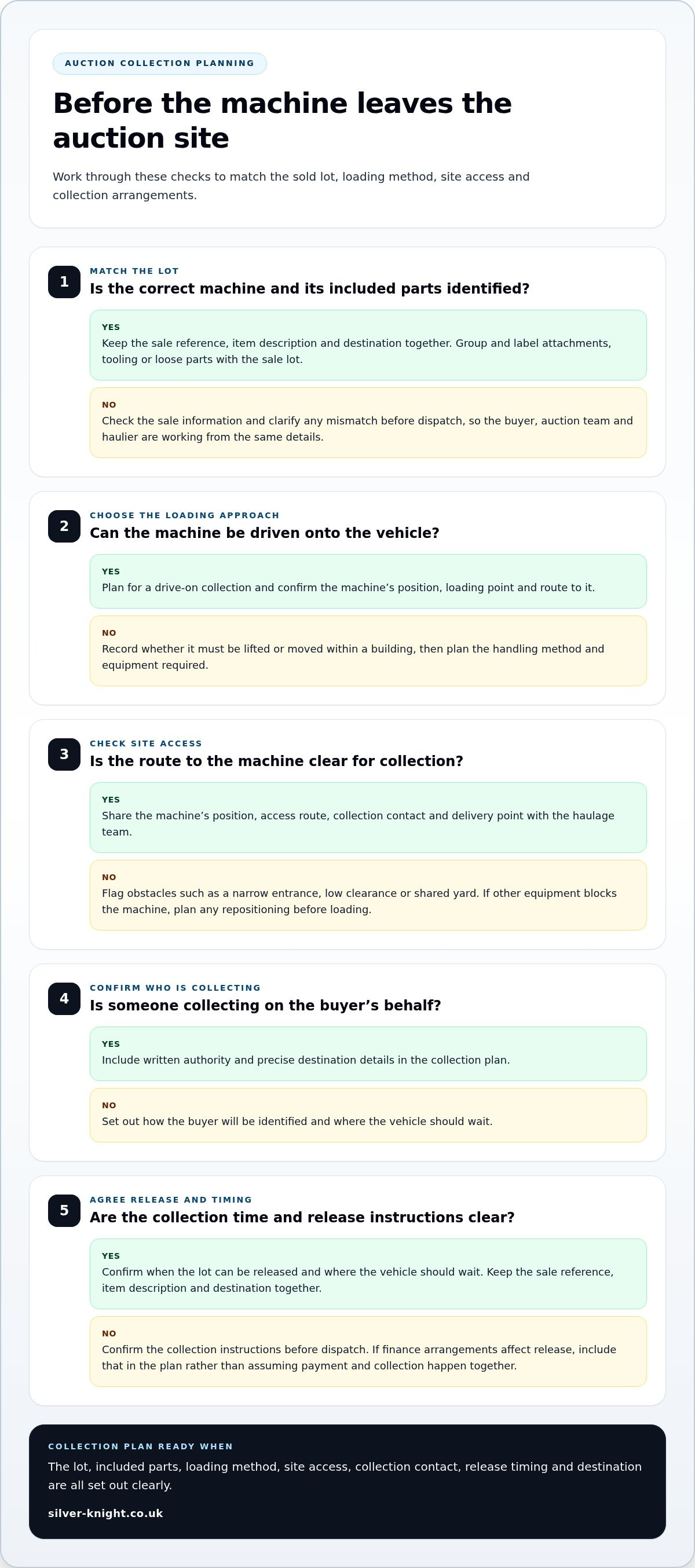
Before collection, record who is arranging each part of the move. Set out the loading sequence, agreed collection point and site rules for vehicle movements. Make sure the sale information identifies the correct machine and any components travelling with it. This keeps the auction team, buyer and haulier working from the same plan.
UK collection area coverage
Plan coverage around the auction location, delivery address and transport route. A buyer collecting a press from an auction in England for delivery in Scotland needs a journey plan for both ends, not just the sale site. If someone is collecting on the buyer’s behalf, include written authority and precise destination details.
Set out the collection and delivery points clearly in the transport arrangements. Include access restrictions, opening times and loading facilities at each end. These details help establish whether the journey is a straightforward domestic haul or needs additional planning, such as international machinery transport.
Once a lot is identified, match its condition and handling requirements to the collection method. A machine that can be driven onto a vehicle has different loading needs from one that must be lifted or moved within a building. Record whether attachments, tooling or loose parts are included, then group and label them with the sale lot to prevent accessories being separated from the main asset.
Share practical details before dispatch: the machine’s position, access route, collection contact and delivery point. Note obstacles such as a narrow entrance, low clearance or busy shared yard. A machine behind other equipment, for instance, may need repositioning before loading. Clear information helps the haulage team plan the sequence and equipment required.
Collection timing also affects site activity. Agree when the lot can be released, how the buyer will be identified and where the vehicle should wait. If finance arrangements affect release, include the sale’s collection instructions in the plan rather than assuming payment and collection happen together. Keep the sale reference, item description and destination together so any mismatch can be resolved quickly.
For machinery moves that need dedicated transport planning, machinery haulage and relocation can cover the move from collection through delivery. The essential next step is to align the lot details, route, access and handling method before transport is arranged.
Sellers can include machinery moving support in their auction plans when equipment needs to leave the site.
Collection of items for sellers
For sellers, collection planning can cover moving machinery from a business site to an auction venue, as well as removing items that remain after a sale. Separate equipment for sale from machinery that must stay in use. For example, list a surplus lathe, its tooling and attachments as separate inventory entries before arranging transport.
Agree how each item will be handled with the auction organiser. Record its description, current location, condition and whether it can move under its own power. These details help distinguish the main asset from its accessories and support accurate lot identification. If an item is moving to another sale venue, include the receiving address and access details.
A simple seller preparation sequence can keep the handover clear:
- List each machine and its included parts.
- Mark which items are for sale, retained or awaiting collection.
- Photograph labels and the machine’s position before it moves.
- Record the collection contact and agreed handover point.
Keep sale terms separate from transport arrangements. Check the commission terms with the auction organiser, then clarify who is arranging collection and when the machinery can leave. If a buyer purchases a press while the seller still needs nearby equipment, label both clearly to reduce the risk of moving the wrong item.
Before collection, plan the route from the machine to the loading point. Move loose materials that could obstruct access and identify any equipment that must be shifted first. A machine at the back of a workshop may need a different removal sequence from one beside an external loading area. Share this context with the collection team before the move.
After the sale, separate sold machinery from unsold lots and retained assets. Confirm which items are ready for buyer collection and which need another arrangement. If an unsold machine remains on site, add it to a separate removal list rather than treating it as part of a buyer’s lot. This gives the seller a clear record of what has left.
Buyers arranging collection on a seller’s behalf should keep the sale reference, item description and destination together. A buyer elsewhere in the UK or in Europe may need to coordinate onward transport after the item is released. Keep contact details and collection instructions with the relevant lot, especially when several machines are leaving the same site.
Complete the handover by recording which items were collected and whether any parts travelled separately. Compare the collection record with the seller’s inventory and auction documents. If a machine, attachment or tool remains, note its location and arrange the next step separately. This final check helps sellers account for sold, unsold and retained equipment without mixing arrangements.
A wider site move may also require machinery moving support for equipment travelling between industrial premises.
Industrial machine removals and factory relocations
An auction can be one part of a larger factory move. Sellers may need to clear sold plant and machinery while keeping production equipment in place or transferring it to another site. Treat each machine as part of the wider move plan, not as an isolated collection. Identify which assets are sold, relocated, stored or retained before vehicles arrive.
Start with a schedule for each machine. Record its location, destination, handling needs and whether it must be dismantled before removal. A production line may include connected machinery, control equipment and supporting components, so list each separately. The schedule establishes the order of work and shows which items depend on others being moved first.
Next, map the route from each machine to the loading area. Note narrow doorways, changes in floor level, low overhead obstructions and shared access routes. A press inside a workshop may need to pass through several work areas before reaching an external loading point. Plan vehicle positions and internal movements together so one stage does not block the next.
Coordinate site tasks with the factory team. They can identify equipment that must be disconnected, production areas that need to remain operational and services that affect the removal sequence. If a machine shares space with equipment staying behind, for instance, agree how to separate the work area before moving begins. Keep the current site plan alongside the destination layout.
Some factory moves involve auction collections and relocations at the same time. Keep sold machines separate from assets travelling to another production site. A seller might auction a redundant lathe while moving a working press to a new factory. Separate instructions help prevent equipment being loaded onto the wrong vehicle or sent to the wrong destination.
After removal, compare the site record with the agreed schedule. Note which machinery has left, what remains and whether any parts are travelling separately. At the destination, match each delivered item to its planned position before installation. This gives the site team a clear handover and links transport, factory relocation and recommissioning without confusing responsibilities.
The key is sequencing: define each machine’s destination, prepare its route and coordinate site activity before moving begins. This makes an auction collection easier to manage alongside a wider industrial removal, especially when some equipment must keep operating until the new site is ready.
What documents and information are needed to collect auction machinery?
Prepare a collection pack that connects the sale record to the machinery, collection point and destination. The paperwork depends on the sale and transport arrangements, but clear records help everyone identify the correct item. For example, a buyer collecting a lathe should keep its sale reference, lot description and collection instructions together.
Start with the auction paperwork. Keep the invoice or sale confirmation, lot number and buyer details available for collection. If someone else is collecting on the buyer’s behalf, include their name and written authority. These details help site staff match the person and vehicle to the purchased lot instead of relying on a vague description such as “the machine in the workshop”.
Build a separate information sheet for each machine. Include:
- The auction lot number and sale reference.
- The make, model and identifying label, where available.
- The machine’s location and the agreed collection point.
- Included attachments, tooling or loose components.
- The delivery address and a named contact at each end.
- Any access details, such as a restricted entrance or shared yard.
Photographs can support the written details. Take images of the machine, its identification plate, attachments and route to the loading area. A photograph showing a lathe beside a marked workshop bay, for example, can distinguish it from similar equipment nearby. Label each image with the lot number to keep it connected to the correct sale record.
Transport planning also needs practical information about the item. Describe its condition, whether it can move under its own power and whether any parts are separate. Note narrow doorways, low overhead clearance or limited vehicle access along the route. These details help the collection team plan handling and loading for the specific machine.
Keep the collection time and release instructions with the sale documents. Record who will open the site, who will hand over the item and where the vehicle should report. If a buyer uses a representative, give the site contact their details before arrival. If time-critical release documents, security keys or urgent small parts need to reach the premises ahead of collection, dedicated same-day transport from Salus Securities & Courier Services (SS Courier) can ensure they arrive safely on schedule. At delivery, record any components travelling separately so the recipient can check them against the lot information.
For a move involving several machines, use one schedule with a separate entry for each lot. Mark an item as collected only after handover, then record its destination. This helps sellers and buyers account for sold equipment, attachments and anything remaining. For machinery moving beyond the auction collection, arrange haulage and transport as part of the same move plan.
For machinery moving support, visit Silver Knight Haulage & Machineries Ltd.
Silver Knight Haulage & Machineries Ltd for Machinery Moving
Silver Knight Haulage & Machineries Ltd can help when auction collection is part of a wider machinery move. Its machinery moving service covers equipment transported between an auction site, factory or other industrial premises. If machinery needs setting up at its destination, machinery installation can form the next stage.
For sellers clearing a site or moving operations, factory relocation and plant relocation cover the broader task of transferring machinery and equipment. The right service depends on whether you need to move a sold machine, relocate plant or transfer factory equipment as part of a site change.
Visit the Silver Knight Haulage & Machineries Ltd website to discuss your machinery move.
Plan your machinery move with confidence
Turn your sale or site change into a practical move plan. Decide what needs collecting, where each item must go and whether the job ends at delivery or includes installation. A clear brief keeps the next decisions focused on your equipment and destination.
An auction machinery collection service can be part of a wider industrial move. If machinery is being sold while production continues, plan collection around the equipment and areas that must remain in use. For a full site change, consider the sequence from removal to the new layout.
Silver Knight Haulage & Machineries Ltd can discuss machinery moving, installation and factory relocation based on your requirements. Share the sale or relocation details and the outcome you need, so the conversation can focus on the right scope for the move.
Contact Silver Knight Haulage & Machineries Ltd to discuss your machinery move and take the next step with confidence.
Frequently Asked Questions
What does an auction machinery collection service include in the UK?
An auction machinery collection service can coordinate a sold machine’s release, loading, haulage and delivery. The scope depends on the sale terms and equipment. A machine with loose tooling, for example, needs a clear record of which parts belong with the lot. Buyers should also consider whether they need onward transport, temporary machinery storage or installation at the destination.
How much does machinery collection after an auction cost in the UK?
The price depends on the job and is provided after a quote request. Key factors include the machinery’s size and weight, collection and delivery locations, site access, handling requirements, and whether storage or installation is needed. A machine requiring specialist lifting or a complex route needs different planning from equipment that can be loaded directly at an accessible site.
How are auction machinery collection and transport prices calculated?
Transport prices reflect the work required for the specific machine and route. A quote may account for distance, vehicle and handling needs, site access, loading arrangements and delivery requirements. A machine inside a factory, for example, may need internal movement before reaching the vehicle. Clear details about its location, dimensions and destination help define the scope before transport is arranged.
Can a buyer arrange their own transporter to collect auction machinery?
Buyers can arrange a transporter themselves if the auction’s collection instructions allow it. Give the transporter the sale reference, lot details, collection point and delivery address, then agree how the driver will be authorised to collect the item. If a colleague is collecting on the buyer’s behalf, for instance, provide their details to the site contact before arrival.
How is heavy or oversized machinery loaded and transported safely?
Safe movement starts with matching the handling method to the machine, its position and the site layout. A heavy press inside a production building may need lifting or controlled movement before loading, while equipment beside a suitable loading area may follow a simpler route. The transport plan should account for access, lifting equipment, the vehicle and the final position at delivery.
How can buyers compare auctioneer-arranged transport with independent hauliers?
Compare the scope, responsibilities and collection arrangements, not just the transport charge. Check whether each option covers loading, delivery, handling at both sites and onward movement. An auctioneer-arranged option may coordinate collection with the sale, while an independent haulier may let the buyer organise transport directly. In either case, confirm the collection window and release process.

Article by
David Ashby
I'm the Managing Director of Silver Knight Haulage & Machinery Ltd. Silver Knight Ltd is a family-run firm established in the West Midlands in 2005, with the aim of providing a cost-effective, yet professional, service to businesses for the removal, transportation, and installation of machinery, plant, and equipment here in the UK and worldwide. Between us, the Silver Knight workforce has over 50 years of experience with machinery and its operation.
Disclaimer
This article is intended for informational purposes only. Please ensure you seek expert advice or carry out your own research to confirm the information is suitable for your specific needs.