Redundant machinery may have recoverable scrap value, even when it no longer has a role in production. For a large factory clearance, scrap machinery removal in the UK can combine dismantling, removal and scrap metal recovery. Any value depends on current market prices, the type and quantity of metal, and its condition.
It’s understandable to focus first on clearing space and removing equipment. But planning around the machinery, site and work that needs to continue can also help identify what may be recovered and organise the removal. This article explains what large-scale machinery clearance involves, how dismantling and removal are planned, what affects scrap value, and how to approach the process safely and practically. It also explains how factory clearance and decommissioning fit into the wider project, from identifying redundant assets to preparing the site for its next use.
A clearance plan can account for equipment that stays as well as machinery being removed; Silver Knight’s machinery services may support the next stage.
Key Takeaways
- Plan dismantling and removal together, with the machinery, site and work sequence in view.
- Identify redundant assets and consider how production needs will affect the removal plan.
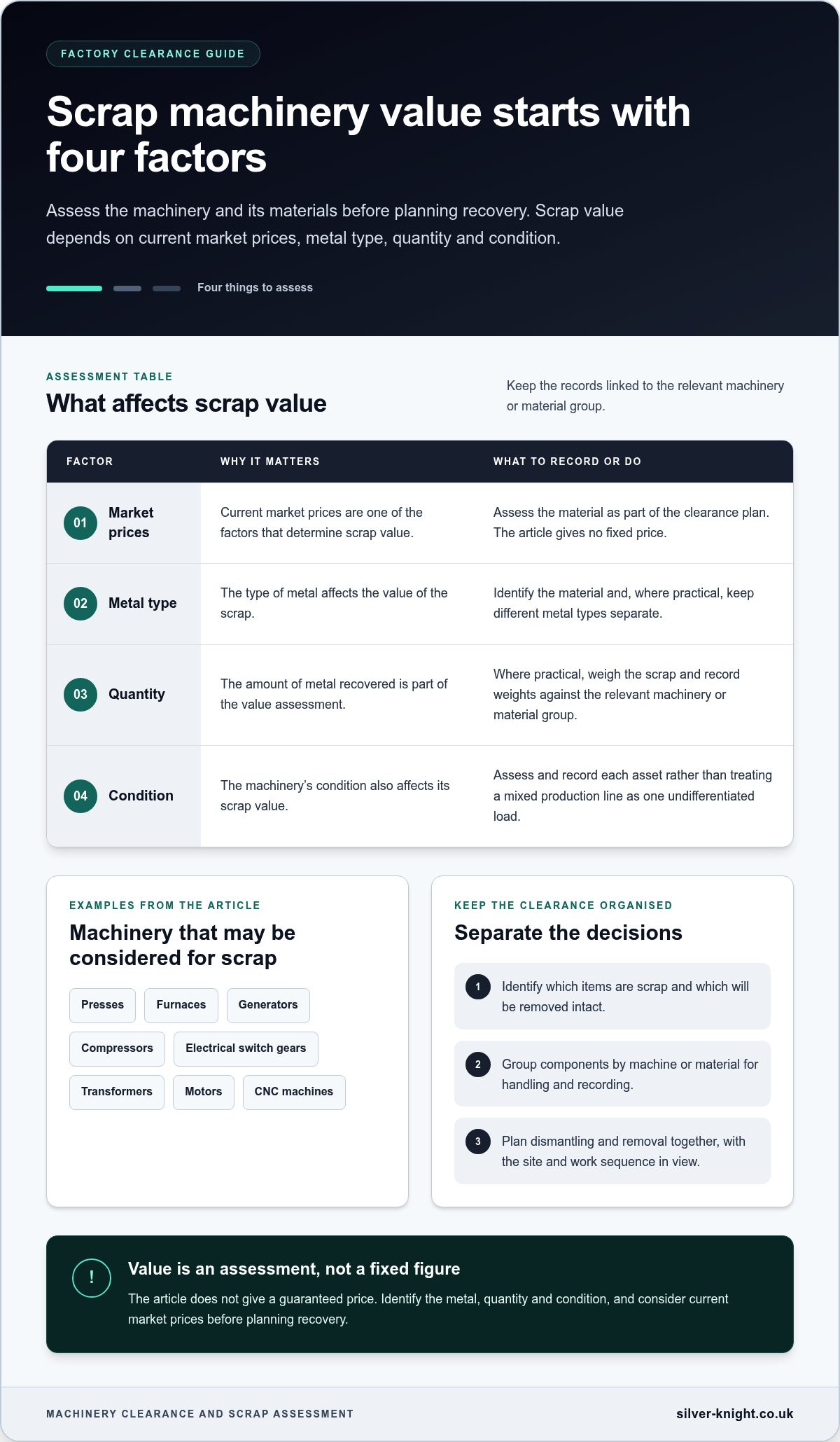
- Scrap value depends on current market prices, metal type, quantity and condition, so assess these factors before planning recovery.
- Keep waste handling and its audit trail in view as part of an organised clearance.
- For a wider move or site change, consider how machinery moving, installation or relocation fits into the project.
Planning machinery moves alongside the clearance keeps the equipment, access routes and the site’s next stage in view. Machinery moving can form one part of a wider project.
Industrial machinery decommissioning and dismantling
Before industrial machinery leaves a factory, plan how it will be assessed, disconnected, dismantled and removed. Identify its connections and condition, isolate relevant services using competent site procedures, and agree a controlled dismantling sequence before work begins.
Safe disconnection and preparation
Start with an asset assessment. Record each machine’s location, condition, approximate dimensions and connection points, then note any access restrictions. A production press may need a different dismantling sequence from a standalone motor because its attached components and the surrounding space affect removal.
Map preparation steps with the people responsible for the equipment and site. Identify electrical, hydraulic, pneumatic and other connections, and ensure relevant services are isolated before dismantling begins. Clear the intended route, consider how each component will be moved, and mark parts that need separate handling. This helps prevent a component being removed before its connections or route are understood.
Heavy machinery dismantling and disposal
Dismantling breaks heavy machinery into manageable components for removal, reuse or disposal. The sequence depends on the machine’s construction and condition, as well as the available space. For an industrial production line, this may mean separating connected units and supports in an order that keeps access clear and the route out of the building unobstructed.
Where specialist equipment or lifting is needed, plan how components will be supported and moved at each stage. A machinery dismantling service can be relevant when a machine must be taken apart before removal. Keep components grouped by machine or material, so the next handling decision is clear rather than lost in a mixed pile.
Weighing scrap metal helps establish how much material a clearance recovers. Where practical, keep different metal types separate and record weights against the relevant machinery or material group. Scrap value depends on current market prices, metal type, quantity and condition, so clear identification supports a useful assessment. Establish which items are scrap, which will be removed intact, and how each group will be recorded.
Disposal is one part of the plan, not a substitute for deciding how machinery will be dismantled. For large quantities, coordinate the sequence across the site, from initial assessment to final removal. This clarifies what is leaving, how it will be handled and what space will be available for the next stage of factory clearance.
When a clearance also involves moving equipment elsewhere, machinery moving can form part of the wider plan.
Industrial machinery and production-line removal
Plan factory machinery removal around the equipment, its route and the site’s next use. The sequence depends on access, machinery condition and whether production must continue during the work.
Machinery collection and removal
Collection planning starts with an inventory identifying each item and its location. Industrial presses, generators, compressors, motors and CNC machines are examples of heavy machinery that may be removed as scrap. Record which assets will leave intact and which are scrap. This helps organise handling, loading and each machine’s destination.
Production-line removal logistics
A production line may include connected machines, controls and supporting equipment. Map the removal order so one item does not block access to another. If production must continue, plan around active areas and the sequence of equipment being removed. If operations can stop, the clearance plan can cover a wider area at once.
Transport planning should account for each machine’s dimensions, weight, loading point and route through the factory. Decide whether equipment will move directly to its next location or require storage first. For larger moves, machinery storage can form part of the logistics plan when equipment cannot move straight to its destination.
Factory and site clearance
Factory clearance involves more than collecting machines from the production floor. Map the areas to be cleared, including stores, workshops and yard spaces, then separate machinery from other items. Redundant equipment can obstruct access and occupy space needed for the next stage of a site change. A planned clearance makes the work areas clear.
Set out what must remain, what is leaving and how each group will be handled. For a whole-site project, connect machinery removal with the wider factory clearance process. This helps avoid moving retained items or leaving useful equipment behind.
Machinery accepted for scrap removal
Machinery that may be considered for scrap includes presses, furnaces, generators, compressors, electrical switch gears, transformers, motors and CNC machines. Metal type, quantity and condition affect scrap value. Identify each asset and its material before removal, rather than treating a mixed production line as one undifferentiated load.
Commercial scrap machinery removal can be arranged through licensed scrap metal dealers. To find a local option, look for a licensed dealer serving your area and establish whether the work covers your machinery and collection needs. Before agreeing the scope, identify risks such as blocked access, difficult loading, unplanned dismantling, or separate transport and storage requirements. These details can help reveal possible extra charges before work is booked.
Free collection for large quantities
A large scrap load may make collection more practical, but the word “free” needs a clearly defined scope. Compare the collection terms with the machinery, lifting and transport work involved.
Collection for large quantities
For a substantial quantity, list the machines, their locations and their condition before discussing collection. A group of accessible motors presents different handling needs from heavy machinery fixed to a production line. Include dismantling, lifting, loading and any restricted access in the description, so the collection scope reflects the actual work, not just vehicle attendance.
Ask what “free collection” includes. It may cover only the collection of agreed scrap, while dismantling or specialist lifting is outside the scope. Specify which items are included, how the scrap will be weighed, and what happens to equipment that cannot be collected as planned. This makes the offer easier to compare with the work required.
Quantity alone doesn’t show whether a load is efficient to collect. Metal type, condition, separation and access all affect handling and recycling. For example, a clearly grouped set of redundant machines may be easier to assess than mixed machinery and loose materials spread across several areas. Prepare an inventory and photographs to define the scope.
Removal costs
Scrap machinery removal costs in the UK depend on the job and are provided after a quote request. The machinery, quantity, metal type, condition, access, dismantling, lifting and transport all affect the price. Scrap value also depends on current market prices, the type and quantity of metal, and its condition.
Separate the removal work from the value of recovered scrap when reviewing a proposal. Ask for the scope to identify collection, dismantling, lifting, transport and recycling, along with how scrap weight and material will be recorded. A single figure can obscure whether the quote covers a machine that must be dismantled or only accessible items ready for loading.
A fair comparison starts with the same information for each proposed collection. Provide an itemised machinery list, note where each asset is located, and describe access from the work area to the loading point. Identify equipment that must remain and items requiring separate handling. These details help reveal exclusions, potential extra work and differences in how scrap recovery is treated.
Before agreeing a collection, make sure the written scope names the machinery included and the work required to remove it. For a mixed factory load, distinguish scrap from intact equipment and record how each group will be handled. This breakdown helps you assess whether a collection offer suits the site, rather than relying on the word “free” alone.
Waste legislation and environmental compliance
Plan waste handling alongside industrial machinery removal, not after loading begins. A clear record of each machine’s destination supports an audit trail and helps organise the clearance.
Start by separating equipment intended for scrap from machinery being kept, reused or moved elsewhere. For example, mark a redundant motor for scrap and identify a production machine that must remain. Keep the groups distinct during handling so their destinations and records do not get mixed. A site inventory can link each item to its status and removal route.
Scrap collection can support recycling, reduce business carbon emissions and help protect the environment. These benefits depend on identifying what is recovered and where it goes. Record the machinery or material collected, its destination and the relevant collection details. A complete audit trail gives the business a clearer account of waste movements after the manufacturing site is cleared.
Site safety also matters during loading. Identify obstructed walkways, restricted access and areas where machinery removal could affect people or ongoing production. For instance, a compressor near an active work area may need a planned removal sequence to limit disruption. Mark the route, keep unrelated items clear, and coordinate timing with site operations.
Before work starts, agree how the removal team will distinguish scrap metal from other materials. Mixed loads can make it harder to record what has left the site. Separate machinery or components into agreed groups and keep the inventory aligned with the collection. If a machine has parts that need separate handling, identify them before dismantling and loading.
An environmental review should also consider the condition and quantity of the scrap. Metal type, quantity and condition affect its value, while careful sorting makes recovery easier to document. Record the weights and material groups used for the collection, then retain that information with the site clearance records. This creates a useful record from the factory floor to the stated destination.
For a large clearance, assign responsibility for the inventory, loading records and destination details before collection day. The person coordinating the work can compare removed items against the list and note any change in scope. This helps keep the audit trail complete, supports orderly disposal and gives the business a factual record of how redundant industrial machinery was handled.
Factory decommissioning and site clearance
Factory decommissioning coordinates machinery removal with the wider plan for a facility. Start by deciding what must leave, what stays and what the site needs next. This turns separate tasks into a clear sequence for machinery removal, material recovery and site clearance.
Build an asset register before equipment is moved. Record each machine’s location and condition, then tag it so the removal team can identify it. Effective machinery removal planning includes checking equipment condition and tagging assets for identification. For example, a tag can distinguish a redundant press from a similar machine retained for another production area.
Next, decide whether manufacturing will continue during the work or stop. Comprehensive removal planning should account for whether production needs to continue or can stop. If one line remains active, define the work area and sequence around it. If the facility is closing, the programme can coordinate equipment removal across connected areas rather than treating each machine as a separate job.
Industrial dismantling also requires risk assessment and contingency planning. These help the team consider the work sequence, access and what to do if site conditions disrupt the planned removal. A furnace in a confined part of the building, for instance, may need a different dismantling and exit sequence from a freestanding motor. The plan should connect each machine’s removal to its route and work area.
Redundant machinery can clutter a warehouse or yard and create a health and safety hazard. Include these spaces in the clearance plan, not just the main production floor. Mark equipment for removal, keep retained assets identifiable, and specify where collected materials will go. This reduces confusion when machinery, metals and other items occupy the same facility.
For a full factory clearance, link decommissioning, dismantling and removal to the condition in which the site must be left. Identify work areas, access routes and items that will stay. A specialist removal service can coordinate machinery tasks with the wider clearance, while a change of use or relocation may require a different sequence from a complete closure.
Close the process by comparing the asset register with the equipment removed. Record changes, identify any machinery still on site, and retain waste destination details for the audit trail. This final review gives the site team a practical record of what was cleared and what remains, ready for the facility’s next stage.
For efficient scrap machinery removal UK wide, machinery moving, installation or a wider site change, explore how Silver Knight Haulage & Machineries Ltd can support your project.
Silver Knight Haulage & Machineries for Machinery Moving
Silver Knight Haulage & Machineries can support machinery moves as part of a factory or plant project. Its machinery moving service is suited to equipment being relocated within a site or prepared for a new location. Machinery installation can support the next stage, while factory relocation and plant relocation cover wider moves.
These services are a practical next step when scrap removal is only one part of a larger change. For example, machinery being retained may need to be moved or installed elsewhere while redundant equipment is cleared. Keeping both requirements in view helps shape the overall project.
To discuss machinery moving, installation or relocation, visit Silver Knight Haulage & Machineries’ website.
For a wider machinery project, explore Silver Knight Haulage & Machineries.
Plan your next move with confidence
Choosing a route for scrap machinery removal across the UK can shape what happens to the rest of your site. If equipment is being retained, relocated or installed elsewhere, plan that work alongside the clearance. A joined-up plan can help you move from an empty production area to the next stage of your facility’s use.
Silver Knight Haulage & Machineries offers machinery moving and installation, as well as factory relocation. These services may suit projects where clearing redundant machinery is only one part of a larger operational change. Set out what needs moving, where it needs to go and how the work fits your plans.
When you’re ready to discuss the machinery work involved, contact Silver Knight Haulage & Machineries. A clear next step can help you turn the clearance plan into progress.
Frequently Asked Questions
Can you help recover value from redundant machinery during a factory clearance?
Yes, separating scrap from machinery that could be reused helps identify potential value during a clearance. Make an asset list showing whether each item is for scrap, relocation or retention. For example, a redundant machine may be assessed for metal recovery, while usable equipment can be kept for another site. This distinction directs items appropriately and gives the clearance team a clearer record of what is leaving.
Can you manage machinery removals while my factory remains operational?
Yes, machinery removal can be planned around ongoing production. First, identify active work areas, access routes and equipment that must remain available. For example, machinery in a disused area could be removed before work reaches an operating production line. Agreeing the sequence with site operations helps reduce disruption and keep the removal plan aligned with the factory’s working needs.
How Do I Get Rid Of A Heavy Machine?
Start by recording the machine’s location, condition, dimensions and visible connections. Decide whether it is scrap, reusable or moving to another site. A large press in a confined workshop, for example, may need dismantling before it can pass through the available exit. Include the route, handling and loading requirements in the plan, then record the machine’s destination.
How Do You Dispose Of Machinery?
First, decide whether the machinery is being scrapped, reused or relocated, as each option has a different destination. Scrap equipment can be dismantled and separated for material recovery, while usable machinery may be moved intact. Record what leaves the site and where it goes. For a mixed clearance, label groups before collection so scrap, retained equipment and machinery for relocation are not confused.
How do you ensure environmental compliance during industrial asset disposal?
Keep clear records of what is removed, how materials are grouped and where they go. Separate scrap machinery from equipment being retained or relocated, then match collection details to each group. For example, record the weight and destination of a scrap load. This creates an audit trail of waste movements and helps the business account for materials recovered during an industrial clearance.
What is Industrial Dismantling and Factory Clearance?
Industrial dismantling is the planned process of taking machinery or production equipment apart for removal. Factory clearance is the wider task of removing agreed machinery and other items from a facility. For example, dismantling may prepare a fixed production line for removal, while clearance also identifies what stays, what leaves and which areas must be emptied.
Do scrap metal dealers pay for old industrial machinery in the UK?
Scrap metal dealers may pay for machinery sold as scrap, based on its recoverable metal. The value depends on current market prices, metal type, quantity and condition. Identify the machinery and separate materials where practical before assessment. This helps distinguish saleable scrap from equipment intended for reuse or relocation and gives the valuation a clearer basis.
What licences and legal rules apply to scrap machinery removal in the UK?
Commercial scrap machinery removal can be arranged through licensed scrap metal dealers. Keep records of the machinery collected, its destination and any recorded weights. Separate scrap from intact assets being retained or moved elsewhere, so the records reflect what actually left the premises. For a large clearance, assign responsibility for documenting each material group and keep those details with the site’s clearance records.

Article by
David Ashby
I'm the Managing Director of Silver Knight Haulage & Machinery Ltd. Silver Knight Ltd is a family-run firm established in the West Midlands in 2005, with the aim of providing a cost-effective, yet professional, service to businesses for the removal, transportation, and installation of machinery, plant, and equipment here in the UK and worldwide. Between us, the Silver Knight workforce has over 50 years of experience with machinery and its operation.
Disclaimer
This article is intended for informational purposes only. Please ensure you seek expert advice or carry out your own research to confirm the information is suitable for your specific needs.