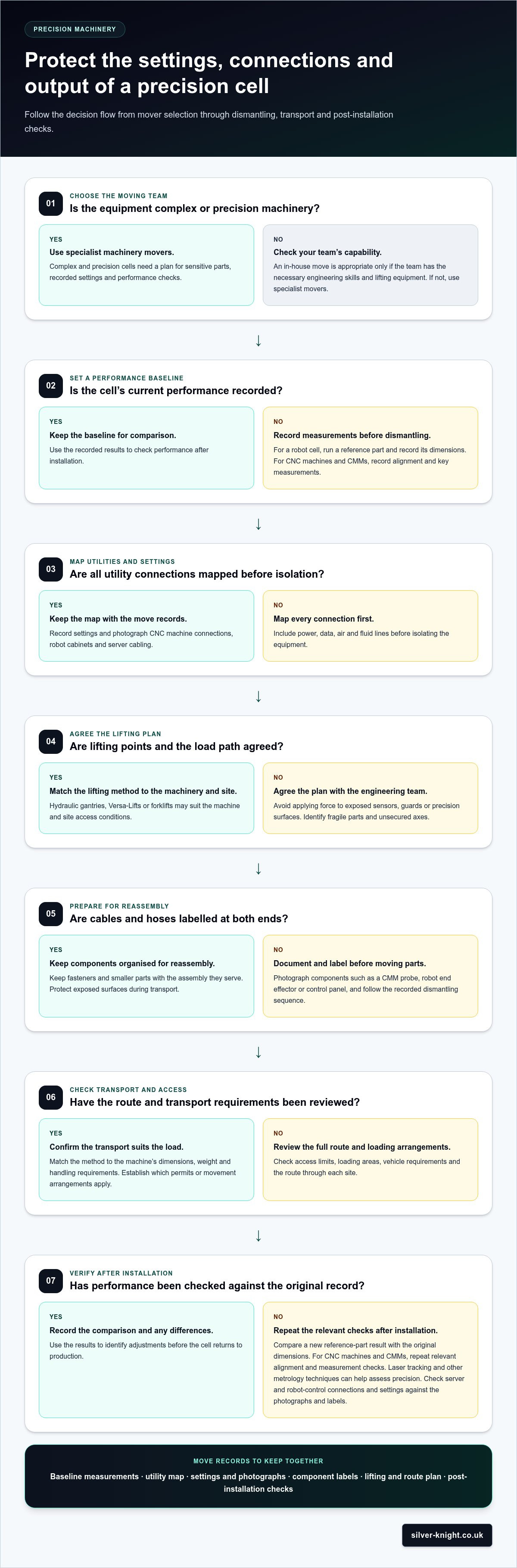
Precision machinery requires more than careful lifting. When relocating a single production cell, record its current performance, label cables and hoses at both ends, and plan how the equipment will be protected, moved and reinstalled. For a robot cell, run a reference part before dismantling and record its dimensions.
It is natural to focus on moving equipment safely between sites. But the move must also preserve the settings and connections that make the cell work, so its performance can be checked after installation.
This guide explains how to assess equipment, map utilities and plan the move, including preparation for precision machinery. It also covers what to document during dismantling and how to approach reinstallation, testing and commissioning.
Use these takeaways to shape your move plan and explore how machinery moving support may fit your project.
Key Takeaways
- Record how precision equipment performs before the move, then use the same reference part to compare its output after installation.
- Label cables and hoses at both ends, and document machinery and components to make reassembly easier.
- Plan the route, lifting method, transport and new-site utilities around the cell’s equipment and layout.
- Allow time for foundations, electrical work, alignment, safety checks and commissioning when building the move schedule.
- Choose a phased or full cutover approach based on how the move affects production, staff, stock and material supplies.
For precision equipment, plan each lift, disconnection and transport around the machine’s sensitive parts and recorded settings. Plan a machinery move with these checks in mind.
Do you take special precautions for precision equipment, CNC machines, CMMs, robots, servers?
Use specialist machinery movers for complex or precision cells. An in-house move is appropriate only when your team has the necessary engineering skills and lifting equipment. The main risks are damage, lost settings, misalignment and delayed production. Reduce them by documenting the cell, controlling lifting forces and checking performance after installation.
-
Plan equipment disconnection and rigging
Map every utility connection before isolating equipment, including power, data, air and fluid lines. Record settings and photograph CNC machine connections, robot cabinets and server cabling. Agree lifting points and the load path with the engineering team, taking care not to apply force to exposed sensors, guards or precision surfaces. Select hydraulic gantries, Versa-Lifts or forklifts for the machinery and site access conditions.
-
Dismantle and label equipment
Document each component as it is removed, then label cables and hoses at both ends. This makes matching a connection at the machine and control cabinet easier during reassembly. Keep fasteners and smaller parts grouped with the assembly they serve, and protect exposed surfaces before transport. A photograph of a CMM probe, robot end effector or control panel can help crews restore its original arrangement. Machinery dismantling should follow the recorded sequence.
-
Mitigate production cell moving risks
Before moving a robot cell, run a reference part and record its dimensions. This gives the team a baseline for checking output after installation. Identify fragile components, unsecured axes and any lifting point that could transfer force to an alignment surface. Protect and secure machinery for transport, and plan the route around access limits, loading areas and vehicle requirements.
-
Check transport and route requirements.
Match the transport method to the machine’s dimensions, weight and handling requirements. Hydraulic gantries, Versa-Lifts and forklifts are possible loading methods for dismantled machinery. Review the route, site access and loading arrangements before transport, then establish which permits or movement arrangements apply to the load. Never assume a route suitable for a standard vehicle will work for specialist machinery transport.
-
Use metrology to check precision.
For CNC machines and CMMs, record alignment and key measurements before dismantling, then repeat relevant checks after installation. Laser tracking and other metrology techniques can help assess precision. Compare a new reference-part result with the original dimensions and record differences for adjustment. For servers and robot controls, check connections and settings against the photographs and labels before returning the cell to production.
Use machinery moving support as part of your planning for equipment transfer and installation.
Planning an industrial production cell move
Build the plan around the new site, the equipment and production needs. A single-line move may take a few weeks; BIOS states that teardown, transport and rebuild can typically take 2-3 months.
-
Survey the site and plan the project
Walk both sites and record access, floor conditions, doorways, loading areas and the cell’s final layout. Before setting a move date, check that the destination has the necessary utilities, infrastructure and permits. Include foundation and electrical work in the programme, as these can affect the critical path. Map the route from the vehicle to the cell, noting turns, obstructions and the distance equipment must travel inside each building.
Set out the timeline, people, equipment and decisions required at each stage. Involve an experienced relocation contractor before finalising the scope, so site-preparation needs and rigging challenges inform the plan.
-
Assess feasibility and plan costs
Compare the cost and practicality of moving existing machinery with buying replacement equipment. Assess labour availability, infrastructure, proximity to suppliers and customers, regulations and market access at the destination. Check that the cell fits the available floor space without disrupting material flow or access for assembly and maintenance.
Build the cost plan around the actual work: preparation, disconnection, lifting, transport, installation and commissioning. Account for shipping timelines, inventory management and possible interruptions to raw material or component supplies. A route survey and clear equipment list help reveal scope gaps before they create schedule or budget pressure.
-
Plan the relocation budget and KPIs
Create a project plan that records the timeline, resources and budget. Assign responsibility for every task, from site preparation through production restart, and set decision points for schedule changes. Allow time for foundations and electrical infrastructure, then include commissioning on the critical path with schedule float.
Set baseline KPIs before the move, such as cycle time, output, downtime and quality measures relevant to the cell. After restart, compare results with those baselines and identify gaps for improvement. For a CO-RELAP cell layout, map workstations, material flow and operator movement against the intended process before fixing equipment positions.
-
Address health and safety rules
Plan the move around task-specific risk assessments, safe equipment isolation, controlled lifting and clear access routes. Identify hazards from stored energy, suspended loads, vehicle movements and work near other production activity. Record who controls each task and how workers will communicate during lifting and installation.
UK requirements depend on the work and equipment involved, so build risk controls into the project plan rather than treating them as a final check. Brief workers on the agreed sequence, access restrictions and emergency arrangements before dismantling begins. Review controls if the site, method or equipment changes.
Use machinery moving support to plan how equipment will be assessed, prepared and transferred.
Pre-move equipment assessment and utility mapping
Assess each machine, its connections and its role in the cell before setting the dismantling sequence. Record what can be moved, what needs modification and how the cell performs before the move.
-
Assess equipment and required modifications
List each machine, control unit, fixture and conveyor, then assess its condition and suitability for relocation. Compare moving it with buying replacement equipment, including any changes needed to fit the destination layout. Identify dependencies between machines, such as a conveyor feeding an assembly station. Record the decision and reason for every item, so the move scope includes equipment that supports the cell’s operation.
-
Map utilities and document the teardown
Trace each machine’s services from its connection point and map them against the destination layout. Record the location and type of every connection, including power, data and other operating services. Photograph connections and components before dismantling, then document the removal sequence. Label machinery and parts clearly. This gives the reassembly team a practical record rather than leaving them to rely on memory or unorganised photographs.
-
Tag equipment for the move
Give each machine and removable component a unique label that matches the equipment register and layout plan. Use the same identifier on its photographs, connection notes and packing record. For cells with similar fixtures, include the workstation or assembly position on each tag. Check that labels remain readable after handling, and keep related fasteners and small parts with the correct machine.
-
Record cycle time and equipment efficiency.
Measure the cell before shutdown so the new installation has a clear performance baseline. A designed production cell had an expected cycle time of 60 seconds. Its projected average equipment efficiency was around 47 per cent, with 6.7 per cent at the packing workstation and 100 per cent at the bottleneck, the first manual assembly workstation. Use relevant measures for your own cell.
-
Match the new layout to the documented cell.
Compare the destination floor plan with the equipment register and utility map. Check that each machine can reach its intended position and connect to the required services without changing the planned process flow. Mark each item’s position on the layout and reconcile it with the tags before transport. This final comparison can reveal missing components, mismatched connections or equipment that needs modification.
Reassembly, installation and commissioning
Use the equipment register and destination layout to guide installation. Test the cell in stages before releasing it for manufacturing.
- Position and assemble equipment in sequence. Use the agreed layout to place each machine, fixture and conveyor in its planned position. Reassemble components in the documented order, checking that interfaces align before connecting adjoining equipment. Keep access clear for installation and future maintenance. Confirm that each machine is correctly positioned in relation to the next workstation, so material flow matches the production plan.
- Reconnect utilities and restore controls. Match every service connection to the utility map and equipment labels. Reconnect power, data and other required supplies, then compare control connections with the original documentation. Check that cables and hoses follow their planned routes without obstructing moving parts or access points. Restore recorded machine settings where applicable, and resolve connection mismatches before starting individual equipment.
- Check alignment and safety systems. Inspect machine position and alignment before running the cell. Check for unusual vibration during operation, and investigate any movement or noise before proceeding. Test safety systems and guards during commissioning, not after full production starts. Confirm that conveyors, interlocks and workstation controls operate together in the intended sequence. Record test results and adjustments.
- Commission equipment in controlled stages. Start with individual machines, then test connected workstations and the complete cell. This sequence helps isolate faults to a specific machine, connection or process. Run a reference part and compare its dimensions with the pre-move record. Measure cycle time and check that output meets the production target. Document deviations and correct them before acceptance.
- Plan the production restart. Before manufacturing restarts, make sure operators understand the relocated layout, equipment controls and process sequence. Check that raw materials and components are available at the new workstations and that supply routes support the planned flow. Start production only after commissioning checks are complete and output meets specification. Monitor early runs for recurring faults, quality changes or delays, then record follow-up actions.
Single production line and cell relocation
Relocating a single production cell involves defining what moves, planning the shutdown, transferring the equipment, then reinstalling and testing it. The key decision is whether to move the cell in one cutover or phase the work to protect production continuity.
- Define the move boundary. List every machine, fixture, conveyor and control unit included in the cell. Mark equipment staying behind, including shared utilities and material-handling equipment. A clear boundary separates the cell’s mechanical and electrical scope from other production areas. Record dependencies, such as a conveyor supplying parts to an assembly station, before setting the sequence.
- Choose a cutover method. A full cutover moves everything in one event: the existing facility shuts down before the move, and the new facility starts afterwards. A phased relocation transfers equipment line by line or cell by cell. It can allow parallel production at two facilities during the transition, but requires careful coordination of staffing, output and inventory.
- Protect supply and stock. Match the move sequence to shipping timelines, inventory management and the availability of raw materials or components. Identify which parts the cell needs before, during and after transfer. Build a stock plan around production demand and delivery timing, then assign someone to monitor it. This helps prevent a ready-to-run cell from waiting for materials or components.
- Plan people and process changes. Set out who will dismantle, transport, install and test each part of the cell. Include workforce planning and training on new equipment, processes and safety protocols. If the new layout changes operator movement or workstation access, document the revised process before restart. Make sure production staff understand the handover points between the old and new sites.
- Control layout changes. Compare the current cell with the intended industrial layout and record every planned change. If a machine is removed from the final arrangement or moved to an adjacent building, update the equipment list, flow plan and installation sequence. Check that the remaining equipment still supports the planned process. Clear drawings help prevent machinery being installed where it blocks access or interrupts material flow.
- Set restart and acceptance conditions. Define what must be working before the cell returns to production, including mechanical alignment, utility connections, safety systems and output checks. Agree who records results and accepts the installation. Compare production at the new location with the agreed targets, then track issues affecting quality, cycle time or supply. Keep unresolved work visible after the initial restart.
Silver Knight Haulage & Machineries Ltd for Machinery Moving
Silver Knight Haulage & Machineries Ltd supports production cell moves with machinery moving and installation. Turn to the team when equipment needs lifting, transport and positioning as part of a planned factory or plant relocation. Bringing moving and installation together in one project connects the handling plan with the destination layout and commissioning sequence.
Share the cell’s equipment list, site layouts, utility details and intended move sequence when discussing the work. These details help define the machinery moving and installation tasks, including how the equipment fits into the wider relocation plan.
To discuss moving a production cell, contact Silver Knight Haulage & Machineries Ltd.
Turn your move plan into a project brief
Before relocating a single production cell, bring the people responsible for production, engineering and site access together around one project brief. Set out who owns each decision, what must be ready at the destination and how the team will approve the restart. A shared reference helps everyone respond consistently when schedules shift or installation details need attention.
Use the brief to start a focused discussion about the practical scope of the move. Silver Knight Haulage & Machineries Ltd offers machinery moving, machinery installation and factory relocation to support projects that involve transferring and setting up equipment at a new site.
Share your project requirements and discuss the next step with Silver Knight Haulage & Machineries Ltd. A clear starting brief can help you move forward with purpose.
Frequently Asked Questions
How do you keep production downtime to a minimum?
Reduce downtime by preparing the destination before the existing cell stops production. When relocating a single production cell, agree on the shutdown point, restart sequence and acceptance criteria with production, engineering and maintenance teams. Prepare materials for the first production run and identify an alternative supply route if the cell’s output is essential. A clear handover plan helps teams spot delays early and avoid restarting before the equipment is ready.
What does dismantling and reassembly cover, and is it really turnkey?
Dismantling and reassembly can involve disconnecting, removing, transporting, positioning and installing machinery, depending on the agreed project scope. “Turnkey” should mean that responsibilities and the handover point are clearly defined, not assumed. Clarify, for example, whether the work includes reconnecting utilities, testing controls, commissioning the cell and supporting production acceptance. Silver Knight Haulage & Machineries Ltd provides machinery moving and installation as part of relocation projects.
What does the engineering and feasibility work cover before the move?
Engineering and feasibility work establishes whether the existing cell can be moved and fitted into the new site. It can assess machine condition, access routes, lifting requirements, floor space, utility connections and installation needs. For example, a layout review might show that a machine’s intended position blocks access to an electrical connection. This analysis helps define the move scope, identify preparation work and plan the sequence before dismantling.
How much does it cost to relocate one production cell in the UK?
The cost depends on the project and is provided after a quotation request. Key factors include machinery size and weight, lifting method, access at both sites, transport distance, dismantling and installation requirements, specialist labour and storage needs. The number of machines and the complexity of their connections also affect the work involved. A clear equipment list and site details help establish the project scope for a quotation.
What site surveys and preparations are needed before moving a production cell?
Survey both sites to assess vehicle access, internal routes, floor conditions, doorways, loading areas and the destination layout. Record where the cell will sit and whether utilities and infrastructure are ready for installation. For example, check that machinery can travel from the unloading point to its final position without obstruction. List preparation tasks, assign owners and complete essential work before scheduling the equipment transfer.
How should machinery be disconnected, dismantled, packed and transported safely?
Plan the sequence around the equipment and its connections. Photograph assemblies before removal, label components against an equipment register and protect exposed surfaces during handling and transport. Keep small parts with the machinery they belong to so they can be found during reassembly. Choose lifting and loading equipment to suit the load and site access. Keep the route and handling plan consistent from the machine’s original position through to unloading.
How can production downtime be minimised during a cell move?
Use the production plan to decide whether the move needs a single cutover or a phased transfer. If parallel production is possible, schedule the cell’s transfer around material availability and staffing at both locations. Prepare work instructions for the relocated layout and train operators before restart. Make handover responsibilities clear, so production, installation and quality teams know when the cell is ready for the next stage.
How should utilities, controls and production lines be reconnected and commissioned?
Reconnect services according to the site utility plan and machinery records, then test individual equipment before running the full line. Check that controls, sensors and connected workstations respond in the intended order. Commissioning should also assess alignment, vibration, safety systems and production output. For acceptance, make a part at the new site and compare its dimensions and cycle time with the agreed production requirements. Record results and resolve issues before routine manufacturing resumes.

Article by
David Ashby
I'm the Managing Director of Silver Knight Haulage & Machinery Ltd. Silver Knight Ltd is a family-run firm established in the West Midlands in 2005, with the aim of providing a cost-effective, yet professional, service to businesses for the removal, transportation, and installation of machinery, plant, and equipment here in the UK and worldwide. Between us, the Silver Knight workforce has over 50 years of experience with machinery and its operation.
Disclaimer
This article is intended for informational purposes only. Please ensure you seek expert advice or carry out your own research to confirm the information is suitable for your specific needs.