That makes rent a useful starting point when comparing industrial storage costs in the UK, but it is only part of the bill. Location, space requirements and service charges can all affect the total.
It’s easy to focus on the advertised rate, especially when you’re planning a move or trying to keep stock and equipment costs under control. The final cost also depends on how much space you need, how long you need it for and what the storage arrangement includes.
This guide explains UK warehouse and storage pricing, the factors that can raise or lower costs, and how to compare unit sizes and locations. It also covers business rates and practical ways to control spending, helping you make an informed decision for your operation.
As you plan storage needs, explore Silver Knight’s services alongside the key points below.
Key Takeaways
- Compare the full cost of warehouse space, not just the rent, as services and extra charges can affect the total.
- Understand how fixed space-based rent differs from flexible 3PL pricing based on pallets or bins.
- Match unit size and location to your stock, equipment and access needs to avoid paying for unsuitable space.
- Find out how business rates may apply, including whether Small Business Rate Relief could reduce the bill.
- Review stock levels and storage needs to spot practical ways to control costs across your operation.
For more about industrial storage, visit Silver Knight’s website.
How much does warehouse storage cost in the UK?
Your total storage cost also depends on contract length, inventory volume and the services included.
Rent and Occupancy Costs
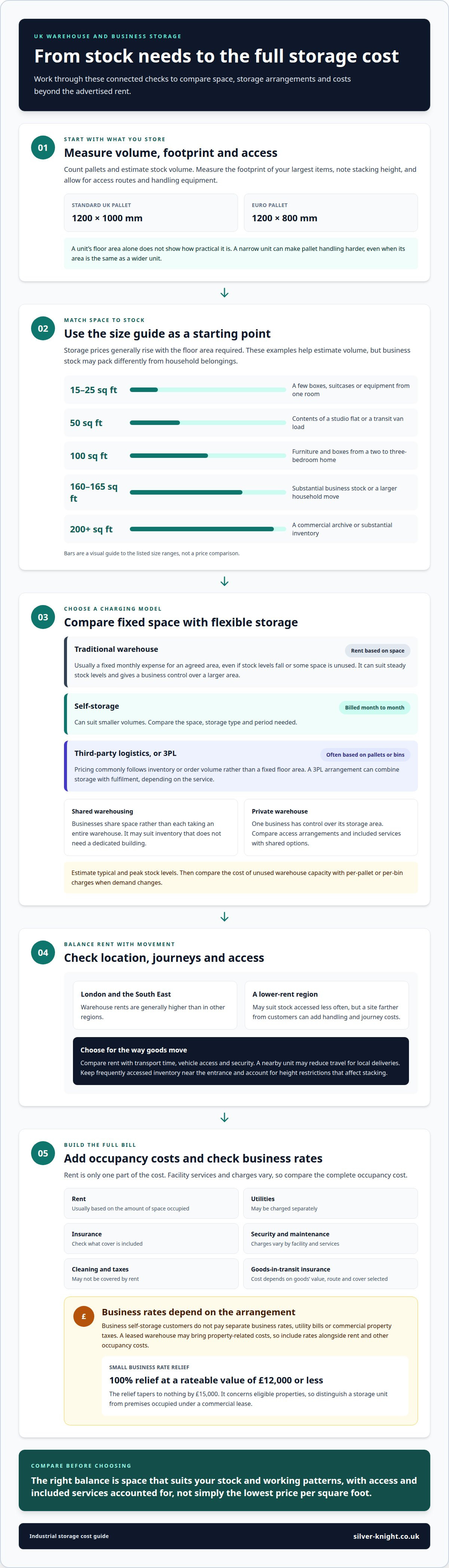
Warehouse rent is the charge for occupying a set amount of space, usually calculated by square footage.
Rent may not cover utilities, insurance, security, maintenance, cleaning or taxes. These costs vary by facility and services, so compare the full occupancy cost rather than rent alone. Warehouse rent is generally a fixed monthly expense, even when inventory levels fall or some space sits unused.
Storage Alternatives and Cost Comparisons
Business storage options range from self-storage units to dedicated warehouses and third-party logistics, or 3PL, services.
Traditional warehouse space suits businesses needing control over a larger area, but can become expensive when demand drops. Self-storage can suit smaller volumes, while 3PL storage charges are often based on pallets or bins rather than a fixed floor area. A 3PL service can also combine storage with fulfilment, depending on the arrangement.
Short-Term and Long-Term Storage Costs
Short-term storage costs depend on the space, storage type and period needed. Self-storage is billed month to month. For longer-term use, warehouse rent is usually a fixed monthly cost, while annual rent offers a clear basis for comparing a lease with flexible storage options.
The best comparison depends on your inventory volume and how often it moves. A fixed warehouse may suit steady stock levels, while flexible pricing can better match changing demand.
Shared warehousing lets businesses share space rather than each taking an entire warehouse. It may suit inventory that does not need a dedicated building, while a private warehouse gives one business control over its storage area. Compare the charging basis, access arrangements and included services before weighing the options.
Insurance is another possible cost. Goods-in-transit insurance costs depend on factors such as the goods’ value, the route and the cover selected, so include transport protection in your wider storage budget.
For flexible storage, 3PL pricing commonly follows inventory or order volume, unlike traditional warehouse rent, which is based on space. Estimate typical and peak stock levels, then compare the cost of unused warehouse capacity with the per-pallet or per-bin charges of a flexible arrangement. For guidance on sourcing and comparing third-party logistics partners, Warenous provides helpful sector insights and resources.
If storage planning is part of a machinery project, explore Silver Knight’s services alongside your space and access requirements.
Choosing the right unit size and location
Choose space based on your stock volume, pallet footprint and access needs. A well-sized unit can prevent you from paying for unused floor area or struggling to move inventory safely.
Storage Costs by Unit Size
Unit size is the floor area available for stored goods, measured in square feet. Storage prices generally rise with the area required, so estimating stock volume helps narrow your options.
Regional Variations in Storage Prices
Regional differences reflect local warehouse rents, with London and the South East generally costing more than other regions.
For a size guide, measure the footprint of your largest items and add the space needed to reach them. A standard UK pallet measures 1200 by 1000 millimetres; a Euro pallet measures 1200 by 800 millimetres. Include stacking height, access routes and handling equipment in your layout, not just the floor footprint.
- 15 to 25 square feet suits a few boxes, suitcases or equipment from one room.
- 50 square feet can hold a studio flat’s contents or a transit van load.
- 100 square feet can fit furniture and boxes from a two to three-bedroom home.
- 160 to 165 square feet can suit substantial business stock or a larger household move.
- 200 square feet or more may suit a commercial archive or substantial inventory.
These examples help estimate volume, but business stock may pack differently from household belongings. Count pallets, note the height of stacked goods and identify items that need clear access. A narrow unit may have the same floor area as a wider one, yet make pallet handling less practical.
Choose a location based on how often goods move and where they need to go. A London unit may reduce travel for nearby deliveries, while a lower-rent region may suit stock accessed less often. Compare rent with transport time, vehicle access and security. If goods move frequently, a cheaper site farther from customers may add handling and journey costs.
Before choosing, sketch the layout using the largest pallet footprint and the space needed to retrieve stock. Keep frequently accessed inventory near the entrance and account for height restrictions that affect stacking. The right balance is a unit that suits your stock and working patterns, not simply the lowest price per square foot.
Businesses planning storage alongside machinery work can explore Silver Knight’s industrial services as they consider suitable arrangements.
Do I have to pay business rates on business storage units?
Business rates depend on the type of storage arrangement and property, not simply on whether the stored goods belong to a business. Business self-storage customers do not pay separate business rates, utility bills or commercial property taxes, while a leased warehouse may bring property-related costs.
UK Government states that Small Business Rate Relief provides 100% relief on properties with a rateable value of £12,000 or less, tapering to nothing by £15,000. This relief concerns eligible properties, so distinguish a storage unit from premises your business occupies under a commercial lease.
For a warehouse, include rates alongside rent and other occupancy costs. That example excludes the risk of a lease commitment, so it does not capture every business’s total cost.
Minimum charges can also affect small or changing storage needs. A business storing a small volume of equipment may still pay the minimum, even when its goods occupy little floor area.
Compare the minimum charge with the pricing basis. A warehouse rental may charge for agreed space, while logistics storage can be priced around inventory volume. If stock levels change, a fixed minimum can make unused capacity costly. Include handling, insurance and other listed services when comparing the total.
Introductory discounts may lower the charge for the first few weeks, but they do not show the ongoing rental cost. Compare the discounted period with the standard rate and any account administration fee.
Deposits affect how much you need at the start of a rental. A self-storage security deposit can typically equal two to four weeks’ rent. For a commercial warehouse, the lease terms determine the commitment and payment structure; commercial warehouse leases typically last one to three years.
That difference matters if you need equipment or inventory only for a temporary project. A month-to-month self-storage arrangement can offer more flexibility to scale down or leave with notice. A warehouse lease may suit stable, ongoing requirements, but its longer term can be harder to match to uncertain demand.
Before agreeing, compare the full contract cost, not just the headline rent. Record the minimum charge, discount period, deposit, additional fees and required rental term. Then match those terms to your expected storage volume and how long you need the space.
For information about storage planning, visit Silver Knight’s website.
Ways to reduce storage costs
Reducing storage costs starts with matching space and services to actual stock movements. Across the UK, businesses can review inventory levels, unit loads and seasonal demand before paying for capacity they rarely use.
Start with stock levels. Keep only the inventory needed for expected demand, and identify slow-moving goods that occupy valuable storage space. Regular reviews can show whether surplus stock should be sold, used, returned or stored elsewhere. Buying larger volumes may secure better purchase prices, but can also increase storage and stock maintenance costs.
Next, map how stock changes through the year. For example, an ecommerce business preparing for Black Friday and Christmas may receive peak stock in September and October, sell it in November and December, then hold less in January. Planning around that pattern can help avoid paying for peak capacity all year.
Standardise unit loads to use available space more efficiently. Consistent pallet dimensions can make stacking, handling and layout planning easier. A standard UK pallet measures 1200 by 1000 millimetres, while a Euro pallet measures 1200 by 800 millimetres. Choose a format that suits the goods and storage layout, rather than mixing sizes without a clear reason.
Review how orders are picked, too. Preparing numerous small orders can multiply the trips and operations needed for fulfilment. Where practical, group work and position frequently picked inventory for easy access to reduce unnecessary movement. Picking aids, such as packaging machines or pick-to-light devices, can also increase productivity, though their value depends on the operation.
Compare providers using the same assumptions. Set out your average and peak stock volume, pallet count, order activity and storage period. Then compare the space or inventory charged for, along with handling and other services. A flexible option may suit fluctuating stock better than a fixed warehouse commitment, while steady inventory may make dedicated space more practical.
Finally, assess savings across the supply chain, not just inside the warehouse. A lower storage charge may mean extra handling, longer journeys or slower order preparation elsewhere. Compare the combined effect on storage, transport and fulfilment before changing locations or arrangements.
- Remove or relocate stock that does not support expected demand.
- Plan capacity around seasonal peaks instead of year-round maximum stock.
- Standardise pallet loads and improve access to frequently picked goods.
- Compare providers against the same stock volume and service requirements.
For further industrial storage information, explore the available guidance.
Factors affecting industrial storage costs
The quoted rate is only part of the total. Industrial storage costs also reflect the goods, facility conditions, handling required and services included, so two spaces with similar footprints can have different overall costs.
Storage conditions: Ambient space usually costs less than storage requiring tighter environmental controls. Temperature-controlled or hazardous goods storage in the UK typically costs 30 to 70 per cent more than ambient storage. The difference reflects the extra requirements involved in storing those goods, rather than floor area alone.
Handling and access: Goods that need frequent movement can add labour and operational costs. Handling goods at height can also increase picking costs because it adds time to each operation. Consider how often stock moves, where it is stored and the equipment needed to retrieve it.
Insurance and liability: Warehouse insurance may be included in the facility price, charged separately or arranged through your own policy. Compare what the quoted arrangement covers, then include any separate premium in your estimate.
Location and facility: Location affects rent, while the facility’s services influence other occupancy costs. Depending on the facility and services, a warehouse bill may include rent, utilities, insurance, security, taxes, maintenance and cleaning. Lower rent can therefore be less economical if essential services or utilities cost extra.
Inventory profile: The number and variety of stock lines affect storage management. A warehouse with more SKUs generally has higher storage and management costs. Bulky, fragile or awkward goods may also need more floor space or careful handling than compact, standardised items. Describe your inventory clearly when comparing facilities.
To compare offers, separate costs into space, storage conditions, handling, insurance and utilities. Apply the same assumptions to each option, including pallet numbers, stock movement and access needs. This makes additional services visible rather than hiding them in a single headline rate.
The main cost driver depends on the operation. For a small number of slow-moving pallets, space and location may dominate. For high-turnover stock, repeated handling and picking can weigh more heavily. Temperature control or hazardous-goods requirements can change the comparison, making the cheapest standard unit unsuitable.
Build your estimate around a real inventory example, such as one month’s expected pallet intake and dispatches. List unloading, booking-in, storage conditions and insurance separately. This breakdown shows which requirements drive the bill and where an alternative facility or storage arrangement could reduce costs.
Silver Knight Haulage & Machineries Ltd for Machinery Moving
Silver Knight Haulage & Machineries Ltd can help when machinery needs to move between storage and a working site. Its Machinery Moving and Machinery Installation services support equipment changes, while Factory Relocation and Plant Relocation help coordinate wider site moves.
Consider these services when stored machinery must be transported, positioned or installed as part of a project. Planning the move alongside storage helps you account for access, handling and the equipment’s destination. The right approach depends on the machinery and work involved.
If you plan to move machinery or relocate a factory or plant, contact Silver Knight Haulage & Machineries Ltd to discuss your project.
Plan your next storage move
Use your storage decision to support the next stage of your operation, not just to find space for equipment. A clear plan for what needs storing, when it must move and where it needs to go can link storage with installation or a wider site change.
Silver Knight Haulage & Machineries Ltd offers Machinery Moving, Machinery Installation and Factory Relocation. If you’re weighing up industrial storage costs in the UK alongside a move, consider how transport, positioning and installation fit into the same project plan. This helps set practical priorities before work begins.
Contact Silver Knight Haulage & Machineries Ltd to discuss your machinery or relocation requirements. A considered plan is a positive next step towards keeping your operation moving.
Frequently Asked Questions
What factors influence storage costs?
Storage costs depend on the space occupied, the goods stored and the services required. A business holding bulky machinery may need more floor area and careful access than one storing compact cartons. Location, storage conditions, stock movement and the rental arrangement also affect the quote. Compare the same inventory profile across options, including expected deliveries and collections, to see whether a lower headline rate remains economical once operating needs are included.
What is the average cost of industrial storage per square foot in the UK?
For context, average UK self-storage costs are £2.43 per square foot per month before VAT. These figures are not interchangeable: a self-storage unit and an industrial warehouse may include different facilities and services. For budgeting industrial storage costs in the UK, compare like-for-like space and charges.
How much does UK warehouse storage cost per pallet per week or month?
Pallet storage is commonly priced by pallet position each month, while some third-party logistics arrangements charge by pallet each week. Check whether the quote counts occupied positions, includes goods receiving or charges separately for dispatch, as these details affect the effective rate.
What extra fees apply to industrial storage, such as handling, insurance and access charges?
Extra charges can cover unloading, booking goods into inventory, insurance, utilities or access services. Insurance may be included, billed separately or arranged through your own policy. Request an itemised quote showing which services are included, how access works and whether handling applies on arrival, collection or both.
How do indoor warehouse, self-storage and container storage costs compare in the UK?
Indoor warehouses generally suit larger volumes or goods needing managed storage, while self-storage can suit smaller quantities and flexible access. Container storage is another format, with prices depending on space, location and included services. Compare usable capacity, weather protection, access arrangements and handling requirements. A lower fee may not be the better option if your goods need frequent retrieval or careful indoor conditions.
What factors affect industrial storage costs, including unit size, contract length and climate control?
Unit size, rental period and storage conditions all affect the total. Larger units use more space, while a longer commitment may change the charging structure. Climate control costs more than standard ambient storage, particularly for sensitive goods. Also consider how often stock moves and whether items need special handling. A useful comparison is based on your actual stock profile, not just the unit’s advertised capacity.
What UK regulations, business rates or VAT apply to industrial storage facilities?
VAT listed for UK self-storage costs is 20%. Business rates depend on the property and the storage arrangement: a self-storage unit differs from a warehouse occupied under a commercial lease. Small Business Rate Relief may apply to eligible properties, with relief based on rateable value. Separate storage charges, rent and business rates in your budget so you can see which obligations relate to your premises.
How can businesses reduce industrial storage costs and compare provider quotes?
Use a consistent comparison before choosing a provider. Give each one the same pallet count, stock profile, storage period and expected movement pattern, then compare space, handling, insurance and access charges. Review slow-moving inventory and seasonal peaks to avoid paying for unused capacity. Consider the wider supply chain too: cheaper storage can cost more overall if it adds transport, handling or fulfilment work.

Article by
David Ashby
I'm the Managing Director of Silver Knight Haulage & Machinery Ltd. Silver Knight Ltd is a family-run firm established in the West Midlands in 2005, with the aim of providing a cost-effective, yet professional, service to businesses for the removal, transportation, and installation of machinery, plant, and equipment here in the UK and worldwide. Between us, the Silver Knight workforce has over 50 years of experience with machinery and its operation.
Disclaimer
This article is intended for informational purposes only. Please ensure you seek expert advice or carry out your own research to confirm the information is suitable for your specific needs.