A safe machinery move starts before the vehicle arrives. Knowing how to prepare machinery for transport means recording its weight, dimensions and handling requirements, then matching the vehicle and lifting equipment to the load. Make the machine safe, position it securely and restrain it for the journey.
It’s easy to focus on haulage, but the wrong vehicle capacity or lifting plan can cause problems before the machine leaves the site. Careful preparation helps you plan a suitable move, reduce avoidable delays and protect both the equipment and the people handling it.
This guide explains how to assess machinery requirements, select transport and lifting equipment, prepare the machine and secure the load. It also covers route planning and factors that affect cost, helping you organise a practical move without unnecessary equipment or handling steps.
Explore machinery moving support from Silver Knight Haulage & Machineries Ltd.
Key Takeaways
- Record the machine’s weight, dimensions and handling needs to help select a suitable transport method.
- Match the vehicle and lifting equipment to the load, and plan how the machine will be safely loaded and unloaded.
- Assess the UK route for restrictions such as bridge heights, weight limits, narrow roads and access constraints.
- Secure moving parts and loose components, then check the machine and restraints for stability before departure.
- Plan transport steps around the wider schedule to help manage disruption, delays and avoidable costs.
For complex moves, specialist machinery moving support can help coordinate the vehicle and lifting arrangements.
Choosing suitable transport vehicles and lifting equipment
Use a specialist machinery transport company when the load requires specialist vehicles, lifting equipment or route planning. Transporting it yourself is suitable only if your vehicle can carry and load the machine safely, with adequate capacity and equipment. For smaller equipment or lighter workshop relocations where heavy haulage is not required, guidance from Fool Movers offers practical advice on planning and coordinating smaller-scale moves.
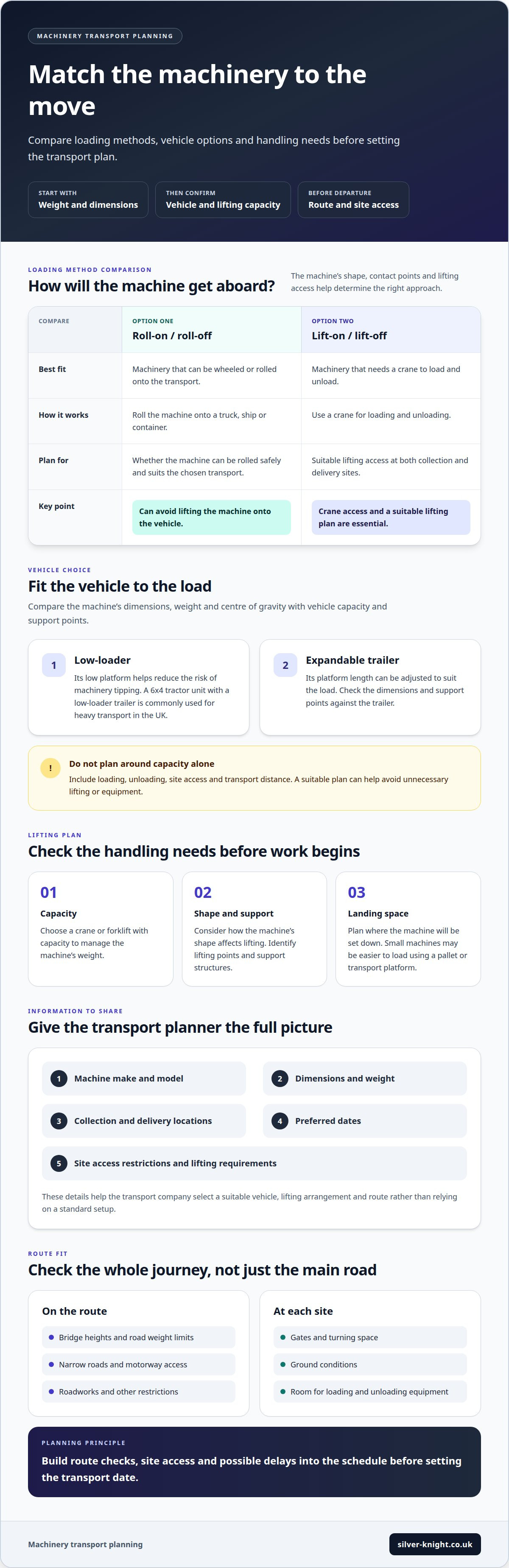
- Match the vehicle to the machine. Record its dimensions, weight and centre of gravity, then compare them with the vehicle’s capacity and support points. A low-loader’s low platform helps reduce the risk of machinery tipping. For heavy transport in the UK, a 6x4 tractor unit with a low-loader trailer is commonly used. An expandable trailer can adjust its platform length to suit the load.
- Choose a transport method that fits the load. Machinery that can be wheeled may be rolled onto a truck, ship or container, avoiding the need to lift it onto the vehicle. Roll-on/roll-off can be a quick, straightforward option when the machine can be rolled. Lift-on/lift-off uses a crane to load and unload machinery, so plan for suitable lifting access at both ends.
- Check the lifting plan against the machine. Choose a crane or forklift with capacity to manage the machine’s weight, and consider how its shape affects lifting. Small machines may be easier to load using a pallet or transport platform. For larger or awkward equipment, plan where lifting points, support structures and landing space need to be before work begins.
- Choose an experienced heavy-equipment logistics partner. Look for a transport company with several years of experience moving machinery or operating trailers. Share the machine’s make and model, dimensions, weight, collection and delivery locations, preferred dates and site access restrictions. These details help the company select a suitable vehicle, lifting arrangement and route rather than relying on a standard setup.
- Factor in distances and route restrictions. Truck transport offers flexible routing and suits short to medium distances. For a large or unusual load, the route may need to avoid narrow roads, unsuitable bridges or weight restrictions. Oversized loads can require permits and notification to relevant authorities, so allow time for route planning before setting a transport date.
Compare the complete handling plan, not just the vehicle. A suitable plan accounts for loading, unloading, site access and transport distance, helping avoid unnecessary lifting or equipment.
For route coordination on a machinery move, specialist machinery transport support can help bring site access and delivery timing into the plan.
How to organise the transport of industrial machinery cheaply and safely in 2024?
Plan the route, site access and contingency arrangements before setting a transport date. For oversized or overweight machinery, assess UK movement requirements against the load’s dimensions and gross weight.
Plan the route and site access
Assess the full journey from collection to destination, including the final approach at each site. Check bridge heights, road weight limits, narrow lanes, motorway access, roadworks and other restrictions. At both ends, consider gates, turning space, ground conditions and room for loading or unloading equipment. A route suitable for a standard vehicle may not work for an oversized load.
Build the route into a detailed schedule, allowing time to coordinate arrival and manage possible delays. If restricted access or roadworks make the planned route unsuitable, revise it before departure. This helps prevent machinery damage and avoids a vehicle becoming blocked near a site entrance.
Check road restrictions and requirements
Compare the load’s dimensions and weight with UK abnormal load thresholds. A load exceeding 2.9 m in width, 18.65 m in length or 44,000 kg can fall within Abnormal Indivisible Load requirements under STGO rules. Oversized or overweight machinery may need notification and permission, depending on gross weight.
For abnormal loads weighing up to 80,000 kg, provide 2 clear working days’ notice. Loads weighing from 80,000 kg to 150,000 kg need 5 working days’ notice. A Special Order application is required at least 8 weeks in advance for loads exceeding 150,000 kg, 6.1 m wide or 30 m long. Escort vehicles may be required for STGO 1, 2, or 3 loads.
Check whether movement is restricted by particular hours, routes or weather conditions. Include notification lead times and escort arrangements in the schedule so they do not disrupt collection or delivery.
Arrange insurance and contingency plans
Review the cargo insurance terms and make sure the insured sum covers the machinery’s value. Check what the policy covers during loading, travel and unloading. Freight insurance terms vary between shippers, and third-party providers may offer additional cover.
Plan alternatives for road closures, delays or accidents, including establishing contacts with vehicle recovery specialists. For example, operators like Dependable Towing & Recovery Services illustrate how professional towing and roadside assistance help resolve transit breakdowns without excessive delay. Agree how the driver and site contacts will communicate, who can approve a route change and how delivery times will be updated. At the destination, unload with suitable equipment and inspect the machine for visible damage. Compare its condition with pre-transport photographs and record any changes.
A planned machinery move needs a restraint plan that fits the load; machinery moving support can help coordinate the handling.
Securing loads with appropriate restraint systems
Before moving machinery, prepare its restraints and protect parts that could shift or be damaged by impact. The right method depends on the machine’s shape, contact points and journey.
Secure machinery and loose parts
- Stabilise the machine and its moving parts. Put arms, levers and shafts into their transport positions, then lock or support them so they cannot swing. Anchor the machinery to prevent tipping or collisions, using restraint systems suited to its weight and shape. Certified chains can restrain machinery, while supports and locks help hold irregular loads steady.
Detach loose hoses, wires and accessories where needed. Wrap each item separately, label it for reassembly and secure it so it cannot rub against the machine or crate. A trailing cable, for example, could snag during loading or become trapped against another component. Parts that shift can abrade or break against nearby surfaces in transit.
Inspect the secured load
- Check every restraint after loading. Inspect the machinery, anchor points and securing equipment before departure. Test the load’s stability and correct any movement or weakness immediately. Agricultural machinery transport guidance cites EN 12195 as a relevant safety standard.
Check that the machine sits securely on its support structure and that restraints are positioned correctly. For crated machinery, check for movement before closing the vehicle doors. Look for contact between restraints and vulnerable parts, since pressure in the wrong place can damage controls or housings. Monitor load stability during transit, particularly when an unusual shape makes movement hard to see.
Protect machinery during transit
- Cover sensitive areas and cushion contact points. Protect control panels, displays and sensors with suitable covers or bubble wrap. Rubber mats or airbags can cushion machinery against vibration and shock. Choose packaging to suit the equipment’s weight, shape, fragility and value.
Complex equipment may need a custom crate designed for its dimensions and weight. Add waterproofing if exposure during transit is a concern, and mark the packaging with clear handling instructions, such as “this way up” arrows or fragile-handling signs. If machinery will pass through several handling stages, consider how each transfer could affect the packaging and restraints.
Photograph the machine’s condition before shipping, and keep its operating instructions and specifications with it. These records help the receiving team handle the equipment and identify changes after delivery.
A surveyor’s pre-shipment inspection and supervision of loading can help manage the risks of transporting agricultural machinery. After loading, inspect the machinery and restraints, and promptly fix any issue that could worsen during transit.
Secure arms, levers and shafts in their transport positions. Detach loose accessory hoses and wires, wrap them and label them clearly for reassembly. If machinery parts shift against crate walls or other components, they can suffer abrasion or breakage. When agricultural machinery exceeds transport limits, wheels, arms or attachments may need to be removed and shipped separately.
Assessing machinery dimensions, weight and transport requirements
Record the machine’s weight, dimensions and handling requirements before selecting transport equipment. An essential part of how to prepare machinery for transport is gathering accurate details to guide lifting, vehicle selection and route planning.
Assess machinery dimensions and weight
- Measure the machine as it will travel. Note its length, width and height, including attachments or parts that extend beyond the main frame. Confirm the total weight from reliable machine information and record where that weight sits. Shape and weight distribution affect how the equipment can be supported and moved safely.
Industrial machinery can weigh from a few to several tonnes. Machinery over 5,000 pounds, about 2,268 kg, is commonly classed as heavy equipment. Agricultural machinery transported by road can weigh more than 20 tons, which may require specialised transport vehicles. Measurements should reflect the actual transport configuration, not just the machine’s dimensions during operation.
Identify sensitive components and requirements
- List parts that need special handling. Identify control panels, displays, sensors and other sensitive components, then note how they should be protected or supported. Read the manufacturer’s operating instructions and specifications for transport limits, lifting points and preparation requirements. Knowing how to prepare machinery for transport also means identifying features that could be damaged by vibration, pressure or unsuitable lifting.
Record unusual shapes, removable attachments and components that affect the machine’s overall profile. An excavator’s attachments, for example, may change its dimensions and loading requirements. Check whether preparation alters the machine’s weight or measurements, then share the updated details with those arranging the move.
Check vehicle size and weight restrictions
- Compare the loaded machine with the vehicle and route. Check that the vehicle’s payload capacity, platform dimensions and support features suit the machine. A 40-tonne excavator, for example, needs a heavy-duty low-loader with sufficient payload capacity and suitable dimensions. Include loaded height and width when assessing clearances along the planned route.
In the UK, a load exceeding 2.9 m in width can fall within Abnormal Indivisible Load requirements under STGO rules. Gross weight and length can also affect requirements. Compare loaded measurements with bridge heights, road weight limits and other route restrictions before finalising transport arrangements.
A crane or forklift used for lifting must be able to handle the machine’s weight. Match the equipment to the load and the access available at the collection and delivery sites. Manufacturer instructions or advice from an equipment specialist can clarify machine-specific requirements before transport.
Lifting equipment and vehicle capacity
Use lifting equipment and a vehicle with capacities suited to the machinery and its planned movement. Safe loading and unloading depend on matching every part of the lifting setup to the load, its support points and the available access.
- Check the vehicle’s usable capacity. Compare the machine’s loaded weight with the vehicle’s payload capacity, not simply its empty weight or general description. Include any attachments travelling with it. Check that the trailer platform and support structure can carry the load without relying on unsupported areas of the machine.
- Plan how the weight will sit on the trailer. Position machinery so its weight is distributed evenly across the trailer, helping maintain stability during the journey. Consider the machine’s shape and where its weight is concentrated. If a machine has a heavy attachment at one end, the loading position must account for that imbalance.
- Match the lifting equipment to the load. A crane or forklift must be capable of managing the machine’s weight. The lifting method also needs to suit the machine’s shape and lifting points. Check that the chosen equipment can approach, lift and place the load without striking nearby structures or forcing an unstable movement.
- Check the supporting structure before lifting. Machinery must be loaded onto structural framing strong enough to support its weight. Confirm that the intended contact points can take the load, and keep the machine stable as it transfers from lifting equipment to trailer. A narrow or uneven base may need careful positioning to avoid concentrated pressure.
- Plan loading and unloading as separate operations. Identify the equipment and working space needed at both sites. A crane may move machinery onto or off a transport vehicle, while a forklift can suit loads it can safely handle. Allow for the lifting path, available headroom and the position where the machinery must be set down.
- Choose the right system for restricted access. Where a forklift or crane cannot reach the machine directly, hydraulic gantries or jack and slide systems can form part of a planned move. Select a method that supports controlled movement through the available space. Account for turns, floor transitions and the final position before lifting begins.
Coordinate the vehicle, lifting equipment and support structure as one plan before the move begins. If any part cannot handle the machine’s weight or intended position, revise the setup before loading, not during the lift.
Silver Knight Haulage & Machineries for machinery moving
Silver Knight Haulage & Machineries provides machinery moving for businesses transferring a machine, relocating a factory or moving a plant. Its machinery installation service can also support projects where equipment needs to be positioned at its destination.
Turn to the team when a move involves heavy machinery, several pieces of plant or close coordination between removal and installation. Sharing the machine’s dimensions and weight, collection and delivery points, and site access details helps shape a suitable work plan. For a wider project, factory or plant relocation can bring machinery moving and installation together.
To discuss machinery moving or installation for your project, contact Silver Knight Haulage & Machineries.
Turn your transport plan into the next step
Before booking a move, bring the key decisions together in a practical project brief. Set out the machine’s handling requirements, collection and delivery arrangements, site access and any timing constraints that could affect your operation. This gives everyone involved a shared starting point and connects preparation to the work planned at each site.
A clear brief is also a useful first step in deciding how to prepare machinery for transport. Note anything that could change the plan, such as restricted loading space or machinery that needs careful positioning after delivery. With these priorities in view, you can move from planning to action with greater clarity.
For support with the next stage, discuss your machinery move with Silver Knight Haulage & Machineries Ltd. A well-prepared plan can help your project move forward with confidence.
Frequently Asked Questions
What Does a Professional Machinery Transport Service Include?
A professional service can coordinate the planning, handling and movement of machinery between sites. The work may include a site survey, specialist labour, lifting arrangements, haulage and positioning at the destination. For a factory move, clarify which machines are included and how the work fits the site’s operating schedule. Silver Knight Haulage & Machineries provides Machinery Moving, Machinery Installation and Factory Relocation.
How do you clean and inspect machinery before transport?
Clean accessible surfaces and remove dirt, grease or residue that could hide damage or create a slipping hazard during handling. Inspect the casing, guards, connections and visible working parts for cracks, loose fittings or signs of leakage. Note existing faults for the receiving team and keep inspection records with the machine’s handover documents. Pay close attention to areas that will be difficult to see once the equipment is packed.
How should machinery be drained, disconnected and secured for transport?
Follow the machine manufacturer’s shutdown and transport instructions before disconnecting services. Isolate electrical, pneumatic and hydraulic supplies, and manage stored energy according to the equipment’s instructions. Decide whether fluids need draining based on the machine’s design and the risk of leakage during movement. Close or seal remaining fluid circuits, secure disconnected cables and hoses, and label removed fittings for reassembly with the machine.
How should machinery be secured on a trailer or lorry?
Use restraints suited to the machine’s weight and shape, attached to approved securing points rather than fragile guards or controls. Position the machine so its base sits securely on the vehicle, then tension restraints evenly to limit movement without damaging the equipment. Check that attachments cannot swing and that loose items travel separately. A final walk-round should identify contact points where vibration could cause rubbing or damage.
What insurance and risk assessments are needed when transporting machinery?
Review the transport insurance terms and compare the insured value with the machinery’s replacement or declared value. Assess risks at collection, during lifting, along the route and at unloading, including restricted access and nearby people or equipment. Before removal or transport begins, the haulage company should submit a health and safety pack for customer approval. Its method statement should explain how the work will be carried out.

Article by
David Ashby
I'm the Managing Director of Silver Knight Haulage & Machinery Ltd. Silver Knight Ltd is a family-run firm established in the West Midlands in 2005, with the aim of providing a cost-effective, yet professional, service to businesses for the removal, transportation, and installation of machinery, plant, and equipment here in the UK and worldwide. Between us, the Silver Knight workforce has over 50 years of experience with machinery and its operation.
Disclaimer
This article is intended for informational purposes only. Please ensure you seek expert advice or carry out your own research to confirm the information is suitable for your specific needs.