Skip to Content
Silver Knight
  • Our Equipment
  • Services
  • About Us
  • Job Vacancies
  • Latest News & Guides
  • 0121 544 8118
  • Contact Us
Silver Knight
      • Our Equipment
      • Services
      • About Us
      • Job Vacancies
      • Latest News & Guides
    • 0121 544 8118
    • Contact Us

    How to Organise Factory Move Logistics Planning for Minimal Downtime

  • Machine Moving Guides & Tips
  • How to Organise Factory Move Logistics Planning for Minimal Downtime
  • 23 May 2026 by
    Public user for Silver Knight Machineries

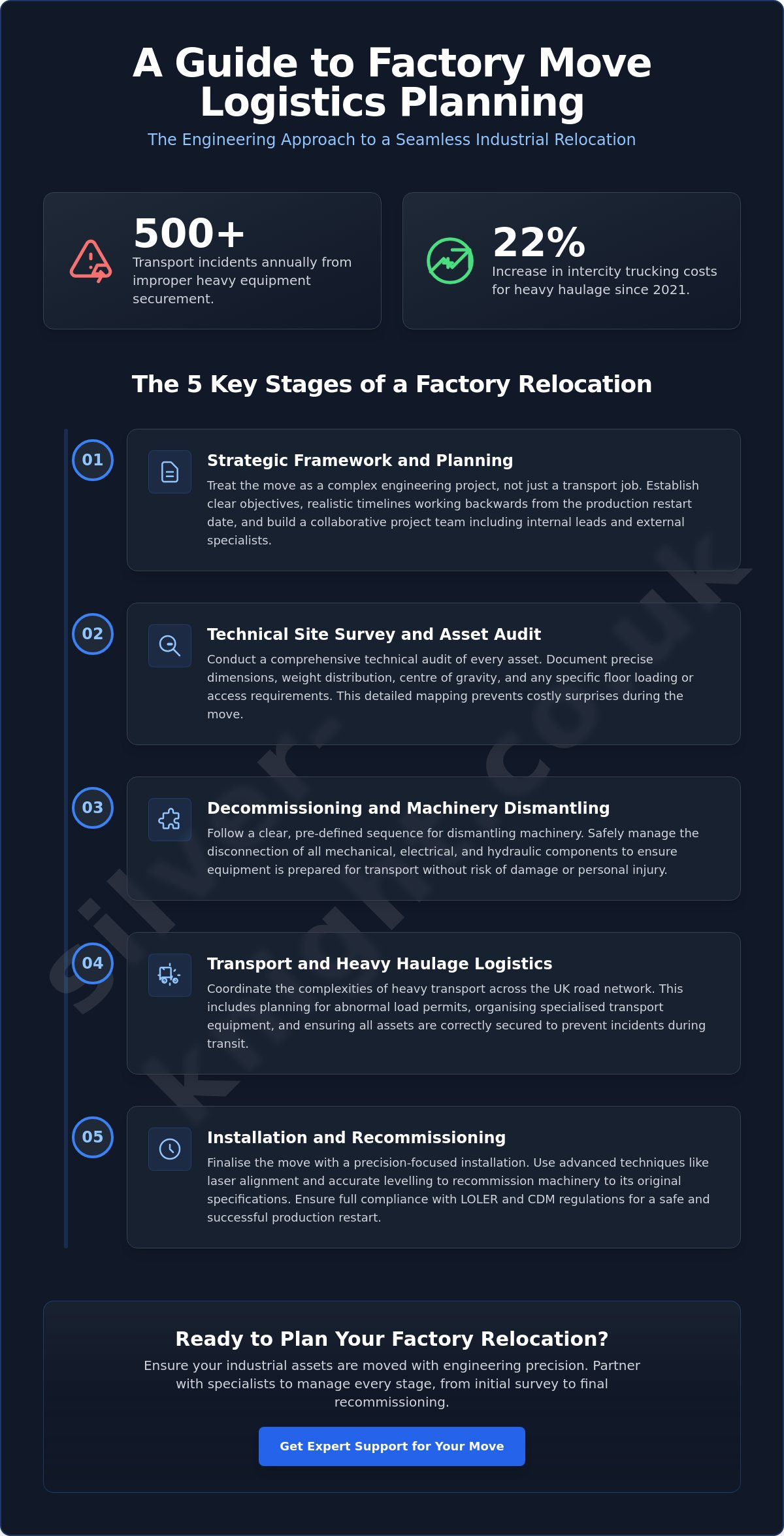
    Did you know that improper heavy equipment securement leads to more than 500 transport incidents every year? This statistic highlights why factory move logistics planning is far more than just a transport task. It's a complex engineering challenge where a single oversight can lead to broken machinery or weeks of lost production. Most site managers feel the weight of this responsibility when production schedules are on the line, often seeking the expertise of The CFS Group to ensure their facilities operate seamlessly and efficiently throughout the move.

    We understand that the fear of extended downtime and the complexity of coordinating multiple contractors can feel overwhelming. You need your bespoke machinery recommissioned to original specifications without any costly surprises along the way. This article provides the precise technical sequence required to plan your relocation whilst protecting your industrial assets. We will explore how to manage rising intercity trucking costs, which have increased by 22% since 2021, and ensure full compliance with LOLER and CDM regulations for a seamless transition to your new facility, which may also involve partnering with Excel Business Environments Ltd for professional turnkey office fit-outs and commercial refurbishments.

    Whether you are planning a complex industrial shift or a corporate office transition, you can discover Clear Lake Movers, Inc. for professional relocation support that ensures a smooth and efficient move.

    Key Takeaways

    • Effective factory move logistics planning requires a strategic framework that treats relocation as an engineering project instead of a simple transport job.
    • Conduct a detailed technical site survey and asset audit to identify specific floor loading and access requirements for your heavy machinery.
    • Manage the decommissioning stage with a clear sequence to ensure all mechanical and electrical components are safely dismantled.
    • Address the challenges of heavy haulage by planning for abnormal load permits and specialised transport equipment across the UK road network.
    • Achieve a successful production restart through precision recommissioning using laser alignment and accurate levelling techniques.

    Table of Contents

    • Establishing a framework for factory move logistics planning
    • Executing a technical site survey and asset audit
    • Managing the decommissioning and machinery dismantling stage
    • Coordinating the transport and heavy haulage logistics
    • Finalising the installation and recommissioning process

    If you are preparing for a major industrial transition, you can find expert support through our professional factory moving services.

    Establishing a framework for factory move logistics planning

    A modern factory relocation is far more than a simple haulage task. It involves a sophisticated structure relocation process that starts months before the first lorry arrives at your gates. Successful factory move logistics planning requires a deep understanding of how production lines interact and how machinery behaves during transit. If you treat it like a standard office move, you risk catastrophic delays and equipment damage that could stall your operations for weeks. The scope must cover everything from initial site surveys to the final recommissioning of your most sensitive assets.

    Treating the relocation as an engineering project is the best way to reduce operational risk. This means every phase is sequenced with technical precision rather than just being a series of transport bookings. By leaning on 180 years of collective experience, a specialist team can anticipate logistical hurdles that usually stall a project. This depth of knowledge helps in identifying potential bottlenecks in the factory relocation service programme, such as restricted site access or the need for specialised lifting equipment. This proactive approach ensures that the move supports your wider business objectives instead of hindering them.

    To better understand the complexity of these logistical layouts, watch this helpful video:

    Defining project objectives and timelines

    You must identify production deadlines that are set in stone before any work begins. A realistic timeline has to account for the time needed for decommissioning and rigorous testing at the new site. It's often helpful to work backwards from your required restart date to ensure every milestone is achievable. Clear communication with staff and stakeholders is density vital to keep morale high and ensure everyone understands their role during the transition. This transition is also an ideal time to review site accessibility; for instance, Etech Motion offers advanced electric mobility solutions that help personnel with specific accessibility requirements navigate extensive industrial layouts safely. Establishing these goals early prevents scope creep and keeps the project on track whilst protecting your production schedules.

    Building the relocation project team

    Your internal team should include leads from IT, production, and health and safety to cover all technical bases. Partnering with a specialist industrial moving company brings technical expertise that internal teams often lack, especially regarding heavy lifting and complex transport. Defining these roles early prevents confusion and ensures no task falls through the gaps. You should also define roles for external contractors clearly to avoid any overlap; for example, qualis.energy can assist with the design and installation of solar PV and battery storage to improve the energy profile of your new site. This collaborative structure allows you to manage the factory move logistics planning process with confidence, knowing that every asset is in safe hands.

    While the focus is often on heavy machinery, the health and safety lead must also account for the personal requirements of the workforce. Ensuring that personnel have access to essential daily living aids and support from Mobility and You can help maintain a supportive and inclusive environment throughout the relocation.

    You can ensure your project starts on the right track by partnering with our experts for professional machinery moving services.

    Executing a technical site survey and asset audit

    Before you move a single bolt, you need a comprehensive map of your operational landscape. Effective factory move logistics planning relies on a technical site survey that captures every detail of your machinery and the environments they inhabit. This isn't just a simple inventory list. It is a technical audit that identifies the physical and mechanical requirements of every asset on your floor. You must record dimensions, weight distributions, and any bespoke disconnection requirements for electrical or hydraulic systems whilst documenting the current condition of each unit. This survey is also an ideal time to assess the electrical capacity and energy efficiency of your new site; to see how solar power could benefit your operations, you can learn more about Jelvis and their renewable energy expertise.

    Professionals often refer to an industrial relocation study to understand the common pitfalls of manufacturing shifts. One major risk is failing to document the specific centre of gravity or the delicate calibration points of heavy equipment. By following the standards used by expert machinery movers UK, you can ensure your assets are handled with the necessary precision. This includes measuring access points for large CNC machines and verifying that the destination facility's floor load capacity can support your heaviest presses. If the new site cannot handle the point loads of a 20 tonne machine, you'll need to plan for floor reinforcements before the equipment arrives.

    Assessing infrastructure and utilities

    Power and utilities are the lifeblood of your production. You must verify that the destination facility has the correct voltage and connection points for your machinery. It's also vital to check for compressed air and water supply compatibility to avoid delays during the recommissioning phase. Reviewing the layout at this stage allows you to design a logical production flow that might even improve your efficiency compared to your old site. Don't just look at the machine itself; look at the surrounding space needed for maintenance and operator safety, such as ensuring proper light management in monitoring stations with made to measure blinds West Midlands from Universal Blinds UK.

    When planning these facility improvements, incorporating bespoke architectural features such as lean-to glass roofs from Grabex Windows Ltd can provide the high-quality finish and natural light required for modern manufacturing environments.

    Ensuring the structural integrity and drainage of your new site is a priority; you can discover Archers Roofing Services Ltd for expert PVC guttering, facia, and soffit installations tailored for commercial properties.

    Regulatory compliance and risk assessments

    Compliance is where many projects stumble. In the United Kingdom, you must adhere to the Construction (Design and Management) Regulations 2015 (CDM 2015) throughout the move. This involves creating site specific risk assessments and method statements (RAMS) for every lift and transport phase. You also need to ensure full compliance with LOLER and PUWER standards. As of 2026, standards also emphasise the cybersecurity of machinery during decommissioning, especially for networked systems. If you're unsure about these legal requirements, you can speak with our compliance team for guidance.

    To ensure your relocation is handled by industry experts, please visit our factory relocation services page for comprehensive support.
    Factory move logistics planning

    Managing the decommissioning and machinery dismantling stage

    Decommissioning is a high-risk phase that requires a strict technical sequence to prevent damage to internal components. Effective factory move logistics planning treats dismantling as the reverse of installation. You don't just pull cables; you follow a documented isolation process to ensure all electrical, pneumatic, and hydraulic systems are safe. Once isolated, any residual energy or fluids must be drained and disposed of according to environmental standards. Utilising professional machinery dismantle services ensures that complex plant equipment is broken down into manageable sections without compromising its structural integrity.

    When working in restricted spaces, traditional lifting often isn't possible. This is where jack and slide systems become essential. These systems use low-profile tracks and hydraulic cylinders to move heavy assets through tight corridors or under low ceilings where a crane cannot reach. Documentation is vital during this stage. You should label every wire, pipe, and fastener whilst taking detailed photographs of the assembly. This level of detail is a core part of the Freight Professional Capacity Building Program standards, which emphasise the importance of precision in multimodal logistics.

    Preparing machinery for safe transit

    Before any machine leaves the floor, it must be prepared for the rigours of the road. This involves draining all coolants and oils to prevent leaks during transit. Moving parts like tool changers or robotic arms should be mechanically locked or braced to avoid vibration damage. If your equipment is destined for overseas, you'll need to follow strict export packing requirements, including vacuum sealing and the use of desiccants. Specialised pallets and custom timber frames are often required to support delicate components and prevent them from shifting whilst in the lorry; for businesses in the health and food sectors, you can visit Simplepack Ltd to explore how professional contract packing can further secure your products during the move.

    To ensure that all components are fit for transit and meet technical specifications, you can discover The Testing Lab PLC for accredited testing services that provide an extra layer of quality assurance for your industrial assets.

    To ensure that all elements of your business transition are handled with care, you can check out Carryall Transport for expert commercial relocation and transport solutions.

    Utilising specialised lifting equipment

    Choosing the right lifting tool depends on your factory's layout. Hydraulic gantries are often preferred for indoor lifts because they provide high capacity with a much smaller footprint than mobile cranes. For moving heavy loads in exceptionally tight spots, Versa-Lift hire offers a compact solution that combines the power of a large forklift with the manoeuvrability needed for factory floors. Every lift must be supervised by qualified operators to ensure full LOLER compliance. This helps you avoid the transport incidents that often occur due to improper securement or poor weight distribution.

    If you require professional support for your upcoming industrial move, please visit the Silver Knight website to learn more about our capabilities.

    Coordinating the transport and heavy haulage logistics

    Moving heavy machinery across the United Kingdom is a logistical feat that requires more than just a large lorry. As part of your factory move logistics planning, you must account for the physical constraints of the UK road network and the rising costs of transport. Intercity trucking costs have increased by 22% since 2021, making efficient route planning essential to protect your budget. A successful move relies on selecting the right equipment, such as low loaders for tall machines or semi-trailers for standard loads, to ensure every asset is transported safely and legally. This may also involve external site preparation, where services like WGS Tree Services help clear overhanging branches or vegetation that could obstruct high-sided transport vehicles.

    The condition of the access routes at your new facility is equally important for heavy haulage; if you're looking to upgrade your site's entrance or explore Block Paving Driveways, professional property maintenance can ensure your site is ready for heavy vehicles.

    In addition to external groundworks, internal site preparation often requires specialised skills; for professional carpentry and property maintenance across the region, CPT Services can assist in readying your facility's interior for its new operations.

    Route planning is a critical technical step. You cannot simply rely on standard GPS when moving industrial assets. You must identify low bridges, narrow lanes, and weight-restricted roads that could block your progress. In many cases, you will need to coordinate with police forces for notifications or arrange for private escort vehicles to manage traffic flow. Utilising professional factory relocation services provides you with a team that manages these end to end haulage complexities, ensuring your equipment arrives without the delays often caused by poor route scouting.

    Managing abnormal loads and permits

    In the UK, a load is considered abnormal if it exceeds standard weight or dimensions, such as a width over 2.9 metres. When your machinery falls into this category, you must follow a strict notification process. This involves informing local authorities, bridge owners, and sometimes the police through the ESDAL system. For relocations that require site access modifications or planning permissions, ML Traffic Engineers provides the specialised traffic engineering documentation necessary to support your applications. Timing is also a major factor. Moving large equipment during peak traffic hours is often prohibited, so you must schedule departures to minimise disruption. Proper factory move logistics planning ensures that all necessary permits are secured before the wheels begin to turn, helping you avoid legal issues or fines.

    International logistics and shipping

    If your relocation involves moving equipment overseas, the complexity increases significantly. You will need to manage detailed customs documentation and ensure all duties are correctly calculated to avoid border delays. The process of securing machinery in shipping containers requires expert lashing and blocking techniques to withstand the forces of sea travel. Coordinating multi-modal transport, where a machine moves from a lorry to a ship and then back to a lorry, requires a unified data platform to maintain visibility. If you need help managing these complex movements, you can contact our logistics team for a detailed consultation.

    If you are ready to begin your industrial relocation project, you can find a full list of our capabilities on the Silver Knight website.

    Finalising the installation and recommissioning process

    The arrival of your machinery at the new facility is a significant milestone, but the final phase of factory move logistics planning is where technical precision truly matters. You cannot simply place a machine and turn it on. Instead, you must follow a structured installation programme that ensures every asset is positioned to millimetre accuracy. This process involves precision positioning using laser alignment and high grade levelling tools. By utilising specialised equipment like hydraulic jacks and precision levels, you ensure that your production line is perfectly balanced and ready for high speed operation.

    Once the machinery is in place, the systematic reconnection of mechanical and electrical services begins. This is where the detailed documentation and labelling from the decommissioning stage pay off. Every wire and pipe is reattached according to the original specifications. After the physical connections are made, the recommissioning phase starts. This involves a series of rigorous tests to ensure the machinery meets its original production standards. It is a critical step to protect your industrial assets and confirm that no damage occurred during the transit phase across the UK road network. To ensure your equipment looks as professional as it performs in its new setting, you can learn more about specialist respray services for industrial machinery.

    Precision positioning and anchoring

    Achieving this level of accuracy requires high-quality gear; you can discover New Local Tools for a range of professional power tools that ensure your machinery is installed and secured to the highest industrial standards.

    Correct levelling is essential for the longevity of any heavy industrial machine. Even a slight tilt can cause uneven wear on bearings and drive systems, leading to premature failure and costly repairs. Once the equipment is level, it must be securely anchored to the floor to prevent vibration and movement during operation. This often involves drilling into the concrete and using heavy duty resin or mechanical anchors. For facilities requiring more extensive structural preparation or high-quality building services, Horns Construction can provide expert support to ensure the site is ready for heavy plant installation. A final inspection is conducted before any power is applied to verify that all safety guards are in place and the machine is structurally sound.

    Post move review and support

    A successful transition ends with a comprehensive walkthrough to ensure all project objectives were met. You should receive a full set of documentation, including safety certificates and recommissioning reports, to confirm that the installation complies with current regulations. If your new facility is not quite ready for certain assets, you might consider machinery storage as a short term solution. This allows you to move items out of your old site without rushing the installation at the new one. This final review ensures that your production schedules are protected and your facility is fully operational from day one.

    If you are ready to secure your production schedule and protect your industrial assets, you can find expert support through our professional factory relocation services.

    Securing your production future with technical precision

    Relocating an industrial facility is a technical engineering project that demands precision at every stage. You've seen how a detailed asset audit and a sequenced decommissioning plan prevent the damage and delays that often plague standard moves. By coordinating abnormal load transport and precision recommissioning, you can maintain customer confidence and resume operations without a hitch. This structured approach protects your valuable machinery and ensures it's returned to its original specifications in the new facility. As you prepare your business for its next chapter, you can learn more about optimising your payment processing systems to match your new facility's capabilities.

    Our team brings over 180 years of collective industry experience to every project. We utilise a specialised fleet, including Versa-Lifts and hydraulic gantries, to manage even the most complex lifts across the UK or globally. Contact our expert team to discuss your factory move logistics planning today. With the right framework and technical expertise, your next move can be the catalyst for a more efficient and productive future.

    Frequently Asked Questions

    How long does factory move logistics planning typically take?

    Planning usually takes between three and six months depending on the scale of your facility. For larger or more complex projects, you should start even earlier to ensure all technical surveys and utility upgrades are completed. This lead time allows for thorough factory move logistics planning, which is essential for identifying potential bottlenecks before they affect your production schedule.

    What are the most common risks during a factory relocation?

    The most common risks include physical damage to bespoke machinery and extended production downtime. Data from 2026 shows that improper securement leads to more than 500 transport incidents every year across the industry. You also face the risk of infrastructure incompatibility at the new site if floor loading capacities or power supplies aren't correctly verified during the technical audit phase.

    Do I need to hire a specialist company for machinery moving?

    Hiring a specialist is vital for protecting your industrial assets and ensuring site safety. Specialist movers have the technical training and the specific equipment, such as hydraulic gantries, needed to handle heavy loads in industrial environments. They understand the engineering requirements for decommissioning and recommissioning, which reduces the chance of operational failure once the machines are reinstalled at your new facility. For the technological and security setup of your new site, Jurij's Solutions LTD offers professional IT infrastructure and security system installations.

    Beyond the physical machinery, retail businesses must also consider their inventory management; you can learn more about EZ3PL Ltd for expert 3PL solutions that ensure your e-commerce fulfilment remains uninterrupted during a move.

    What insurance cover is required for industrial equipment relocation?

    You typically need Goods in Transit insurance and Public Liability insurance for a relocation project. It's important that the coverage reflects the full replacement value of your machinery rather than just its weight or age. You should check with your insurance provider or a specialist broker like Just Quote Me to ensure that specialised tasks like decommissioning and heavy lifting are fully covered under your existing or temporary policy throughout the move.

    How can I minimise production downtime during a factory move?

    You can minimise downtime by using a phased relocation strategy and preparing the new facility in advance. Moving your equipment in stages allows you to maintain some production output whilst the transition occurs. Detailed factory move logistics planning ensures that all utilities are ready at the destination, allowing for immediate recommissioning and a faster return to full capacity for your business. Furthermore, if you need to sell your previous premises quickly, you can learn more about Auction Property Ltd to explore commercial property auction options.

    What regulations govern the lifting and transport of heavy machinery in the UK?

    Lifting operations in the UK are governed by the Lifting Operations and Lifting Equipment Regulations (LOLER). You must also comply with the Provision and Use of Work Equipment Regulations (PUWER) and the Construction (Design and Management) Regulations 2015. These standards ensure that all equipment is fit for purpose and that every lift is planned and supervised by a competent person.

    Can you manage international factory relocations outside of the UK?

    We offer full support for international machinery transport and global relocations to various destinations. This service includes handling complex customs documentation and coordinating multi-modal transport across different countries. We use specialised export packing techniques to protect your machinery from the environmental and physical stresses of sea or air freight, ensuring it arrives in perfect condition at its final destination.

    What specialised equipment is used for moving machinery in restricted spaces?

    We use jack and slide systems and hydraulic gantries to navigate tight factory environments where space is limited. These tools allow us to move heavy machinery under low ceilings or through narrow corridors where a standard crane cannot operate. Versa-Lift hire is also a key solution, providing high lifting capacity in a compact frame for precision positioning in restricted areas.

    David Ashby

    Article by

    David Ashby

    I'm the Managing Director of Silver Knight Haulage & Machinery Ltd. Silver Knight Ltd is a family-run firm established in the West Midlands in 2005, with the aim of providing a cost-effective, yet professional, service to businesses for the removal, transportation, and installation of machinery, plant, and equipment here in the UK and worldwide. Between us, the Silver Knight workforce has over 50 years of experience with machinery and its operation.

    Disclaimer

    This article is intended for informational purposes only. Please ensure you seek expert advice or carry out your own research to confirm the information is suitable for your specific needs.

    Latest Stories

    Explore fresh ideas and updates from our editorial team.

    See All
    Industrial Plant Decommissioning Services and Site Clearance Guide 2026

    What if the closure of your facility wasn't just a drain on resources but a final opportunity to reclaim significant capital? With the global offshore decommissioning market alone projected to reach $...

    Creating a Robust Factory Decommissioning Plan for Industrial Success

    Did you know that a single serious safety violation during an industrial closure in 2026 can now result in a penalty of $16,550? For many site managers, the prospect of closing a facility is a minefie...

    Abnormal Load Haulage UK Guide for Industrial Machinery 2026

    Did you know that roughly one in ten HGVs stopped by the DVSA during the 2024/2025 period were found to have overloading or construction violations? This statistic is a sobering reminder that abnormal...

    Oversized machinery transport and industrial relocation guide 2026

    The global market for heavy equipment transport services was valued at $10 billion in 2024 and is projected to reach $15 billion by 2033, highlighting the massive scale of industrial logistics in 2026...

    Professional Forklift Hire for Industrial Machinery and Factory Moves

    Choosing the wrong equipment for a heavy machinery move isn't just a minor error; it's a risk that can lead to catastrophic damage or severe injury. With over 1,300 forklift-related accidents occurrin...

    Heavy Equipment Transport Cost UK Guide for 2026

    Did you know that 18% of heavy transport delays across the country are caused by site access errors identified only after the vehicle arrives? This statistic highlights why calculating the heavy equip...

    Industrial Relocation Checklist

    A factory relocation is a precision engineering project rather than a simple haulage task. You likely understand that even a minor oversight during a move can result in eye-watering costs from product...

    How to Organise a Successful Industrial Relocation in 2026

    Did you know that improper heavy equipment securement leads to more than 500 transport incidents every single year? When you combine this safety risk with the fact that intercity trucking costs have r...

    Expert Heavy Machinery Exporters and International Relocation Standards

    UK exports of machinery and transport equipment to the EU rose by £0.6 billion in January 2026. This surge drives the need for international machinery relocation services UK manufacturers use to expan...

    Decommissioning Industrial Machinery, The Professional Technical Guide 2026

    As of April 1, 2026, the Health and Safety Executive (HSE) has increased the Fee for Intervention (FFI) rate to £188 per hour for any material breach found during industrial decommissioning. This regu...

    Export Packing Checklist for International Machinery Transport 2026

    UK manufacturing growth hit a 17-month high in January 2026 as the PMI reached 51.8 points, driving a surge in the demand for professional export packing. This expansion drove the first increase in ne...

    Specialised Lifting, Versa-Lift, Gantry, and Jack Systems

    Corporate relocation spending in the United Kingdom reached £2.3 billion in 2023, representing a 15% increase as manufacturers reshored operations to mitigate global risks. This surge in activity dema...

    Professional machinery installation project management for industrial success in 2026


    About us


    Silver Knight Ltd is a family-run machinery moving company established in the West Midlands in 2005 with the aim of providing a cost-effective, yet professional machinery moving service to businesses as machine movers, machine installation & factory plant relocation specialists.

    We specialise in the removal, transportation and installation of machine plant and equipment here in the UK, and worldwide

    Get in touch

    Current Job Vacancies


    Our Location

    We are located in Walsall in the UK, but, move machines across the UK and abroad.

    Which is:

    • 11 miles from Birmingham
    • 9.2 miles from Dudley
    • 4 miles from Wednesbury
    • 7 miles from Wolverhampton

    Company Information


    Registered in England & Wales
    Company No: 5263216

    Registered Office:
    Silver Knight Haulage & Machineries Ltd
    Unit 2 Alma Street
    Walsall
    West Midlands

    WS2 8JQ

    • +44 (0)121 544 8118 
    • info@silver-knight.co.uk

    Powered by Odoo - Create a free website