90% of UK manufacturers have seen their energy bills rise since 2022, making any period of unproductive downtime in 2026 a risk most simply cannot afford. It's a common fear amongst plant managers that a move means weeks of expensive silence on the factory floor. You likely worry about the complexity of shifting heavy CNC machinery or the risk of your budget spiralling out of control. Adopting a phased factory relocation strategy is the most effective way to tackle these challenges. This approach treats the move as a modular exercise where logistics support your manufacturing schedule, rather than dictating it.
In this guide, you'll learn how to plan and execute a modular move that protects your production continuity and reduces operational risk. We'll show you how to maintain zero or minimal production lag whilst ensuring the safe transfer of your high value assets. From decommissioning stages to the final recommissioning, you'll find a clear roadmap for your stakeholders to follow. This ensures your transition to a new site is both safe and predictable.
Key Takeaways
- Learn why a phased factory relocation strategy protects your bottom line by moving production cells in a sequence that maintains partial output.
- Discover how to carry out detailed site audits to identify utility requirements and technical risks before any machinery is disconnected.
- Compare the benefits of modular moves against single stage relocations to understand which approach offers the lowest risk for your plant.
- Find out how to manage the decommissioning and transportation of heavy production lines whilst ensuring every asset arrives safely.
- Understand how to use performance benchmarks to verify that your machinery is fully operational and meeting targets after the move.
If you are planning a complex machinery move, it is vital to work with experts like Silver Knight to ensure every stage of your transition is handled with precision.
The fundamental principles of a phased factory relocation strategy
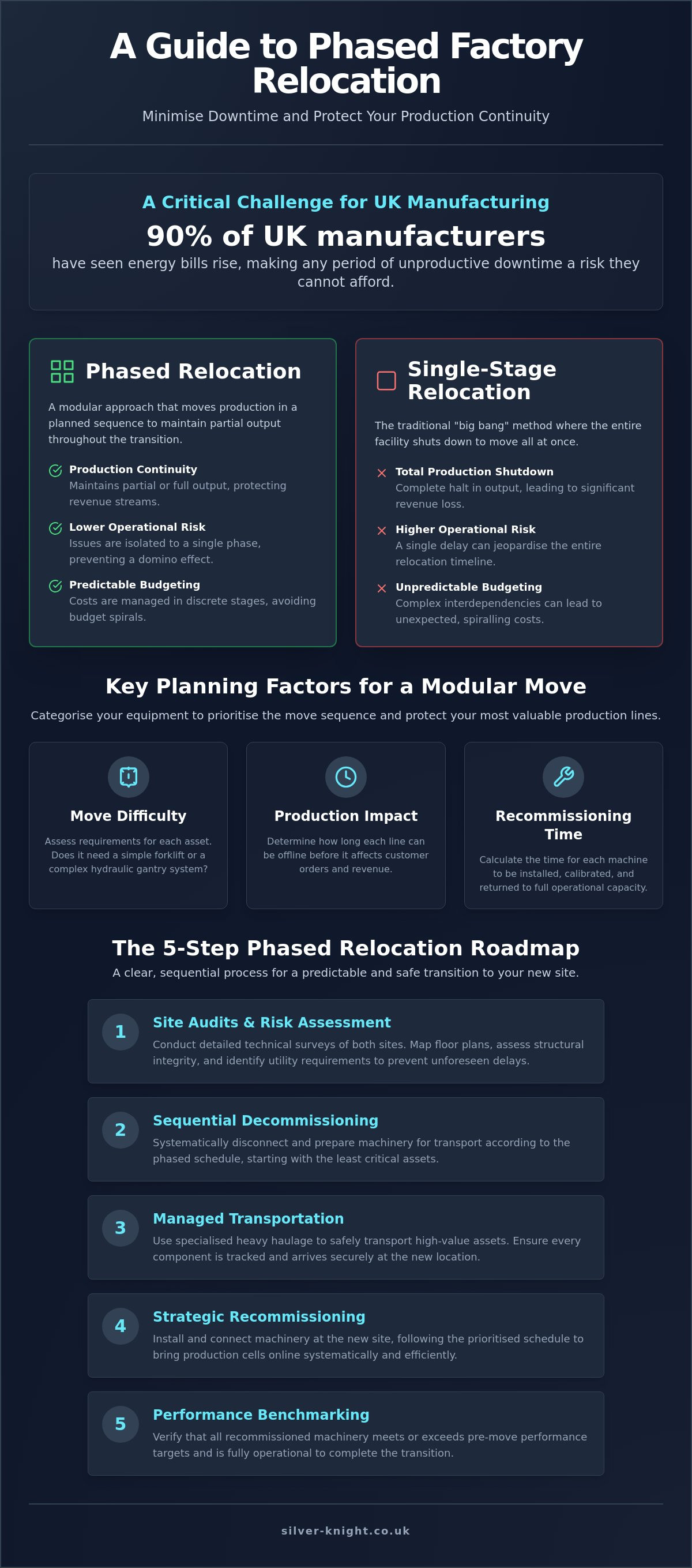
A phased factory relocation strategy is a methodical approach where you move production cells or specific departments in a calculated sequence. This contrasts sharply with the traditional big bang method, where an entire facility shuts down to move everything at once. By breaking the process into manageable modules, you maintain partial output throughout the transition. This is particularly relevant when considering the broader context of business process relocation, where physical restructuring must not compromise your market presence.
To better understand how logistics and floor planning intersect during a move, watch this helpful video below.
Your move shouldn't happen in a vacuum. It must align with your wider supply chain strategy to prevent stockouts. One essential tactic is building up buffer stock before the first phase begins. This inventory acts as a safety net whilst your primary machines are in transit or being recommissioned. It is about ensuring your customers never feel the impact of your internal changes. With the UK manufacturing sector accounting for 8.5% of total economic output in early 2026, maintaining production continuity is a national priority as much as a business one.
Defining modular relocation phases
Effective planning starts by dividing your facility into logical production units. You need to identify the critical path for each product line to understand which machines must be operational first. Categorise your equipment by the following factors:
- Move difficulty: Does it require hydraulic gantry systems or simple forklift hire?
- Production impact: How long can this specific line be offline before it affects orders?
- Recommissioning time: How long does the machine take to reach full calibration?
This categorisation helps you prioritise the sequence of the move to protect your most profitable lines first. You don't want your most critical CNC machine sitting on a trailer whilst your assembly line is ready and waiting.
Aligning move schedules with business objectives
Your relocation timeline has to match your customer demand cycles. Don't plan a heavy move during your peak season. You should integrate this technical guide to industrial removals into your early planning stages to understand the engineering requirements. Setting clear KPIs for downtime limits per phase is also vital. If a production cell is scheduled for a three day stop, your logistics team must stick to that window. A successful phased factory relocation strategy relies on these tight deadlines to prevent a domino effect across the rest of the factory.
Partnering with a professional industrial moving company allows you to identify hidden risks before they become expensive problems on moving day.
Detailed site audits and technical risk assessments
Before any heavy haulage begins, you must conduct a deep audit of your current assets. A phased factory relocation strategy relies on accurate data to avoid bottlenecks. You need to map out your existing floor plan against the layout of your new facility. This isn't just about where machines sit; it's about how they interact and the flow of materials between cells. Assessing the structural integrity of both sites is crucial. You must know if the floor can handle the concentrated load of your heaviest CNC machines or the pressure from hydraulic gantry systems. This level of planning is even more important as the UK corporate re-domiciliation regime makes it simpler for firms to move operations into Britain. The technical site survey is the primary tool for preventing unforeseen installation delays.
Machinery condition and decommissioning audits
You should document the current performance of every machine before anyone touches a bolt. Record cycle times, precision levels, and any existing quirks. Utilising machinery dismantle services during this stage helps you identify potential points of failure that might cause trouble during transit. It is a good time to verify that all technical manuals and service records are up to date. Having this paperwork ready prevents confusion when it's time to put things back together. If a machine has a specific vibration profile or cooling requirement, you need that data now.
Infrastructure and utility mapping
The new site must be ready to receive the load. Identify the exact power, pneumatic, and fluid requirements for every production cell. Many manufacturers in 2026 are facing high energy costs, with average electricity prices reaching 17.47 pence per kWh in Q1. Proper mapping ensures you don't waste energy on inefficient layouts or redundant piping. Check for restricted access points like low ceilings or narrow doorways. These might require specialised lifting gear like Versa-Lifts or Jack and Slide systems. Finally, plan for the safe disposal of industrial waste during the decommissioning phase to stay compliant with environmental regulations. This prevents delays and keeps your site clean.
If you need help identifying these risks, you can speak with our technical team today for expert advice on your specific site requirements.
Securing the help of a team experienced in expert factory plant relocation ensures your business remains operational throughout the transition.
Evaluating the benefits of phased versus one off moves
Choosing between a phased move and a single event relocation is a balance of risk and resources. A one off move might seem faster, but it creates a single point of failure. If a critical machine is damaged or the new site's power supply fails, your entire output stops. A phased factory relocation strategy acts as a safety valve for your business. By moving in stages, you ensure that at least part of your facility is always generating revenue. This is a vital consideration when the manufacturing sector accounts for 8.5% of total UK economic output in 2026. You can't afford a total shutdown whilst your competitors continue to trade.
The financial impact of this choice is also significant. Running parallel sites means you will temporarily face double overheads for utilities and rent. Since nearly nine in ten manufacturers reported an increase in business rates from April 2026, these costs must be managed carefully. However, the cost of total production failure is almost always higher than these temporary expenses. You should consult this industrial plant relocation guide to understand how to balance these operational costs against the long term benefits of a secure transition. Protecting your workforce morale is another factor. A gradual move is often less stressful for staff than a chaotic weekend shift to a new location.
Production continuity and risk mitigation
A phased approach serves as an insurance policy. It allows you to test the infrastructure of your new facility with a single production line before committing the rest of your assets. If you discover a problem with the floor load capacity or the pneumatic lines, you can fix it whilst the rest of your factory is still running at the old site. This reduces the pressure on your project managers. In April 2026, UK manufacturing output rose by 0.4%, and maintaining that momentum requires a move that doesn't cause a massive production lag. Testing a single module first gives you the data you need to ensure the rest of the move goes smoothly.
Resource allocation and project management
Spreading the relocation over several weeks or months allows for a more precise technical focus. Your engineers don't have to worry about fifty machines at once. They can concentrate on the decommissioning and recommissioning of one specific cell. This reduces the chance of errors during the technical setup. Managing the logistics of moving staff is also easier when done in stages. You can transition teams alongside their specific machinery, ensuring they are ready to work as soon as the line is live. This modular approach keeps your internal teams focused and prevents the burnout that often follows a high pressure, single event move.
If you are looking for reliable machinery haulage and transport solutions, our team provides the expert support needed for complex industrial transitions.
Managing the sequential move of production lines
Executing a phased factory relocation strategy requires precise timing and coordination. You start by disconnecting the first production cell whilst the rest of your facility continues to operate at full capacity. This modular approach means your specialised lifting equipment must be on site and ready for immediate use. You don't want a heavy machine sitting in a gangway whilst you wait for a crane or a Versa-Lift to arrive. Effective coordination prevents bottlenecks and ensures the move stays on schedule.
Once a line is decommissioned, the transport phase begins in earnest. Secure packing is essential for high value CNC machines and sensitive electronics to prevent vibration damage. You should use real time tracking for every load to ensure you know exactly where your assets are at all times. This visibility allows the engineering team at the new facility to prepare for reinstallation and commissioning the moment the haulage arrives. By managing the move in these distinct stages, you maintain control over the entire process and reduce the risk of total production lag.
Utilising specialised lifting equipment
Moving heavy machinery in restricted factory spaces requires more than just a standard forklift. Hydraulic gantry systems are excellent for lifting heavy loads where overhead space is limited. You should also consider jack and slide systems for moving heavy CNC machinery across factory floors with precision. Versa-Lifts provide the necessary capacity for internal factory moves, offering a compact footprint with high lifting power. These tools ensure your assets are moved safely without damaging the building structure or the machines themselves.
Logistics and heavy haulage coordination
Route planning is a critical step for oversized loads to avoid height restrictions or roadworks that could cause costly delays. You must coordinate closely with haulage partners to ensure a seamless flow of assets between sites. If the new facility isn't quite ready for every machine, you might need to manage the temporary storage of assets in a secure warehouse. This keeps the new site organised and allows for a logical installation sequence. Proper logistics management ensures that every piece of equipment arrives in the correct order for reassembly.
Technical decommissioning protocols
The decommissioning protocol is the systematic shutdown and labelling of all mechanical and electrical connections. You must follow a strict checklist for fluid drainage and internal component securing to prevent leaks or damage during transit. It's vital to ensure all safety systems are locked out and tagged out according to UK standards. This protects your staff and ensures the machine is ready for a clean recommissioning at the new location. Taking the time to label every cable and pipe now will save days of work during the reinstallation phase.
To ensure your production lines are moved with absolute precision, you can contact our specialist team to discuss your relocation schedule.
When you work with a specialist like Silver Knight Haulage and Machineries, you ensure that every technical detail of your reinstallation is handled by experts.
Strategic commissioning and post move support
The final phase of your phased factory relocation strategy is where your planning pays off. Once the heavy lifting is finished, the focus shifts to bringing your production back to full capacity. You must verify that every machine meets its pre move performance benchmarks to avoid any drop in quality or output. This is where the value of a partner with 180 years of collective industry experience becomes clear. Their deep technical knowledge ensures that your recommissioning is not just a restart, but an optimisation of your entire workflow. You should also provide staff training on any new facility layouts or safety protocols to ensure a smooth transition for your team.
Conducting a post project review is a vital step before you close the project. This allows you to identify lessons learned from the first modules and apply them to any future phases of your relocation. It is also the time to celebrate the safe transfer of your high value assets. By following a modular approach, you have protected your production continuity whilst others might have faced weeks of silence. This strategic oversight ensures that your business remains competitive in a challenging economic environment.
Recommissioning and performance verification
Leveling and alignment must follow precision engineering standards to prevent premature wear on your machinery. You shouldn't settle for close enough when it comes to high value CNC equipment. Perform rigorous test runs on the first batch of products to confirm that calibration is perfect and matches your historical data. Integrating professional factory relocation services for this final sign off provides an extra layer of security for your stakeholders. It confirms that the line is not only moving but performing at its peak.
Ongoing facility management and optimisation
Review your utility consumption immediately after the machines are live. In a year where energy costs are a major concern for 90% of manufacturers, your new layout should be as efficient as possible. Look for ways to reduce waste in your workflow and establish a new maintenance schedule that accounts for the specific conditions of the new site. Finally, ensure all health and safety documentation is updated for the new premises. This includes new fire exit routes, updated risk assessments for the floor layout, and ensuring all lockout procedures are clearly displayed for the staff.
If you are ready to begin your next project, working with a specialist in machinery moving ensures that your transition is handled with the highest level of technical skill.
Securing your manufacturing future through modular planning
A successful transition to a new facility doesn't have to mean a total production shutdown. By adopting a phased factory relocation strategy, you can protect your output whilst ensuring every piece of machinery is moved with absolute precision. We've seen how detailed site audits and sequential moves allow you to manage technical risks and stay within your budget. This modular approach turns a complex logistics challenge into a manageable production exercise.
Silver Knight provides the expertise needed to execute these moves safely. Our team offers over 180 years of collective industry experience and uses specialised equipment like hydraulic gantries and Versa-Lifts for even the most restricted spaces. We provide a comprehensive nationwide and international service that prioritises your production continuity above all else. You don't have to navigate the complexities of a factory move alone.
Contact our expert machinery movers for a technical site survey to start planning your 2026 relocation with confidence. We are ready to help you move your business forward.
Frequently Asked Questions
What is a phased factory relocation strategy?
A phased factory relocation strategy is a method of moving industrial operations in distinct stages or modules rather than all at once. This allows a business to maintain a level of production at either the old or new site throughout the duration of the move. By moving one production line or cell at a time, companies can mitigate the risk of total operational downtime and manage resources more effectively.
How long does a phased factory move typically take?
The duration of a phased move depends entirely on the scale of the facility and the number of production lines involved. A small workshop might complete a phased move in two weeks, whilst a large scale manufacturing plant could take several months. The key is to build a schedule that aligns with production cycles and allows for thorough commissioning at each stage to prevent cumulative delays.
Is a phased relocation strategy more expensive than a single move?
Whilst a phased move may involve higher logistics costs due to multiple transport events and the potential for dual overheads, it often proves more cost effective in the long term. The primary saving comes from the prevention of production downtime and the protection of customer contracts. A single event move that goes wrong can result in catastrophic financial losses that far outweigh the costs of a managed phased factory relocation strategy.
Can you move heavy machinery whilst the rest of the factory is operational?
You can move heavy machinery whilst the rest of the factory is operational, provided that a strict health and safety plan is in place. Specialised machinery movers use equipment like hydraulic gantries and jack and slide systems to move heavy loads with minimal disruption to surrounding operations. Clear exclusion zones and out of hours working can further ensure that production continues safely whilst assets are being relocated.
What are the main risks associated with a phased factory move?
The main risks include the complexity of managing two sites simultaneously, potential communication breakdowns between teams, and the challenge of maintaining a cohesive supply chain. There is also the risk of move fatigue amongst staff. These risks are best managed through a dedicated project management team and clear, transparent communication across the entire organisation to ensure everyone understands their role in the transition.
How do you decide which production lines to move first?
The order of movement is usually determined by production priority and machine dependency. Often, it is best to move the least critical lines first to test the new facility and the relocation process. Alternatively, some businesses choose to move their most modern, reliable equipment first to establish a high quality production base at the new site as quickly as possible. This decision depends on your specific business goals.

Article by
David Ashby
I'm the Managing Director of Silver Knight Haulage & Machinery Ltd. Silver Knight Ltd is a family-run firm established in the West Midlands in 2005, with the aim of providing a cost-effective, yet professional, service to businesses for the removal, transportation, and installation of machinery, plant, and equipment here in the UK and worldwide. Between us, the Silver Knight workforce has over 50 years of experience with machinery and its operation.
Disclaimer
This article is intended for informational purposes only. Please ensure you seek expert advice or carry out your own research to confirm the information is suitable for your specific needs.