What if a factory relocation could actually improve your long-term efficiency instead of draining your bank account through weeks of lost production? Understanding how to minimise downtime during a factory move is the biggest challenge for any plant manager who needs to keep their revenue flowing. It's a stressful time. You're juggling the risk of machinery damage with the pressure of coordinating multiple contractors and meeting strict safety standards.
This guide explains exactly how to coordinate technical decommissioning, specialised lifting, and rapid installation to protect your production schedule. You'll learn how to protect your assets whilst ensuring your machinery is restored to full capacity quickly. We'll also cover how to stay compliant with 2026 safety standards, such as the latest OSHA penalties of up to $16,550 per violation and the updated ANSI ACE 35-2026 crane regulations. By the end of this article, you'll have a clear roadmap for a seamless transition that keeps your costs predictable and your site safe.
Key Takeaways
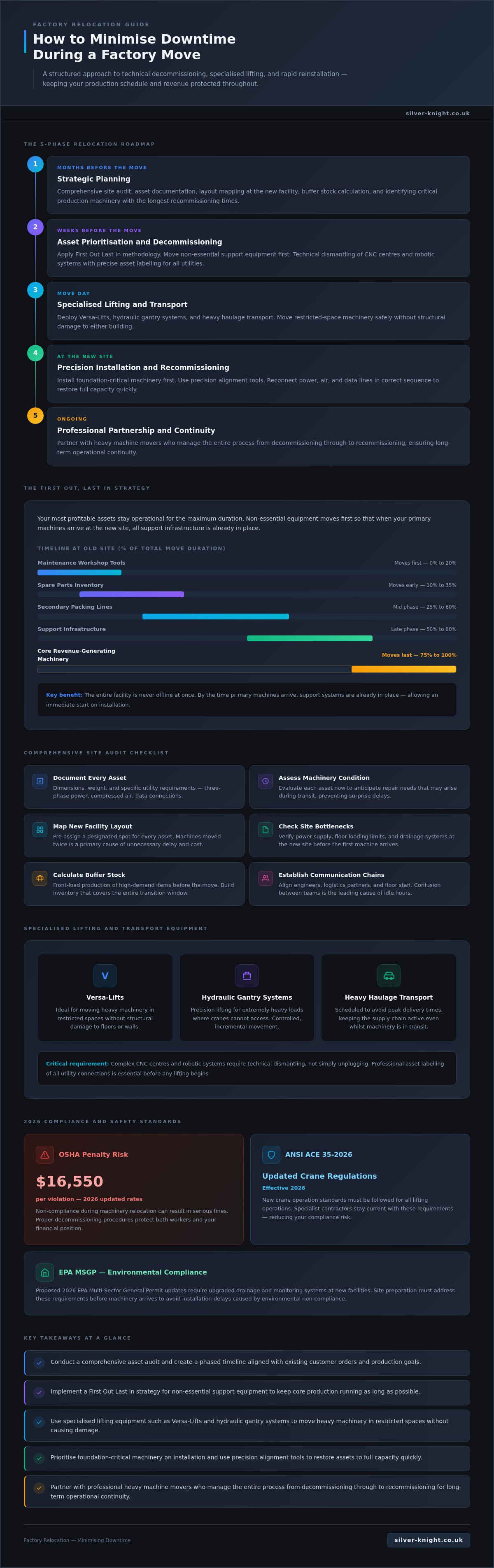
- Conduct a comprehensive asset audit and create a phased timeline to align your relocation with existing customer orders and production goals.
- Master how to minimise downtime during a factory move by implementing a first out last in strategy for non-essential support equipment.
- Utilise specialised lifting equipment such as Versa-Lifts and hydraulic gantry systems to move heavy machinery in restricted spaces without damaging the building.
- Prioritise the installation of foundation-critical machinery and use precision alignment tools to ensure your assets are restored to full capacity quickly.
- Secure long term operational continuity by partnering with professional heavy machine movers who manage the entire process from decommissioning to recommissioning.
Professional factory relocation support can make the difference between a chaotic move and a structured transition.
Strategic Planning to Prevent Operational Delays
Success starts months before the first machine is unplugged. When you are researching how to minimise downtime during a factory move, the focus often lands on transport, but the real gains are made in the boardroom. A well-structured strategy ensures that your production line remains active for as long as possible whilst the new site is prepared. It's a complex task that requires synchronising your internal engineering teams with external specialists.
To better understand this concept, watch this helpful video:
You must identify your critical production machinery early. These are the assets that generate the most revenue or have the longest recommissioning times. By establishing a clear communication chain amongst your engineers, logistics partners, and floor staff, you can avoid the confusion that leads to idle hours. You should also check the new facility for potential bottlenecks, such as insufficient power supply or floor loading limits that might delay the installation of heavy units. Addressing these site issues in 2026 is vital, especially with stricter environmental regulations like the proposed EPA MSGP requiring updated drainage and monitoring systems.
Conducting a Comprehensive Site Audit
A successful move relies on data. You should document every piece of equipment, including its dimensions, weight, and specific utility requirements such as three-phase power or compressed air. Evaluate the condition of your machinery now to anticipate any repair needs that might arise during transit. By mapping the layout of the new facility in advance, you ensure that every asset has a designated spot the moment it arrives off the trailer. This prevents machines from being moved twice, which is a common cause of unnecessary delays.
Managing Buffer Stock and Production Schedules
The most effective way to protect your revenue is to manage your inventory levels before the move begins. Calculate how much stock you need to maintain supply whilst the factory is in transit. Many businesses fail because they don't front-load production of high-demand items. You should organise your production runs to build a significant buffer. This allows you to stop production at the old site without disappointing customers. Coordinate with your logistics partners to ensure that heavy haulage transport does not clash with peak delivery times, keeping your supply chain moving even as the machines are being lifted.
Engaging an experienced team for factory relocation ensures every piece of equipment is handled with technical precision.
Asset Prioritisation and Technical Decommissioning Strategies
Moving a production line is about more than just transport. It requires a clinical approach to disconnecting power, air, and data lines. If you want to know how to minimise downtime during a factory move, you must master the sequence of decommissioning. Taking the wrong machine offline too early can halt your entire output, leading to the revenue loss you planned to avoid. A structured approach ensures that the heart of your operation continues to beat whilst the periphery is transitioned to the new site.
The First Out Last In Methodology
This strategy ensures your most profitable assets remain operational for the maximum duration. You should start by moving non-essential support equipment, such as maintenance workshop tools, spare parts inventory, and secondary packing lines. These items are the "first out" of the old facility and the "last in" to the new one. This keeps the core of your factory running whilst the new site is populated with the necessary infrastructure. By the time your primary machines arrive, the support systems are already in place to receive them, allowing for an immediate start on installation. This phased approach prevents the entire facility from being offline at once.
Technical Dismantling and Asset Labelling
Complex CNC centres and robotic systems cannot simply be unplugged. You should utilise professional machinery dismantle services to ensure that every mechanical and electrical connection is safely severed. Meticulous labelling is the secret to a fast restart. Use a colour coded system for all wiring and pneumatic hoses. This prevents errors during the high pressure reassembly phase. You should also refer to detailed schematics to guide the dismantling of complex systems, ensuring that sensitive electronic components are protected from static or physical shock during the process.
Taking photographs at every stage of the teardown provides a visual manual for your engineers later. You must also ensure that all hydraulic fluids and coolants are drained and disposed of according to environmental standards. With OSHA penalties in 2026 reaching $16,550 per serious violation, handling hazardous materials correctly is a matter of financial survival as well as safety. For expert support with your technical decommissioning needs, you can explore our comprehensive factory relocation service to keep your project on track.
To ensure your project stays on schedule, consider a professional machinery moving partner with the right technical resources.
Leveraging Specialised Equipment for Efficient Machinery Transport
Using standard forklifts for heavy industrial assets is often impossible. If you want to understand how to minimise downtime during a factory move, you must look at the technology used to shift the loads. Conventional methods often require you to dismantle walls or raise roof sections to fit large cranes. This adds days or even weeks to your timeline. By using equipment designed for the industrial environment, you can keep the building intact and move machines through existing access points. This approach keeps your facility secure and significantly reduces the time spent on site preparation.
Versa Lift and Gantry Systems for Restricted Spaces
Versa-Lifts are essential for modern factory moves. These machines feature an extendable wheelbase that allows them to carry significant weight whilst remaining compact enough to navigate tight aisles. They provide the lifting capacity of a large crane but with the footprint of a standard forklift. This means you can move heavy presses or CNC machines through the factory without removing other production lines. For taller or more sensitive assets, hydraulic gantry systems offer unmatched stability. These systems can be erected around a machine to provide a controlled, vertical lift. This precision is vital for protecting delicate internal components and ensures that you don't need to clear the entire factory floor just to move one piece of equipment.
Jack and Slide Systems for Massive Loads
When you encounter massive loads in areas with low overhead clearance, jack and slide systems are the most efficient solution. Instead of trying to lift a machine high into the air, which carries significant risk, these systems slide the asset along a guided track. This method is particularly useful in 2026 as factories become more densely packed with automated systems. It eliminates the need for complex crane setups inside buildings, which often require extensive structural checks and long setup times. By sliding machinery into position, you reduce the risk of accidents and speed up the transition to the installation phase. Choosing a partner with a diverse fleet of specialist equipment means you always have the right tool for the job, regardless of site constraints. This versatility is a key factor in keeping your relocation costs predictable and your timeline short.
Professional machinery movers ensure that your assets are returned to full production capacity without delay.
Precision Installation and Rapid Recommissioning Protocols
Once the assets arrive at the new facility, the clock is still ticking. If you've been wondering how to minimise downtime during a factory move, the installation phase is where you win or lose the race. It's not just about putting machines on the floor. It's about ensuring they are perfectly positioned to integrate with the rest of the facility. You should prioritise foundation-critical machinery first. These are the heavy units that dictate the flow of the entire line. By getting these in place early, you allow secondary equipment to be installed around them without obstruction. This prevents the bottleneck of trying to move large assets past smaller ones later in the week.
Precision Alignment and Levelling Techniques
High precision industrial machinery requires more than just a visual check. Even a fraction of a millimetre out of level can lead to premature wear or product defects. You should use precision levelling tools to ensure each asset is perfectly balanced on its new floor. For long production lines and conveyors, laser alignment tools are essential to maintain a straight path over several metres. This level of detail prevents the teething problems that often plague new factory setups. Proper alignment is a core part of professional machinery installation and protects your long term investment. Engineers must check the floor for any settling after the machine is bolted down, as the weight of industrial gear can sometimes cause minor shifts in the first 24 hours.
Safety Compliance and Final Testing
Speed should never come at the expense of safety. Before you resume full production, you must carry out systematic testing. This involves performing rigorous dry runs without raw materials. It's the best way to catch mechanical issues before they cause a costly jam. You must also verify that all safety guards and emergency stops are fully functional and meet current UK safety standards. Compliance with 2026 regulations is non-negotiable. With OSHA penalties for serious violations reaching $16,550, the financial risk of a safety oversight is high. A final walkthrough with the site manager is necessary to sign off on each asset. This ensures that every machine is not just running, but running safely and at full capacity. To ensure your team is ready for the first shift at the new site, get in touch for a technical consultation today.
For a seamless transition between sites, you can rely on the expert services provided by Silver Knight to protect your production schedule.
Professional Partnership and Long Term Continuity
Selecting the right contractor is the final piece of the puzzle. When you are looking at how to minimise downtime during a factory move, the coordination between different teams is often where time is lost. Using a single contractor for both machinery movers UK and heavy haulage simplifies the logistics chain. You won't have to worry about a transport company arriving before the lifting crew is ready or a crane waiting idle because the trucks are delayed. A comprehensive service that covers everything from initial factory clearance to final recommissioning ensures that one project manager is accountable for the entire timeline. This accountability keeps the project moving and prevents the blame shifting that can occur between multiple subcontractors. It's about creating a unified flow from the old site to the new one, where every transition is managed by a single point of contact.
A unified approach also allows for better risk management. When one team handles decommissioning, transport, and installation, they carry the knowledge of the machine's specific quirks from one site to the next. They know exactly how it was disconnected, which makes the recommissioning phase much faster. This continuity is vital for complex industrial assets that require delicate handling. In the high pressure environment of a 2026 factory move, having a partner who understands the full scope of the project reduces the likelihood of costly errors and ensures that your machinery is restored to full capacity as quickly as possible.
Choosing an Experienced Industrial Moving Partner
Experience is more than just a number. It is the ability to anticipate problems before they occur. Partnering with a company that offers over 180 years of collective industry expertise provides you with a level of foresight that newer firms cannot match. You should look for a proven track record, especially if your move involves international machinery transport. Assessing the contractor's certifications for heavy lifting and contract lifting operations is also essential for insurance and safety compliance. Many businesses prefer family run values because they lead to more personalised project management. You want a partner who treats your machinery with care, ensuring that every asset is protected throughout the journey. This includes verified compliance with the latest 2026 ANSI standards for crane operations and OSHA safety requirements.
Ongoing Support and Machinery Maintenance
The move doesn't end when the last machine is bolted down. You should establish a post move support plan to address any minor adjustments after production starts. It is common for machines to require a secondary visit to check alignment after one week of high volume operation. This ensures that the precision levels established during installation are maintained under load. If you have assets that are not immediately needed at the new site, look for a partner that provides secure machinery storage. This allows you to clear the old site on time whilst keeping your valuable equipment in a secure environment until you are ready for it. Finally, encourage a review of the entire process to improve any future relocation strategies. This final debrief helps to identify what worked well and ensures that your next move is even more efficient.
Choosing a professional team for factory relocation ensures that your transition is handled with the highest level of care.
Secure Your Production Future with a Managed Move
Mastering how to minimise downtime during a factory move requires a blend of technical precision and strategic foresight. By prioritising your most critical assets and utilising specialised equipment like Versa-Lifts and hydraulic gantry systems, you can avoid the structural delays that often stall industrial projects. A successful transition isn't just about moving machinery. It's about restoring your full production capacity with zero safety incidents.
With over 180 years of collective industry experience, Silver Knight provides the expertise needed for both nationwide UK and international machinery moving. Our team handles everything from technical decommissioning to precision installation. This ensures your move is seamless and your costs remain predictable. Contact Silver Knight for a comprehensive factory relocation quote to start planning your move today. Your next site is an opportunity for growth, and with the right partner, you can make the transition with complete confidence.
Frequently Asked Questions
How long does a typical factory move take to complete?
A move can take anywhere from three days for a simple workshop to six months for a large scale manufacturing plant. The actual physical relocation is often the shortest part of the project. Most of the time is spent in the planning and site preparation phases to ensure that the new facility is ready for a quick installation immediately upon arrival.
What are the most common causes of downtime during relocation?
The most common causes include inadequate site surveys and delayed utility connections at the new facility. If you are focused on how to minimise downtime during a factory move, you must ensure that power and compressed air lines are ready before the machinery arrives. This prevents your installation teams from standing idle whilst waiting for basic infrastructure to be completed.
Can production continue whilst some machinery is being moved?
Production can certainly continue if you use a phased relocation strategy. By moving non-essential lines first and maintaining a buffer of finished goods, you can keep your revenue flowing. This approach allows you to transition your factory in stages. It ensures that the core of your operation remains active for as long as possible before the final move.
What is the difference between decommissioning and recommissioning?
Decommissioning involves the systematic shutdown, fluid drainage, and electrical disconnection of machinery at the original site. Recommissioning is the reverse process at the new facility. It includes the precise installation, levelling, and rigorous testing required to return the asset to full production capacity. Both phases require technical expertise to ensure the machinery is not damaged during the transition.
Is specialised insurance required for moving heavy industrial equipment?
Specialised insurance is essential because standard business policies rarely cover the specific risks associated with heavy lifting and industrial transport. You should verify that your contractor has comprehensive goods in transit and public liability insurance. This protects your business from the financial impact of accidental damage or site incidents during the relocation process.
How can buffer stock help reduce the impact of a move?
Buffer stock acts as a safety net for your supply chain whilst your lines are offline. By increasing your production runs in the weeks leading up to the move, you can build up enough inventory to satisfy customer demand during the transition. This prevents a temporary halt in production from becoming a permanent loss of market share or customer trust.
What role does a technical site survey play in reducing delays?
A technical site survey identifies potential obstacles like low doorways, weak floors, or insufficient power supplies at the new location. Identifying these issues early allows you to make structural adjustments before the machines arrive. This prevents the costly delays that occur when a heavy asset cannot be moved into its designated position due to unforeseen site constraints.
Should I use my own maintenance team or a professional moving company?
Whilst your internal team understands the machinery, a professional moving company has the specialised lifting equipment and experience needed for safe transit. Using professionals reduces the risk of workplace injuries and equipment damage. The most efficient moves usually involve a partnership where your engineers guide the technical setup whilst the movers manage the heavy lifting and haulage.

Article by
David Ashby
I'm the Managing Director of Silver Knight Haulage & Machinery Ltd. Silver Knight Ltd is a family-run firm established in the West Midlands in 2005, with the aim of providing a cost-effective, yet professional, service to businesses for the removal, transportation, and installation of machinery, plant, and equipment here in the UK and worldwide. Between us, the Silver Knight workforce has over 50 years of experience with machinery and its operation.
Disclaimer
This article is intended for informational purposes only. Please ensure you seek expert advice or carry out your own research to confirm the information is suitable for your specific needs.