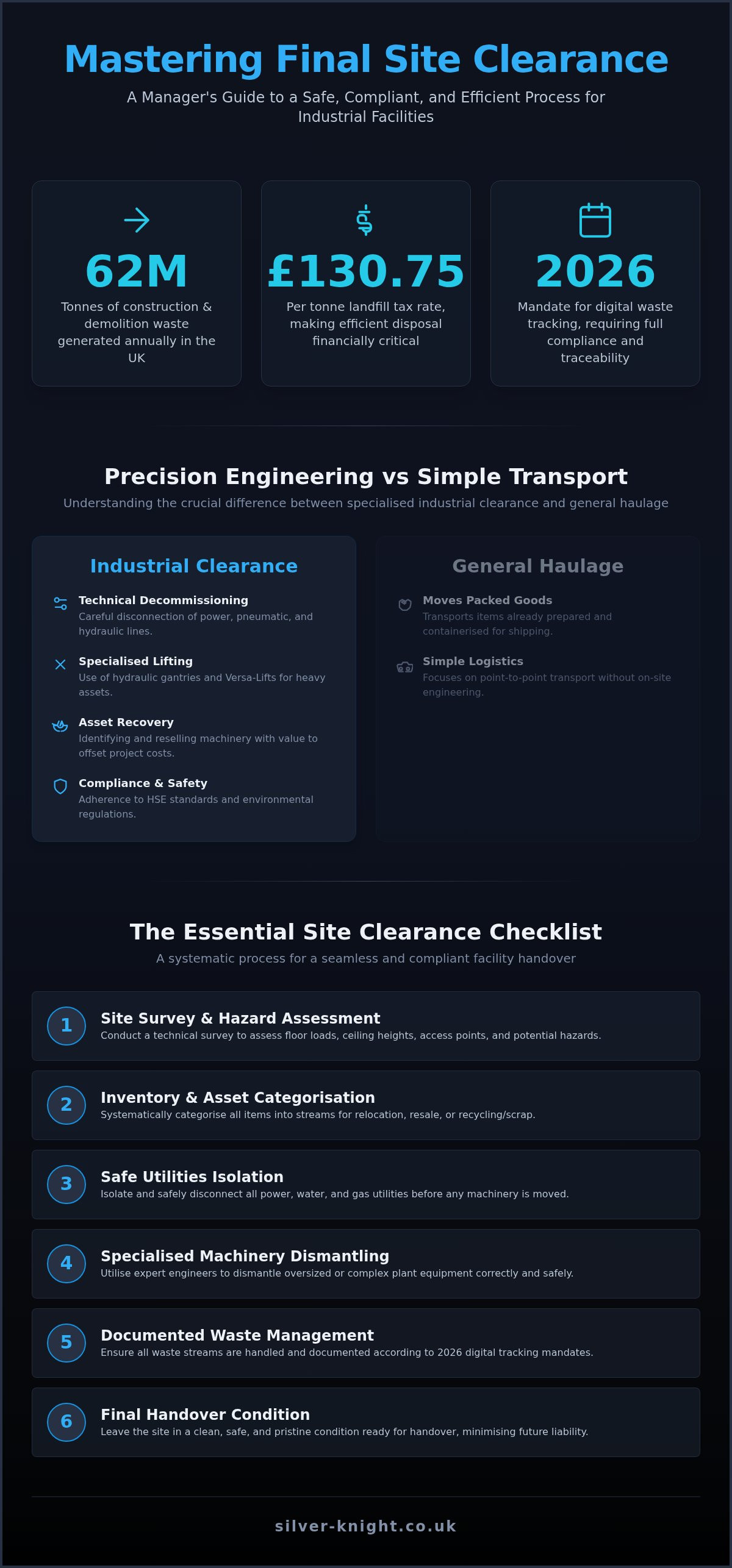
Did you know that the UK generates 62 million tonnes of construction and demolition waste every year, making it our largest waste stream? Closing an industrial facility or relocating operations is often the most stressful phase a manager will face, especially when you're tasked with a complex final site clearance. You're likely feeling the pressure of meeting the 2026 digital waste tracking mandates whilst worrying about the spiralling costs of removing redundant plant machinery. It's a daunting task that requires more than just a skip; it demands precision and specialised expertise.
We agree that the fear of missing a critical regulatory step or the sheer cost of moving heavy assets can make the process feel overwhelming. This article promises to help you master these complexities with an expert checklist for a safe and efficient project. We will walk you through the essential steps for managing heavy asset removal, navigating the latest £130.75 per tonne landfill tax rates, and ensuring your site is handed over in a compliant, pristine condition.
Key Takeaways
- Learn how to define the scope of a professional final site clearance to distinguish precision engineering tasks from simple waste disposal.
- Follow a systematic checklist to manage the decommissioning and removal of heavy plant equipment without missing critical handover steps.
- Stay compliant with the latest 2026 digital waste tracking mandates and HSE standards to protect your business from legal liability.
- Identify the specialised lifting technology, such as hydraulic gantry systems and Versa-Lifts, required for the safe relocation of complex industrial assets.
- Understand the essential criteria for selecting an expert partner capable of conducting technical site surveys and managing nationwide clearances.
Before you begin the decommissioning process, ensure you have the right experts on hand. You can find out more about our nationwide services at Silver Knight's UK factory clearance service.
Defining the Scope of Final Site Clearance for Industrial Facilities
A final site clearance represents the concluding phase of an industrial facility's lifecycle. It's often triggered by factory relocations, business closures, or the termination of a commercial lease. For facility managers, the primary goals are to achieve a clean site ready for handover whilst minimising any ongoing liability. Industrial clearance is the systematic removal of all assets, machinery, and waste from a facility to return it to a neutral state.
This process differs significantly from construction or general commercial waste removal because of the technical complexity involved. You aren't just dealing with office furniture or building rubble. You're managing heavy plant, production lines, and potentially hazardous substances. Every item must be accounted for under the latest 2026 digital waste tracking mandates, ensuring that the transition from an active site to a vacant shell is legally compliant and physically safe.
Distinguishing Industrial Clearance from General Haulage
Standard haulage companies move goods that are already packed and ready for transport. In contrast, a professional clearance requires deep technical knowledge of machinery moving and decommissioning. You can't simply drag a five-tonne lathe out of a building; it requires careful disconnection from power and pneumatic lines. Professional teams use specialised equipment like hydraulic gantry systems to lift heavy assets without damaging the building's infrastructure or the floor slab.
Asset recovery is another vital component. Not every piece of equipment is destined for the scrap heap. Experts can identify machinery with resale value, helping to offset the total project cost. However, for materials that cannot be repurposed, understanding Environmental Remediation Explained is essential. This ensures that any ground contamination or chemical residues are handled according to UK environmental standards, protecting you from future environmental claims.
Planning the Timeline for Your Site Closure
Timing is everything when coordinating a site closure. The duration of a project depends on the size of the facility, the density of the machinery, and the presence of any hazardous materials. Rushing the process often leads to safety breaches or missed regulatory steps. It's best to align your clearance schedule with your lease termination dates to avoid costly holding over penalties from your landlord.
A technical site survey is the essential first step in any timeline. This survey allows engineers to assess floor loads, ceiling heights, and access points. It ensures that the right lifting gear is booked and that any logistical bottlenecks are identified before the work starts. Without this initial assessment, you risk delays that could push your handover date back by weeks, leading to unnecessary rental costs.
Managing the transition from an active facility to an empty shell requires a meticulous strategy. For those overseeing large scale transitions, Silver Knight's factory clearance service provides the technical expertise needed to manage every asset safely.
The Essential Final Site Clearance Checklist for Industrial Assets
A successful final site clearance is not merely about emptying a building; it's about protecting the value of your assets whilst meeting strict legal obligations. You must begin by categorising every item into three streams: assets for relocation, items for resale, and materials for scrap or recycling. This systematic approach ensures that you don't accidentally dispose of high value components or fail to document hazardous materials. Planning for site reuse often involves understanding the standards for EPA Brownfields Cleanup, which provides a useful framework for managing industrial sites safely during a handover.
- Perform a comprehensive site survey and hazard assessment.
- Inventory all machinery and categorise by disposal method.
- Isolate and safely disconnect all power, water, and gas utilities.
- Utilise a specialised machinery dismantle service for oversized production lines.
- Record all waste movements in the mandatory 2026 digital waste tracking system.
- Conduct a final sweep to ensure the premises are left in a broom clean state.
Machinery Decommissioning and Heavy Lifting
Safe disconnection is the most critical part of the decommissioning phase. You must ensure that all residual energy is bled from hydraulic lines and that electrical circuits are locked out before any movement begins. Documenting the condition of your assets prior to removal is vital, especially if they are destined for relocation or resale. This evidence protects you against claims of damage during transit. Executing a final site clearance requires a focus on detail that general hauliers simply cannot provide. For complex moves, engineers will often use jack and slide systems to navigate heavy plant through tight factory exits without compromising the structural integrity of the building.
Dealing with Redundant Plant and Equipment
Identifying equipment with resale value can significantly offset the costs of your project. High grade scrap metal or functioning CNC machines often have a ready market, provided they are removed without damage. However, you must also manage the logistics of removing fixed infrastructure like mezzanines, racking, and overhead ducting. Once the heavy assets are gone, the focus shifts to the final sweep. Leaving the site in a broom clean state is typically a requirement of most UK commercial leases, and failing to do so can result in significant dilapidation charges. If you're unsure where to start with your inventory, our team can provide a professional assessment of your site.
Ensuring safety during complex moves is paramount to protecting your staff and your business assets. You can learn more about our rigorous safety protocols at Silver Knight’s heavy equipment moving service.
Safety and Compliance Requirements During Final Site Clearance
Adhering to strict safety standards is not just a best practice; it is a legal necessity. In the UK, the Health and Safety Executive (HSE) provides the framework for managing industrial risks, but the specific requirements for a final site clearance go much deeper. You must account for the Construction (Design and Management) Regulations 2015, even during decommissioning phases. Compliance with these regulations and the new 2026 digital waste tracking mandates is the facility manager's primary safeguard against personal and corporate liability.
Environmental responsibilities are equally critical. Industrial facilities often house legacy fluids, such as hydraulic oils, coolants, and chemicals, that require specialised handling. Whilst UK firms follow domestic legislation, looking at international benchmarks like OSHA construction safety standards highlights the global importance of rigorous safety controls during site work. Every drop of hazardous fluid must be documented and disposed of via licensed contractors to avoid heavy fines or environmental damage claims.
Risk Assessments and Technical Site Surveys
Every heavy lift or machinery relocation requires a bespoke Risk Assessment and Method Statement (RAMS). These documents aren't just paperwork; they are the blueprint for a safe operation. A technical site survey identifies hidden dangers such as restricted access points, weak floor slabs, or overhead obstructions that could lead to accidents. Qualified project managers use these surveys to choose the right gear, like hydraulic gantries or Versa-Lifts, ensuring the load remains stable throughout the move. This proactive approach prevents the physical injuries and asset damage that often occur when teams attempt to "make do" with standard equipment.
Environmental Regulations and Waste Documentation
The landscape of waste management changed significantly in October 2026 with the introduction of mandatory digital waste tracking. Every movement of material off-site must now be recorded in real-time. This provides a clear audit trail that proves your business has met its duty of care. With the standard rate for landfill tax now at £130.75 per tonne, there's also a strong financial incentive to separate waste streams accurately. Hazardous materials, which can cost between £40 and £600 per tonne to dispose of, must be handled with extreme care. Maintaining a precise record of Waste Transfer Notes and Hazardous Waste Consignment Notes is the only way to ensure your final handover is legally watertight.
To see the advanced machinery we use to tackle these challenges, visit Silver Knight’s specialised lifting equipment page.
Logistics and Specialised Equipment for Complex Site Moves
Many facility managers mistakenly believe that a standard haulage firm can handle a final site clearance. This assumption often leads to delays, damage, or safety incidents. General hauliers typically possess the trucks to move goods but lack the precision engineering tools required to extract them from a factory floor. A professional clearance involves navigating narrow aisles, low ceilings, and fragile floor surfaces whilst handling assets that weigh dozens of tonnes. Advanced lifting technology is the backbone of any industrial decommissioning project. Unlike standard construction plant, which is often too bulky for indoor work, industrial movers use compact yet powerful systems. For a deeper look at these technologies, consult our guide to specialised lifting systems. These tools allow for the safe removal of production lines without disrupting the structural integrity of the premises you are vacating.
Specialised Lifting Equipment for Restricted Access
When access is restricted, standard cranes are useless. Versa-Lift hire is a game changer for indoor clearances. These machines feature a telescoping frame and a high capacity winch, allowing them to lift heavy loads whilst maintaining a small footprint that fits through standard factory doors. For even heavier assets in confined spaces, hydraulic gantry systems provide a stable overhead lift. They work within the height limits of a factory ceiling, offering a safer alternative to mobile cranes. If a machine is too large for any lift, jack and slide systems are the answer. Engineers use these to move massive units along a temporary rail, sliding them out of the building with millimetre precision. This method is particularly effective for protecting sensitive floor finishes.
Heavy Haulage and Transport Logistics
Once the machinery is outside, the logistics shift to heavy haulage. Transporting oversized industrial loads requires more than just a flatbed truck. You need low loaders and specialised trailers designed to distribute weight evenly and clear low bridges. Route planning is also vital. In the UK, moving wide or heavy loads often requires notifying the police and local authorities. Managing these transport requirements is a core part of the final site clearance process, ensuring that assets reach their next destination or disposal site safely. If your project is particularly complex, you might consider a heavy moving equipment hire service to supplement your on-site capabilities. Our team manages the entire process, from the first lift to the final delivery.
If you need help planning the logistics of your move, book a technical site survey with our team.
Choosing the right team is the final hurdle in your decommissioning journey. You can start your project on the right foot by visiting Silver Knight's machinery moving homepage.
Selecting a Partner for Professional Final Site Clearance
Choosing an industrial clearance contractor requires more than just checking a price list. You need a partner who understands the high stakes of a final site clearance, from the financial implications of asset recovery to the legal requirements of environmental compliance. A professional partner should offer technical site surveys as standard and possess the specialised equipment necessary to protect both your machinery and the building itself. Selecting a team with nationwide expertise ensures that no matter where your facilities are located, the same high standards of safety and efficiency are applied to every move.
Protecting Your Property and Asset Integrity
One of the biggest risks during a move is damage to the building fabric. Scuffed floors, broken doorways, or structural damage can lead to massive dilapidation claims from landlords. Professional machinery movers use floor protection and precision lifting gear to ensure the premises remain in the condition required by your lease. Beyond the building, careful decommissioning protects the resale value of your equipment. A machine that is dismantled with surgical precision by experts is worth significantly more on the secondary market than one that has been roughly handled. This careful approach ensures a clean handover and prevents costly disputes that could delay your exit from the site. By prioritising asset integrity, you turn a potential liability into a financial recovery opportunity.
The Advantage of 180 Years of Collective Expertise
Experience is the only real safeguard in a high risk industry. Silver Knight is a family run business established in 1996, but our team brings over 180 years of collective industry experience to every project. This depth of knowledge is particularly valuable when managing contract lifting operations, where every variable must be controlled. We handle the technical planning, the specialised labour, and the heavy lifting, providing you with complete peace of mind. Whether you are relocating a single production line or managing a nationwide facility closure, our expertise ensures the job is done right the first time. We encourage you to reach out for a technical consultation to discuss your specific requirements and see how we can streamline your next project.
For a professional site assessment and a tailored quote, visit our contact page today.
Secure Your Industrial Handover Today
Managing a final site clearance is a precision engineering task that extends far beyond simple waste removal. By following a systematic checklist and prioritising technical site surveys, you ensure that your facility is returned to a neutral state whilst protecting the resale value of your heavy assets. We have explored how specialised equipment like hydraulic gantries and Versa-Lifts are essential for navigating tight spaces without damaging property; we also highlighted why staying ahead of 2026 digital waste tracking mandates is your best protection against future liability.
With over 180 years of collective industry experience, our family run business provides a comprehensive nationwide service across the United Kingdom. We combine technical expertise with advanced lifting technology to deliver a seamless decommissioning process from start to finish. Don't leave your site handover to chance or unequipped general hauliers. Contact our expert team for a professional site clearance assessment and ensure your premises are ready for their next chapter. We look forward to helping you achieve a safe and compliant transition.
Frequently Asked Questions
What does final site clearance involve for industrial properties?
It is the systematic removal of all assets, machinery, and waste to return a premises to a neutral state. This process includes decommissioning production lines, managing asset recovery for resale, and ensuring the site is broom clean for handover. It is a precision engineering task that covers utility disconnection and the safe extraction of heavy plant equipment using specialised lifting gear like hydraulic gantries and jack and slide systems.
How long does a full factory clearance typically take?
The duration depends on the facility size and the complexity of the machinery involved. A small unit with standard equipment might take a few days; however, a large multi-acre production facility can take several weeks to clear fully. Factors like the presence of hazardous materials or the need for specialised dismantling of fixed plant will influence the timeline. A technical site survey is the best way to establish an accurate project schedule.
Do I need a technical survey before the clearance begins?
Yes, a technical site survey is an essential first step for any safe final site clearance. This survey allows engineers to assess floor load capacities, ceiling heights, and potential access bottlenecks. It ensures the correct lifting equipment, such as Versa-Lifts or jack and slide systems, is deployed for the job. Without this assessment, you risk project delays, building damage, or safety incidents that could lead to costly legal liabilities.
What happens to redundant machinery during a site clearance?
Redundant machinery is typically categorised into three streams: relocation to a new site, resale to offset project costs, or disposal as scrap. Specialist movers ensure that items for resale are decommissioned with surgical precision to maintain their market value. For assets destined for disposal, we manage the logistics of transport to licensed recycling centres, ensuring all movements are recorded under the latest 2026 digital waste tracking regulations.
Are there specific legal requirements for industrial waste removal?
UK law requires a clear audit trail for all industrial waste. As of October 2026, mandatory digital waste tracking is in effect in England, replacing traditional paper notes. You must ensure all hazardous materials, such as hydraulic oils or chemicals, are handled by licensed contractors. Failure to comply can result in significant fines. Professional clearance services provide the necessary Hazardous Waste Consignment Notes to ensure your handover is legally watertight.
How can I minimise downtime during a site decommissioning?
Phased decommissioning is the most effective way to minimise operational disruption. By planning the removal of non-essential plant first, you can keep core production lines running for as long as possible. Working with an experienced partner who provides fully managed contract lifting ensures that the transition is efficient. Detailed project management and the use of specialised equipment like hydraulic gantries allow for faster, safer extraction of heavy assets compared to standard methods.
Why should I hire a specialist machinery mover for site clearance?
Specialist machinery movers possess the technical expertise and advanced equipment that general hauliers lack. With over 180 years of collective industry experience, our team understands how to disconnect and extract complex plant without damaging the building fabric. We use precision tools like Versa-Lifts and hydraulic gantry systems to manage heavy loads in confined spaces. This expertise protects your asset value and ensures a compliant final site clearance that meets all HSE standards.
Can you handle international machinery transport as part of the clearance?
Yes, we provide a comprehensive international machinery transport service as part of our factory relocation packages. Once your assets are decommissioned and extracted, we manage the entire logistics chain, including secure packing into shipping containers and heavy haulage to ports. We coordinate global relocations to Europe, the US, India, and Asia, ensuring your machinery arrives safely at its new destination, regardless of the distance or the complexity of the customs requirements.

Article by
David Ashby
I'm the Managing Director of Silver Knight Haulage & Machinery Ltd. Silver Knight Ltd is a family-run firm established in the West Midlands in 2005, with the aim of providing a cost-effective, yet professional, service to businesses for the removal, transportation, and installation of machinery, plant, and equipment here in the UK and worldwide. Between us, the Silver Knight workforce has over 50 years of experience with machinery and its operation.
Disclaimer
This article is intended for informational purposes only. Please ensure you seek expert advice or carry out your own research to confirm the information is suitable for your specific needs.