A single millimetre of misalignment during aerospace equipment transport can ground an entire fleet or cost a manufacturer millions in repairs. Moving sensitive aviation components is never just about standard haulage. It involves protecting highly calibrated instruments whilst managing oversized loads that far exceed normal transport limits. You likely feel the pressure of strict AOG deadlines and the constant worry that a delicate asset might suffer damage during transit. It's a high-stakes environment where there is simply no room for error.
This guide helps you manage the complex logistics of moving sensitive aerospace machinery and oversized aviation components with absolute precision. You'll learn about the specialised lifting equipment required for restricted access areas and the rigorous steps needed to ensure full compliance with transport regulations. We'll also explain how expert positioning and installation at the destination lead to a seamless relocation with zero damage to your vital assets.
Key Takeaways
- Understand why standard haulage is insufficient for sensitive aviation assets and how to manage high value, calibrated machinery.
- Discover the technical advantages of using hydraulic gantry systems and specialised lifting gear for moving heavy assets in confined factory spaces.
- Learn how to secure aerospace equipment transport by using bespoke padding and shock absorbing materials to protect against transit damage.
- Identify the critical export packing requirements needed to prevent corrosion and structural issues during international sea or air relocations.
- Find out how 180 years of collective industry experience helps your business meet strict AOG deadlines whilst staying in full regulatory compliance.
If you need professional support for high-value relocations, you can contact the team at Silver Knight for a bespoke quote.
Understanding aerospace equipment transport requirements
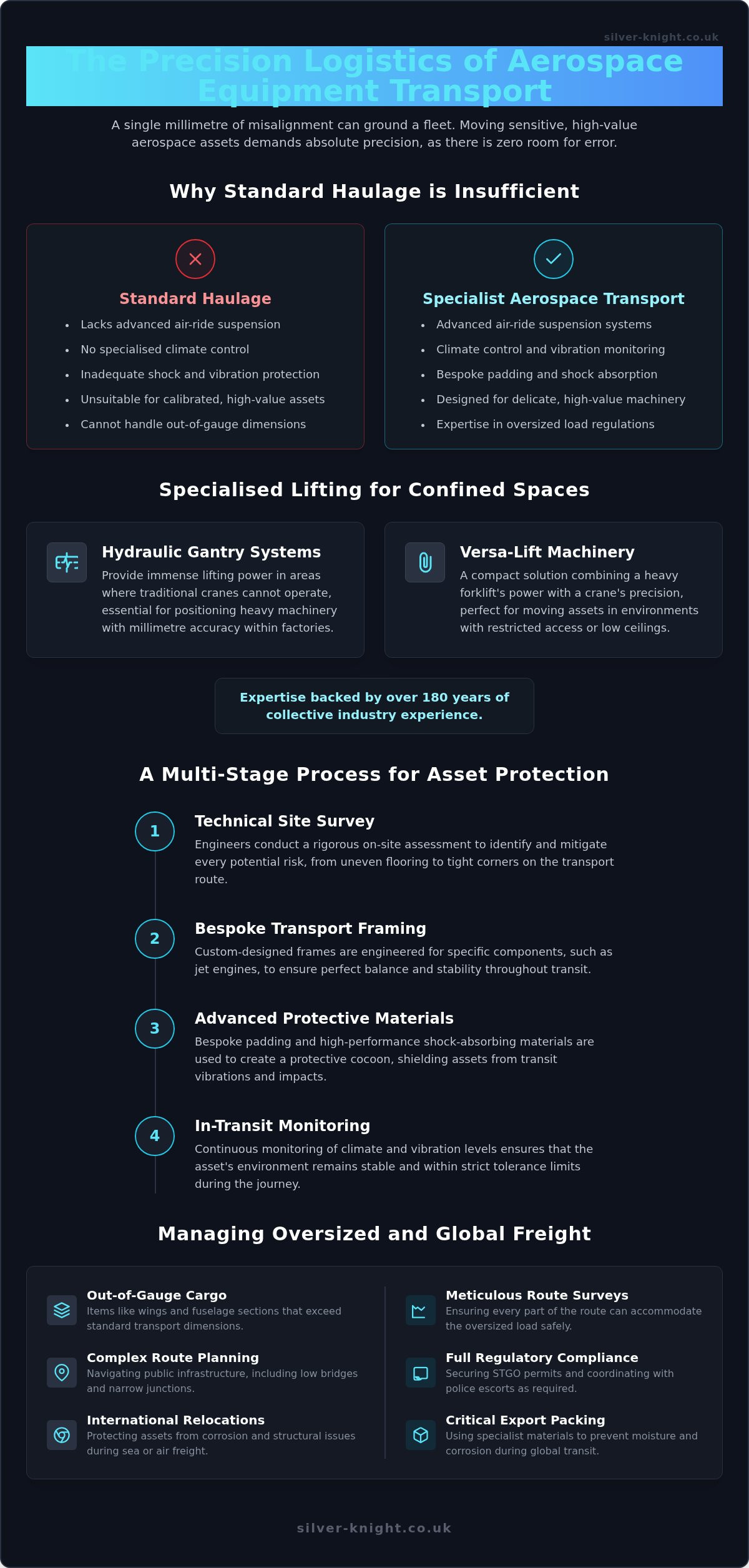
Aerospace assets represent some of the most expensive and delicate cargo in the world. Unlike standard industrial goods, aerospace equipment transport requires a deep understanding of structural integrity and calibration. A single jet engine or a set of avionics can be worth millions of pounds. Standard haulage simply cannot provide the environmental stability or shock protection these items demand. Most standard lorries lack the advanced air-ride suspension systems needed to dampen road vibrations that could otherwise lead to microscopic fractures in composite materials.
To see the scale and complexity involved in modern aviation logistics, watch this program update:
Climate control and vibration monitoring are non-negotiable for many aerospace equipment transport projects. Changes in temperature can cause metal components to expand or contract, potentially affecting tight tolerances. In the UK, moving oversized components like wings or fuselage sections involves a complex regulatory framework. You must often secure permits under the Special Types General Order (STGO) and coordinate with police escorts to ensure the load moves safely through public infrastructure without damaging roads or bridges.
The importance of precision in aviation logistics
Precision is the foundation of every successful move. Even a minor jolt during transit can decalibrate sensitive sensors or flight control systems. This is why a technical site survey is the first step in any project. Engineers must identify every potential risk, from uneven warehouse flooring to tight corners on the transport route. Bespoke transport frames are often designed for jet engines to ensure they remain perfectly balanced. This level of technical planning is common for high-stakes missions involving a Military Transport Aircraft, where every centimetre of space is calculated for safety.
Challenges with oversized aerospace freight
Moving a fuselage section or a wide wing component creates massive logistical hurdles. These items are often out of gauge, meaning they exceed standard width or height limits. Planning these moves requires meticulous route surveys to ensure the cargo can clear every bridge and narrow junction. You will often need a specialised machinery haulage service that uses extendable trailers or low-loaders. These vehicles allow the cargo to sit as low to the ground as possible, providing better stability and helping the driver clear overhead obstacles whilst maintaining a steady pace through difficult terrain.
To ensure your high-value assets are handled by experts with nearly two centuries of collective experience, visit the Silver Knight website to learn more about our specialist services.
Specialised lifting equipment for aerospace machinery
Aerospace equipment transport requires more than just a lorry and a driver. In many UK manufacturing centres, the ceiling height or floor loading limits prevent the use of standard mobile cranes. This is where specialised technical gear becomes essential. Versa-Lift machinery is often the preferred choice for restricted access environments because it combines the power of a heavy forklift with the precision of a crane, all within a compact footprint. These machines allow for the movement of heavy jigs and assembly components without the need for massive overhead clearance.
Using the right tools ensures that delicate assets are never subjected to unnecessary stress during aerospace equipment transport. For instance, specialised forklift hire and crane hire provide the flexibility to navigate tight factory floors whilst maintaining the highest safety standards. This technical approach is a hallmark of firms with deep industry roots, drawing on over 180 years of collective knowledge to solve complex lifting puzzles that would baffle standard haulage companies.
Hydraulic gantries and precision lifting
Hydraulic gantry systems are vital for lifting heavy aviation assets such as large wing moulds or assembly jigs. Unlike cranes that require significant vertical clearance, these systems can operate in low-ceiling factories whilst providing a perfectly level, stable lift. You can explore the technical specifications of these systems through a heavy moving equipment hire service. This equipment ensures that even the heaviest components are positioned with millimetre accuracy. The stability offered by a gantry is unmatched, as the load is supported from multiple points, eliminating the swinging motion often associated with single-point crane lifts.
Moving machinery with jack and slide systems
When overhead lifting is completely impossible due to structural obstructions or extreme weight, jack and slide systems offer a reliable alternative. This method involves jacking up the load and placing it on a low-profile track system. The machinery is then slid into position with total control, even over delicate flooring. This process is particularly useful when adhering to safety standards similar to Federal aircraft transport regulations, which focus on the secure handling of sensitive cargo. Keeping the load close to the ground significantly reduces the risk of accidental drops or shifts during the relocation. If you're planning a complex installation, you can speak with our technical team for guidance on the best lifting strategy.
Professional handling is essential for maintaining the integrity of your machinery, and you can learn more about our specialist expertise to see how we protect your investments.
Protecting high value assets during relocation
Aerospace assets aren't just heavy; they are complex systems where the slightest oversight can lead to catastrophic failure. Relying on general labour for such tasks is a significant risk. You need personnel who understand the nuances of aerospace engineering and the specific vulnerabilities of high-value machinery. Every successful move begins with a comprehensive method statement and a detailed risk assessment. These documents outline every step of the process, ensuring that safety protocols are followed and that every potential hazard is mitigated before the first piece of equipment is even touched. This meticulous planning is supported by over 180 years of collective industry experience, providing a level of reliability that general hauliers simply cannot match.
Decommissioning and technical preparation
The decommissioning phase is a systematic process that goes far beyond simply unplugging machines. Every wire, pipe, and component must be carefully disconnected and documented. Proper labelling is vital because it ensures that the recommissioning process at the new site is efficient and error-free. Missing a single connection or misidentifying a part can lead to weeks of delays in production schedules. For complex assembly lines, using a professional machinery dismantle service provides the technical oversight needed to maintain the equipment's operational integrity during the move.
Securing sensitive equipment for transit
Once the machinery is dismantled, the focus shifts to protection during aerospace equipment transport. Delicate instruments require anti-vibration mountings to isolate them from the shocks of the road. Standard bubble wrap is rarely enough. Instead, we use specialised shock-absorbing materials and bespoke crating designed specifically for oddly shaped aviation parts. These crates provide a rigid structure that prevents any movement whilst in transit.
For sensitive electronics or composite materials, climate-controlled transport is often necessary. Drastic changes in humidity or temperature can cause condensation or material fatigue. By maintaining a stable environment within the vehicle, you ensure that the equipment arrives at the destination in the exact same condition it left the factory. This level of care is what defines a professional approach to aerospace equipment transport, turning a risky relocation into a controlled, predictable event.
If you are planning a large-scale project, you can explore our full range of haulage and relocation services to see how we can assist.
Global logistics and export packing for aviation
Moving aerospace assets across borders adds significant layers of complexity to any relocation project. Sea and air freight present entirely different sets of challenges. Air freight is often faster, but it requires strict adherence to weight and balance considerations to ensure flight safety. Conversely, sea freight exposes machinery to salty, humid air for extended periods, which can be devastating to sensitive components. This is why aerospace equipment transport must include a robust strategy for customs compliance and documentation. Failure to provide the correct paperwork can lead to expensive delays at ports in Europe, the US, or Asia, disrupting production schedules and increasing costs.
Export packing for sea and air freight
To prevent corrosion during long sea voyages, we use vacuum packing combined with moisture-absorbing desiccants. This creates a protective barrier around sensitive metal surfaces, preventing the oxidation that can ruin highly calibrated parts. We also use heat-treated timber for all crating to comply with international ISPM 15 standards. This prevents the spread of timber-borne pests and ensures your shipment isn't rejected at the border. Securing the machinery inside the container is equally vital. We use heavy-duty timber blocking and steel strapping to ensure the load cannot shift, even in rough seas. You can find out more about our shipping container packing service to understand how we secure your cargo for the journey.
International machinery relocation management
Managing a move to another continent requires precise coordination of multi-modal transport. This often involves a low-loader journey to a UK port, followed by sea freight and a final road leg in the destination country. As international machine movers, we handle the entire chain of custody. Having a single point of contact simplifies communication and ensures that every stage of the journey is monitored. This is particularly helpful for projects in the US or Europe, where differing regulations can complicate the process. We draw on our 180 years of collective experience to navigate these global hurdles smoothly. Our team ensures that all assets are tracked and that every regulatory requirement is met before the cargo even leaves the site. This proactive approach reduces the risk of expensive storage fees at ports whilst your equipment waits for clearance.
If you need a reliable partner for your next global project, get in touch with our international logistics team today.
If you need a partner who understands the high stakes of aviation logistics, you can visit our homepage to explore our full range of services.
Professional aerospace machinery movers for national projects
Selecting a partner for aerospace equipment transport is a decision that impacts your entire production line. In this sector, specialised experience is not just a preference; it is a non-negotiable requirement. General hauliers might understand weight, but they often lack the technical depth to handle the extreme sensitivity of aerospace assets. We bring over 180 years of collective industry knowledge to every project, ensuring that your equipment is handled with the highest level of expertise available in the UK. This depth of knowledge allows us to anticipate challenges before they arise, from navigating narrow UK road networks to managing floor load pressures in older manufacturing sites.
Being a family-run business allows us to prioritise precision and safety over volume. We treat every asset as if it were our own, focusing on the small details that prevent costly damage. Whether you are moving a single calibrated instrument or an entire assembly line, our team provides nationwide coverage to every corner of the country. This ensures that no matter where your facility is located, you have access to the same high standards of technical lifting and transport. We maintain a specialised fleet of low-loaders and trailers specifically designed to handle the unique dimensions of aviation cargo.
Comprehensive factory relocation services
Managing a full plant relocation within the aerospace industry requires a synchronised approach. It is not enough to simply move boxes; you must integrate heavy haulage with precise technical installation. We provide a complete factory relocation service that covers everything from the initial decommissioning to the final recommissioning at your new site. This end-to-end management reduces the risk of miscommunication between different contractors. By having one team handle the lifting, transport, and positioning, you ensure that the technical requirements of your machinery are respected throughout the entire journey.
Ensuring operational continuity
In the aviation world, downtime is the enemy. Whether you are dealing with Aircraft on Ground (AOG) situations or tight production schedules for new components, every hour of inactivity costs money. Professional movers understand the importance of sticking to strict timelines. We work closely with your team to create a schedule that minimises disruption to your operations. This might involve phased moves or working during specific windows to keep your primary assembly lines running whilst other sections are relocated.
The goal is a seamless transition that allows you to resume work as quickly as possible. If you are ready to plan your next project, you can book a technical site survey with our engineers. This allows us to assess your specific needs and provide a detailed plan that guarantees the safety and precision your aerospace assets deserve.
For reliable support with your next industrial move, you can visit our website to see our full range of services.
Securing the future of your aviation assets
Managing the relocation of sensitive machinery requires technical expertise and specialised equipment. Standard haulage cannot meet the rigorous demands of the aviation sector, where calibration is paramount. Successful logistics in this field rely on tools like hydraulic gantries and Versa-Lifts to navigate restricted spaces whilst maintaining stability. Whether moving a single engine or a full production line, the focus must stay on precision.
With over 180 years of collective industry experience, we ensure risks are mitigated through detailed planning. We provide nationwide service covering everything from decommissioning to final installation. Our team helps you meet strict production deadlines with a seamless relocation. To protect your high-value investments, contact Silver Knight for expert aerospace equipment transport. We look forward to supporting your next project with the technical skill it deserves.
Frequently Asked Questions
What makes aerospace equipment transport different from standard haulage?
Aerospace equipment transport differs from standard haulage due to the extreme sensitivity and high value of the cargo. Aviation components often feature delicate calibrations that road vibrations can easily disrupt. We utilise specialised air-ride suspension and technical lifting gear to maintain the integrity of these assets. Unlike general hauliers, we provide a technical site survey and a detailed method statement to manage the complex logistics of oversized or fragile aviation parts.
How do you protect sensitive aerospace electronics during a move?
We protect sensitive electronics by using anti-vibration mountings and bespoke crating designed for each specific component. Shock-absorbing materials isolate the equipment from transit impacts whilst vacuum packing prevents moisture damage and corrosion. For highly sensitive items, climate-controlled vehicles maintain a stable environment to prevent material fatigue. These measures ensure that electronics remain in their original calibrated state throughout the journey, reducing the risk of failure during recommissioning.
What specialised equipment is used to move oversized aviation parts?
Moving oversized aviation parts requires a fleet of specialised low-loaders and extendable trailers. Inside the facility, we use hydraulic gantry systems and Versa-Lifts to lift heavy components where overhead space is limited. Jack and slide systems are also essential for moving massive loads into position without the need for cranes. This technical gear allows us to handle out of gauge items like fuselage sections or wing moulds with millimetre precision.
Do you provide international transport for aerospace machinery?
Yes, we provide international machinery transport to Europe, the United States, India, and Asia. Our service includes the coordination of multi-modal logistics, such as road, sea, and air freight. We handle the entire export packing process, using heat-treated timber and vacuum sealing to meet international standards. Our team also manages the necessary customs documentation to ensure a smooth transition through ports whilst adhering to strict production or AOG schedules.
How do you handle the decommissioning of an aerospace assembly line?
Decommissioning involves a systematic approach where every component is carefully disconnected and documented. Our engineers label every wire and pipe to ensure that the recommissioning process at the new site is as efficient as possible. This technical preparation prevents production delays and ensures that complex machinery maintains its operational integrity. By following a rigorous method statement, we manage the entire dismantling process safely before the assets are prepared for transport.
Are your aerospace moving services available across the entire UK?
We provide nationwide coverage for all aerospace relocation projects across the United Kingdom. Although we maintain a central registered office, our fleet and technical teams operate nationally to serve aviation manufacturers and maintenance facilities. We have the capacity to manage complex projects in any region, providing the same high standards of lifting and transport regardless of your location. This ensures consistency and reliability for businesses with multiple sites throughout the country.
What insurance cover is provided for high value aerospace assets?
Safe and precise moves are the priority for every project we undertake. Whilst we maintain comprehensive liability and transit cover, the specific limits for high-value aerospace assets should be discussed during the initial technical survey. Every move is unique, and we ensure that all assets are protected under appropriate terms for their specific value and risk profile. You should always check with your transport provider to confirm that their policy meets your requirements.
How do you manage restricted access when installing aviation equipment?
We manage restricted access by utilising compact, high-capacity equipment like Versa-Lifts and hydraulic gantries. These systems allow us to lift and position heavy machinery in factories with low ceilings or narrow aisles where standard cranes cannot operate. Jack and slide systems also enable the precise movement of large components across delicate flooring. Our 180 years of collective industry experience helps us solve these difficult access puzzles whilst maintaining the highest safety standards.

Article by
David Ashby
I'm the Managing Director of Silver Knight Haulage & Machinery Ltd. Silver Knight Ltd is a family-run firm established in the West Midlands in 2005, with the aim of providing a cost-effective, yet professional, service to businesses for the removal, transportation, and installation of machinery, plant, and equipment here in the UK and worldwide. Between us, the Silver Knight workforce has over 50 years of experience with machinery and its operation.
Disclaimer
This article is intended for informational purposes only. Please ensure you seek expert advice or carry out your own research to confirm the information is suitable for your specific needs.