What if the most dangerous part of your factory relocation isn't the transport itself, but the moment you first disconnect the power? You likely understand that heavy machinery decommissioning is a high-stakes operation where a single oversight can lead to irreparable damage to precision components or a costly breach of HSE regulations. With the Health and Safety Executive now charging a Fee for Intervention rate of £188 per hour for material breaches, the financial and operational pressure to get every detail right from the start has never been higher.
This guide will help you master the complexities of decommissioning industrial assets whilst ensuring total safety and operational continuity. You'll gain a clear understanding of the technical stages involved, from initial risk assessments to the final disconnection. We provide the confidence you need to meet all UK regulatory standards, including PUWER and LOLER requirements, and help you create a robust plan for what happens to your machinery after it is taken offline. Whether you're moving a single unit or clearing an entire plant, this framework ensures your assets remain protected and your deadlines are met without disrupting your ongoing business operations.
Key Takeaways
- Learn why a systematic approach to heavy machinery decommissioning is essential for protecting the structural integrity of your high-value assets.
- Discover how following manufacturer specifications and using specialised lifting equipment like hydraulic gantries prevents damage during the dismantling phase.
- Understand your legal obligations under UK health and safety regulations, including the necessity of robust Risk Assessment and Method Statements.
- Gain a clear framework for deciding between asset relocation and factory clearance whilst learning how to prepare machinery for long term storage.
- Identify how to evaluate specialist partners based on their collective industry experience and technical capabilities instead of relying on general hauliers.
If you require specialist support for your next industrial project, you can learn more about the machinery moving and decommissioning services provided by Silver Knight.
Understanding the Heavy Machinery Decommissioning Process
Decommissioning is much more than just pulling a plug or unbolting a frame. It's the systematic process of taking industrial assets out of active service whilst preparing them for their next phase, whether that involves relocation, storage, or disposal. Professional heavy machinery decommissioning ensures that every stage of the shutdown is documented and executed with precision. This approach is vital for preserving the structural integrity of heavy equipment, as it prevents the stress and torque damage that often occurs during rushed removals.
The impact of a poor shutdown often only becomes clear during the recommissioning phase. If parts are forced or electrical connections are severed without labelling, the time and cost required to get the machine running again in a new location can double. By following a structured path, as discussed in this look at Understanding the Decommissioning Process, businesses can avoid these expensive pitfalls. Specialist machinery movers manage this high risk stage by treating the machine as a working asset rather than scrap metal.
Defining Professional Decommissioning and Its Importance
Distinguishing between simple machinery removal and a controlled decommissioning programme is critical. A controlled process focuses on maintaining the asset's value for future resale or relocation. Professional planning also prevents damage to the surrounding factory infrastructure. Without a clear strategy, you risk damaging floor slabs, overhead gantries, or adjacent production lines that must remain operational. A systematic approach ensures the facility remains safe for other staff and ready for its next use.
Avoiding Common Risks During Equipment Shutdown
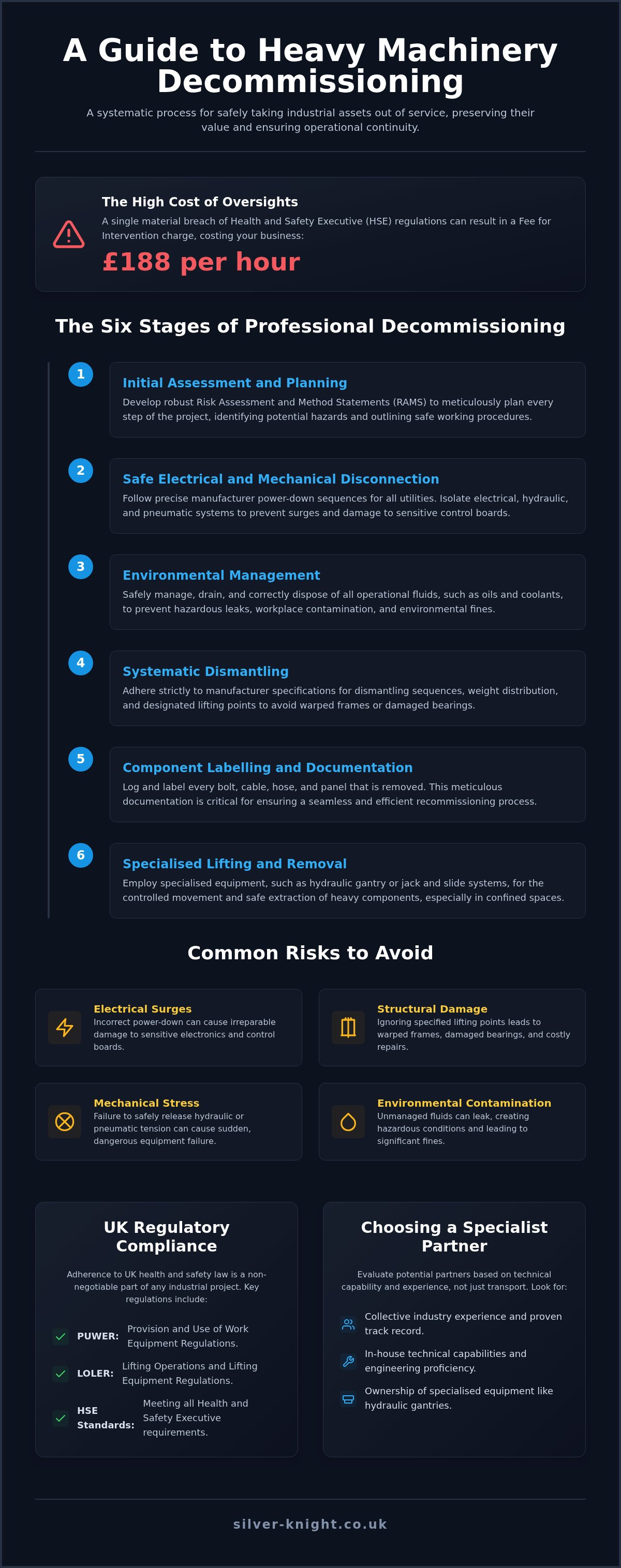
The shutdown phase presents several technical challenges. Primary risks include electrical surges that can damage sensitive control boards if the power down sequence is ignored. Mechanical failure can also occur if tension isn't released correctly from hydraulic or pneumatic systems. Environmental contamination is another major concern. Unmanaged fluids, such as oils or coolants, can leak during the process, leading to hazardous conditions and potential environmental fines.
The financial implications of these errors are significant. Unplanned downtime caused by a decommissioning mistake can halt production across the entire site. Specialist teams, such as those providing machinery dismantle services, use their expertise to mitigate these risks. They ensure a clean break from the building's utilities and structure, allowing the project to stay on schedule without compromising safety or operational continuity.
Professional machinery movers help ensure your project stays on track. You can explore the full range of heavy machinery services available to support your facility.
Technical Stages of Industrial Machine Dismantling
Dismantling industrial assets requires a high degree of technical proficiency. It's not just about taking things apart; it's about reverse-engineering the original installation. Mechanical engineers play a pivotal role here. They ensure that every disconnection is safe and that the structural integrity of the machine remains intact throughout the process. Precision is vital here. Following manufacturer specifications is mandatory. These documents detail the specific lifting points and weight distributions that must be respected during heavy machinery decommissioning. Ignoring these details can lead to warped frames or damaged bearings that are incredibly expensive to repair.
For heavy components, specialised lifting equipment is non-negotiable. Tools like hydraulic gantry systems or jack and slide systems allow for the controlled movement of massive parts in confined spaces where a standard crane cannot reach. Precise labelling and documentation are also essential. Every bolt, wire, and panel removed must be logged so that the recommissioning phase elsewhere is seamless. Without this level of detail, you're essentially leaving the future of your production line to guesswork. This often results in weeks of delay during the rebuild.
Electrical and Mechanical Disconnection Procedures
Safe electrical isolation is the first step. This involves more than just flipping a switch. It requires verifying that no residual energy remains in the system to protect both the staff and the equipment. Control panels are carefully disconnected and protected against static. For mechanical elements, linkages and heavy frames are dismantled in a sequence that prevents the machine from becoming unbalanced. Precision components often require climate controlled handling to prevent moisture damage or thermal expansion during the move.
Managing Fluids and Hazardous Materials
Draining hydraulic oils, coolants, and lubricants is a delicate task. Spills lead to significant cleanup costs and safety risks. Professionals use closed-loop systems to extract these fluids safely. You must also adhere to strict Safety Standards and Regulatory Compliance regarding the disposal of hazardous industrial waste. Once drained, the machinery must be secured with industrial-grade plugs and seals to prevent any residual leaks during subsequent haulage. If you're planning a complex move, you might want to speak with a specialist engineer to discuss your specific technical requirements.
If you need a professional machinery moving team to manage your next project, you can find more information about the specialist decommissioning services offered by Silver Knight.
Safety Standards and Regulatory Compliance
Safety is the foundation of any successful industrial project. In the UK, the Health and Safety Executive (HSE) sets high standards for workplace transport and heavy lifting. As of 1 April 2026, the HSE increased the Fee for Intervention rate to £188 per hour for material breaches. This makes compliance a financial priority as well as a moral one. Heavy machinery decommissioning must adhere to the Construction Design and Management (CDM) 2015 regulations, which ensure that health and safety is managed throughout every stage of a project. With the HSE conducting around 14,000 proactive inspections in 2026, there is a heightened focus on preventing falls from height and transport accidents during industrial moves.
Essential Documentation including RAMS and Site Surveys
Every individual machine move requires a bespoke Risk Assessment and Method Statement (RAMS). These documents aren't just paperwork; they are live blueprints that detail exactly how a task will be completed safely. A site survey is the technical starting point. It identifies critical factors such as floor loading limits and overhead clearance restrictions. This data ensures that equipment like Versa-Lifts or gantry systems can operate without damaging the building structure. Proper documentation protects the client from legal liability and simplifies insurance claims if an unexpected incident occurs. It also helps businesses stay aligned with environmental regulations for hazardous waste when managing the disposal of old oils and chemicals.
Adhering to Health and Safety Executive Guidelines
Clear communication between the decommissioning team and the factory manager is essential to avoid conflicts with ongoing operations. Under the Lifting Operations and Lifting Equipment Regulations (LOLER) 1998, which is currently undergoing a review in 2026, all lifting must be planned by a competent person. For complex tasks, a contract lifting service provides an appointed person to supervise the entire operation. This individual takes full responsibility for the safety of the lift, ensuring all personnel are trained and certified to operate heavy lifting gear. This level of supervision is vital for maintaining site safety whilst meeting tight deadlines. It provides peace of mind that every technical stage follows the latest ABA operator competence standards introduced in January 2026.
If you are planning a facility move, you can access comprehensive factory relocation and decommissioning services from the experts at Silver Knight.
Strategic Planning for Asset Relocation or Disposal
Once the technical disconnection is complete, the focus shifts to the future of the equipment. Strategic planning for heavy machinery decommissioning involves a critical choice between relocating an asset or opting for a total site clearance. If a machine still holds production value, relocation is often the priority. However, for older units, the cost of moving might exceed their operational worth. In these cases, asset recovery becomes a vital tool. By selling surplus equipment, businesses can offset the significant costs of a factory move. For disposals occurring after 6 April 2026, the Capital Gains Tax rate for Business Asset Disposal Relief is 18%, which may influence your financial strategy during this phase.
International moves require even greater foresight. If your machinery is destined for a facility abroad, professional export packing is essential to protect sensitive components from the rigours of sea or air freight. This involves more than just a crate; it requires vacuum sealing and moisture protection to prevent corrosion during transit. Proper planning ensures that when the machine arrives at its new destination, it's ready for immediate recommissioning without the need for expensive repairs or deep cleaning.
Preparing Machinery for Transport or Secure Storage
Securing heavy equipment for transit requires specialised pallets and custom steel frames. These tools distribute the weight of the machine evenly, preventing damage to the internal bearings or the vehicle bed during heavy haulage. If your new facility isn't ready, you may require a secure warehousing and storage service to protect your assets. Sensitive machinery often needs a climate controlled environment to prevent the degradation of electronic control systems and precision mechanical parts. Storing equipment correctly preserves its resale value and ensures it remains functional for future use.
Factory Clearance and Asset Recovery Options
After the primary machinery is removed, the remaining site must be cleared of smaller tools, racking, and industrial waste. This process must be handled responsibly to meet environmental standards. From 1 October 2026, the Digital Waste Tracking Regulations will require all waste generated from factory clearances to be recorded in a new digital system, replacing older paper records. Utilising a UK factory clearance service ensures your site is handed back to the landlord in the required condition whilst maximising the recycling of scrap materials. If you want to explore how asset recovery can benefit your project, you should request a consultation with our clearance team today.
To ensure your project is managed by a team with over 180 years of collective industry experience, explore the specialist machinery moving services offered by Silver Knight.
Choosing a Specialist Partner for Decommissioning Projects
General hauliers often struggle with the technical demands of heavy machinery decommissioning because they lack the specialised engineering knowledge needed for safe disconnection. Moving a heavy item is a straightforward haulage task, but understanding how to dismantle it without causing internal stress or structural damage requires a different set of skills. By choosing a partner with over 180 years of collective experience, you ensure that every technical challenge is met with a proven solution. Being a family run business allows for a higher level of accountability and a personalised service that larger, less agile firms simply cannot match. This heritage ensures that precision and safety remain the primary focus throughout the project duration.
Evaluating Experience and Specialist Lifting Equipment
Technical capability is defined by the tools a team brings to the site. Utilising a heavy moving equipment hire service gives you access to advanced technology such as Versa-Lifts, hydraulic gantry systems, and jack and slide systems. These machines are designed for the high capacity lifting required in confined factory environments where traditional cranes cannot operate. This level of expertise allows the onsite team to identify risks early, such as floor loading issues or clearance restrictions, and solve them before they cause expensive delays. Anticipating these problems is what separates a professional engineering team from a standard transport company. Our team understands the nuances of precision machinery and the delicate nature of industrial control systems.
The Benefits of a Fully Managed Turnkey Solution
A turnkey solution provides a single point of responsibility for the entire project. This simplifies factory relocation by removing the need to manage multiple contractors for dismantling, transport, and installation. Whether you are moving a single asset across the UK or require international machinery transport, a fully managed service handles every detail, including the necessary health and safety documentation and site clearance. This approach ensures operational continuity and provides total confidence in the project outcome. You can visit the Silver Knight Haulage & Machineries Ltd home page to discuss your specific decommissioning requirements with a technical expert. Having one team manage the transition from decommissioning to recommissioning significantly reduces the risk of error and ensures your production line returns to service as quickly as possible.
If you are looking for professional assistance with your next industrial move, you can learn more about the machinery moving and decommissioning services provided by Silver Knight.
Secure Your Industrial Assets for the Future
Successful decommissioning transforms a high-risk engineering challenge into a controlled, strategic phase of your business life cycle. By prioritising technical precision during the dismantling stage and adhering to strict UK health and safety standards, you protect both your workforce and your financial investments. Whether you are preparing for a factory relocation or clearing a site for new operations, having a robust plan for your heavy machinery decommissioning ensures that no asset is damaged and no deadline is missed.
You can rely on a partner with over 180 years of collective industry expertise to manage the entire process. From producing bespoke RAMS for full UK compliance to deploying advanced lifting equipment like hydraulic gantries and Versa-Lifts, the right support makes all the difference. Contact the experts at Silver Knight Haulage & Machineries Ltd to discuss your decommissioning project today. We are ready to help you achieve a seamless transition for your industrial facility.

Article by
David Ashby
I'm the Managing Director of Silver Knight Haulage & Machinery Ltd. Silver Knight Ltd is a family-run firm established in the West Midlands in 2005, with the aim of providing a cost-effective, yet professional, service to businesses for the removal, transportation, and installation of machinery, plant, and equipment here in the UK and worldwide. Between us, the Silver Knight workforce has over 50 years of experience with machinery and its operation.
Disclaimer
This article is intended for informational purposes only. Please ensure you seek expert advice or carry out your own research to confirm the information is suitable for your specific needs.