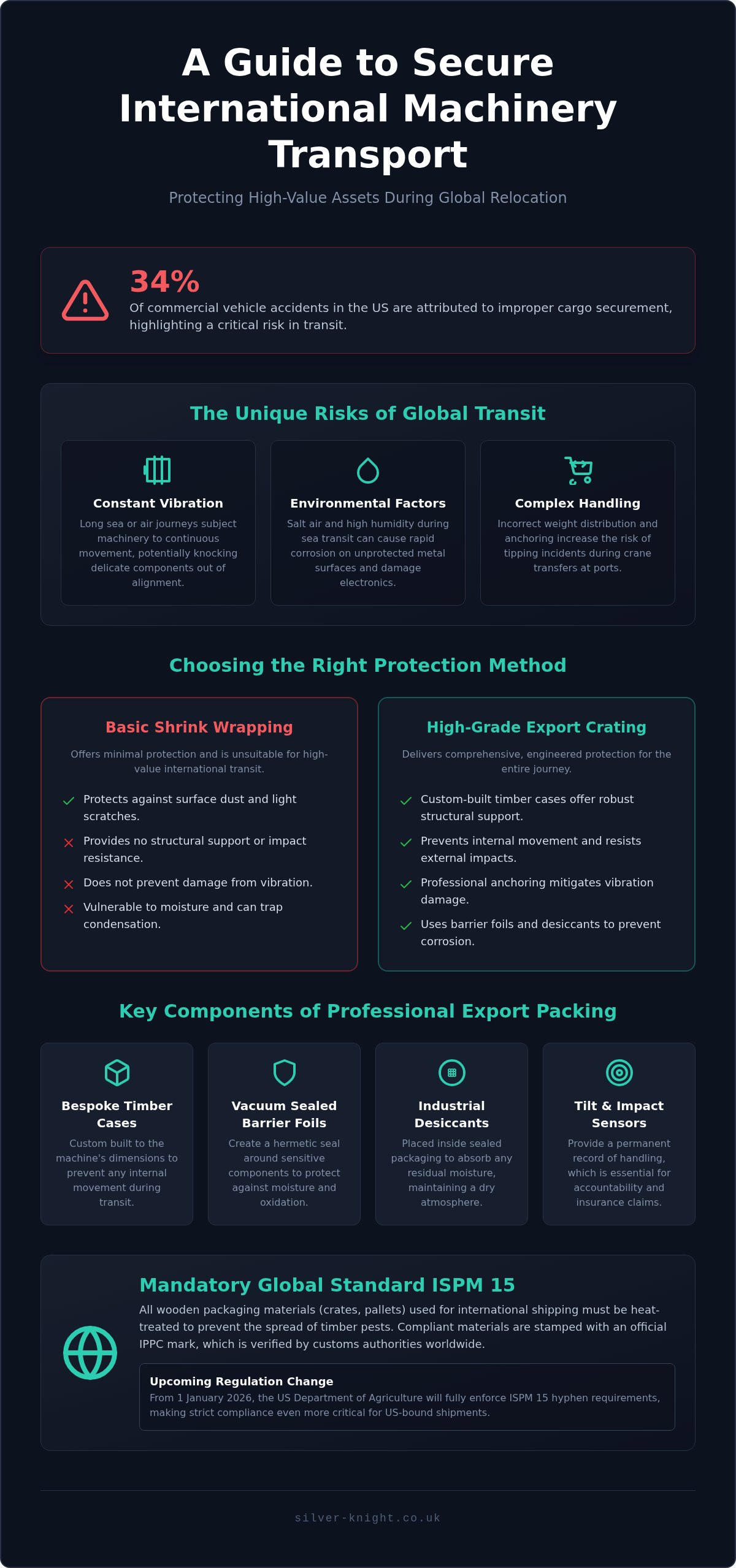
Did you know that improper cargo securement accounts for 34% of all commercial vehicle accidents in the US? When you're moving expensive industrial assets across oceans, that statistic is terrifying. It's completely normal to feel stressed about the prospect of your machinery arriving damaged or getting stuck in a customs bottleneck whilst sitting in a foreign port. This guide helps you master international machinery transport by providing expert advice on export packing, customs compliance, and specialist lifting.
We understand that coordinating multiple contractors across different countries is a logistical nightmare that often leads to delays. You'll find out how to secure a damage-free relocation within your project timeline and manage the entire move through a single point of contact. We'll explore the latest 2026 regulations, such as the full enforcement of the ISPM 15 hyphen requirement in the US and the mandatory digital documentation now required in Spain. By the end of this article, you'll have a clear roadmap for a compliant and efficient global relocation.
Key Takeaways
- Learn why technical expertise is essential for managing the unique risks found in multi modal transit across international borders.
- Identify the best protection methods for your assets by comparing high grade export crating with basic shrink wrapping.
- Navigate the complexities of international machinery transport by understanding the critical role of the Bill of Lading and global trade regulations.
- Discover how specialised tools like hydraulic gantry systems allow for precision lifting and positioning within confined industrial spaces.
- Streamline your global relocation by creating a detailed project timeline that manages every stage from decommissioning to final installation.
If you are planning a complex industrial move, you can learn more about our specialist machinery moving solutions to ensure your assets are handled with the highest level of care.
Challenges of moving heavy equipment across international borders
Moving heavy assets across borders involves more than just driving a lorry. It requires a deep understanding of multi-modal logistics, where goods move between road, sea, or air. Standard haulage companies often struggle with these moves because they don't have the technical engineering background required for complex international machinery transport. You must account for different oversize load regulations in every territory your cargo crosses. Our team draws on over 180 years of collective industry experience to manage these variables. Coordinating with international partners is also vital to ensure that the correct lifting gear is ready for local offloading. Without this synchronisation, your project timeline will slip, leading to costly production lag.
Managing the risks of long distance transit
Precision machinery is sensitive to the constant vibrations found during sea or air freight. Unlike a short road trip, a long sea voyage subjects equipment to continuous movement that can knock delicate components out of alignment. Professional anchoring within shipping containers is mandatory to prevent damage. It's not just about stopping the machine from sliding. It's about understanding the machine's specific centre of gravity. If the weight isn't distributed correctly, the risk of a tipping incident increases during crane transfers at the port. Using a professional shipping container packing service ensures every asset is secured for the journey.
Understanding the impact of environmental factors
Salt air and high humidity are the silent enemies of industrial machinery during sea transit. Exposed metal surfaces can begin to corrode within days if they aren't properly protected. We use specialised barrier foils and desiccants to create a moisture-free environment around the equipment. In some cases, climate controlled storage is necessary if there are delays at customs or during transshipment. Protecting sensitive electronics from these harsh conditions ensures your machines are ready for immediate factory relocation and recommissioning upon arrival at the new site. This attention to detail prevents expensive repairs and ensures you can resume operations as quickly as possible.
For more information on how we manage global projects, you can visit our factory relocation specialists online.
Export packing and protection for industrial machinery
Successful international machinery transport starts long before the assets reach the port. You must choose a packing method that matches the specific hazards of your route. For instance, air freight requires lightweight but sturdy protection, whilst sea transit demands heavy duty barriers against salt spray. Before any packing begins, ensure your equipment has gone through a thorough machinery dismantle service. This decommissioning phase is vital because you cannot simply wrap a machine that still contains fluids or residual pressure. We also recommend using tilt and impact sensors on the crates. These devices provide a permanent record of how your load was handled. This data is essential for insurance purposes and helps you hold contractors accountable if the machinery is mishandled during transshipment.
Essential packing materials for sea and air freight
High grade export crating is significantly more robust than basic shrink wrapping. Whilst shrink wrap protects against dust, it offers no structural support. In contrast, bespoke timber cases are custom built to the machine's dimensions to prevent internal movement. We use vacuum sealed barrier foils for sensitive electronics to create a hermetic seal that prevents oxidation. Desiccants are placed inside these crates to absorb any remaining moisture and maintain a dry internal atmosphere throughout the voyage. This combination of physical and chemical protection ensures your assets arrive in the same condition they left.
Meeting ISPM 15 standards for wooden packaging
All wooden packaging used for global moves must meet ISPM 15 standards to prevent the spread of timber pests. This means all pallets and crates must be made from heat-treated timber and carry the official IPPC mark. As of 1 January 2026, the US Department of Agriculture’s APHIS has resumed full enforcement of the ISPM 15 hyphen requirement. If your markings are incorrect, customs officials may refuse entry or order the destruction of the packaging at your expense. Using a professional shipping container packing service ensures your materials are fully compliant with these strict 2026 regulations. If you're unsure which packing method suits your equipment, you can speak with our specialist team for tailored advice.
If you need help managing the paperwork for your move, our specialist machinery movers provide expert support to handle every detail of your global relocation.
Coordinating global logistics and customs compliance
Managing international machinery transport in 2026 requires more than just physical strength. You must navigate a complex web of trade regulations and tariffs that vary significantly between the US, Europe, and Asia. One of the most important documents you'll encounter is the Bill of Lading. This acts as both a receipt for your goods and a contract of carriage. It's essential that all weight and dimension data on this document is 100% accurate. In the USA, weight violations can result in fines ranging from $500 to $5,000 per violation. Working with an experienced freight forwarder ensures that these details are managed correctly before your cargo reaches the port.
Preparing technical documentation and customs manifests
Your customs manifest must be precise to avoid delays at the border. This includes using the correct Harmonised System (HS) codes to classify your machinery. These codes determine the tax and duty rates you'll pay upon arrival. Using a professional partner for international machinery transport ensures your HS code classifications are accurate. For moves into Spain, you must now account for the Electronic Administrative Control Document (DeCA), which became mandatory on 5 October 2026 for certain freight operations.
Essential paperwork for Europe, Asia, and the US typically includes:
- A detailed packing list for efficient customs clearance
- Commercial invoices showing the value of each asset
- Certificates of origin where required by local trade agreements
A detailed packing list allows customs officials to verify the contents of your crates without necessarily opening them, which speeds up the process. This documentation is vital for ensuring your machinery passes through inspections without being held for extended periods.
Choosing the right shipping method for heavy loads
Selecting the correct container type is a balance between cost and protection. Standard closed containers are ideal for smaller units, but oversized equipment often requires Flat Rack containers. These allow for loading from the top or sides, which is necessary for machines that don't fit through standard doors. If you're moving industrial vehicles, Roll on Roll off shipping is often the most efficient choice. Air freight is reserved for time critical precision parts that are needed urgently to prevent factory downtime. For the heaviest loads, we often utilise our heavy moving equipment hire service to manage the transition from the factory floor to the shipping terminal.
If you need professional assistance with your industrial move, you can view our full range of heavy machinery transport services to see how we can support your project.
Specialist lifting equipment for international relocations
When your assets arrive at a foreign facility, you may find that the local infrastructure isn't equipped to handle heavy industrial installation. Many modern factories lack the overhead crane capacity required for precision machinery placement. This makes the use of specialised lifting gear a necessity for successful international machinery transport. It's not enough to simply deliver the cargo to the loading bay. You need a team that can manage the final positioning with engineering accuracy. Our fleet includes advanced tools like hydraulic gantries and Versa Lifts, which allow us to work in environments where traditional cranes can't operate. This ensures your project moves from the shipping container to the production line without delay.
Utilising hydraulic gantries and jack systems
Hydraulic gantry systems provide a safe and controlled lifting solution for sites without permanent overhead cranes. These modular systems can be assembled inside a factory to lift heavy components directly from a trailer. If you're dealing with extremely heavy industrial assets, we often use jack and slide systems to skid loads into position. These allow us to move machinery through tight doorways or under low ceilings where vertical clearance is limited. When handling loads exceeding thirty tonnes, we prioritise stability and compliance with local safety standards.
The role of Versa Lifts in restricted environments
Congested factory floors are a common challenge during global relocations. A standard forklift is often too bulky to navigate narrow aisles, but a Versa Lift offers a unique solution. These machines feature an extendable counterweight that increases lifting capacity without increasing the vehicle's footprint. This versatility is essential when you need to move varied machinery weights within a single facility. You can find more technical specifications for these machines on the our equipment page. If you have a challenging lift at your international site, contact our engineering team for a technical consultation.
To ensure your global move is managed by experts, you can learn more about our machinery transport and relocation services before you begin your project.
Planning a successful factory relocation abroad
Successful international machinery transport relies on a structured programme with clearly defined milestones. You should start by mapping out the entire journey, from the initial decommissioning at your current site to the final installation at the new facility. Having a single point of contact for the entire global move is one of the most effective ways to reduce stress. This person manages the coordination between hauliers, shipping lines, and local lifting teams, ensuring that nothing is lost in translation. You must also account for the financial complexities of moving across borders. Budgeting should include not only the haulage costs but also potential port fees, customs duties, and local taxes that may apply in the destination country.
Conducting a comprehensive technical site survey
For those coordinating the first stage of a relocation from Western Australia, Allout Towing provides the specialised support required to transport industrial vehicles safely to the departure terminal for export.
A thorough site survey is the foundation of any global relocation. Many businesses make the mistake of only looking at the machinery itself, but you must evaluate the infrastructure at both ends of the journey. This includes checking floor load capacities to ensure the ground can support heavy assets. You also need to identify physical obstacles such as overhead power lines, low bridges, or narrow access roads that might restrict large transport vehicles. Using this survey data allows you to select the most efficient lifting and transport equipment, preventing last minute problems during the move.
Coordinating multi modal transport and final installation
Managing the transition between different modes of transport is where many projects face delays. You need to synchronise road haulage with sea or air freight schedules to ensure your machinery isn't sitting idle at a port. Once the equipment reaches the destination, the focus shifts to the final installation. Professional recommissioning is a vital step to ensure your machinery is fully operational and safe to use. For comprehensive support throughout this process, you can utilise our factory relocation services. This managed approach ensures that your international machinery transport project stays on track and your production downtime is kept to an absolute minimum.
To get started with your next global relocation, you can explore our full range of managed machinery transport services before requesting your specialist consultation.
Secure your global industrial future
Success in international machinery transport depends on balancing engineering with compliance. It's about more than just haulage. You've seen how high grade packing and ISPM 15 standards prevent delays at the border. Using tools like hydraulic gantries and Versa-Lifts ensures your assets are precisely installed. Whether you're moving one machine or a whole factory, a solid plan keeps you on track.
Our family-run team brings over 180 years of collective industry experience to every move. We use our directly owned fleet of specialised lifting equipment to manage relocations across Europe, the USA, India, and Asia. You don't have to manage the stress of multiple contractors. We provide a turn-key solution from decommissioning to recommissioning. If you're ready to start your next global move, you can request a quote for your international machinery transport project today. We're here to make your transition as smooth as possible.
Frequently Asked Questions
How do you prepare heavy machinery for international sea freight?
Preparing machinery for sea freight involves professional decommissioning followed by high grade export packing. We use vacuum sealed barrier foils and desiccants to protect sensitive components from salt air and humidity. Each machine is then anchored within a shipping container or on a flat rack to prevent movement during the voyage. This thorough preparation ensures your assets remain in perfect condition whilst they are in transit to your new global facility.
What is ISPM 15 and why is it mandatory for international transport?
ISPM 15 is an international standard for wood packaging that requires timber to be heat treated to prevent the spread of pests. It is mandatory for international machinery transport to avoid the introduction of invasive species into new ecosystems. As of January 2026, the US has resumed full enforcement of the hyphen requirement in compliant markings. Using non compliant materials can lead to your cargo being seized or destroyed at the port of entry.
Can you relocate an entire factory to another continent like Asia or the US?
We specialise in managed factory relocations to global destinations including Europe, the US, India, and Asia. Our family run team manages the entire project timeline, including decommissioning, technical site surveys, and multi modal logistics. We use our directly owned fleet of equipment to handle every stage of the move. This turn-key approach ensures you have a single point of contact for the relocation, reducing the stress of coordinating multiple contractors in different countries.
What documentation is required for machinery transport between the UK and Europe?
Transporting machinery between the UK and Europe requires technical documents such as a commercial invoice, a detailed packing list, and a Bill of Lading. You must also use the correct HS codes for tax and duty classification. For certain freight operations in Spain, the Electronic Administrative Control Document (DeCA) became mandatory on 5 October 2026. Accurate documentation is vital to prevent bottlenecks and ensure your assets pass through customs without any unnecessary delays.
How long does a typical international machinery relocation project take?
The duration of a project depends on the destination and the complexity of the machinery involved. A move within Europe might take a few weeks, whilst shipping to Asia or the US can take several months once you account for sea transit. We establish a clear project timeline with defined milestones for each phase. This professional planning ensures that decommissioning, packing, and shipping are synchronised to minimise your production downtime and meet your specific deadlines.
Is it possible to track the progress of my machinery during global transit?
We provide regular updates on your project through a single point of contact who manages the global logistics. We also recommend the use of tilt and impact sensors on your crates to monitor how the load is handled during transshipment. These devices provide a permanent record of the journey. This data is essential for maintaining the integrity of your assets and provides peace of mind throughout the international machinery transport process.
What are the benefits of using a hydraulic gantry for international installs?
Hydraulic gantry systems are essential for sites where overhead cranes are unavailable or have insufficient capacity. They allow for the precise lifting and positioning of heavy assets in restricted factory spaces. These modular systems provide a safe solution for handling loads exceeding thirty tonnes. By using gantries, we can install your machinery directly from the transport trailer, which speeds up the recommissioning process and ensures your new facility is operational as quickly as possible.
Do you provide insurance coverage for high value machinery during transport?
We recommend that clients verify their specific insurance requirements for high value assets during global transit. Standard haulage liability in the UK is limited to £1,300 per tonne as of January 2026, which may not reflect the replacement cost of precision machinery. We ensure all technical documentation and packing are completed to the highest standards to support your coverage. Our team follows strict safety protocols to protect your investment during every stage of the move.

Article by
David Ashby
I'm the Managing Director of Silver Knight Haulage & Machinery Ltd. Silver Knight Ltd is a family-run firm established in the West Midlands in 2005, with the aim of providing a cost-effective, yet professional, service to businesses for the removal, transportation, and installation of machinery, plant, and equipment here in the UK and worldwide. Between us, the Silver Knight workforce has over 50 years of experience with machinery and its operation.
Disclaimer
This article is intended for informational purposes only. Please ensure you seek expert advice or carry out your own research to confirm the information is suitable for your specific needs.