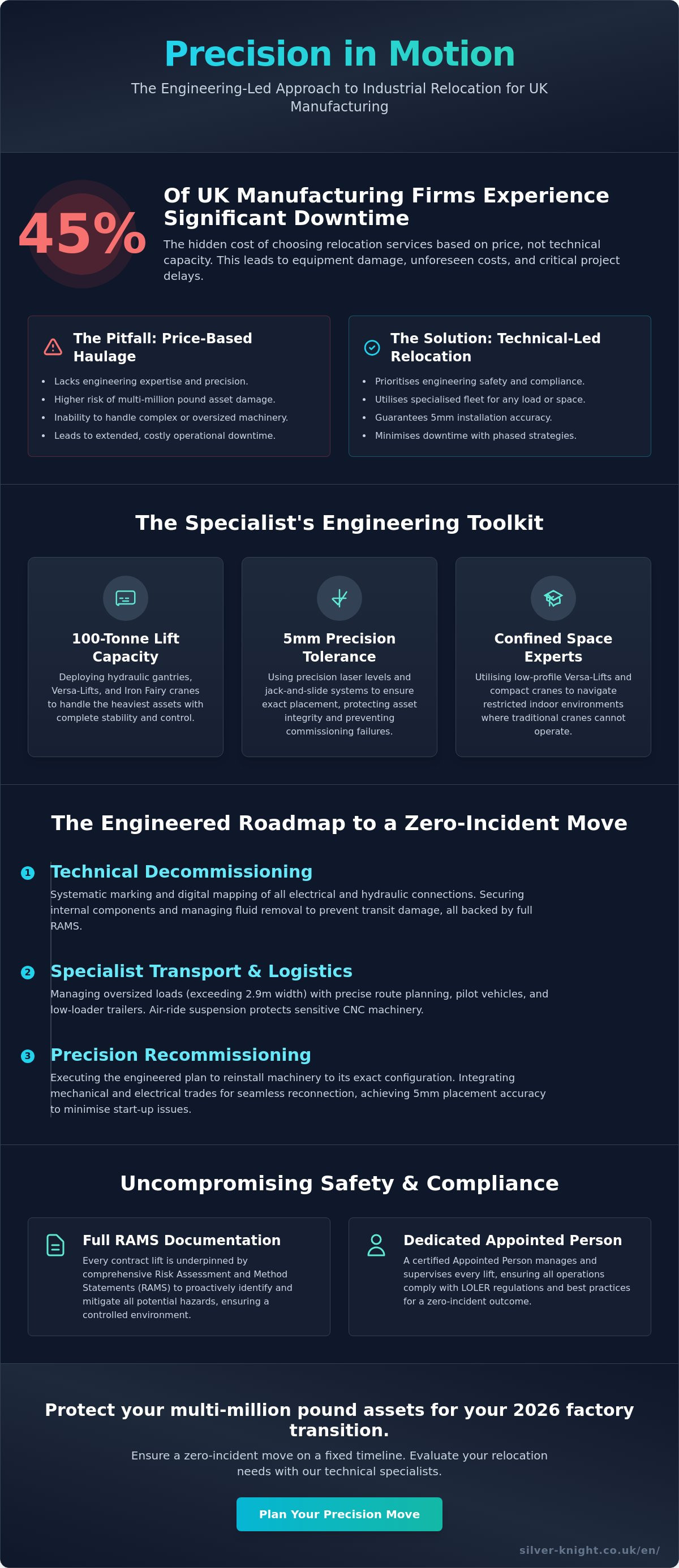
45% of UK manufacturing firms experience significant downtime because they select industrial relocation services based on price rather than technical fleet capacity.
As heavy lifting specialists, we advocate for a technical approach that prioritises engineering expertise and specialised machinery over basic haulage.
Crucially, the fear of equipment damage and unforeseen decommissioning costs often stems from using providers who lack 5mm precision tolerances.
We solve these challenges by deploying specialised Versalift units and iron fairy cranes capable of lifting loads up to 100 tonnes.
You understand that protecting multi-million pound assets requires a partner who treats engineering safety as a non-negotiable standard.
You'll learn how to evaluate providers based on technical machinery and full RAMS compliance to ensure a zero-incident move on a fixed timeline.
We'll explore the technical fleet requirements and best practice for achieving 5mm installation accuracy during your 2026 factory transition.
Key Takeaways
- Identify how turnkey industrial relocation services manage the entire engineering process for assets exceeding standard haulage dimensions through professional decommissioning and recommissioning.
- As heavy lifting specialists, we advocate for comparing hydraulic gantries against specialised fleet units like Versa-Lift to ensure precision placement within 5mm in restricted spaces.
- Ensure safety compliance by verifying that every contract lift is managed by a dedicated Appointed Person and supported by full RAMS documentation to prevent accidents.
- Minimise operational downtime by utilising phased relocation strategies that allow UK manufacturing facilities to maintain continuous production whilst moving heavy machinery.
- Select the right partner by prioritising family-run businesses that offer higher levels of continuity and technical accountability for complex multi-year projects.
Defining industrial relocation services for modern manufacturing
UK manufacturing output reached £224 billion in 2024, driving a surge in precision asset migration across the Midlands and beyond. This growth forces facilities to upgrade or move to larger sites to accommodate Industry 4.0 standards. Many firms struggle when moving assets because standard logistics providers cannot manage the intricate mechanical requirements of modern production lines. Specialist industrial relocation services solve this by providing an engineered roadmap for every machine.Industrial relocation is a turnkey engineering process involving the systematic decommissioning, transport, and recommissioning of heavy production assets. It transforms a complex logistical hurdle into a controlled technical exercise that preserves the operational integrity of the plant.
Specialist movers are required for assets exceeding standard UK haulage dimensions of 2.9 metres in width or 4.1 metres in height. These oversized loads require specific route planning and pilot vehicles to comply with Department for Transport regulations and ensure safe passage through urban centres.
Crucially, there is a vital distinction between simple haulage and the engineered lifting solutions required for factory environments. While haulage focuses on the road journey, our process utilises technical lifting capabilities to extract machinery from tight internal spaces using 100-tonne capacity hydraulic gantries and Versalift units.
As heavy lifting specialists, we advocate for a holistic approach to plant movement that treats the machine and its environment as a single unit. This ensures that floor loadings and overhead clearances are calculated to within a 5mm tolerance using precision laser levels.
Scope of factory and plant relocation
Moving entire production lines across national borders requires more than just a fleet of HGVs. Our factory relocation service integrates mechanical and electrical engineering to ensure seamless reconnection at the destination.
We manage sensitive CNC machinery and high-value industrial assets using air-ride suspension and bespoke crating. Every project includes the coordination of various trades to maintain the integrity of the original factory layout and minimise downtime.
Technical dismantling and decommissioning
The process begins with a systematic approach to marking and documenting every electrical connection and hydraulic line. Best practice dictates a full audit before any bolt is turned to prevent data loss or mechanical misalignment during the eventual restart.
Engineers must prioritise fluid removal and the securing of internal moving parts to prevent damage during transit. We use digital mapping to ensure that every component returns to its precise configuration during the recommissioning phase, backed by full RAMS documentation.
https://silver-knight.co.uk/contact-us/
Evaluating equipment and technical lifting capabilities
UK manufacturing investment in automated production lines reached £2.1 billion in 2023.
Modern factory footprints are shrinking to optimise floor space and energy efficiency.
Traditional mobile cranes often lack the headroom for indoor manoeuvres within these dense environments.
Specialist industrial relocation services utilise low-profile lifting technology to bypass these structural constraints.
Best practice dictates a thorough comparison between hydraulic gantries and mobile cranes for indoor work. While mobile cranes offer reach, hydraulic gantries provide superior stability for vertical lifts in environments with less than 6 metres of headroom.
Crucially, moving a 100-tonne transformer requires a jack and slide system rather than a single-point lift. This method distributes the weight across a broader surface area to prevent structural floor failure during the transit phase.
Iron fairy units provide a low-profile solution for moving loads through standard factory doorways. These mobile cranes are essential when overhead obstructions prevent the use of traditional gantry setups for internal machinery shifts.
For oversized loads, low-loader trailers provide the necessary clearance for UK bridge heights. These trailers often feature hydraulic suspension to maintain a level plane during the transit of sensitive CNC machinery over uneven terrain.
Specialised fleet and heavy lifting assets
As heavy lifting specialists, we advocate for the use of Versa-Lift units for payloads up to 45 tonnes. These compact machines feature an extending frame that allows for high-capacity lifting within confined aisles where standard forklifts fail.
Hydraulic gantry systems offer a 4-point lift configuration that ensures the load remains perfectly level throughout the elevation process. You can view the technical specifications for these units on our page for our equipment.
Our fleet also includes specialised skates and air film movers for 20-tonne loads. These tools allow for frictionless movement across epoxy-coated floors without causing surface degradation or cracking.
Precision positioning and installation
Successful industrial relocation services depend on aligning production lines within a 5mm tolerance. Technicians use laser levelling and optical alignment tools to ensure driveshafts and conveyors sync perfectly for immediate production restarts.
We must also verify that machine guarding meets OSHA machine safety requirements during the final positioning phase. Specialist movers calculate point loading to ensure the factory floor can support the static weight of the asset without long-term subsidence.
Optical tooling is used to calibrate the level of heavy presses to within 0.02mm per metre. This level of accuracy is vital for maintaining the structural integrity of the machine during high-speed operations.
If you're planning a complex move, you can learn more about our heavy moving equipment hire service to support your project. Our teams provide full RAMS for every lift to ensure total site safety and regulatory compliance.
https://silver-knight.co.uk/contact-us/
Managing safety and regulatory compliance
According to HSE data, over 25% of all workplace injuries in the UK manufacturing sector are directly attributed to the handling and movement of heavy loads.
Industrial relocation services require rigorous adherence to LOLER 1998 and PUWER 1998 standards to mitigate these operational risks.
Moving a single 40-tonne CNC machine involves intricate physics and structural engineering that goes beyond basic haulage.
Project managers often overlook the legal complexity of the Construction (Design and Management) Regulations 2015 (CDM 2015) during large-scale factory moves.
We implement a zero-compromise safety framework that exceeds statutory minimums to protect your personnel and assets.
Crucially, every contract lift we undertake requires a dedicated Appointed Person (AP) to oversee the technical lift plan. This individual holds the legal responsibility for ensuring the crane or Versalift 40/60 unit operates safely within its calculated working load limits.
CDM 2015 regulations apply to factory relocations because the work involves the dismantling and installation of heavy plant. Best practice dictates that a Principal Designer and Principal Contractor must be appointed to organise the pre-construction phase and site safety files.
As heavy lifting specialists, we advocate for zero-compromise safety protocols that treat the factory floor as a high-risk construction zone. This approach ensures that every movement of equipment up to 100 tonnes is controlled, documented, and executed with absolute precision.
RAMS and site-specific risk assessments
A robust Method Statement for a 50-tonne lift must detail every step from the initial jack-and-skate procedure to the final positioning. It includes specific calculations for floor loading capacities and the exact centre of gravity for asymmetrical machinery to prevent tipping.
Working in live manufacturing environments presents unique hazards such as overhead crane movements and pedestrian traffic. Our machinery dismantle service incorporates physical barriers and laser-guided exclusion zones to protect your staff during the decommissioning phase.
Safety documentation must be site-specific rather than based on generic templates. We ensure that every risk assessment identifies underground services or floor voids that could fail under the weight of an iron fairy unit or heavy-duty forklift.
This ensures the final placement of equipment is accurate to within 5mm of the floor plan specifications. Rigorous RAMS are the foundation of a successful relocation, providing the technical roadmap for every operative on the site.
Insurance and asset protection
Standard goods-in-transit insurance is often insufficient for high-value industrial relocation services. Specialist machinery movement insurance covers the asset whilst it is being lifted, handled, and installed, providing protection that standard haulage policies lack.
Professional indemnity is vital for engineering-led moves where we provide technical advice on structural modifications. This cover protects the client if a technical calculation regarding floor reinforcement or gantry capacity requires adjustment during the project.
Full site-specific cover is non-negotiable for any project involving precision assets worth over £500,000. We provide transparent certification of our liabilities to ensure your capital equipment is protected to its full replacement value from start to finish.
https://silver-knight.co.uk/contact-us/
Minimising operational downtime through strategic planning
UK manufacturing downtime costs an average of £21,000 per hour across high-volume sectors. This financial pressure makes the scheduling of industrial relocation services the most critical phase of a project. Moving a facility requires balancing the decommissioning of live assets against the commissioning of new production cells. Best practice dictates a phased strategy to ensure that at least 70% of production capacity remains online during the transition.
As heavy lifting specialists, we advocate for a "leapfrog" methodology where redundant or secondary units move first. This creates a production buffer at the new site before the primary machinery, such as 100-tonne hydraulic presses, is disconnected. Crucially, using temporary machinery storage allows project managers to clear floor space early. It's a strategy that prevents the "logjam" effect where installers and decommissioners compete for the same square footage.
Technical site surveys and logistics mapping
Planning begins 6 to 12 months before the physical move to map every logistical constraint. We measure doorway clearances within a 5mm tolerance and verify floor loading capacities, often exceeding 50kN/m2, to ensure safe transit. Detailed surveys identify hidden bottlenecks like overhead crane height restrictions or underground utility runs that won't support a Versalift 44/60. Every survey results in a full RAMS package that details the exact path of every asset through the facility.
For oversized loads exceeding 2.9 metres in width or 18.65 metres in length, we coordinate directly with UK police forces. Securing police escorts and Abnormal Load Task Force approvals requires precise timing to avoid peak traffic windows on the M1 or M6 corridors. As heavy lifting specialists, we advocate for early engagement with local authorities to prevent transit delays. This level of detail ensures that once a machine is lifted by our iron fairy units, it moves directly to its new foundation without idling.
International transport and export packing
Exporting heavy plant to Asia or the US requires specialised sea-freight packing using ISPM 15 heat-treated timber. This prevents biological contamination and ensures compliance with international shipping regulations at every port of entry. We provide comprehensive international machinery transport solutions that include moisture-barrier vacuum sealing for sensitive electronics. These protective measures are vital when assets spend 30 days or more in high-humidity transit environments.
Customs documentation for heavy plant export is managed through EORI registrations and specific commodity codes to avoid fiscal penalties. Our logistics teams handle the complex paperwork required for temporary exports or permanent relocations to ensure assets don't sit in port. We've found that pre-clearing documentation saves an average of four days in the total relocation timeline. It's this technical rigour that allows UK manufacturers to maintain global supply chain commitments during a move.
If you're planning a facility move, contact our technical team for a detailed consultation.
https://silver-knight.co.uk/contact-us/
Selecting the right industrial relocation partner
UK manufacturing output reached £224 billion in 2023, necessitating high-precision logistical transitions for ageing infrastructure. Selecting industrial relocation services requires more than a standard haulage contract to protect these high-value assets. Operational downtime costs for a mid-sized UK plant can exceed £10,000 per hour during a mishandled move. As heavy lifting specialists, we advocate for a vetting process based on technical engineering depth and asset ownership.
Best practice dictates a thorough audit of the on-site engineering team's collective industry experience before signing a contract. Crucially, choosing a partner with 180 years of collective experience ensures that complex decommissioning tasks are handled with precision. Family-run businesses often provide higher levels of continuity for multi-year projects because they maintain a consistent core team. Our solution involves providing a dedicated fleet of specialised vehicles to eliminate the risks associated with third-party sub-contracting.
Criteria for specialist machinery movers
Verify the ownership of the fleet to ensure equipment availability for your specific move date without relying on external hire availability. Checking for certifications such as SafeContractor or ISO 9001 ensures the provider meets rigorous UK safety standards and quality management protocols. When evaluating factory relocation service providers, check for lifting capacities up to 100 tonnes to handle heavy presses. Detailed RAMS must be provided for every lift to satisfy HSE requirements and ensure the safety of all personnel on-site.
The Silver Knight approach to industrial projects
Utilising a family-run specialist for complex moves provides a direct line of accountability that corporate logistics firms cannot match. Every site is assigned a dedicated project manager to oversee the entire lifecycle from initial survey to final machine commissioning. We offer 24/7 support for time-critical factory clearances to minimise disruption to your production schedules and revenue streams. Our team uses precision measurements within 5mm to ensure machinery is perfectly levelled and aligned at the new destination.
https://silver-knight.co.uk/contact-us/
Frequently Asked Questions
What is included in a full RAMS document
A full RAMS document includes a detailed risk assessment and a step-by-step method statement for the entire relocation process. It covers specific hazards such as overhead obstructions and floor loading capacities for 40-tonne Versalift units. Our engineers produce these documents to ensure every lift complies with the Lifting Operations and Lifting Equipment Regulations 1998.
How do you handle 24/7 factory clearances
We deploy rotating shifts of qualified fitters and drivers to maintain continuous progress on time-sensitive clearances. This approach allows for the removal of up to 500 square metres of machinery per 24-hour cycle. Every shift is overseen by a senior supervisor to maintain safety standards throughout the night.
Securing your manufacturing future through precision logistics
Successful industrial relocation services depend on technical lifting capabilities and meticulous planning to protect high-value assets. Crucially, every project requires full RAMS to ensure safety standards remain within HSE regulatory frameworks whilst moving machinery weighing up to 100 tonnes.
As heavy lifting specialists, we advocate for using specialised equipment like Versa-Lifts and hydraulic gantries to achieve placement precision within 5mm. Best practice dictates that 180 years of collective industry experience is necessary to mitigate the risks associated with complex factory moves and decommissioning tasks.
Our fleet is specifically designed to navigate the tight constraints of UK manufacturing facilities without compromising on lifting power. We provide a turnkey solution that handles everything from the initial site survey to final commissioning of your production line.
Contact our specialist team to discuss your machinery moving requirements
Modernising your facility shouldn't result in prolonged operational downtime. With the right technical partner, your transition to a 2026-ready production environment will be seamless and secure.
Article by
David Ashby
I'm the Managing Director of Silver Knight Haulage & Machinery Ltd. Silver Knight Ltd is a family-run firm established in the West Midlands in 2005, with the aim of providing a cost-effective, yet professional, service to businesses for the removal, transportation, and installation of machinery, plant, and equipment here in the UK and worldwide. Between us, the Silver Knight workforce has over 50 years of experience with machinery and its operation.
Disclaimer
This article is intended for informational purposes only. Please ensure you seek expert advice or carry out your own research to confirm the information is suitable for your specific needs.