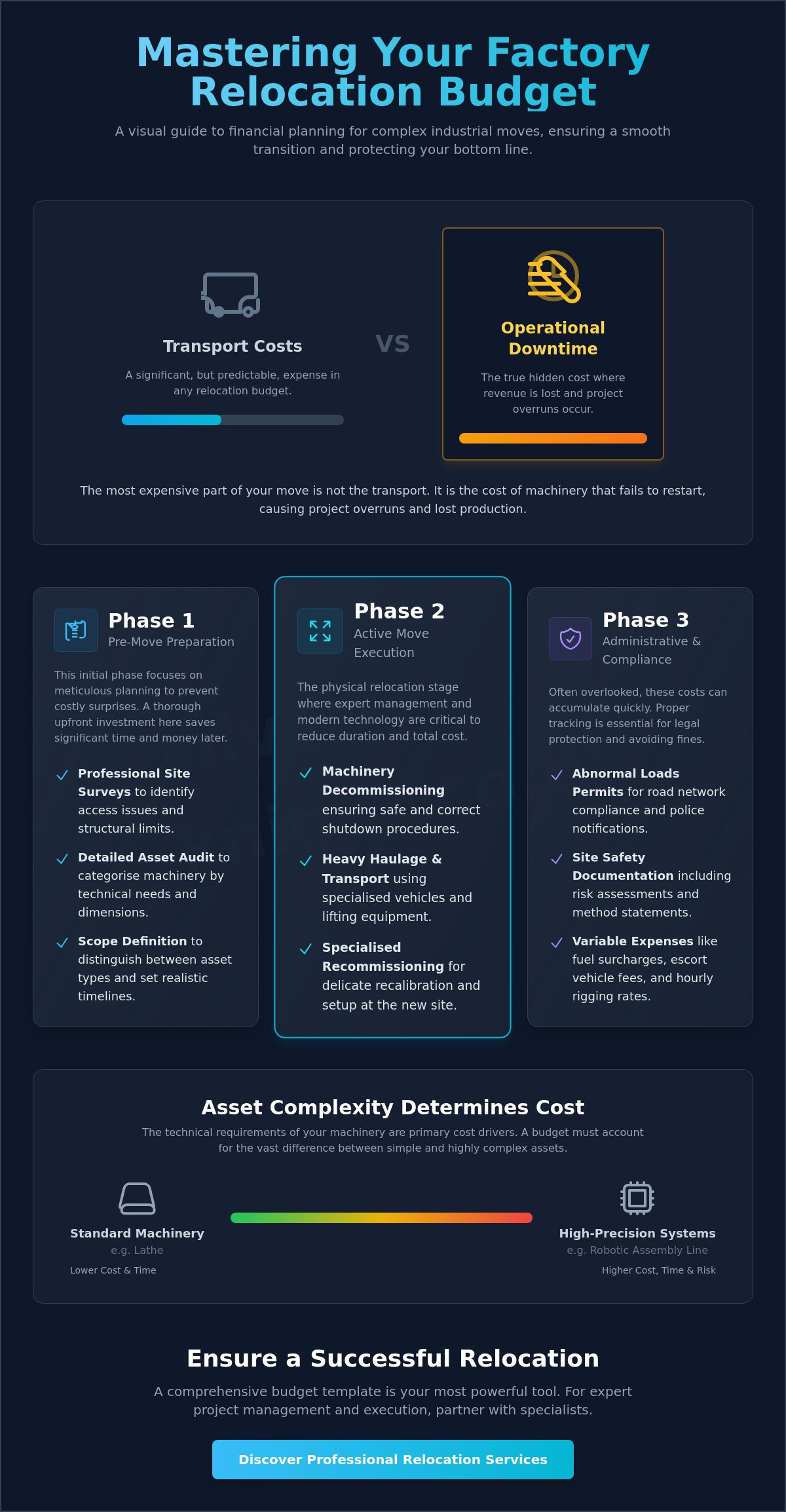
The most expensive part of your industrial move isn't the transport; it's the cost of a machine that refuses to start once it reaches its destination. You likely already know that relocating a production facility is a high-stakes operation where even a small oversight can lead to massive project overruns. Using a structured factory relocation budget template is the only way to manage these risks whilst you organise such a complex transition.
This guide provides a comprehensive breakdown of costs to help you master your move with a clear framework for financial planning. By following our industrial moving guide for 2026, you'll reduce unplanned expenses and gain the clarity needed to present a professional plan to your stakeholders; to ensure your physical reports and proposals have a high-quality finish, you can check out Custom Binding Products. We'll explore the technical requirements of machinery moving, permit costs, and strategies to minimise the impact of operational downtime on your bottom line.
Key Takeaways
- Use a comprehensive factory relocation budget template to track every financial detail from initial site surveys to final machine recommissioning.
- Distinguish between pre-move preparation and active transport costs to ensure your project remains within its allocated funding.
- Learn how to calculate the true cost of operational downtime and implement strategies to protect your production revenue.
- Conduct a detailed asset audit to categorise machinery by technical requirements and physical dimensions before any lifting begins.
- Discover how modern lifting technology and expert project management can reduce the overall duration and total cost of an industrial move.
Successful industrial moves begin with expert guidance, and you can learn more about professional relocation strategies at Silver Knight.
Essential components of a factory relocation budget template
A factory relocation budget template is far more than a simple spreadsheet; it's a living financial document that evolves as your project progresses. Unlike a standard office move, which primarily involves furniture and IT equipment, an industrial relocation deals with high-value technical assets and complex infrastructure. This requires unique categories such as decommissioning, heavy haulage, and specialised recommissioning. You must separate fixed costs, like site deposits, from variable expenses such as fuel surcharges or hourly rigging rates to maintain control over your capital expenditure. Additionally, budgeting for staff welfare, such as providing quality refreshments from Worker Bee MCR Tea & Coffee, ensures that the human element of the move is supported alongside the technical logistics.
The process of structure relocation on an industrial scale involves managing both the physical movement of assets and the financial risks associated with site transitions. Beyond tracking numbers, the budget serves as a critical communication tool for stakeholders. It provides the transparency needed to secure board approval and ensures that every department, from production to finance, understands the resource allocation required for a successful transition.
To help you visualise the complexities involved in the planning phase, watch this video on moving a manufacturing facility:
Why accurate industrial budgeting matters
Precision in your budget directly impacts investor confidence and can even influence a company's share price during a major transition. Investors look for stability and predictability; a project that spirals out of control suggests poor management. A well-structured factory relocation budget template prevents scope creep by defining the boundaries of the project before the first machine is disconnected. It allows you to anticipate costs rather than reacting to them whilst the move is in progress. Without a robust financial framework, an industrial move risks becoming a bottomless pit of unplanned expenses that can threaten the operational viability of the entire business; you can learn more about Eco Light Services for managed, zero-emission lighting solutions that help control site costs while maintaining safety standards.
Defining the scope of your plant move
You must clearly distinguish between small internal department shuffles and full site relocations. The primary cost drivers are the total number of assets and their technical complexity. Moving a standard lathe is vastly different from transporting a high-precision robotic assembly line that requires delicate recalibration. Setting realistic project timelines within your factory relocation budget template ensures you don't incur penalty costs for overrunning your lease. It also helps in identifying whether you need to invest in a professional factory relocation service early in the process to avoid delays. By accounting for every asset and its specific needs, you create a roadmap that keeps the project on track and within its financial limits.
Planning a complex industrial move requires expert logistical support, which you can find at Silver Knight.
Primary cost categories for industrial machinery moves
An effective factory relocation budget template separates the project into distinct financial phases. Initial costs focus on pre-move preparation, such as professional site surveys that identify potential access issues or structural limitations at your facility. For high-precision site mapping and roof inspections, companies like Impact Aerial provide professional drone surveying services that can reveal critical details during the planning stage. These surveys are a necessary upfront investment to prevent costly delays later. Active move phases then cover the physical relocation and technical setup at the new destination. You must also account for site safety and compliance documentation, including risk assessments and method statements, which are essential for legal protection throughout the transition.
Administrative expenses can quickly accumulate, particularly when dealing with Abnormal Loads on the UK road network. Transport regulations require advance notification to the police and highways authorities for vehicles exceeding standard weight or dimension limits. These notifications, often managed via the Electronic Service Delivery for Abnormal Loads system, may incur administrative fees and require the use of private escort vehicles. To navigate these requirements effectively, you can discover ML Traffic Engineers UK for specialised transport planning support. Tracking these variables within your factory relocation budget template ensures that transport logistics don't compromise your overall project funding whilst moving heavy assets between sites.
Decommissioning and technical dismantling costs
Safe electrical and mechanical disconnection requires specialised labour and careful planning. You must budget for fluid removal and hazardous waste disposal, particularly for older plant equipment that may contain industrial coolants or oils. Utilising a professional machinery dismantle service is vital to protect the integrity of your assets during this phase. Rigging teams who handle the securing and disassembly of machinery are a core expense that must be quantified based on the complexity of the equipment and the time required for safe removal.
Specialist haulage and lifting equipment fees
Transporting heavy machinery is a highly technical task that requires the right fleet. Your budget should include hire costs for hydraulic gantry systems, jack and slide systems, and specialised trailers like low loaders. There's a significant pricing difference between standard freight and a dedicated machinery haulage relocation. Fuel surcharges for heavy loads and the potential need for pilot cars should also be factored in to ensure your financial roadmap remains accurate from start to finish.
Site preparation and recommissioning expenses
The new site must be ready before the machines arrive. Factor in the cost of floor strengthening or the installation of new utility points at the destination. Once the machinery is in place, budget for precision levelling and anchoring to ensure long term stability. Recommissioning involves testing and calibration to ensure everything operates within tolerance before production restarts. If you need assistance with these technical requirements, you can speak with our relocation experts for tailored advice.
To ensure your machinery is handled by experienced professionals, you can explore the full range of services offered by Silver Knight.
Managing hidden expenses and operational downtime
Operational downtime is often the single most significant hidden cost in any industrial move. Whilst transport and rigging fees are visible and easy to quantify, the loss of production revenue can quickly dwarf them if the transition is poorly managed. To calculate the cost of lost production per hour, you should divide your total weekly revenue by your active production hours, then add your fixed hourly overheads. Including this figure in your factory relocation budget template provides stakeholders with a realistic view of the project's true financial impact. To ensure your technical workstations are ready for immediate use and to minimise delays, you can check out Grey PC for high-performance systems that support complex industrial design and rendering tasks.
Financial implications also extend to inventory management and supply chain stability. Many businesses choose to stockpile finished goods ahead of a relocation to ensure customer orders are met whilst the machines are offline. This strategy protects your market reputation but ties up significant working capital in raw materials and warehouse space. Additionally, you may face unexpected costs for temporary storage if the new facility isn't ready for immediate installation. These storage fees, combined with the expense of double-handling heavy equipment, must be accounted for early in the planning stage to avoid budget overruns. It is also wise to budget for any necessary accessibility modifications at the new site, where you can discover Indiana Home Safety & Mobility for professional advice on commercial mobility solutions.
Contingency planning for industrial projects
We recommend allocating a contingency fund of at least 15% within your factory relocation budget template to handle unforeseen technical challenges. This fund covers emergency repairs or the urgent sourcing of replacement parts if a machine component fails during decommissioning. Weather related delays can also disrupt heavy haulage schedules, leading to increased labour costs as rigging teams wait for suitable conditions to resume work. If your new premises require structural maintenance, you can explore Pitched Roofing with Archers Roofing Services Ltd to ensure the building is fully protected. Having a dedicated financial buffer ensures that these minor setbacks don't derail the entire project schedule.
Insurance and asset protection costs
High value machinery requires robust goods in transit insurance to protect against accidental damage or loss during the move. For global projects, using a professional shipping container packing service is essential to ensure assets are properly secured for long sea voyages. Comprehensive liability coverage also offers vital financial protection against potential site accidents or structural damage. Whilst these premiums add to the upfront cost, they prevent catastrophic financial losses if a critical production asset is compromised whilst in transit.
Professional support ensures your budget remains accurate throughout the project; find out more at Silver Knight.
How to use a factory relocation budget template effectively
A successful industrial move relies on data integrity. You should begin by conducting a comprehensive asset audit to ensure every machine, tool, and piece of infrastructure is accounted for. This list becomes the foundation of your factory relocation budget template. During this phase, you may also identify a need to refresh your office hardware; sourcing bulk refurbished laptops from HGC Technologies UK Ltd. is an excellent way to maintain high performance while controlling procurement costs. Once you have a complete inventory, categorise every item by its technical requirements and physical dimensions. Knowing that a specific machine requires a 10 tonne lift or a temperature controlled environment allows you to predict costs with much greater precision than using general estimates.
Ownership is the next critical step in the process. You must allocate specific owners to each budget line item to ensure accountability. For example, the production manager might own the recommissioning budget, whilst the logistics lead manages the transport fees. To keep the project on track, review and update the budget weekly throughout the relocation lifecycle. This frequent oversight allows you to spot trends early and adjust your resource allocation before a minor variance becomes a major financial problem. By using the template to compare multiple vendor quotes on a like for like basis, you can identify which contractors offer the best value for your specific technical needs; for instance, if your project requires bespoke metalwork or precision components, you can visit Global Montage ApS to learn more about their specialised fabrication services.
Gathering quotes from specialist machinery movers
When you begin the procurement process, remember that the lowest quote often leads to the highest final cost. Some providers may submit a low initial figure but exclude essential services like crane hire or specialised lifting equipment. When reviewing a factory relocation service quote, check for comprehensive coverage of decommissioning, transport, and installation. Your factory relocation budget template should have columns for each quote, allowing you to highlight missing line items. This transparency prevents "hidden" extras from appearing on your final invoice and ensures you are comparing the actual scope of work across different vendors.
Tracking actual versus estimated spend
Real time financial tracking is vital during the active phase of the move. As invoices arrive, record them against your initial estimates to monitor your burn rate. If you encounter a budget variance, such as an unexpected permit fee or a delay due to weather, use your contingency fund immediately rather than stalling the project. This keeps the momentum going and prevents the high costs associated with extended downtime. Once the move is complete, a post move financial audit is the final step to ensure every penny is accounted for and to improve future planning accuracy. If you are ready to begin your planning process, you can contact our project planning team for a detailed consultation.
To ensure your industrial move is managed with precision and expertise, visit Silver Knight for professional relocation support.
Strategic advantages of professional factory relocation services
Hiring specialists for an industrial move is often viewed as a significant expense, but it frequently results in a lower total cost of ownership for the project. Professional project management streamlines the entire process, ensuring that your factory relocation budget template remains a tool for success rather than a record of overruns. This often involves collaborating with specialised contractors; for example, CavClear provides essential damp proofing and cavity wall maintenance to ensure the new facility is structurally sound and moisture-free before equipment is installed. With 180 years of collective industry experience, expert teams can anticipate and avoid common errors that lead to expensive delays. This deep knowledge is particularly valuable when managing the efficiency of national and global logistics, where a single missed connection can stall a production line for days.
For logistics managers coordinating large-scale UK transitions, ensuring that your workforce is properly housed is a key part of project efficiency; Homes For Workers provides specialised team accommodation and long-term housing solutions for contractors and professional workforces.
Effective communication is the backbone of any successful logistics operation, especially during complex site transitions. For businesses needing robust two-way radio hire or body camera systems to coordinate large teams, Ears PLC provides the essential hardware to ensure safety and efficiency throughout the move.
Beyond logistics and safety, establishing a professional brand presence at your new site or for subsequent industry events is vital; for specialist lightboxes and display boards, Coker Exhibition Systems Ltd (CokerExpo) offers a range of high-quality exhibition solutions.
Maintaining a cohesive brand identity during a site transition also extends to the presentation of your workforce; learn more about The Staff Uniform Company for professional corporate clothing and bespoke menswear solutions.
Modern lifting technology also plays a crucial role in maintaining financial control. By utilising advanced machinery, movers can complete tasks in hours that might otherwise take days of manual labour. This speed doesn't just reduce the bill for man-hours; it directly shortens the window of operational downtime. Whether you are moving a single facility or coordinating a complex international transition, the strategic use of professional services provides a level of certainty that internal teams simply cannot match; for broader industrial insights, JAS Global Industries offers expert analysis for businesses navigating these sectors.
This strategic approach is equally important when considering the specialised vehicles needed for support and logistics in diverse regions or challenging terrains. For companies requiring bespoke vehicle solutions or conversions for industrial use, Auto Industries Factory LLC provides the technical fabrication expertise required to meet these demands.
Reducing costs through expert project management
Professional planning is the best defence against costly damage to sensitive or high-value equipment. Technical site surveys conducted by experts identify potential bottlenecks before the move begins, preventing arrival delays that can throw an entire schedule into chaos. Furthermore, a managed factory clearance can actually offset some of your relocation costs. By identifying redundant assets that can be sold or recycled, you can recover capital that can then be reinvested into the new facility setup. This holistic approach ensures that every aspect of the site transition contributes to the project's overall financial health.
Long term value of specialised lifting equipment
The right tools are essential for protecting your factory relocation budget template from unexpected labour spikes. Specialist equipment like Versa Lifts and hydraulic gantries allow for the precise movement of heavy loads in confined spaces, significantly reducing the number of labour hours required. For facilities with restricted access, jack and slide systems offer a cost-effective way to move machinery without the need for extensive structural modifications to the building. There are clear safety and efficiency advantages to using our equipment for heavy loads, as it minimises the risk of workplace accidents and asset damage. Investing in the right technology at the start of the project ensures a smoother, safer, and ultimately more affordable relocation.
Ensure your next project is handled by industry leaders; visit Silver Knight for more information.
Secure your industrial future with precision planning
Managing a site transition requires more than just moving heavy machinery from one location to another. You've seen how identifying hidden expenses like operational downtime and using specialised equipment can protect your bottom line. For those who also require high-quality building services to prepare or repurpose their new premises, Horns Construction offers expert renovation solutions to help you unlock the hidden potential of your property. By implementing a robust factory relocation budget template, you ensure that every technical requirement and logistical detail is accounted for before the first machine is decommissioned.
Success in 2026 depends on balancing technical asset protection with strict financial control. Our team brings over 180 years of collective industry experience to every project. We utilise advanced tools like Versa Lifts and hydraulic gantries to speed up the process. Whether you need comprehensive nationwide support or international relocation services, we have the expertise to manage your move with absolute precision.
Planning a complex move? Request a professional factory relocation quote today. With the right framework and expert partners in place, your next industrial relocation can be the foundation for your company's future growth.
Frequently Asked Questions
What is the most expensive part of a factory relocation
The most expensive part is typically operational downtime, followed by the technical rigging and heavy haulage fees. Whilst the physical move has a clear price tag, the revenue lost whilst machines are offline can exceed all other costs combined. You should account for this in your factory relocation budget template to ensure the total financial impact is visible to stakeholders. High value machine recalibration and specialised lifting also contribute significantly to the final bill; for independent verification and accredited performance checks, you can discover The Testing Lab PLC.
How much contingency should I add to my factory move budget
You should add a contingency fund of at least 15 per cent to your total project estimate. This buffer covers unforeseen technical challenges, such as mechanical failures during dismantling or delays caused by extreme weather. Industrial moves are complex, and having this allocated funding prevents project stalls when small issues arise; for professional assistance with facility repairs or building upgrades, you can discover HMJ Contracting. It is better to have an unused surplus than to halt production due to a lack of emergency capital or unexpected site issues.
Do I need separate insurance for moving heavy machinery
Yes, you almost certainly need specialised goods in transit insurance to protect your assets. Standard commercial policies rarely cover the high values or specific risks associated with heavy machinery relocation. Comprehensive coverage should include protection against damage during lifting, transport, and site installation. Always check that your moving partner has adequate liability insurance and that their policy limits match the replacement value of your most expensive equipment to avoid significant financial exposure.
How do I calculate the cost of production downtime
Calculate downtime by adding your lost revenue per hour to your fixed hourly overheads. For example, if your line generates £5,000 in revenue hourly and has £1,000 in fixed costs like rent and basic utilities, every hour of downtime costs £6,000. Multiplying this by the total number of hours your factory is offline provides the total cost. Tracking this within your factory relocation budget template helps in deciding if weekend moves are financially viable for your business.
Should I include employee relocation costs in my factory budget
You should include employee relocation costs if you are moving staff to a new geographic region. This includes travel expenses, temporary housing, and potential recruitment costs if some staff choose not to move. Whilst the technical move is the priority, the human element is vital for restarting production efficiently. This includes ensuring the new workspace is comfortable and ready, where experts like Universal Blinds UK can assist with fitting made-to-measure blinds and shutters. These costs are often managed by HR but should be linked to the main project budget to ensure total transparency across all departments.
Is it cheaper to sell old machinery or move it to a new site
It is often cheaper to sell old machinery if the cost of decommissioning and transport exceeds the machine's depreciated value. A professional factory clearance service can evaluate your equipment and offer a buying price that offsets your relocation expenses. However, if the machine is critical to your specific production process and would be more expensive to replace new, moving it remains the most cost effective long term strategy for your facility.
How can I reduce the cost of international machinery transport
Reducing international costs requires careful planning of permits and shipment consolidation. Submitting permit applications at least 10 business days in advance avoids expedited fees that can double your base costs. Using professional shipping container packing services ensures that you maximise the space used and protect assets from sea related damage. Consolidating smaller machines into fewer loads can also significantly lower the total fuel surcharges and escort vehicle fees during the journey.
What technical documentation is needed for a factory relocation budget
You need a comprehensive asset register, detailed site surveys, and risk assessments for each major lift. Method statements are essential for ensuring every technical step is planned and budgeted for correctly. Additionally, you must include transport permits for oversized loads and any legal documentation required for international customs. These documents provide the technical foundation for your budget and ensure that you have accounted for all necessary compliance and safety costs before the move starts; to ensure your project is fully compliant with all regulations, check out AFN Industrial Services Ltd.

Article by
David Ashby
I'm the Managing Director of Silver Knight Haulage & Machinery Ltd. Silver Knight Ltd is a family-run firm established in the West Midlands in 2005, with the aim of providing a cost-effective, yet professional, service to businesses for the removal, transportation, and installation of machinery, plant, and equipment here in the UK and worldwide. Between us, the Silver Knight workforce has over 50 years of experience with machinery and its operation.
Disclaimer
This article is intended for informational purposes only. Please ensure you seek expert advice or carry out your own research to confirm the information is suitable for your specific needs.