Your standard business insurance policy is almost certainly insufficient to cover the relocation of a production line or a heavy industrial plant. It's a worrying reality that many site managers only discover when a high-value asset is damaged during transit or installation. You likely feel the pressure of ensuring a multi-stage move goes perfectly whilst fearing that a single oversight could lead to a massive financial loss. Understanding the specific machinery moving insurance requirements for 2026 is the only way to protect your investment and your reputation.
We've created this comprehensive guide to help you manage the complexities of liability and cover during industrial relocations. You'll gain a clear understanding of the difference between mandatory and recommended insurance, such as riggers liability and cargo cover. We also provide a practical checklist to verify your contractor's credentials so you can proceed with confidence. From navigating new FMCSA Motus registration rules to closing hidden gaps in your policy, this article ensures your next move is fully protected and compliant.
Key Takeaways
- Learn why standard business insurance often fails to cover industrial relocation and why specific policies are a legal necessity.
- Discover how to navigate machinery moving insurance requirements to ensure your assets are protected from the moment they are decommissioned until they are recommissioned.
- Identify the critical differences between public liability and goods in transit cover to avoid expensive gaps in your protection.
- Get a practical checklist for verifying contractor insurance certificates and ensuring their policy limits match your equipment's total value.
- Find out how technical site surveys and pre-move documentation can safeguard your business against disputed liability claims.
If you are preparing for a complex industrial project, you can find expert support through our machinery moving services.
The fundamental machinery moving insurance requirements
Insurance is more than just a box-ticking exercise for industrial projects. It is a fundamental shield against the high costs of equipment failure or accidental damage during a move. Without the correct cover, a single incident could halt your production for weeks or even months. It is not just about replacing a piece of hardware; it is about protecting the future of your entire operation.
Meeting the specific machinery moving insurance requirements is essential to ensure that your business remains compliant with UK law. These requirements often change based on the total value of the equipment and the technical difficulty of the lift. Relying on basic policies often leads to expensive gaps that only become apparent when a claim is rejected. This is why a detailed assessment of your current cover is the first step in any successful relocation plan.
To better understand the scale and complexity of these operations, watch this helpful video:
Why standard business insurance is usually insufficient
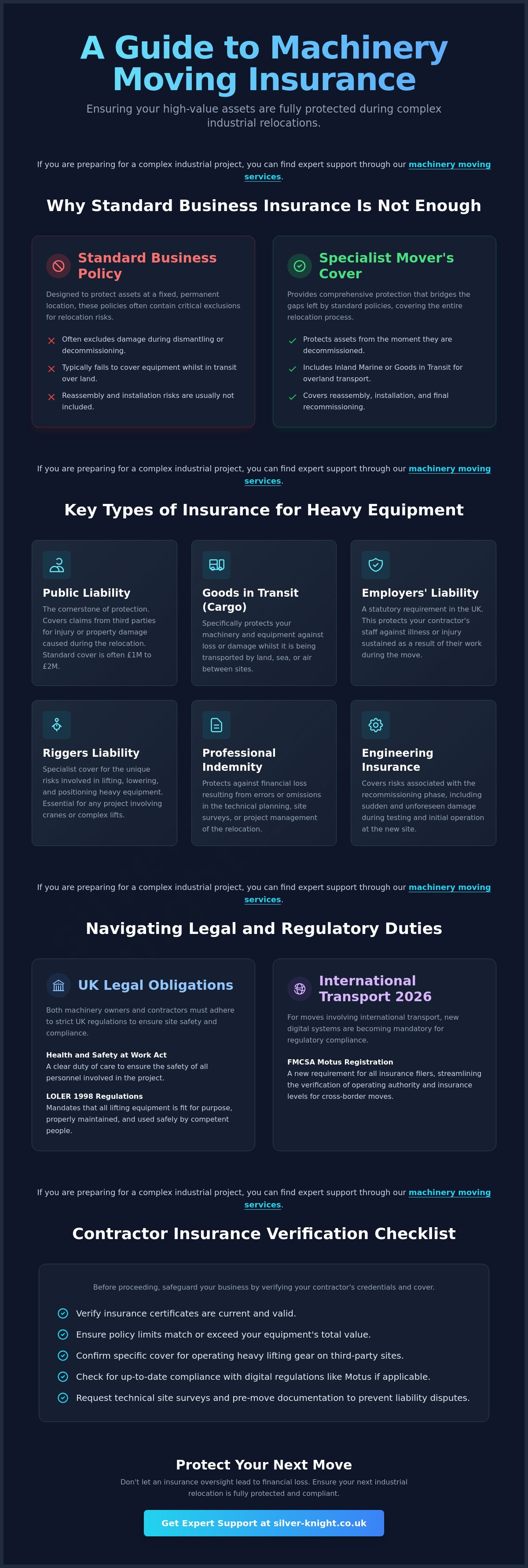
Most standard business insurance policies are designed to protect assets whilst they are at a fixed, permanent location. They rarely account for the unique risks involved when heavy equipment is being dismantled, lifted, or transported across the country. These policies often contain strict exclusions for accidental damage during reassembly or decommissioning. For comprehensive protection, specialist Inland Marine Insurance is often required to cover goods and equipment whilst they are in transit over land. This type of cover is vital because it bridges the gap between your property insurance and your motor haulage policy.
Legal obligations for machinery owners and contractors
Both the machinery owner and the contractor have significant legal duties during a factory relocation service. Under the Health and Safety at Work Act, there is a clear duty of care to ensure the safety of all personnel on site. Additionally, the Lifting Operations and Lifting Equipment Regulations 1998 (LOLER) mandate that all lifting equipment is fit for purpose and used safely. Contractors must hold valid employers liability insurance and specific policies that permit the operation of heavy lifting gear on third party sites. Failing to verify these credentials can leave you legally liable if an accident occurs.
Beyond internal site safety, there are broader regulatory shifts to consider in 2026. If your move involves international transport, compliance with the new Motus registration system is now a requirement for all insurance filers. This technological shift aims to streamline how operating authority and insurance levels are verified. Ensuring your contractor is up to date with these digital requirements is just as important as checking their physical equipment. Understanding these requirements early in the planning phase prevents costly disputes and ensures that your business continuity remains a priority throughout the transition.
If you are planning an industrial relocation, you can find expert support through our machinery moving services.
Key types of insurance cover for heavy equipment
Meeting the diverse machinery moving insurance requirements involves balancing several different policies. Whilst public liability is well known, other covers like professional indemnity for technical planning and engineering insurance for recommissioning are just as vital. Employers liability remains a statutory requirement for all UK businesses, ensuring that staff involved in the move are protected. Each of these components works together to create a safety net that covers your project from the initial survey until the final bolt is tightened.
Public liability and its role in machinery moving
Public liability insurance is the cornerstone of any relocation project. It provides protection against claims from third parties if an accident occurs on site. Standard coverage in 2026 is often $1 million per occurrence and $2 million aggregate, though corporate clients frequently demand between $2 million and $5 million. This policy covers damage to your premises or other equipment that might be affected during the move. You must verify these limits before work begins, as a shortfall in cover can leave your business exposed to significant financial risk.
Goods in transit and marine cargo insurance
Goods in transit insurance protects your assets whilst they are on the road. Many haulage contracts only offer weight-based cover, which is often insufficient for high-value industrial assets. You should ensure your policy covers the full replacement value of the machinery instead. For added security during the haulage phase, using advanced monitoring from Lock and Track can help protect these high-value loads in real-time. For shipments crossing into the United States, you must also consider Federal Insurance Requirements to stay compliant with overseas regulations. Commercial contracts generally specify $50,000 to $100,000 per shipment, but corporate clients often require $250,000 or higher to account for the true cost of modern technology.
Insurance for specialised lifting equipment
Using specialised lifting equipment like hydraulic gantry systems or jack and slide systems introduces unique risks. Standard motor insurance does not cover the operated hire of a Versa-Lift or a heavy crane. These machines require specific engineering insurance and riggers liability to cover the cargo whilst it is "on the hook." If you are using a heavy moving equipment hire service, you must clarify who is responsible for the insurance of the machinery being moved versus the lifting gear itself. Complex lifts often increase policy premiums, but they provide the necessary protection for your most valuable assets. To ensure your move is fully protected, you can speak with our experts about your specific requirements.
You can ensure your project is handled by professionals with the right cover by choosing our professional machinery movers.
Evaluating contractor liability and insurance limits
Selecting a contractor based on price alone is a common mistake that can lead to significant financial exposure. You must scrutinise their paperwork to ensure they meet all machinery moving insurance requirements before any equipment is touched. A standard haulage policy is rarely enough for industrial relocations. You need to see evidence of riggers liability, which specifically protects the asset whilst it is being handled by cranes, gantry systems, or other lifting gear. Verification should be a formal part of your procurement process to avoid disputes if an incident occurs.
Verifying the validity of insurance certificates
When you receive a Certificate of Insurance (COI), your first task is to check the expiry date. Industrial relocations can take several weeks; if the policy expires mid-move, your assets could be left unprotected. Confirm that the name of the insured party matches the company name on your contract exactly. It is also vital to understand the difference between a broker letter and a full policy. A broker letter is merely a summary. For high-stakes moves, you should request the full policy wording to check for specific exclusions. Some policies might exclude "goods on the hook" or damage caused during the decommissioning and dismantling phases.
Assessing the adequacy of liability limits
General liability limits of £1 million are common, but they are often insufficient for modern industrial environments. Corporate clients in 2026 typically require between £2 million and £5 million in total coverage to account for the high cost of machinery and potential business interruption. You must also consider the aggregate limit. If a contractor is working on multiple sites simultaneously, a single large claim elsewhere could exhaust their total cover for the year. If your equipment value exceeds their standard limits, you may need to arrange top-up cover or a project-specific policy to bridge the gap.
Specific equipment requires specific cover. If your mover uses hydraulic gantry systems or jack and slide systems, their policy must explicitly allow for these operations. Many standard policies only cover basic forklift work and exclude more complex mechanical lifting. Using a heavy machine movers specialist ensures that the insurance is tailored to the actual equipment being used on your site. This level of detail provides peace of mind that every stage of the move, from the first lift to the final installation, is fully indemnified. We recommend maintaining a contingency buffer of 10 to 15 per cent in your budget to cover unforeseen costs that might arise from delays or additional site requirements.
If you are looking for a reliable partner for your next project, explore our heavy machinery relocation services.
Steps to ensure your assets are fully protected
Securing the right paperwork is only half the battle. To truly meet machinery moving insurance requirements, you must take active steps to mitigate physical risks before the first piece of equipment is even touched. Many insurance brokers understand the policy wording but fail to grasp the mechanical reality of shifting a forty tonne press through a narrow factory door. Protection starts with a rigorous assessment of the environment and a clear plan for every stage of the move. By following a structured approach, you reduce the likelihood of a claim and ensure that your business remains operational throughout the transition.
The importance of a technical site survey
A technical site survey is the most effective way to prevent damage. This process involves a specialist visiting both your current site and the new destination to identify access restrictions, such as low overhead cables or tight corners. They will assess floor loading capacities to ensure the ground can support the weight of the machinery and the lifting equipment itself. Identifying these structural requirements early prevents accidents that could lead to a catastrophic insurance claim. A survey also allows the team to select the most appropriate tools, such as hydraulic gantries or jack and slide systems, which are specifically suited to the environment.
Once the physical path is clear, you must document the condition of every asset. Take high resolution photographs and videos of all machinery, noting any existing wear or cosmetic marks. This creates a definitive record that can be used to resolve any disputes regarding damage during transit. It is also a good time to contact your own insurance provider. Inform them of the planned relocation to ensure your property cover remains valid whilst the site is in a state of flux. Some policies require a temporary endorsement to cover the decommissioning phase.
Preparing for dismantling and recommissioning
The risks involved in the dismantling of complex production lines are often overlooked. Standard transit insurance might not cover damage that occurs whilst a machine is being taken apart or put back together. You must ensure that your contractor's policy explicitly includes decommissioning and recommissioning. This is particularly vital during the reassembly phase, where delicate components must be aligned with precision. Testing and commissioning should always be managed by an insured expert to ensure that the machinery is safe to operate before it is handed back to your production team.
Finally, ensure that all lifting operations are managed under a formal contract lift. This framework, governed by BS 7121 in the UK, shifts the responsibility for the lifting plan, equipment selection, and insurance liability to the contractor. It provides a much higher level of protection than a basic "hire and square" arrangement. To get a detailed assessment of your specific relocation needs, you can request a site survey from our technical team today.
If you need a team that understands every aspect of industrial relocation, you can book our professional machinery moving services.
Professional machinery moving with Silver Knight
Silver Knight is a family run business that prioritises safety and precision in every project. With over 180 years of collective industry experience, our team understands the unique pressures of factory relocation. We don't just move equipment; we provide a fully managed service that addresses all machinery moving insurance requirements from the outset. This expertise ensures that your high value assets are protected by comprehensive cover tailored specifically for heavy industrial environments. We work closely with you to ensure every stage of the move is documented and compliant.
We use a range of advanced equipment to execute complex moves with minimal disruption. Our fleet includes hydraulic gantry systems and Versa Lifts, allowing us to operate in confined spaces where traditional cranes cannot reach. Whether you require a single machine move or a complete plant relocation, our approach is always professional and helpful. Our heritage as a family business means we treat your machinery with the same care as if it were our own.
Our commitment to safety and compliance
Safety is our primary concern. We maintain rigorous adherence to the Lifting Operations and Lifting Equipment Regulations 1998 (LOLER) and all relevant health and safety standards. Every operator in our team is highly trained to use specialised lifting equipment, ensuring that every lift is planned and executed with total control. Our proven track record in factory relocation and plant moving across the UK and internationally speaks to our dedication to excellence. We manage the entire process, including decommissioning and recommissioning, so you can focus on your core business operations. This thoroughness reduces the risk of accidents and helps maintain business continuity.
Comprehensive logistics and storage solutions
Industrial relocations often require more than just transport. We offer secure warehousing and storage for machinery between moves, providing a safe environment for your equipment if your new site isn't ready. For clients moving assets overseas, we provide expert export packing and international machinery transport services to ensure compliance with global regulations. Our dedicated fleet for machinery haulage operates across the UK, offering a reliable link in your supply chain. From factory clearance to contract lifting, Silver Knight provides the technical expertise and insurance backing necessary for a seamless transition. We take the stress out of moving heavy assets by providing a complete, insured solution from start to finish.
To ensure your relocation is handled with the highest level of care, you can explore our machinery moving and installation solutions.
Securing the future of your industrial relocation
Protecting high value assets requires more than standard business cover. It demands a thorough understanding of machinery moving insurance requirements, including specialised riggers liability and technical site surveys. Verifying contractor credentials and ensuring policy limits match the full replacement value of your plant are essential steps for any site manager. By bridging the gap between property insurance and transit cover, you safeguard your business against unforeseen financial loss.
Silver Knight brings over 180 years of collective industry experience to every project. As a family run business with a national and global reach, we specialise in heavy lifting using hydraulic gantries and jack systems. We provide the technical expertise and robust insurance backing needed for even the most complex factory relocations. To ensure your industrial assets are moved with expert care and full insurance protection, contact Silver Knight Haulage & Machineries Ltd today. Your next move can be a seamless and successful transition with the right preparation and a professional team by your side.
Frequently Asked Questions
Does my standard business insurance cover machinery whilst it is being moved?
Standard business insurance typically excludes coverage for assets once they leave their registered premises. These policies are designed for static risks and rarely account for the unique dangers of lifting or road transit. To protect your equipment during a relocation, you must secure a specific endorsement or hire a contractor who meets all machinery moving insurance requirements. Without this, you could face the full cost of repairs or replacement out of your own pocket.
What is the difference between public liability and goods in transit insurance?
Public liability insurance protects against claims for injury or damage caused to third parties and their property. In contrast, goods in transit insurance specifically covers the physical machinery whilst it is on the move. Whilst public liability is essential for site safety, it does not provide cover for the value of the machine being transported. You need both types of protection to ensure your assets and your business are fully shielded from financial risk.
Who is responsible if a machine is damaged during a move?
Responsibility generally falls on the party identified in the moving contract, which is why a formal contract lift is so important. Under a contract lift, the moving company takes full responsibility for the planning, execution, and insurance of the project. If damage occurs due to contractor negligence or equipment failure, their professional indemnity or riggers liability should cover the loss. Always clarify these liability boundaries in writing before the project begins to avoid disputes.
How much insurance cover should a machinery moving company have?
A professional contractor should carry public liability cover of at least £2 million, though £5 million is increasingly standard for industrial sites in 2026. Their goods in transit cover must match or exceed the total replacement value of your most expensive asset. For high value production lines, you may need to request a specific increase in their policy limits. Never assume that a contractor's standard cover is enough for your specific machinery moving insurance requirements without seeing their documents.
What is engineering insurance and do I need it for my relocation?
Engineering insurance provides cover for machinery whilst it is being tested, commissioned, or operated during the installation phase. Standard transit policies often end the moment the machine is offloaded, leaving a gap during the critical recommissioning stage. If your relocation involves complex mechanical or electrical setup, engineering insurance is vital. It protects against accidental damage or breakdown during the initial startup, providing peace of mind that your equipment is safe to return to service.
Are there specific insurance requirements for international machinery transport?
Yes, international moves require marine cargo insurance and compliance with the regulations of the destination country. For moves involving the United States in 2026, contractors must be registered with the new Motus system to verify their insurance filings. You should also ensure that the cover accounts for different legal jurisdictions and potential delays at customs. International transport involves higher risks, so full replacement value cover is more important than ever to protect your investment.
What documents should I ask for to verify a contractor insurance?
You should request a valid Certificate of Insurance (COI) that clearly states the policy expiry date and the name of the insured party. It is also wise to ask for the full policy schedule to check for exclusions related to dismantling or lifting. A broker letter can provide a helpful summary, but it does not replace the detail found in the actual policy wording. Checking these documents ensures that the contractor is actually covered for the specific work they are doing.
Does insurance cover the dismantling and installation of machinery?
Coverage for dismantling and installation is not always included in standard transit policies and must be specifically requested. Many basic haulage covers only apply whilst the machine is on the vehicle. To ensure protection, your contractor needs riggers liability or an all risks policy that includes the decommissioning and reassembly phases. Always confirm that these activities are covered, as many accidents happen during the technical dismantling process rather than during actual road transport.

Article by
David Ashby
I'm the Managing Director of Silver Knight Haulage & Machinery Ltd. Silver Knight Ltd is a family-run firm established in the West Midlands in 2005, with the aim of providing a cost-effective, yet professional, service to businesses for the removal, transportation, and installation of machinery, plant, and equipment here in the UK and worldwide. Between us, the Silver Knight workforce has over 50 years of experience with machinery and its operation.
Disclaimer
This article is intended for informational purposes only. Please ensure you seek expert advice or carry out your own research to confirm the information is suitable for your specific needs.