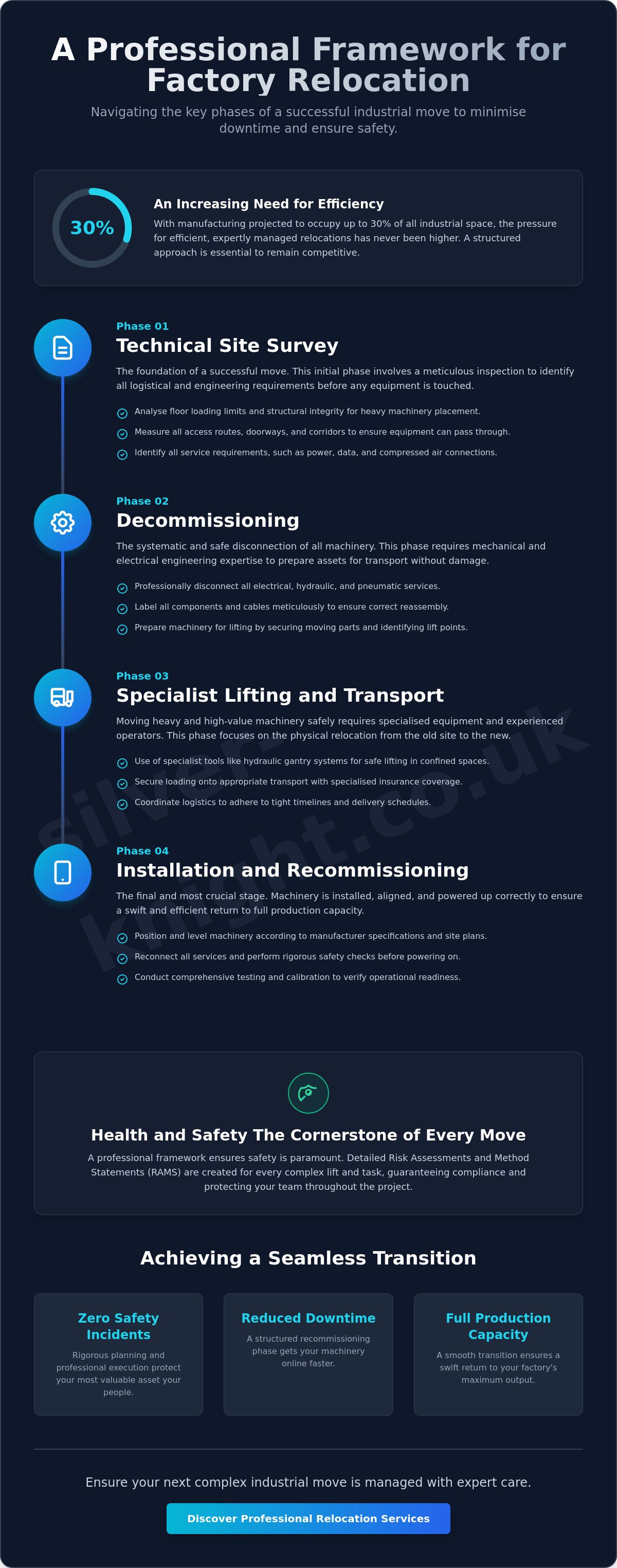
With manufacturing now occupying up to 30% of all industrial space, the pressure to move equipment quickly and safely has reached a peak. You probably feel that the logistical burden of a move is overwhelming, especially when you consider the risks to your production schedule. Successful factory relocation project management is about more than just moving boxes; it's about protecting your bottom line and your people whilst maintaining a strict schedule. It is natural to worry about the safety risks associated with lifting heavy machinery or the potential for expensive delays.
We understand that the fear of extended downtime and the complexity of trying to organise different contractors can be daunting for any team. This guide offers a professional framework to help you manage complex industrial moves with minimal disruption. You'll learn how to create a reliable timeline, handle heavy machinery lifting safely, and ensure all equipment is recommissioned correctly. By following these steps, you can gain the confidence that your move will result in zero safety incidents and a swift return to full production capacity.
Key Takeaways
- Learn how effective factory relocation project management integrates mechanical engineering with complex logistics to protect your production schedule.
- Understand why a technical site survey is vital for identifying floor loading limits and access restrictions before moving any equipment.
- Discover how specialist tools such as hydraulic gantry systems enable the safe lifting of heavy machinery within confined factory spaces.
- Ensure site safety by following a professional framework for creating detailed Risk Assessments and Method Statements for every complex lift.
- Reduce operational downtime by implementing a structured recommissioning phase to test and power up machinery correctly.
If you are planning a complex industrial move, you can find expert support through professional factory relocation services to ensure your project stays on track.
The Critical Role of Factory Relocation Project Management
Effective factory relocation project management represents the vital integration of logistics and mechanical engineering. It is much more than simply moving equipment from one building to another. This process involves the detailed planning of decommissioning, specialised transport, and precise recommissioning. By applying rigorous project management principles, a business can maintain control over every variable, ensuring that the transition is both smooth and predictable.
A dedicated project manager is essential for coordinating tight timelines and various subcontractors. Without this central figure, communication often breaks down, leading to expensive delays. Professional management reduces operational lag and protects your high value assets from damage during transit. It provides a single point of contact for the entire relocation process, which ensures that every phase of the project is transparent and accountable. This approach is particularly important as manufacturing is predicted to use up to 30% of all industrial space by late 2026, making efficient space transitions more competitive than ever.
While industrial moves focus on heavy machinery, you might also need to manage the clearance of residential or office-based assets. In such instances, you can explore House Clearance Service providers like Clear This Ltd to ensure that all non-industrial spaces are emptied professionally.
Beyond the physical move, manufacturing and retail businesses must also consider their ongoing supply chain requirements. Partnering with a third-party logistics expert like EZ3PL Ltd allows companies to maintain their fulfilment services even while their main facility is in transition.
Furthermore, to prevent any interruption in your production of health or food items, you can explore Sachet Packing with Simplepack Ltd as a contract packing solution during your facility's transition.
If your move involves the acquisition of new premises or the sale of your current site, you can check out Auction Property Ltd for specialist commercial property auction services.
To ensure your new facility's office and administrative areas are as efficient as the production floor, Excel Business Environments Ltd provides comprehensive commercial refurbishment and office partitioning services.
To better understand how these processes work in a manufacturing context, watch this helpful video:
Why In House Teams Often Struggle with Large Moves
Standard maintenance teams are excellent at keeping a factory running day to day. However, they often lack the heavy lifting equipment and specific experience required for a full site move. Relying on general hauliers instead of industrial relocation specialists also introduces significant risks. General movers don't always have the specialised insurance and liability coverage needed for high value machinery. This can leave a business exposed if a critical piece of equipment is damaged. Internal teams might also not be fully aware of the latest safety updates, such as the January 2026 OSHA re-classification deadlines for substances, which must be managed during a move.
The Value of Collective Industry Experience
Experience is the most valuable asset in any move. Having 180 years of collective experience allows a specialist team to anticipate common relocation pitfalls before they cause problems. A family run approach, where senior experts lead every project, offers a level of care that generalist firms cannot match. These specialists provide hands on expertise in mechanical engineering. They don't just manage the paperwork. They understand the physical requirements of the machines, whereas generalist project management firms often lack this practical, technical depth.
This commitment to a family-run service is equally important when handling the removal of non-industrial items or clearing out old sites; for these specific needs, lancashirehouseclearance.com provides a professional solution that complements the technical relocation process.
If you're looking for a partner to handle your industrial move, Silver Knight offers the expertise needed for a seamless transition.
Key Phases of a Successful Industrial Move
A successful project is built on a foundation of clear, sequential phases. Professional factory relocation project management ensures that each step, from the first survey to the final machine test, is handled with technical precision. It's helpful to view the move as a lifecycle rather than a single event. Many professionals use resources like the HBR Project Management Handbook to help map out these complex dependencies. By breaking the move into distinct stages, you reduce the risk of unforeseen costs or safety issues that could halt your production lines.
The process generally moves from a technical survey into decommissioning, followed by transport, and finally installation. Each phase requires a different set of skills, from logistics planning to heavy mechanical engineering; for those coordinating long-distance relocations in the US, providers like Southern Elite Van Lines can assist with the complex transport logistics involved. Managing these transitions correctly is what separates a smooth relocation from a chaotic one. It's about protecting the integrity of your machinery while keeping the project on a strict timeline.
Conducting a Thorough Technical Site Survey
The survey is the most critical part of the planning process. Technicians must measure every doorway, ceiling height, and turning circle to ensure that specialised moving equipment, such as Versa-Lifts, can operate safely within the space. They also evaluate floor loading limits at both the old and new sites. If a floor isn't strong enough to support the weight, we use heavy duty spreader plates to distribute the load. This level of detail is standard in a professional factory relocation service. It prevents the nightmare scenario of a machine arriving at a new facility only to find it won't fit through the entrance.
Systematic Decommissioning and Dismantling
Decommissioning is where the mechanical engineering aspect of the move really begins. It involves far more than just cutting the power. Every wire, pipe, and component must be systematically labelled and logged before any dismantling starts. For complex production lines, using professional machinery dismantle services is a necessity. This ensures that the machine can be reassembled at the destination without losing its calibration or functional integrity. A well documented dismantling phase directly leads to a faster and safer recommissioning process. If you have concerns about your specific equipment, it's a good idea to consult with experienced movers early in the planning stage.
Once the machinery is dismantled, the focus shifts to heavy haulage and precise installation. Logistics managers must coordinate transport permits and escort vehicles, which is particularly complex for international moves; in such instances, the expertise of a global provider like Asiatic International Relocation can help ensure a seamless transition between countries. Once the machinery arrives at the new site, it must be carefully positioned, levelled, and anchored before any recommissioning takes place. This systematic approach ensures that production can resume as quickly as possible with no loss of accuracy.
When managing the logistics of such a move, it is also important to consider the efficiency of the vehicles involved; many organisations use Fleetmaxx Solutions to help manage their fuel expenses and overall fleet performance during intensive transport periods.
Expert planning is the cornerstone of any successful industrial move, and you can access professional support at Silver Knight to manage your machinery assets safely.
Specialist Lifting and Technical Requirements for Heavy Machinery
The technical side of factory relocation project management involves more than just lifting; it requires the correct application of engineering principles to move assets through tight spaces. As highlighted in an academic case study on factory relocation, the choice of lifting equipment significantly impacts both the project timeline and the safety of the workforce. For many indoor moves, traditional cranes are impractical due to low ceiling heights or restricted access. This is where hydraulic gantry systems become essential. They provide a stable, overhead lift without the massive footprint or vertical clearance required by a mobile crane.
In scenarios where headroom is extremely limited, jack and slide systems are often superior. These systems allow heavy machinery to be lifted just a few inches off the floor and then slid into position on high capacity tracks. This method is much safer than a suspended lift in a cramped environment. To learn more about these tools, you can read our detailed guide on specialised lifting equipment. Using the right tools ensures that even the most awkward loads are handled with precision.
Choosing the Right Equipment for Restricted Access
Mobile cranes are often restricted to outdoor use because of their size and exhaust emissions. In contrast, hydraulic gantries are compact and can be assembled inside a factory to lift heavy components from above. For horizontal movement through narrow aisles, Versa-Lifts provide a unique solution. These specialised forklifts feature an extending chassis to increase capacity whilst maintaining a small enough footprint to navigate tight corners. A typical hydraulic gantry system can safely lift loads exceeding 400 tonnes within a confined industrial environment. These machines also use non marking tyres and load spreading technology to ensure that high value factory floors remain undamaged.
Precision Positioning and Levelling
Once a machine is moved to its new location, the work is far from over. Modern manufacturing demands positioning to within millimetre accuracy. This is especially true for CNC machines and high speed production lines where even a tiny misalignment can lead to mechanical failure or poor product quality. Precision levelling is the final technical hurdle. We use specialised skates and air mats to glide delicate equipment into its final position with minimal friction. This ensures that the machinery is perfectly stable before it is anchored and recommissioned for use.
Ensuring the safety of your staff and assets is paramount, so it is wise to partner with a firm that specialises in professional machinery moving to manage these risks.
Managing Health and Safety during Complex Industrial Relocations
Safety is not just a checkbox; it is the core of effective factory relocation project management. Every heavy lift or machinery move carries inherent risks that must be mitigated through meticulous planning. Project managers must coordinate closely with on site health and safety officers to align the relocation schedule with the facility's existing safety protocols. This collaboration ensures that the move doesn't compromise the health of workers remaining on site or the integrity of the building itself. Effective communication between all parties is the only way to prevent accidents in a busy industrial environment.
A major part of this coordination involves ensuring all activities comply with LOLER and PUWER regulations. These UK standards dictate how lifting equipment is used and maintained. Every operator handling specialised gear, from Versa-Lifts to hydraulic gantries, must have the correct training and certifications. It's also important to stay aware of broader regulatory shifts. For example, by January 2026, manufacturers must re-classify pure substances to align with updated safety standards. This means your project manager must account for new labelling and Safety Data Sheets when decommissioning chemical processing equipment. Keeping these records up to date is vital for maintaining a site's safety standing.
The Anatomy of a Machinery Move RAMS
A Risk Assessment and Method Statement (RAMS) is a live document tailored to each specific job. It identifies hazards such as crush zones, overhead obstructions, and floor loading limits. The method statement section provides a clear, step by step sequence for the entire move, ensuring every team member knows their role. This includes everything from the initial disconnect to the final anchoring of the machine. RAMS must be site specific and not based on generic templates because every factory layout presents unique challenges. This level of detail prevents confusion during the high pressure moments of a heavy lift.
Compliance with Industrial Safety Standards
Choosing a contract lifting service is one of the most effective ways to manage risk. Under a contract lift, the specialist provider takes on the responsibility for planning the lift and, crucially, assumes the legal liability for the operation. This is a significant benefit for factory managers who want to minimise their exposure. All lifting tackle and machinery undergo rigorous testing and certification to ensure they are fit for purpose. During the lift itself, clear communication and the establishment of exclusion zones are mandatory. This keeps non essential personnel away from the work area, reducing the chance of accidents. To ensure your next project meets these high standards, you should contact our safety experts today for a consultation.
To ensure your machinery is moved and installed by experts, you can visit Silver Knight for professional relocation support.
Ensuring a Smooth Transition to Full Production
The final phase of any industrial move is the most critical for your bottom line. Recommissioning is the systematic process of powering up machinery and testing its performance after it has been positioned and levelled. Professional factory relocation project management ensures this isn't a rushed event but a controlled technical procedure. By following a structured technical guide to industrial removals, teams can avoid the common pitfalls of hasty restarts. This phase is about more than just turning on a switch; it is about verifying that every system operates exactly as it did before the move.
A post-move review is essential to ensure all project objectives were met. This review looks at the timeline, safety records, and the mechanical state of the equipment. When managed correctly, the process delivers a turnkey solution where the client can walk into a fully functional facility. Beyond functionality, ensuring your machinery looks pristine is vital; you can visit SKR Specialists for expert industrial respray services. This level of oversight is what prevents the production "lag" that often haunts poorly planned relocations. It turns a potentially chaotic transition into a predictable business move.
To maintain this high level of operational efficiency in your new premises, you can check out The CFS Group for tailored facilities management that ensures your business operates seamlessly.
Technical Recommissioning and Testing
Reconnecting mechanical and electrical services requires precision and a deep understanding of the equipment. It's not enough to simply restore power. Every connection must be tested for integrity and safety. For example, if you are moving refrigeration systems, you must now account for the new EPA regulations effective from January 1, 2026, which require automatic leak detection for systems with high-global-warming-potential refrigerants. To ensure your new facility uses the most efficient climate technology, you might learn more about Vesinimas.LT and their expertise in modern heat pump systems. Initial test runs are crucial before returning to full production speeds. The project manager plays a vital role in "snagging," which involves identifying and resolving minor post-move issues before they can impact your output or cause mechanical failure.
Final Handover and Documentation
A well-managed move sets a strong foundation for the new facility's operational efficiency. For businesses requiring high-end construction or refurbishment of their new commercial premises, Daniels Contractors provides the specialist build services needed to create a premium environment. By treating the relocation as a controlled engineering project, you turn a daunting task into a manageable process. This professional approach ensures that your business is ready to meet the demands of a market where manufacturing space is becoming increasingly specialised and competitive.
Ensuring operational continuity is also vital for businesses with temperature-sensitive inventory. Mobile solutions, such as those provided by KC Frost Wagon, offer the necessary cooler and freezer trailer rentals to maintain stock safety while permanent cooling systems are being relocated and recommissioned.
To ensure your machinery is moved by a team of specialists, you can explore our full range of factory relocation services to begin your project.
Securing Your Future Production Capacity
Relocating an entire production facility is a complex undertaking that requires precise coordination and technical expertise. By prioritising effective factory relocation project management, you can bridge the gap between high level logistics and hands on mechanical engineering. This guide has highlighted how detailed site surveys, systematic decommissioning, and the use of specialist lifting gear are essential for protecting your high value assets whilst minimising downtime.
Our team brings 180 years of collective industry experience to every project, offering a nationwide service across the United Kingdom. We utilise a specialist fleet, including Versa-Lifts and hydraulic gantry systems, to ensure even the most restricted spaces are managed safely. Whether you are moving a single production line or an entire plant, professional management ensures your equipment is recommissioned correctly with zero safety incidents. This systematic approach allows you to focus on your core business whilst we handle the technical heavy lifting.
Discuss your factory relocation project with our expert team to start planning your move today. We look forward to helping you achieve a smooth and successful transition to your new facility.
Frequently Asked Questions
How long does a typical factory relocation project take to complete
A project can take anywhere from a few days for a single production line to several months for a full site move. The exact timeline is influenced by the number of machines, their complexity, and the distance between locations. We always provide a detailed schedule during the initial consultation to ensure your production downtime is kept to an absolute minimum.
What is the difference between a general haulier and a factory relocation specialist
General hauliers focus on transporting goods from one point to another without handling the mechanical aspects of the load. A specialist handles decommissioning, heavy lifting, and the eventual recommissioning of industrial assets. They use technical expertise to ensure machinery is not just moved but is ready to operate safely in its new home.
How much planning time is required before the actual move begins
Planning should ideally begin at least three to six months before the physical relocation takes place. This period allows for technical site surveys, the creation of RAMS, and the coordination of transport permits. For international moves, even more lead time might be needed to handle customs and cross border logistics effectively.
Can I keep parts of my production line running during the relocation
Yes, we can organise a phased relocation that allows your business to maintain partial production whilst other areas are being moved. This requires careful factory relocation project management to ensure the work areas are safely cordoned off and that utility disconnections don't affect the live parts of the factory.
What happens if my machinery is too heavy for a standard mobile crane
If a standard crane is unsuitable, we use alternative lifting solutions such as hydraulic gantry systems or jack and slide systems. These tools are designed for heavy loads in confined spaces where a crane cannot reach. They provide a stable and controlled lift for machinery weighing hundreds of tonnes.
Are professional machinery movers insured for damage during transit
Professional movers carry specific insurance policies that cover high value industrial assets during transit and lifting. This typically includes goods in transit insurance and public liability coverage. It is always best to check the specific limits of the policy to ensure they match the total value of your machinery.
Do you provide international factory relocation project management
We provide comprehensive international factory relocation project management including sea and road freight coordination. This service covers everything from packing machinery into shipping containers to managing the technical decommissioning and reassembly across borders. We handle the complex logistics so you don't have to worry about international transport regulations.
What technical documentation do I need to provide before the move
You should provide original equipment manuals, electrical wiring diagrams, and foundation drawings for the machines. Site plans for the new facility and data on floor loading limits are also essential. This information helps our engineers plan the decommissioning and ensure the new site is ready for a safe installation.

Article by
David Ashby
I'm the Managing Director of Silver Knight Haulage & Machinery Ltd. Silver Knight Ltd is a family-run firm established in the West Midlands in 2005, with the aim of providing a cost-effective, yet professional, service to businesses for the removal, transportation, and installation of machinery, plant, and equipment here in the UK and worldwide. Between us, the Silver Knight workforce has over 50 years of experience with machinery and its operation.
Disclaimer
This article is intended for informational purposes only. Please ensure you seek expert advice or carry out your own research to confirm the information is suitable for your specific needs.