Most people think heavy haulage starts when the wheels hit the tarmac, but successful industrial relocation is actually an engineering project that begins on your factory floor. Finding a reliable heavy equipment shipping company UK that handles both the intricate lifting and the complex logistics is the first step to protecting your investment. You likely feel the pressure of potential machinery damage or the sting of hidden costs that often creep into logistics and permit applications. It's a difficult process where you don't want a small planning error to lead to expensive operational downtime.
This guide shows you how a specialist manages complex industrial moves with precision and safety across the United Kingdom. You will learn how expert handling, from decommissioning to final installation, guarantees a safe and damage-free relocation whilst staying compliant with 2026 UK transport regulations. We will look at how a single point of contact for lifting and haulage simplifies your project and keeps your business moving. From new safety systems for trucks to updated workplace transport training, we will cover everything you need for a successful move.
Key Takeaways
- Learn why specialised transport is essential for high-mass assets and why standard haulage companies often lack the precision required for industrial moves.
- Discover how using hydraulic gantry systems and specialised lifting gear allows for safe machinery handling even in confined factory spaces.
- Understand how an expert heavy equipment shipping company UK selects the correct trailers, like step-frames or low-loaders, for domestic and global routes.
- Identify the critical planning phases, such as professional decommissioning, that protect your equipment from internal damage during transit.
- Recognise the value of choosing a partner with technical expertise and personal accountability to ensure your factory relocation stays on schedule.
If you are planning a complex move, you should work with a team that understands the technical requirements of industrial logistics. Visit the Silver Knight website to see how we can assist with your next project.
Understanding the Scope of Heavy Equipment Shipping in the UK
Heavy equipment shipping involves much more than just putting a machine on a lorry. It's the specialised transport of oversized or high-mass industrial assets that require expert handling from start to finish. A professional heavy equipment shipping company UK provides a level of technical oversight that standard haulage firms simply cannot match. This service covers everything from individual CNC machines to entire production lines that must be moved across the country or overseas.
Standard hauliers often lack the equipment or the training to manage precision machinery. These assets are sensitive to vibrations and require specific heavy lift transport methods to ensure they arrive in the same condition they left. To better understand this concept, watch this helpful video showing how industrial assets are managed during the unloading process:
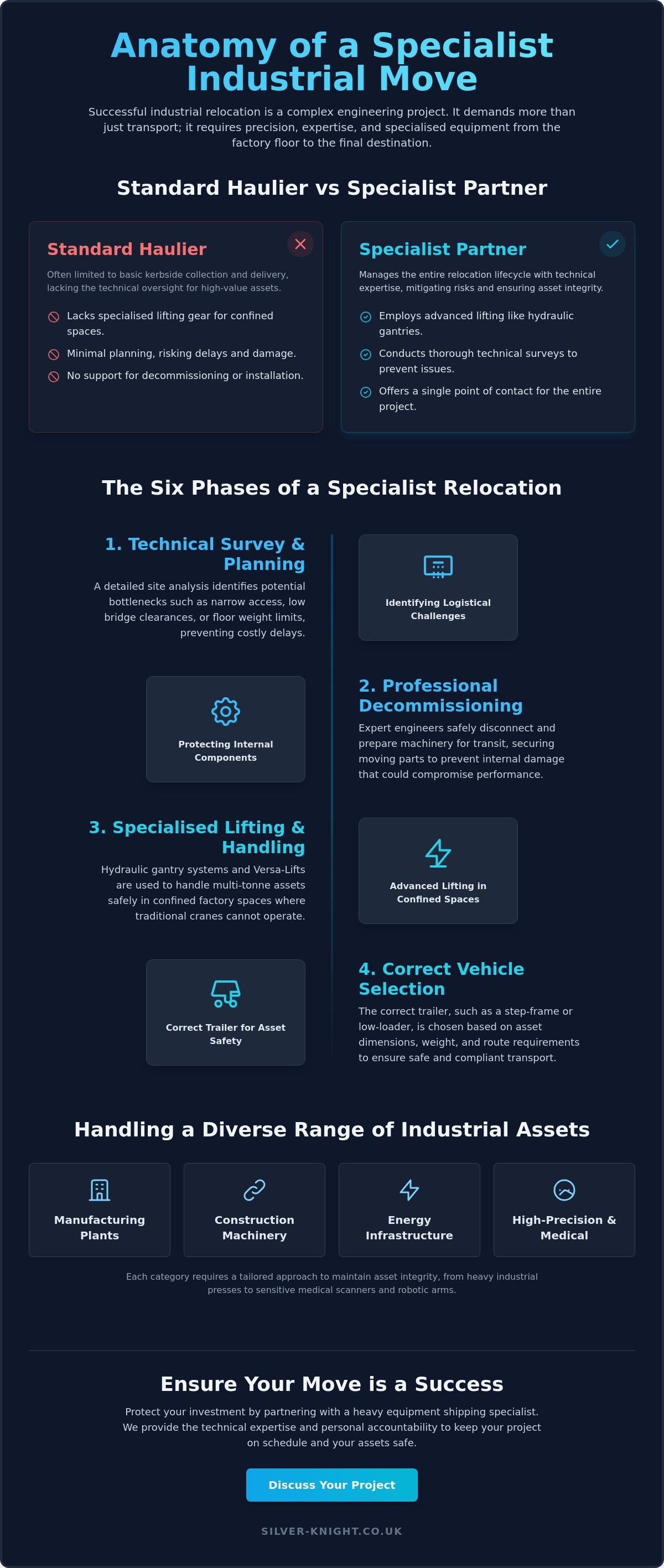
A successful move starts with a thorough technical survey. This identifies potential logistical bottlenecks such as narrow access points, low bridge clearances, or floor weight limits. By spotting these issues early, we prevent delays and ensure the safety of both the equipment and the site personnel. This level of planning is essential whilst moving heavy cargo through the UK's varied road network.
Defining the Role of a Specialist Shipping Partner
There is a significant difference between a simple carrier and a project-managed shipping solution. A carrier merely moves a box; a specialist partner manages the entire lifecycle of the relocation. With over 180 years of collective industry experience, our team understands how to mitigate risks that others might overlook. We integrate decommissioning and transport into a single, seamless transition so that your machinery is ready for recommissioning as soon as it arrives at its new home.
Core Equipment Categories for Industrial Transport
We handle a diverse range of assets including manufacturing plants, construction machinery, and energy infrastructure. High-precision equipment like medical scanners or robotic arms requires a different approach compared to high-mass items like industrial presses. Using a machinery haulage relocation transport moving service ensures that asset integrity is maintained regardless of the weight or sensitivity of the load. This tailored approach is what sets a true heavy equipment shipping company UK apart from general freight providers.
If you need expert help with machinery relocation, visit the Silver Knight website to explore our full range of services.
Technical Lifting and Handling Solutions for Industrial Machinery
Many people assume that shipping starts at the kerbside. In reality, a specialist heavy equipment shipping company UK must first solve the engineering puzzle of moving a multi-tonne machine through a factory floor. Standard forklifts often fail when ceiling heights are low or floor space is limited. This is where specialised lifting hardware becomes essential for a successful relocation. You need equipment that can handle extreme mass without requiring the vast clearance of a mobile crane.
Hydraulic gantry systems are a vital tool in these environments. They allow for the vertical lifting of massive loads in confined factory spaces where traditional overhead cranes are unavailable. For high-capacity lifting within a compact footprint, Versa-Lift technology provides the manoeuvrability of a forklift with the strength of a heavy crane. These tools ensure that your industrial assets are handled with the precision they deserve.
Advanced Lifting Systems for Restricted Spaces
Using specialised lifting, versa-lift, gantry, and jack systems solves the most difficult access problems. It's not just about having the gear; it's about the skill of the person using it. Choosing operated lifting equipment rather than general hire offers significant safety benefits. An experienced operator brings the precision required to position machines onto low-loaders or step-frame trailers without risking structural damage. If you have a specific technical challenge, you can speak to our technical team for a tailored solution.
Ensuring Safety through Contract Lifting
Safety remains the top priority during any industrial move. A contract lift is a comprehensive service where the shipping company takes full responsibility for the planning, supervision, and execution of the lift. This arrangement transfers the primary risk to the shipping provider, giving you peace of mind. All movements must strictly adhere to UK regulations for abnormal loads to maintain high site safety standards. The jack and slide system is a method for horizontal movement of loads exceeding 500 tonnes. This technology allows for the movement of massive assets where cranes are impractical, such as under low-hanging mezzanine floors or through narrow internal doorways.
To ensure your industrial assets are moved by experts, contact the team at Silver Knight today.
Domestic Haulage versus International Machinery Shipping Methods
Choosing between domestic haulage and international shipping involves different regulatory hurdles and equipment needs. For a UK-wide move, the primary focus is road suitability and local compliance. A professional heavy equipment shipping company UK selects trailers based on the machine's specific dimensions and weight distribution. Low-loaders are used for taller equipment to ensure they clear bridges, whilst step-frames provide a versatile platform for various industrial loads. Each journey requires a bespoke plan to ensure the asset remains stable throughout the transit.
International relocations to Europe, the US, or Asia introduce sea freight into the logistics chain. This adds layers of complexity, such as export packing and port coordination. Whether your machinery is staying within the British Isles or crossing oceans, the level of technical oversight remains the same. The goal is always to minimise transit time whilst maximising the safety of the cargo.
Domestic Transport and Abnormal Load Logistics
Moving oversized machinery within the UK requires meticulous route planning. You can't simply drive a wide load through a city centre without prior authorisation. This process involves obtaining necessary permits and, in many cases, arranging for escort vehicles to manage traffic. Compliance is non-negotiable, and the Special Types Enforcement Guide provides the essential framework for these operations. Coordination with local authorities ensures that the road surfaces and bridge capacities can handle the mass. For a deeper look at these domestic requirements, see our machinery movers UK guide.
International Shipping and Export Requirements
International moves contrast Roll-on Roll-off (RoRo) methods with containerised shipping. RoRo is often used for self-propelled machinery, but containerised shipping is usually preferred for high-value factory assets that need protection from the elements. Using a professional shipping container packing service is vital to prevent movement at sea. Salt air and rough weather can damage sensitive electronics or precision parts if they aren't properly secured and treated for export. Beyond physical protection, your partner must handle customs clearance and documentation. This prevents your assets from being held up at ports, which could cause costly delays in your production schedule. A heavy equipment shipping company UK with global reach will manage these details to ensure a smooth transition across borders.
If you are preparing for a major industrial move, you can find expert guidance and support on the Silver Knight website.
Essential Planning Steps for a Successful Equipment Relocation
Preparation is the most critical phase of any industrial move. It's the difference between a smooth transition and a costly disaster. A professional heavy equipment shipping company UK will insist on a comprehensive site survey at both the origin and destination before any equipment is touched. This survey assesses floor load capacities, door clearances, and service availability. Skipping this step often leads to operational downtime that could have been avoided with simple foresight.
You must consider how your machinery will be decommissioned before it even reaches the loading bay. Moving heavy assets without proper bracing or securing of internal parts can lead to permanent damage. By planning every detail of the lift and the route, you protect the long term integrity of your production line. This planning phase should also account for the synchronisation of haulage with your factory's production schedule to minimise disruption to your output.
Decommissioning and Site Preparation
Decommissioning involves a systematic process of disconnecting and securing machine components. It's not just about pulling a plug; it's about ensuring every sensor, cable, and moving part is stabilised for transit. Using a professional machinery dismantle service prevents damage during the initial move out of the building. Our team creates a detailed inventory and labelling system for complex plant, which simplifies the recommissioning process at your new site. This organised approach ensures that every bolt and bracket is accounted for, reducing the time your machines are offline.
Managing Timelines and Temporary Storage
Organising a relocation requires balancing tight production schedules with logistical realities. Sometimes, your new facility isn't ready for immediate installation, or you need to move equipment in stages. This is where the benefits of a secure warehousing storage service become clear for phased factory moves. It allows you to clear your old site on time without rushing the setup at the new location. A technical site survey should be conducted at least four weeks prior to the move date to ensure all permits are secured. To get started on your project plan, you can request a site survey for your machinery relocation from our specialist team.
To find out how a professional team can manage your industrial relocation with ease, visit the Silver Knight website.
Selecting a Heavy Equipment Shipping Partner with Proven Expertise
Choosing the right heavy equipment shipping company UK is about more than just finding a lorry and a driver. While many firms can move a pallet, industrial assets require a deep understanding of structural integrity and mechanical sensitivity. You need a partner that views your machinery as a critical business asset rather than just another load. Technical expertise ensures that the lifting points are correctly identified and that the centre of gravity is managed during every stage of the journey. This level of care prevents the structural twisting or internal damage that can occur when equipment is handled by general hauliers.
Working with a family-run business offers a level of personal accountability that large, faceless corporations often struggle to provide. In a family business, the reputation of the company is tied directly to the quality of the service. This means you get a dedicated point of contact who understands your specific needs and takes ownership of the project from the first survey to the final installation. This personal touch is vital when you are trusting someone with your most valuable production equipment. You don't want to be just another job number on a spreadsheet when moving a multi-million pound production line.
Evaluating Experience and Equipment Quality
Experience is the most valuable asset in the industrial relocation industry. With 180 years of collective experience, our team has encountered and solved almost every logistical challenge imaginable. This background allows us to anticipate problems before they occur, which saves you time and money. It's also important to verify the physical capabilities of your partner. By looking at our equipment, you can see the specialised vehicles and lifting gear we use to manage high-mass loads. A diverse fleet, including Versa-Lifts and hydraulic gantries, allows for flexible and cost-effective solutions tailored to your site's unique constraints. Having the right tool for the job isn't just about efficiency; it's about the safety of your staff and your assets.
The Value of a Full Service Industrial Partner
A true turnkey solution goes beyond transport. Combining services like factory clearance with machinery relocation simplifies the entire process and reduces the number of contractors you need to manage. This integrated approach means your site is cleared of redundant plant whilst your valuable assets are moved to their new home. When a single heavy equipment shipping company UK handles decommissioning, haulage, and recommissioning, there is no confusion over responsibility. Recommissioning services are particularly beneficial as they help restore your full operations faster after a move. This ensures your production line is back up and running without unnecessary delay or technical hitches. If you have a specific project in mind, we invite you to contact a specialist to discuss your requirements and see how we can help your business grow.
To find out more about our industrial relocation services, visit the Silver Knight website.
Secure Your Industrial Future with Expert Relocation Planning
Moving massive industrial assets in 2026 requires more than just a lorry; it demands a partner with the technical foresight to manage every detail. Proper decommissioning, specialised lifting gear, and meticulous route planning are the foundations of a successful project. Whether you're navigating domestic road permits or complex international sea freight, the right heavy equipment shipping company UK makes all the difference to your bottom line. It's about protecting your investment and ensuring your production schedule remains on track.
Silver Knight brings over 180 years of collective industry experience to every move. Our comprehensive fleet, featuring Versa-Lifts and hydraulic gantries, ensures that even the most restricted factory spaces won't stall your progress. We specialise in both domestic UK haulage and global relocations, providing a seamless turnkey service from start to finish. This allows you to focus on your core business whilst we handle the heavy lifting.
Ready to take the next step? You can request a technical survey for your heavy equipment shipping project to get a professional assessment of your needs. With the right planning and expertise, your next industrial relocation can be a smooth and stress-free transition.
Frequently Asked Questions
What is the difference between heavy haulage and heavy equipment shipping
Heavy haulage refers specifically to the road transport of large or oversized loads using specialised trailers. A heavy equipment shipping company UK provides a much broader service that includes technical lifting, decommissioning, and final installation. This turnkey approach ensures that your industrial machinery is managed from its original position on the factory floor all the way to its new destination.
How much does it cost to ship heavy machinery across the UK
The cost of moving heavy machinery depends on several variables such as the weight, dimensions, and the total distance of the journey. You must also account for the complexity of the lifting required and whether the move necessitates road permits or escort vehicles. Because every project has unique technical requirements, it is best to provide specific machine details to receive an accurate estimate for your relocation.
Do I need a site survey before booking a heavy equipment shipping company
A site survey is essential for any complex move to identify potential risks and access restrictions at both the origin and destination. This survey allows engineers to measure doorways, check floor load capacities, and determine if specialised gear like hydraulic gantries or Versa-Lifts will be needed. It ensures that the project remains safe and avoids expensive, unexpected delays on the day of the move.
Can you ship heavy machinery that is currently fixed to a factory floor
Machinery that is fixed to the floor can be moved easily through professional decommissioning and dismantling services. Specialists will safely disconnect all services, remove floor fixings, and use jack and slide systems to extract the equipment from its position. This process ensures that both the machine and the factory floor remain undamaged whilst the asset is prepared for transport.
What insurance cover is required for shipping high-value industrial equipment
Standard Road Haulage Association liability is typically £1,300 per tonne, which often does not cover the full replacement value of precision industrial assets. You should verify that your shipping partner offers enhanced goods-in-transit insurance or marine insurance for international journeys. It is vital to ensure that the level of cover matches the actual value of your specific machinery to protect your investment.
How do you handle the transport of oversized or abnormal loads on UK roads
Oversized loads are managed under Special Types General Order regulations which require meticulous route planning and official notifications. This involves informing police authorities and local councils ahead of the move to ensure the chosen roads can accommodate the width and weight. Escort vehicles are often used to manage traffic and ensure the safety of other road users whilst the load is in transit.
What documentation is needed for international machinery shipping from the UK
International shipping requires several key documents including a commercial invoice, a detailed packing list, and a bill of lading. Since the UK's departure from the European Union, you must also manage customs declarations and ensure any wooden packaging meets international heat treatment standards. A professional heavy equipment shipping company UK will help you organise these documents to prevent any hold-ups at the border.
How long does a typical factory equipment relocation project take to complete
The timeline for a relocation depends entirely on the scale of the project and the distance involved. A single machine move might be completed within two or three days, whereas a full plant relocation could take several weeks of active work and months of prior planning. It is generally recommended to start the consultation process at least four to six weeks before your intended move date.

Article by
David Ashby
I'm the Managing Director of Silver Knight Haulage & Machinery Ltd. Silver Knight Ltd is a family-run firm established in the West Midlands in 2005, with the aim of providing a cost-effective, yet professional, service to businesses for the removal, transportation, and installation of machinery, plant, and equipment here in the UK and worldwide. Between us, the Silver Knight workforce has over 50 years of experience with machinery and its operation.
Disclaimer
This article is intended for informational purposes only. Please ensure you seek expert advice or carry out your own research to confirm the information is suitable for your specific needs.