A factory relocation is a precision engineering project rather than a simple haulage task. You likely understand that even a minor oversight during a move can result in eye-watering costs from production delays or damaged assets. It's perfectly normal to feel anxious about meeting strict UK health and safety standards like LOLER whilst trying to keep your project on track. This is why using a detailed industrial relocation checklist is vital to manage the logistics of heavy machinery and maintain a strategic approach to risk management.
This guide provides a technical roadmap to ensure your machinery and plant relocation is completed safely and without operational delays. We promise to help you navigate the complexities of decommissioning and recommissioning whilst protecting your expensive assets. You'll learn how to ensure your new site is operational without unnecessary setbacks. We'll walk through everything from initial planning and heavy haulage logistics to final safety inspections at your new facility.
Key Takeaways
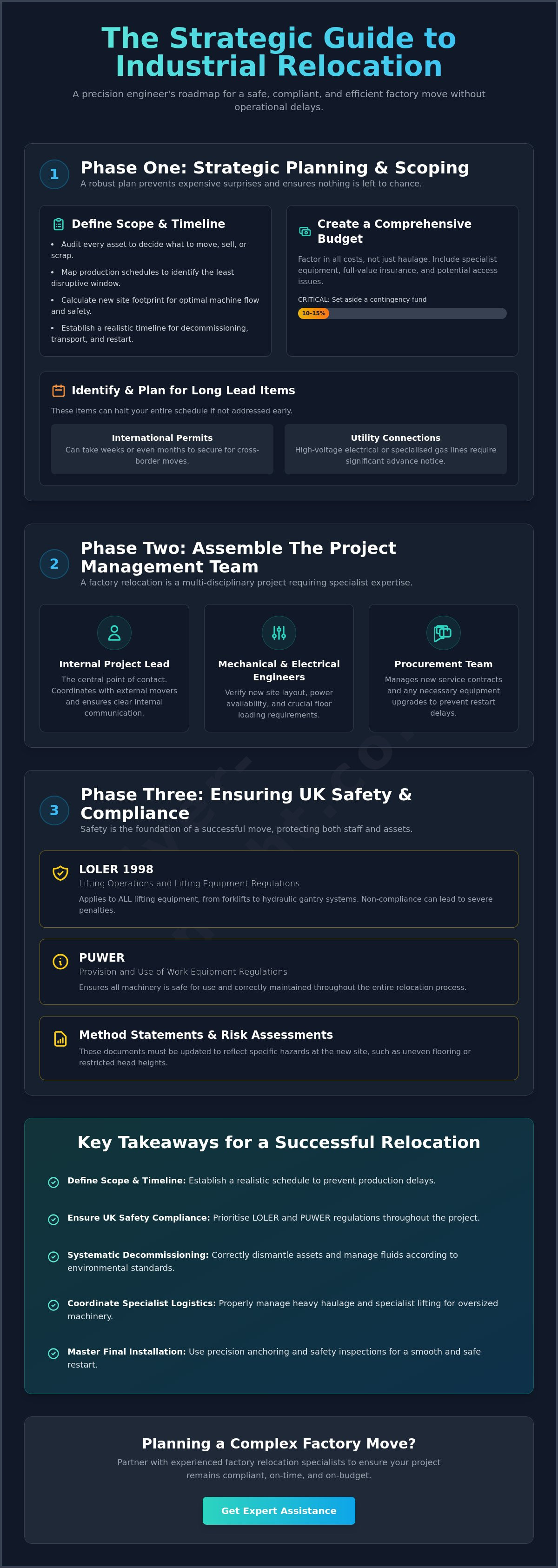
- Learn how to define the full scope of your project and set a realistic timeline for restarting production without delays.
- Use our comprehensive industrial relocation checklist to ensure your site remains compliant with UK safety laws such as LOLER and PUWER.
- Discover the correct methods for systematically dismantling assets and draining fluids according to environmental standards.
- Understand how to coordinate heavy haulage and specialist lifting operations for oversized or awkward machinery.
- Master the final steps of machinery installation including precision anchoring to ensure a smooth and safe restart.
If you are planning a complex move, you can find expert assistance from professional machinery movers.
The Industrial Relocation Checklist for Strategic Planning
Successful factory moves begin long before the first bolt is loosened. You need a robust industrial relocation checklist to track every asset, from your largest press to the smallest ancillary tool. Defining the full scope early prevents expensive surprises later on and ensures that nothing is left behind at the old site. It's about creating a clear picture of what needs to move and how it fits into your future operations.
Establishing a realistic timeline is your next priority. You must account for decommissioning, transport, and the eventual production restart. Rushing this phase often leads to operational delays that hurt your bottom line. A well-planned schedule allows for testing and calibration once the machines are in their new home, reducing the risk of a botched launch.
To better understand how to prepare for your move, watch this helpful video:
Creating a comprehensive budget is more than just getting a quote for haulage. You must factor in the cost of specialist equipment like hydraulic gantry systems or Versa-Lift hire. Don't forget to include insurance premiums that cover the full replacement value of your machinery during transit. Unexpected site access issues at either end can also inflate costs, so it's wise to set aside a contingency fund of at least 10% to 15% of the total project value.
Long lead items often cause the most frustration. If you are moving equipment across borders, international permits can take weeks or even months to secure. Similarly, arranging for high-voltage electrical connections or specialised gas lines at a new facility requires significant advance notice to utility providers. Including these in your industrial relocation checklist ensures they don't become bottlenecks that halt your entire production schedule.
Defining the Scope and Timeline
Start by auditing every machine to see which ones need a machinery dismantle service. This audit helps you decide what to keep, what to sell, and what to scrap. Map your production schedule to find the least disruptive window for the move. Whilst industrial moves are unique, they share principles with broader methods for structure relocation used in engineering. You should also calculate the required footprint at the new site to ensure optimal machine flow and worker safety from day one.
Building the Project Management Team
You shouldn't try to manage a relocation alone. Appoint a dedicated internal lead to coordinate with your external movers and ensure clear communication. Bring in mechanical and electrical engineers early to verify that the new site layout supports your power and floor loading requirements. Procurement teams should also be involved from the start. They need to handle any necessary equipment upgrades or new service contracts so that you aren't waiting on parts when the machines are ready to be switched back on.
You can ensure your project remains fully compliant by partnering with experienced factory relocation specialists who understand UK health and safety laws.
Essential Safety Regulations and Compliance Standards
Safety isn't just a box to tick; it's the foundation of any successful plant move. In the UK, you must adhere to strict legal frameworks to protect your staff and assets. Your industrial relocation checklist should prioritise the Lifting Operations and Lifting Equipment Regulations 1998 (LOLER). These rules apply to every task involving lifting equipment, from a simple forklift to complex hydraulic gantry systems. Failing to comply can lead to severe penalties or, worse, workplace accidents.
The Provision and Use of Work Equipment Regulations (PUWER) also play a critical role. You need to ensure that all machinery is safe for use and maintained properly during the transition. Before the move begins, you must update your Method Statement and Risk Assessment. This document should reflect specific hazards at the new site, such as uneven flooring or restricted head height. Whilst many international standards like OSHA safety regulations provide excellent frameworks for heavy equipment handling, UK businesses must stay focused on domestic HSE requirements.
Verify that every contractor you hire holds valid insurance specifically for heavy plant relocation. Standard transit insurance often doesn't cover the complexities of industrial machinery. You need to know that your assets are protected from the moment decommissioning starts until the final recommissioning is complete. If you have any doubts about your current safety protocols, it's worth speaking with a safety consultant to review your plans.
Adhering to LOLER and PUWER Standards
Every piece of lifting gear must have a current thorough examination certificate. This includes slings, shackles, and cranes. You should also confirm that all operators hold the correct qualifications for the specific machinery they'll be using. It's not enough to be a general forklift driver; moving a 20 tonne press requires specialist expertise. Always check that the chosen equipment is suitable for both the weight of the load and the environmental conditions of the site.
Conducting Thorough Technical Site Surveys
A technical survey is the only way to avoid physical bottlenecks. You must analyse the floor loading capacity at both your old and new premises. If a floor cannot support the concentrated weight of a machine and the lifting equipment, you risk structural damage. Measure every access point, including door widths and turning circles for heavy haulage vehicles. Using your industrial relocation checklist, look for overhead obstructions like pipework or lighting that could hinder a safe lift. Identifying underground services like gas or water mains is equally important to prevent a collapse under the weight of a heavy machine mover.
If you want to ensure your machinery is prepared correctly for transport, you can find expert help from specialist industrial movers.
Technical Decommissioning and Asset Preparation Steps
Preparing your machinery for transport is a delicate process that requires more than just brute force. A robust industrial relocation checklist should dedicate significant time to the technical decommissioning phase. This ensures that every asset is ready for the journey and can be reinstalled without missing parts or damaged sensors. Systematic dismantling allows your team to understand the internal state of the machinery before it moves. It's the best way to prevent a chaotic reassembly process later on.
You must drain all fluids and lubricants according to UK environmental safety guidelines before any heavy machine movers arrive. Spills during transit are not only a safety risk but can also lead to heavy fines from environmental agencies. Once the fluids are gone, focus on labelling every cable and component. Using a clear coding system prevents a jigsaw puzzle of wires during reassembly. Secure any moving parts, such as carriage assemblies or pendulums, to prevent them from shifting. Even small vibrations during transit can cause internal damage if parts aren't properly fixed in place.
Systematic Decommissioning of Machinery
Before you cut the power, record all current machine settings and calibration data. This record is vital for getting the machine back to its peak performance level quickly. Isolate all electrical and pneumatic supplies using strict lockout and tagout procedures to keep your staff safe. You should also create a detailed photographic record of the machine whilst it is still in its operational state. These photos serve as a visual guide for the engineers who will be putting everything back together at the new facility. It's a simple step that saves hours of frustration.
Industrial Export Packing and Protection
If your move involves crossing borders, you should utilise specialised shipping container packing services to protect your assets from the rigours of sea or air freight. Long distance moves often expose machinery to salty air and moisture. Applying anti-corrosion coatings to exposed metal surfaces is a simple step that prevents rust. For high value or particularly delicate components, construct custom timber crates. These offer a level of impact protection that standard pallet wrapping simply cannot match. This level of care ensures your equipment arrives in the same condition it left the old factory.
You can secure the transport of your oversized machinery by hiring specialist heavy haulage services.
Managing Heavy Haulage and Specialist Lifting Operations
Moving heavy machinery requires more than just a standard lorry. It demands a technical understanding of weight distribution and the centre of gravity for each asset. Your industrial relocation checklist must include a detailed transport plan that accounts for the physical dimensions of every load. Rushing this stage is a mistake. Research indicates that hidden costs in heavy equipment transportation can add 30% to 50% to the final bill if planning is rushed. These extra costs often come from permit changes, waiting times, or last minute re-routing.
Implementing a contract lifting arrangement is often the safest choice for complex moves. This shifts the legal responsibility for the lift to the contractor, who provides a qualified Appointed Person to oversee the operation. It ensures the move is fully managed and backed by the correct level of insurance. You must also check transit routes for height and weight restrictions. UK roads often have low bridges or weight-limited structures that can halt a heavy haulage convoy if not scouted in advance.
To get a bespoke quote for your lifting requirements, contact our specialist team today.
Selecting Specialist Lifting Equipment
Sometimes traditional cranes aren't an option due to site constraints. Using specialised lifting using versa lift or gantry systems allows for precision movement in confined spaces where headroom is limited. Jack and slide systems are particularly useful when you have very low ceiling heights that prevent any vertical lifting. These systems move machines horizontally across the floor with minimal clearance. Always ensure all lifting gear is inspected immediately prior to the move to maintain safety standards.
Coordinating International Machinery Transport
For moves outside the UK, your industrial relocation checklist needs to include a section for customs documentation. Paperwork must be perfect to avoid expensive delays at ports or border crossings. You will also need to arrange for specialised trailers such as low loaders or semi low loaders to keep high loads within legal height limits. Confirming the arrival window at the destination is vital. It prevents site congestion and ensures that the offloading team and equipment are ready the moment the vehicle arrives. This coordination keeps the project on schedule and reduces the risk of operational downtime.
You can ensure your production line is set up for success by working with expert industrial relocation partners who manage the entire process from start to finish.
Post Move Recommissioning and Production Restart
Recommissioning is the final hurdle in your project. Many businesses assume the job is done once the lorries are unloaded, but the final stage of your industrial relocation checklist involves bringing those assets back to life safely. This requires a precise machinery installation that follows your new factory layout exactly. Rushing this stage can lead to misaligned components or electrical faults that cause long term damage to your equipment.
You must reconnect all utilities and services through qualified industrial engineers. This includes electrical power, compressed air, and water cooling systems. It's not just about plugging cables in; it's about verifying that the infrastructure at the new site can handle the peak load of your machinery. A final safety sign-off is essential before you hand the keys back to the production team. This ensures that every asset is fully operational and meets all UK safety requirements before the first shift begins.
Precision leveling and anchoring are non-negotiable steps. If a machine isn't perfectly stable, it will suffer from increased wear and tear or produce faulty parts. You should also consider whether the move has triggered a need for equipment upgrades. Whilst a simple relocation doesn't always require you to meet the very latest standards, any modifications made during the move might. Keeping your industrial relocation checklist updated with these technical details will help you avoid compliance issues during future HSE inspections.
Leveling and Precision Installation
Use laser alignment tools to ensure each machine is perfectly flat. Traditional spirit levels often lack the accuracy needed for modern, high speed production lines. Once aligned, you must grout and anchor the equipment to the floor to prevent vibration. Excessive vibration can loosen bolts and damage delicate internal sensors over time. Finally, verify that all safety guards and emergency stops are fully functional. You should test these systems multiple times before allowing any staff to operate the machinery in a live environment.
Final Health and Safety Handover
Your relocation partner should provide you with a full folder of compliance and testing documents. This includes LOLER certificates for any lifting done during the install and PUWER inspection reports. Conduct a thorough walk-through with your production team to verify machine positions and ergonomics. This is your chance to ensure the workflow is as efficient as planned. To discuss your next project with the experts, contact Silver Knight today and ensure your factory move is handled with precision and care.
Secure Your Future Production with Expert Planning
Moving a factory is a major engineering undertaking that requires absolute precision at every stage. By following a structured industrial relocation checklist, you can avoid common pitfalls like machinery damage and costly production delays. We have explored how strategic planning, strict compliance with UK safety laws, and technical decommissioning work together to protect your business assets during a transition.
Silver Knight brings over 180 years of collective industry experience to every project we manage. We use specialist equipment including hydraulic gantries and versa lifts to handle even the most challenging lifts in confined spaces. Whether you require a local move or fully managed nationwide and international services, our team provides the expertise needed for a risk-free relocation.
Discuss your industrial relocation with our expert team today to ensure your next move is completed safely and on schedule. Your next successful production chapter is just a well-planned move away.
Frequently Asked Questions
What is an industrial relocation checklist
An industrial relocation checklist is a strategic document used to manage the complex process of moving a factory or plant. It covers every stage from initial planning and asset auditing to decommissioning, transport, and final recommissioning. Using this detailed tool ensures that no critical safety steps or technical requirements are missed, helping you to maintain operational continuity throughout the transition from one site to another.
How long does a typical factory relocation take
The duration varies significantly based on the scale of the facility and the complexity of the machinery. A small workshop move might take a few days, whilst a large scale plant relocation can span several months. Factors such as the distance between sites, the need for international transport, and the time required for precision installation and utility reconnections all influence the final project timeline and production schedule.
Do I need specialised insurance for moving industrial machinery
Standard transit insurance is rarely sufficient for high value industrial assets. You require specialised goods in transit and marine insurance that covers the full replacement value of your machinery during dismantling, transport, and reinstallation. Professional movers typically offer comprehensive cover or can work with your own insurers to ensure that all risks, including accidental damage during lifting or transit, are fully mitigated before the move begins.
What are LOLER and PUWER regulations in machinery moving
LOLER refers to the Lifting Operations and Lifting Equipment Regulations 1998, which ensure all lifting tasks are planned and supervised by competent people. PUWER stands for the Provision and Use of Work Equipment Regulations, which require that all machinery is safe for use and maintained correctly. Compliance with these UK laws is mandatory during any industrial move to protect your workers and avoid potential legal penalties or fines.
How can I minimise downtime during a factory move
Phased relocations are the most effective way to keep production running. By moving equipment in stages, you can maintain a level of output at one site whilst the other is being set up. Detailed labelling and a robust industrial relocation checklist also speed up the reassembly process. Hiring experienced movers ensures that technical tasks like decommissioning and recommissioning are handled swiftly without unexpected delays or operational setbacks.
What equipment is used for moving heavy machinery in restricted spaces
Specialist equipment such as hydraulic gantry systems and Versa-Lift forklifts are designed for tight environments. If ceiling heights are too low for cranes, jack and slide systems allow for the horizontal movement of heavy loads with minimal clearance. These tools enable heavy machine movers to navigate narrow aisles and low doorways without compromising on safety or damaging the building structure during the relocation process.
Can industrial movers handle international machinery transport
Professional industrial moving companies provide comprehensive international services. This includes managing export packing, securing shipping containers, and handling complex customs documentation for moves outside the UK. They coordinate with global logistics partners to ensure that oversized or sensitive machinery reaches its destination safely, whether it is travelling by sea freight, air freight, or heavy haulage across borders to a new international facility.
What is included in a professional technical site survey
A technical site survey involves a detailed assessment of both the origin and destination facilities. Engineers analyse floor loading capacities, measure access points like doorways and roller shutters, and identify overhead obstructions. They also locate underground services and evaluate power requirements for reinstallation. This data is used to create a precise lift plan and method statement, ensuring the physical move proceeds without structural issues or safety incidents.

Article by
David Ashby
I'm the Managing Director of Silver Knight Haulage & Machinery Ltd. Silver Knight Ltd is a family-run firm established in the West Midlands in 2005, with the aim of providing a cost-effective, yet professional, service to businesses for the removal, transportation, and installation of machinery, plant, and equipment here in the UK and worldwide. Between us, the Silver Knight workforce has over 50 years of experience with machinery and its operation.
Disclaimer
This article is intended for informational purposes only. Please ensure you seek expert advice or carry out your own research to confirm the information is suitable for your specific needs.