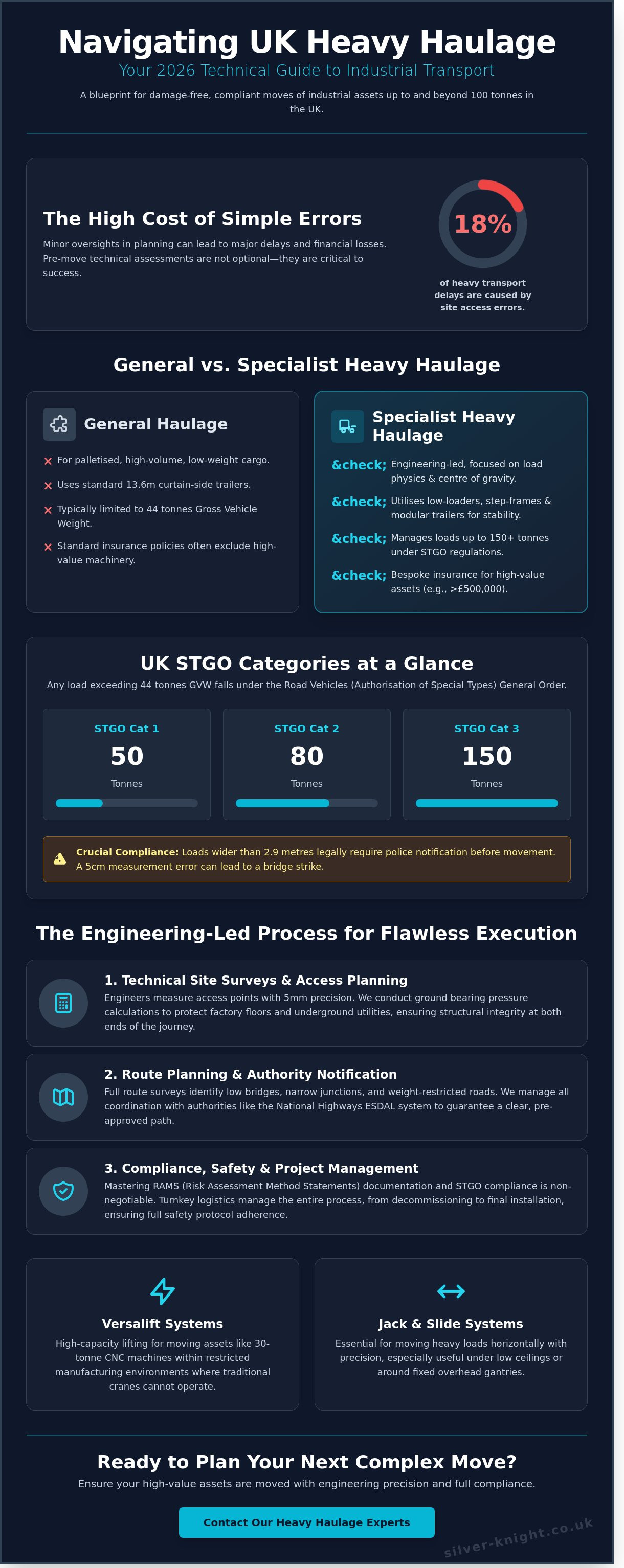
Did you know that 18% of heavy transport delays in the UK are caused by simple site access errors before the vehicle even arrives? You've likely felt that knot in your stomach when a £500,000 piece of machinery is loaded for heavy haulage West Midlands, wondering if the narrow roads or complex STGO regulations will lead to an expensive disaster. It's a common worry because the stakes for your business are incredibly high.
This article clarifies the 2026 technical requirements for industrial transport, giving you the exact blueprint for a damage-free move that keeps your operations running on schedule. We'll provide a detailed breakdown of the latest safety protocols, escort vehicle mandates, and technical specifications for transporting loads up to 100 tonnes across the United Kingdom. By the end, you'll have the confidence to manage even the most complex industrial logistics with full regulatory compliance.
Key Takeaways
-
Understand how technical site surveys and ground bearing pressure assessments mitigate structural risks when moving industrial assets up to 100 tonnes.
-
Discover how specialized Versalift units allow for the high-capacity movement of 30-tonne CNC machines within restricted manufacturing environments.
-
Navigate the complexities of heavy haulage West Midlands by mastering compliance with the Road Vehicles Authorisation of Special Types (STGO) order and RAMS documentation.
-
Learn how turnkey logistics solutions manage the entire lifecycle of a move, from initial decommissioning to final installation and international customs coordination.
Table of Contents
Defining Heavy Haulage Standards for UK Manufacturing
As we approach 2026, the technical standards for industrial transport are becoming more rigorous. Heavy haulage isn't a standard logistics task. It's a precise engineering operation. In the West Midlands, where automotive and aerospace manufacturing remains a core economic driver, the transport of assets up to 100 tonnes is common. We advocate for a technical approach to every move. This ensures that high-value industrial plant arrives without structural stress or site damage. Standard transport methods don't account for the unique centres of gravity found in heavy machinery.
General haulage firms often lack the infrastructure for these complex tasks. They typically operate fleet vehicles designed for high-volume, low-weight cargo. In contrast, heavy haulage West Midlands providers focus on the physics of the load. This involves calculating axle weights and ground pressure to protect both the cargo and the UK road network. Using the wrong equipment can lead to catastrophic structural failure during transit, especially when navigating the tight urban layouts of the Black Country or Birmingham city centre.
The Distinction Between General and Heavy Haulage
Standard haulage relies on 13.6-metre curtain-side trailers and 44-tonne tractor units. These are built for palletised goods and simple logistics. Heavy haulage utilizes low-loaders, step-frames, and modular trailers. Utilizing specialized heavy haulage equipment allows for a lower centre of gravity. This is vital for stability. Specialist movers also provide bespoke insurance. This often covers high-value machinery for sums exceeding £500,000, which standard policies usually exclude. You can find more about these technical requirements through our machinery haulage and relocation service.
Weight and Dimension Thresholds in the UK
UK regulations are strict and legally binding. Any load exceeding 44 tonnes gross vehicle weight falls under the Road Vehicles (Authorisation of Special Types) (General) Order 2003, commonly known as STGO. There are three distinct categories:
-
STGO Cat 1: Up to 50 tonnes total weight.
-
STGO Cat 2: Up to 80 tonnes total weight.
-
STGO Cat 3: Up to 150 tonnes total weight.
If a load is wider than 2.9 metres, you must notify the police authorities before moving. Precision is mandatory. A 5cm error in measurement can lead to a bridge strike or a vehicle getting stuck at a restricted site entrance. We use laser-guided measurement tools to ensure every millimetre is accounted for before the wheels turn. This level of detail is what separates industrial specialists from general transport companies.
Engineering Requirements for Oversized Load Logistics
Successful execution in heavy haulage West Midlands starts with a data-backed fact regarding the machine's exact dimensions. Guesswork is the primary cause of transit delays; therefore, engineers must document every millimetre of width, height, and weight before any hardware is deployed. These technical site surveys form the foundation of a move, ensuring that the chosen equipment can handle the physical realities of the industrial environment. Logistics planning isn't just about the vehicle; it's about accounting for ground bearing pressures at both the collection and delivery sites to prevent structural damage.
A full route survey is best practice for any load exceeding standard dimensions. This process identifies physical obstructions like low bridges, narrow junctions, or weight-restricted culverts that could halt progress. Adhering to Road Haulage Association standards ensures that every project follows a verified safety framework, reducing risk for both the haulier and the client. By mapping out these variables weeks in advance, teams avoid the reactive problem-solving that leads to budget overruns.
Technical Site Surveys and Access Planning
Precision is vital when moving industrial assets. Our engineers measure access points to within 5mm to ensure equipment clearance is guaranteed. We perform detailed ground pressure calculations to prevent damage to factory floors and sensitive underground utilities. When traditional crane access is restricted by low ceilings or overhead gantries, we utilize jack and slide systems to move loads horizontally. If you're facing a challenging environment, our heavy moving equipment hire service provides the specialised tools required for tight tolerances.
Route Planning and Notification Protocols
Moving abnormal loads through the heavy haulage West Midlands network requires strict coordination with the National Highways ESDAL system. Notification periods aren't optional; they vary from two to ten days depending on the total width and weight of the load. We manage all police and local authority permits to prevent costly legal delays. This administrative oversight ensures that the transport stays compliant with the Road Vehicles (Authorisation of Special Types) General Order 2003. It's our responsibility to handle these protocols so the cargo moves without interruption or fines.
Specialized Lifting Equipment for Restricted Industrial Sites
Industrial sites across the West Midlands often present significant logistical challenges. Many older manufacturing hubs in Birmingham and the Black Country weren't designed for the massive 30 tonne CNC machines common in modern production lines. Moving this equipment requires more than just raw power; it demands surgical precision in confined spaces. Traditional mobile cranes often can't operate in these environments because they require massive footprints for outrigger deployment. Specialized heavy haulage West Midlands providers now rely on compact, high-capacity technology to bridge this gap.
The transition to 2026 technical standards emphasizes the use of equipment that minimizes floor loading while maximizing lift capacity. This is particularly relevant for multi-storey industrial units or factories with basement voids. Using the wrong equipment doesn't just risk the machinery; it risks the structural integrity of the facility itself. Our approach involves a detailed site survey to determine which specialized lifting configuration will provide the safest path of travel.
Versalift and Iron Fairy Units
Versalift units have become the industry standard for indoor machinery relocation. These machines feature extendable counterweights that provide maximum lifting stability without the need for a wide chassis. This design allows them to navigate narrow aisles that would be inaccessible to a standard forklift. For low-headroom environments, such as older automotive plants in Coventry, Iron Fairy cranes are essential. These units operate with a low profile, allowing for the precise positioning of machinery within 5mm of the original engineering plan.
Safety is the primary driver for these equipment choices. Operators must ensure every movement aligns with the Official UK guidance on abnormal load compliance to maintain legal and insurance standards. These compact units aren't just about fitting through doors; they're about maintaining a controlled center of gravity while moving assets that weigh as much as several heavy goods vehicles combined.
Hydraulic Gantries and Jack Systems
When a project involves lifting assets up to 100 tonnes inside a building, hydraulic gantry systems offer a safer, more controlled alternative to traditional cranes. These systems distribute weight across four or more legs, eliminating the need for large outriggers that would otherwise block factory floor access. They're particularly effective for installing heavy presses or power generation equipment where overhead clearance is restricted by existing pipework or gantries.
In the most extreme cases where overhead clearance is zero, we utilize jack and slide systems. These allow us to lift a machine just a few inches off the ground and slide it horizontally into position on low-friction tracks. As heavy haulage West Midlands specialists, we advocate for selecting the specific tool that matches the load's dimensions and the site's constraints. You can view the full technical specifications for these systems in our specialized equipment fleet to understand the lifting capacities available for your next relocation project.
Compliance and Safety Protocols for Abnormal Loads
Compliance isn't a suggestion; it's the legal backbone of every heavy haulage West Midlands project. Every movement exceeding standard dimensions must strictly adhere to the Road Vehicles (Authorisation of Special Types) (General) Order 2003, commonly known as STGO. These regulations define the weight limits, axle configurations, and notification periods required to prevent structural damage to UK road networks. For complex, multi-machine industrial relocations, best practice now dictates the appointment of a dedicated safety officer. This individual oversees the entire loading phase, ensuring that the theoretical plans in the RAMS match the physical reality on the factory floor. You can find more detail on these specific requirements through our machinery haulage and relocation service.
Risk Assessment and Method Statements
Full RAMS documents are mandatory for site access in 95% of UK industrial zones. A method statement isn't just a summary; it's a step-by-step technical manual. It specifies the exact lift points for a 20-tonne CNC machine and the load-rated chains used for securing. Rigorous documentation protects the site personnel and ensures the integrity of high-value assets during transit. By detailing every securing method, these documents mitigate the risk of load shifts that can lead to catastrophic failures during heavy haulage West Midlands operations.
Insurance and Liability for High Value Assets
Standard haulage insurance usually operates under RHA conditions, which often limit payouts to approximately £1,300 per tonne. This is dangerously insufficient for a £2 million precision laser cutter weighing only 4 tonnes. Specialist movers provide bespoke goods in transit cover that reflects the actual replacement value of heavy plant. You should always verify that your provider holds at least £10 million in public liability insurance before any equipment moves. This level of cover is standard for 2026 industrial requirements and protects your business from third-party claims during the loading and unloading process.
If you're planning a move that requires strict adherence to UK safety standards, ensure your provider uses a specialist machinery haulage and relocation service that prioritizes these technical protocols.
Strategic Project Management for Heavy Haulage Operations
Successfully moving industrial assets isn't just about the truck; it's about the meticulous planning behind the move. Managing heavy haulage West Midlands projects requires a comprehensive approach that covers every technical detail from start to finish. Choosing a provider that offers turnkey solutions means every stage, from initial decommissioning to the final installation at a new site, stays under one management team. We advocate for a single point of contact because it eliminates the communication gaps that often lead to delays or site safety issues. For complex, global projects, our international machinery transport services provide the oversight needed to manage high-value assets across borders.
A single point of contact simplifies the chain of command. It ensures that the project manager understands the specific constraints of the factory floor in the West Midlands as well as the destination requirements in another country. This streamlined approach reduces the risk of equipment damage during the loading phase. When one team handles the entire process, accountability is clear and the project remains on a strict timeline, which is vital when production downtime costs can exceed £5,000 per hour for large manufacturing plants.
Decommissioning and Export Packing
Technical decommissioning ensures that machines aren't just unplugged, but safely prepared for the stresses of transit. This involves draining fluids, securing internal moving parts, and indexing every component for efficient recommissioning. We use vacuum sealing and bespoke timber crating for sea freight to prevent corrosion from salt air. This level of detail ensures that when the machine arrives, the setup phase is 25% faster than projects without indexed packing. Proper export packing is the first line of defense against the environmental hazards of long-distance shipping.
International Logistics and Customs
Global relocation involves a complex maze of sea freight and air cargo regulations. Our team manages the customs documentation required for smooth transit into Europe or Asia, preventing costly port storage fees. With a collective 180 years of experience, we've navigated the specific customs requirements of 45 different countries. This expertise ensures that even the most complex heavy haulage West Midlands moves stay on schedule, avoiding the 15% average delay typically seen in unmanaged international freight. We coordinate with local authorities at the destination to ensure all permits are in place before the cargo even leaves the UK port.
Future-Proof Your Industrial Logistics Strategy
Navigating the evolving landscape of heavy haulage West Midlands requires more than just raw power. It demands a rigorous commitment to the 2026 technical standards and a deep understanding of UK safety protocols for abnormal loads. Success in industrial transport hinges on integrating advanced engineering with strategic project management. This ensures every oversized asset reaches its destination without a hitch, meeting the strict compliance requirements set by the Department for Transport.
Silver Knight brings 180 years of collective industry experience to every complex move. Whether you're transporting heavy manufacturing machinery or complex infrastructure, our team manages loads up to 100 tonnes with total control. We specialize in restricted industrial sites, offering precision positioning within a 5mm margin to guarantee your equipment sits exactly where it needs to be. You don't have to navigate these logistical challenges alone or risk non-compliance with new regulations.
Contact the Silver Knight team today to secure your 2026 industrial transport schedule. We're ready to help you move your project forward with confidence and technical excellence.
Frequently Asked Questions
What is the maximum weight for heavy haulage in the UK
The maximum weight for standard road haulage in the UK is 44,000kg spread across six axles. For heavy haulage West Midlands projects, loads exceeding this limit fall under STGO regulations. These rules allow for gross weights up to 150,000kg. Anything above this 150-tonne threshold requires a Special Order from National Highways. This process involves a minimum notice period of 8 weeks for structural checks on the chosen route.
Do I need a police escort for an abnormal load
You'll need a police escort if your load exceeds 5.0 metres in width or 30 metres in length. Local authorities like the West Midlands Police evaluate each application based on the specific route and traffic density. Private pilot cars often handle loads between 2.9 and 5.0 metres wide. If your shipment is wider than 6.1 metres, you've got to obtain a Special Order from the Department for Transport before moving.
How long does it take to plan a heavy haulage move
Planning a heavy haulage West Midlands move takes between 5 days and 12 weeks depending on the load's complexity. Standard abnormal loads require 2 clear days of notice to the police and 5 days to bridge authorities. For massive industrial components, we spend 30 to 60 days conducting route surveys and street furniture removal assessments. This ensures every pinch point is mapped before the vehicle departs.
What is the difference between STGO Category 1 and 2
STGO Category 1 covers vehicles with a gross weight up to 46,000kg, while Category 2 permits weights up to 80,000kg. Category 1 vehicles can travel at 56mph on motorways. Category 2 loads are restricted to 40mph on motorways and 25mph on dual carriageways. Choosing the right category is vital for legal compliance and avoiding the £5,000 fines associated with overloading your transport equipment during transit.
Can you move machinery into a building with restricted height
We move heavy machinery into buildings with restricted heights using low-loader trailers and specialized hydraulic jacking systems. These trailers sit just 300mm off the ground to clear low doorways or overhead gantries. If the ceiling is too low for a crane, we use 40-tonne capacity versa-lifts or air skates. These tools allow us to slide equipment into place with only 50mm of vertical clearance in tight spaces.
What insurance cover is provided for heavy machinery moves
Standard heavy haulage insurance typically follows Road Haulage Association (RHA) conditions, which provide cover up to £1,300 per tonne. We offer enhanced Goods in Transit policies that cover the full replacement value of your assets, often reaching £5,000,000 or more. It's essential to verify that the policy includes lifting and looming risks. This ensures your machinery is protected during both the transport and the final installation phases.

Article by
David Ashby
I'm the Managing Director of Silver Knight Haulage & Machinery Ltd. Silver Knight Ltd is a family-run firm established in the West Midlands in 2005, with the aim of providing a cost-effective, yet professional, service to businesses for the removal, transportation, and installation of machinery, plant, and equipment here in the UK and worldwide. Between us, the Silver Knight workforce has over 50 years of experience with machinery and its operation.
Disclaimer
This article is intended for informational purposes only. Please ensure you seek expert advice or carry out your own research to confirm the information is suitable for your specific needs.