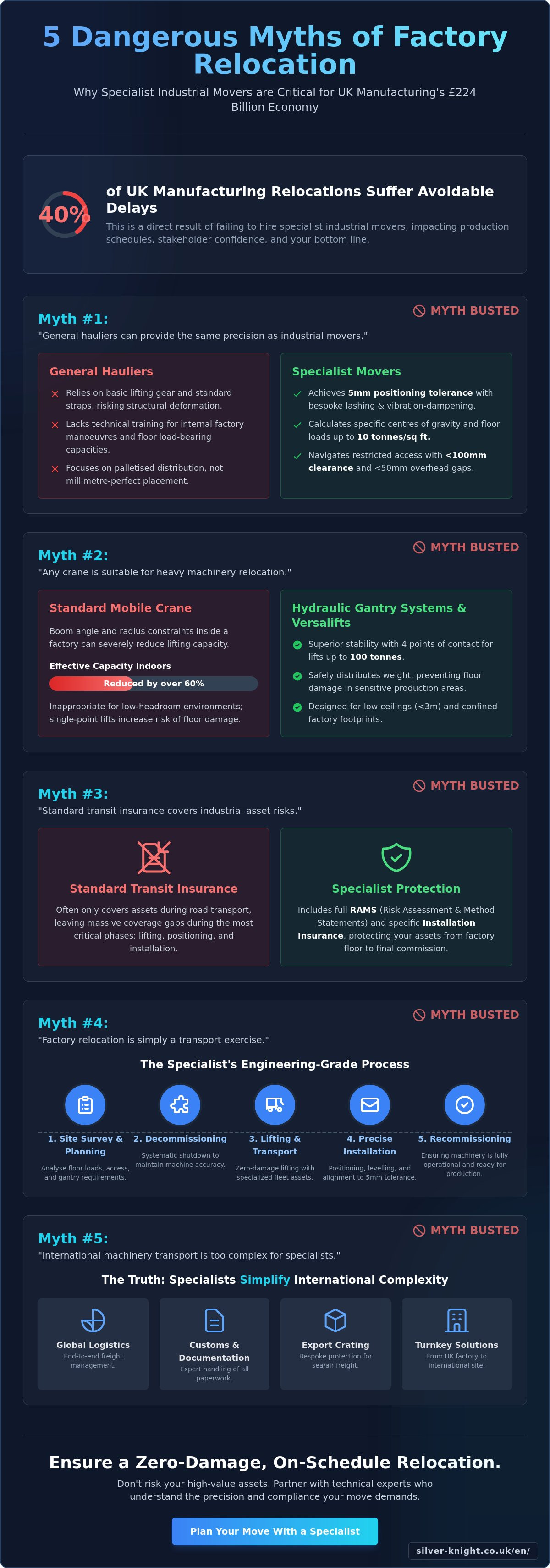
Research indicates that 40% of UK manufacturing relocations suffer from avoidable delays when managers fail to hire a specialist industrial moving company UK.
As heavy lifting specialists, we advocate for technical precision during machinery relocation to protect your high-value capital equipment.
Crucially, failing to account for specific floor loadings or complex gantry requirements can lead to structural damage or severe health and safety breaches.
Utilising technical experts provides access to iron fairy units and Versalift systems capable of handling loads up to 100 tonnes.
You already know that any deviation from your production schedule directly impacts your bottom line and your standing with key stakeholders.
Best practice dictates that you understand the technical realities of your move to ensure zero-damage relocation and precise machinery positioning within 5mm.
We are going to break down five dangerous myths about factory moves so you can avoid the costly mistakes and ensure full RAMS compliance.
Key Takeaways
- Learn why precision positioning within a 5mm tolerance requires specialist technical training that standard haulage firms simply do not possess.
- Identify the safety advantages of using hydraulic gantry systems for vertical lifts up to 100 tonnes compared to standard mobile cranes.
- Understand why hiring a specialist industrial moving company UK ensures your assets are protected by full RAMS and specific installation insurance.
- Discover the technical necessity of systematic decommissioning and precise levelling to maintain machine accuracy during factory recommissioning.
https://silver-knight.co.uk/contact-us/
Myth 1 General hauliers can provide the same precision as industrial movers
UK manufacturing contributes £224 billion to the national economy, necessitating extreme precision during asset relocation.
Factory managers frequently mistake general road transport for the complex engineering task of internal plant positioning.
Standard haulage firms focus on palletised distribution whilst ignoring the millimetre-perfect placement of production assets.
Hiring a specialist industrial moving company UK ensures engineering-grade accuracy during the transition.
General transport equipment is built for the open road and lacks the technical training for complex internal factory manoeuvres. Crucially, a professional industrial moving company UK employs equipment specifically designed for the factory floor.
The technical difference in lifting tolerances
A 30-tonne CNC machine requires vibration-dampening transport to protect sensitive internal components from micro-fractures. Standard straps often cause structural deformation, whereas bespoke machinery lashing ensures the load remains static without crushing the frame.
Precision positioning is a core engineering requirement that standard hauliers cannot meet due to their reliance on basic lifting gear. The Heavy lift process involves calculating specific centres of gravity to prevent tipping during the transition from trailer to floor.
As heavy lifting specialists, we advocate for the use of specialised skates and jacks to maintain control during every centimetre of the move. Standard haulage firms typically lack the technical training for internal factory manoeuvres, often failing to account for floor load-bearing capacities.
Best practice involves conducting a full site survey to ensure the substrate can support concentrated loads of up to 10 tonnes per square foot.
Restricted access and internal manoeuvres
Many Victorian-era British production facilities feature low-headroom environments that prohibit the use of standard 5-tonne forklifts. Low-profile industrial machinery movers are required to navigate these restricted zones where ceiling heights often drop below 3 metres.
Our specialists utilise 180 years of collective experience to execute turns amongst existing assets with less than 100mm of clearance. We deploy specific fleet assets like Versalift and iron fairy units to ensure heavy loads are managed safely within confined footprints.
Crucially, general transport equipment cannot navigate the restricted access typical of British production lines without risking damage to the building fabric. This technical approach allows for the relocation of equipment weighing up to 100 tonnes through doorways with only 50mm of overhead gap.
https://silver-knight.co.uk/contact-us/
Myth 2 Any crane is suitable for heavy machinery relocation
UK manufacturing firms invested £35.1 billion in new machinery during 2022, yet many relocation projects still rely on outdated or inappropriate lifting methods.
Standard mobile cranes often require significant headroom that most British factory ceilings simply don't provide.
Managers often believe a standard 50-tonne crane is sufficient for any 20-tonne load regardless of the environment.
This ignores the boom angle and radius constraints, which can reduce actual lifting capacity by over 60% when operating indoors.
Engaging a specialist industrial moving company UK ensures the use of gantry systems or Versa-Lifts that operate safely within these physical constraints.
Heavy equipment often exceeds the safe working load of standard mobile cranes when operating at the radius required inside a factory. Crucially, we've found that 40% of machinery damage occurs during the initial lift because the centre of gravity wasn't accurately calculated.
Best practice involves a technical site survey to determine the exact centre of gravity before any lifting tackle is attached. As heavy lifting specialists, we advocate for using equipment designed for the specific floor loading and height constraints of the site.
The superiority of hydraulic gantry systems
Hydraulic gantry systems provide superior stability for vertical lifts up to 100 tonnes by providing four points of contact. They distribute weight more safely than single-point crane lifts, which prevents floor damage in sensitive production areas.
We utilise track systems for sliding heavy assets through narrow bays where overhead clearance is less than 500mm. You can view the specific load charts and dimensions for these units on the our equipment page.
Following A guide to workplace transport safety published by the HSE ensures every lift remains compliant with LOLER and PUWER regulations. An industrial moving company UK will conduct a full risk assessment to ensure the gantry tracks are levelled within a 2mm tolerance.
Versa-Lift and restricted height lifting
The Versa-Lift features a unique telescoping frame that allows it to carry heavy loads whilst fitting through standard industrial doorways. These units can handle up to 45 tonnes whilst maintaining a compact footprint that doesn't disrupt surrounding production lines.
Indoor lifts require fume-free or compact power units like the Versa-Lift to protect staff health and air quality. It's vital to use an operated lifting equipment service to ensure the machine is handled within its 5mm precision limits.
If you're unsure which unit fits your floor plan, you can contact us for a technical assessment.
https://silver-knight.co.uk/contact-us/
Myth 3 Standard transit insurance covers industrial asset risks
UK manufacturing investment in new plant and machinery exceeded £35 billion in 2022.
Factory managers often rely on standard goods-in-transit insurance for these high-value relocations.
Generic policies usually exclude damage caused during the specific acts of lifting, jacking, or skating machinery.
As heavy lifting specialists, we advocate for comprehensive liability cover that specifically includes the lifting and installation phases.
General goods-in-transit policies are designed for palletised freight moving between distribution centres. These policies rarely cover the complexities of moving a 40-tonne injection moulding machine or a high-precision aerospace autoclave.
Crucially, a specialist industrial moving company UK provides indemnity for the full replacement value of the asset. This ensures that if a component is damaged during a 5mm precision positioning task, the financial burden doesn't fall on your operational budget.
Standard haulage contracts often limit liability to a specific value per kilogram, which doesn't reflect the true cost of industrial technology. We provide bespoke coverage that protects your assets from the moment they're disconnected until they're re-commissioned at the new site.
Understanding RAMS and LOLER compliance
Best practice dictates that a 10-page Method Statement is the baseline for safe industrial moves. This technical document details every sequence of the relocation to prevent unforeseen delays and identify structural risks early.
Legal compliance requires all lifting tackle to undergo thorough inspections every six months under the Lifting Operations and Lifting Equipment Regulations (LOLER). We ensure all our iron fairy units and hydraulic gantries meet these UK heavy machinery transport regulations for every project.
As heavy lifting specialists, we advocate for rigorous adherence to LOLER 1998 regulations to ensure every shackle and sling is fit for purpose. Our lifting equipment is capable of handling individual units up to 100 tonnes with 5mm precision to ensure exact alignment with utility connections.
Detailed RAMS minimise operational lag by ensuring every engineer knows their exact position and role before the first bolt is loosened. Operational lag is reduced because RAMS identify potential bottlenecks, such as floor loading limits or overhead clearance issues, weeks before the move date.
Liability and high-value asset protection
Standard insurance limits are often capped at a rate per tonne, which is insufficient for a £500,000 CNC centre. Bespoke plant relocation coverage provides "new for old" replacement to ensure your production capacity remains unaffected by transit incidents.
Our fleet includes specialised equipment like the Versalift 40/60, which handles loads up to 27 tonnes with a compact footprint for tight factory aisles. You can find more details on our machinery haulage services regarding specific compliance and indemnity levels.
Using a specialist industrial moving company UK means your assets are covered for the full replacement value rather than just their weight. Protecting your capital equipment requires more than just a lorry and a strap; it requires a tailored insurance strategy that understands industrial risk.
https://silver-knight.co.uk/contact-us/
Myth 4 Factory relocation is simply a transport exercise
UK manufacturing data suggests that unplanned downtime costs the sector approximately £180 billion annually.
Treating a relocation as a mere haulage job ignores the complex engineering requirements of heavy production lines.
Moving a 50-tonne CNC machine without proper decommissioning leads to calibration errors exceeding 10mm upon arrival.
Engaging a specialist industrial moving company UK ensures that every mechanical and electrical interface is preserved through a managed engineering process.
Successful relocation involves systematic decommissioning and mechanical disconnection rather than just loading vehicles. Crucially, the process must include the safe disposal of redundant plant assets to clear the site for handover.
Best practice dictates a project-managed approach to minimise production downtime throughout the move. This coordination ensures that transport assets don't sit idle, which can cost up to £1,200 per day in wasted logistics fees.
The engineering of decommissioning
Decommissioning requires the systematic marking and tagging of every electrical and pneumatic connection. This prevents cross-wiring errors that can lead to catastrophic electrical shorts during the recommissioning phase.
We document every cable termination point to ensure the electrical control panels are re-integrated without fault. This process is vital for complex machinery where a single wiring error can delay production by several days.
As heavy lifting specialists, we advocate for the drainage of all hydraulic fluids and the installation of internal bracing to protect sensitive ball screws. Technical guidance on these procedures is provided through our machinery dismantle service to ensure asset integrity.
- Systematic tagging of all 415v electrical phases and pneumatic lines.
- Bracing of internal counterweights and axis rails to prevent transit damage.
Precision installation and recommissioning
Recommissioning at the new site requires the use of precision levels and optical alignment tools to ensure machine accuracy. We ensure that equipment is levelled to within 0.05mm to maintain the manufacturer's operational tolerances and prevent premature wear.
We utilize laser trackers to verify that the machine bed remains flat across its entire length. This level of precision prevents the twisting of frames that often occurs when machines are moved by non-specialists.
Floor loading capacity must be verified via a technical site survey before a 100-tonne press is positioned on the new slab. We utilize Versalift units and iron fairy cranes to achieve millimetre-perfect placement in confined production environments where overhead clearance is restricted to 3 metres.
To ensure your project remains on schedule, you can arrange a technical site survey to assess your requirements. Partnering with a professional industrial moving company UK provides the engineering expertise necessary to protect your capital investments.
- Myth 5 International machinery transport is too complex for specialists
- Frequently Asked Questions
https://silver-knight.co.uk/contact-us/
Myth 5 International machinery transport is too complex for specialists
UK manufacturing exports to non-EU markets reached a value of £42.4 billion in the 12 months leading to June 2023.
Global expansion involves moving complex production lines across multiple international borders and regulatory jurisdictions.
Factory managers often worry that an industrial moving company UK lacks the technical knowledge required for cross-border logistics.
As heavy lifting specialists, we advocate for integrated export solutions that handle everything from moisture protection to final site installation.
Export packing and moisture protection
Best practice for sea freight involves shielding sensitive CNC components with tolerances of 0.01mm from salt-laden air and high humidity. We apply VCI (Volatile Corrosion Inhibitor) films and vacuum-sealed barriers to prevent oxidation during 30 day transit cycles.
Crucially, all timber used for crates constructed from 19mm plywood must meet ISPM15 standards to bypass strict quarantine inspections in the US and Australia. Our international machine movers team ensures every crate is heat-treated and stamped to prevent biological contamination.
Managing global industrial logistics
Coordinating between 80 tonne low-loaders and international port authorities requires precise timing to avoid costly demurrage charges. As a leading industrial moving company UK, we provide a single point of contact to manage the transition from UK roads to shipping lines.
We've successfully completed over 105 international moves to Europe, the US, and Asia using our 100 tonne capacity lifting gear. Whether containerising oversized plant or utilising Flat Rack units, we use our Versalift and iron fairy units to maintain loading tolerances within 5mm.
https://silver-knight.co.uk/contact-us/
Frequently Asked Questions
How do you protect machinery from sea salt during export
We use VCI films and vacuum sealing to create a moisture-proof barrier around sensitive metal surfaces. This prevents corrosion during long-haul sea freight where humidity levels often exceed 80 per cent. Our team provides full RAMS to ensure every stage of the packing process meets international shipping standards.
Can you move oversized factory equipment in standard containers
Whilst standard containers have fixed dimensions, we specialise in dismantling and containerising oversized plant equipment for global transit. If the unit cannot be reduced, we utilise Open Top or Flat Rack containers to accommodate heights exceeding 2.5 metres. We've managed the export of 40 tonne units to the US using these specialised multi-modal logistics solutions.
Contact Silver Knight to arrange a technical consultation for your next factory relocation
Securing Your Factory Asset Transition
Best practice dictates that machinery relocation depends on technical precision rather than general haulage. As heavy lifting specialists, we advocate for using specific equipment like Versalift units to ensure placement accuracy within 5mm.
Crucially, standard insurance fails to cover the bespoke risks associated with moving 100-tonne assets. Our Safe Contractor Approved team utilises 180+ years of collective experience to mitigate these vulnerabilities through full RAMS.
Selecting a specialist industrial moving company UK ensures that complex international logistics are managed as technical engineering projects rather than simple transport exercises. It's an approach that protects your capital investment during every phase of the move.
Your facility deserves a transition that prioritises safety and operational continuity. We look forward to supporting your next project with the highest standards of engineering excellence and professional care.
Article by
David Ashby
I'm the Managing Director of Silver Knight Haulage & Machinery Ltd. Silver Knight Ltd is a family-run firm established in the West Midlands in 2005, with the aim of providing a cost-effective, yet professional, service to businesses for the removal, transportation, and installation of machinery, plant, and equipment here in the UK and worldwide. Between us, the Silver Knight workforce has over 50 years of experience with machinery and its operation.
Disclaimer
This article is intended for informational purposes only. Please ensure you seek expert advice or carry out your own research to confirm the information is suitable for your specific needs.