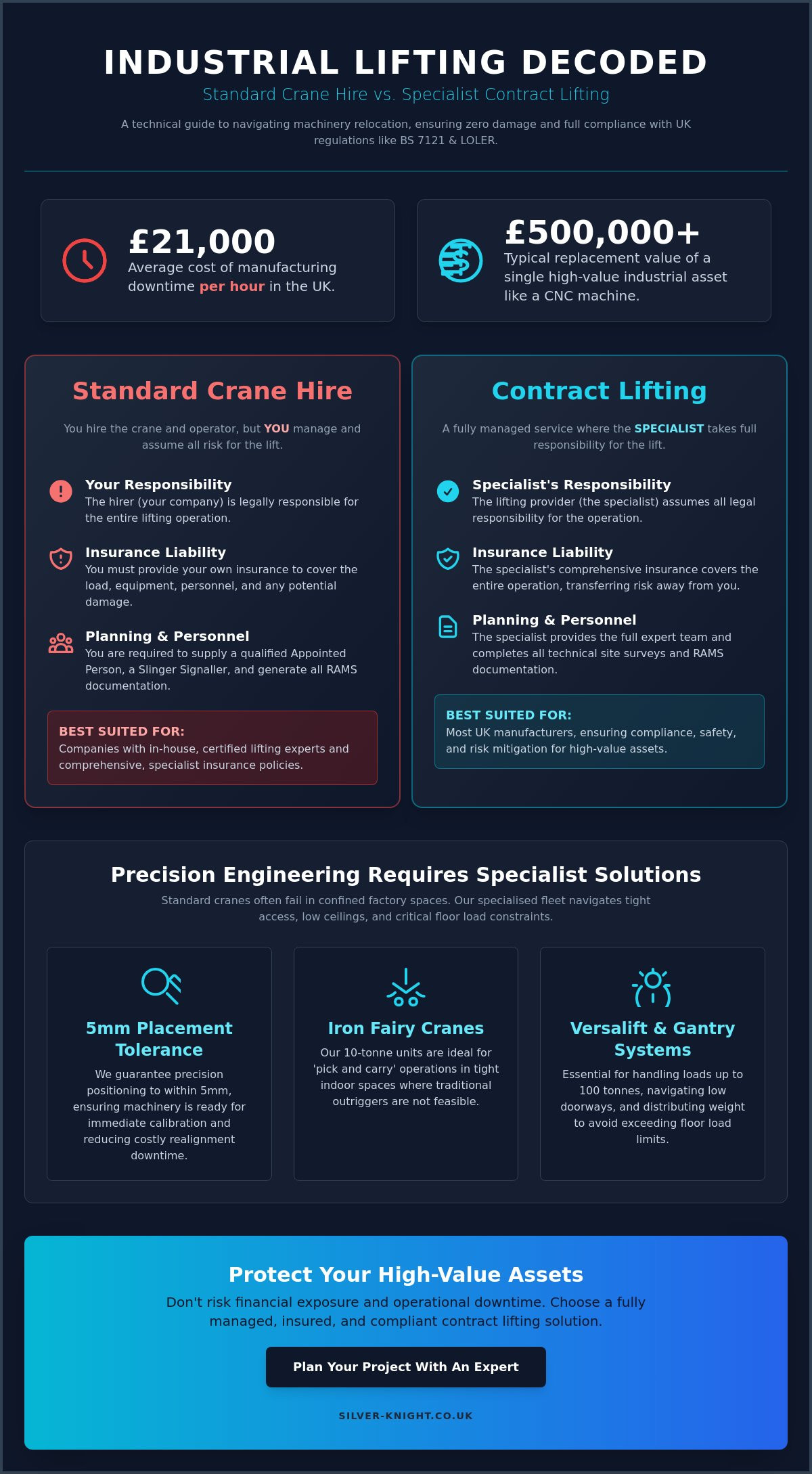
UK manufacturing downtime costs an average of £21,000 per hour according to 2023 industry benchmarking data.
Relocating a 20 tonne CNC machine through a restricted factory doorway requires more than a standard crane hire service.
Crucially, many firms risk significant financial exposure because they don't fully grasp the insurance liability shift between different hire models.
As heavy lifting specialists, we advocate for a technical methodology that ensures every lift meets BS 7121 standards and achieves precision within 5mm.
You likely understand that precision is non-negotiable when handling industrial assets that often exceed a replacement value of £500,000.
The fear of structural damage during a lift is a valid concern for any site manager overseeing a complex plant relocation project.
This guide will clarify the technical differences between standard options to ensure your assets are moved with zero damage and full regulatory compliance.
Best practice dictates a thorough understanding of the specific CPA conditions that govern your site responsibilities during the moving process.
We will examine risk mitigation strategies, LOLER requirements, and the deployment of specialist fleet units such as our 10 tonne iron fairy cranes.
Key Takeaways
- Distinguish between standard crane hire, where the hirer manages supervision, and contract lifting where the specialist takes full responsibility for the lift plan.
- Identify how technical site surveys prevent project delays by uncovering hidden floor load constraints and overhead hazards in UK manufacturing facilities.
- Evaluate the necessity of specialised equipment like iron fairy units or Versalift cranes to achieve precision placement within 5mm in confined indoor spaces.
- Navigate CPA insurance requirements and full RAMS documentation to ensure high-value industrial assets are protected throughout the relocation.
- Learn how to coordinate the transition from specialised lifting to heavy haulage low-loaders for efficient machinery transport across the UK.
Table of Contents
Understanding Crane Hire and Contract Lifting for Industrial Assets
https://silver-knight.co.uk/contact-us/
Understanding Crane Hire and Contract Lifting for Industrial Assets
UK manufacturing output reached £224 billion in 2023, requiring the constant movement of high-value assets across industrial hubs.
Moving a single CNC machining centre often involves assets worth over £250,000 that cannot withstand traditional rigging stresses.
Standard crane hire places the burden of safety and insurance on the customer, which frequently leads to compliance gaps during complex factory moves.
As heavy lifting specialists, we advocate for managed solutions that transfer technical risk away from the plant manager.
Standard crane hire involves the provision of a certified machine and a competent operator to work under the hirer's direct instruction. The customer remains responsible for the lifting plan and all on-site supervision throughout the duration of the project.
Crucially, the legal liability for the lift rests entirely with the hiring organisation under CPA (Construction Plant-hire Association) terms. This means the customer must provide their own insurance cover for the machine, the operator, and the load being lifted.
Best practice dictates that a customer should only choose basic hire if they have in-house expertise and specialist lifting insurance. For most UK manufacturers, the lack of a dedicated Appointed Person makes this route a significant regulatory risk.
The distinction between standard hire and managed lifting
Standard hire requires the customer to provide a qualified Appointed Person and a Slinger Signaller. These individuals must oversee the entire operation to ensure compliance with BS 7121 standards.
Contract lifting offers a fully managed service where the provider takes total responsibility for the project. The specialist provides the full lifting team, including the crane supervisor, and generates all required RAMS.
Choosing a managed service simplifies the planning phase of a factory relocation. It ensures that every aspect of the move is covered by the provider's professional indemnity and public liability insurance.
Why industrial machinery requires specialised lifting protocols
Industrial components like laser cutters or injection moulders are highly sensitive to vibration and improper slinging. Improper techniques can misalign internal optics or damage precision bearings, leading to weeks of expensive production downtime.
Silver Knight maintains a 5mm tolerance for all machine positioning to ensure immediate reinstallation and calibration. Our team utilizes 180 years of collective experience to execute these maneuvers using specialized equipment like Versalift and iron fairy units.
We often deploy our heavy moving equipment hire service to supplement crane operations in tight factory environments. This combination of precision and power allows us to handle loads up to 100 tonnes in restricted spaces.
https://silver-knight.co.uk/contact-us/
Selecting the Correct Lifting Equipment for Heavy Machinery
UK manufacturing output reached £224 billion in 2023. Relocating assets within these facilities often involves navigating tight spaces and fragile infrastructure. Standard crane hire frequently fails due to low ceiling heights or limited floor load ratings. Specialist equipment like Iron Fairy units or Versa-Lifts provides the necessary clearance and weight distribution.
Crucially, floor loading capacities often dictate equipment choice over raw lifting power in British industrial units. Many factory floors are rated for specific point loads that a traditional 50 tonne crane would exceed even when unloaded.
As heavy lifting specialists, we advocate for assessing ground pressure before selecting any lifting medium. All operations must strictly adhere to the Lifting Operations and Lifting Equipment Regulations 1998 (LOLER) to ensure total site safety.
Best practice dictates that a site survey must identify underground voids or service ducts before a crane enters a building. Ignoring these constraints can lead to structural failure or equipment tipping during the lift.
Mobile cranes and Iron Fairy units for factory environments
Iron Fairy cranes are essential for manufacturing bays where overhead gantry cranes are absent or have insufficient capacity. These compact units operate with a low profile that allows them to travel under obstructions while carrying loads of up to 12 tonnes.
Mobile cranes are typically deployed for external lifting or loading assets onto heavy haulage trailers. While basic crane hire is suitable for open construction sites, factory moves require specialised tooling.
Standard mobile units require a footprint of at least 6 metres by 6 metres for outrigger deployment to maintain stability. Iron Fairy units feature a turning circle as tight as 4.5 metres, making them ideal for internal transitions.
Versa-Lift and gantry systems as alternatives to traditional cranes
Versa-Lift hire provides a hybrid solution for heavy machinery moves up to 100 tonnes in confined spaces. These machines feature an extending chassis that increases lifting capacity while maintaining a narrow width for factory aisles.
Hydraulic gantry systems are superior to cranes for vertical lifting when overhead clearance is less than 500mm. They allow for precision placement within 5mm, which is vital for aligning machine beds or CNC equipment.
You can view our full range of specialist assets at Silver Knight Equipment to see these units in action. If you are planning a complex machinery move, our heavy moving equipment hire service
## Comparing CPA Crane Hire and CPA Contract Lifting Frameworks
UK manufacturing output grew by 1.2% in the first quarter of 2024, increasing the demand for complex factory moves.
Relocating a single 20-tonne CNC machine requires a specific legal choice between two CPA frameworks.
Choosing incorrectly leaves the customer liable for the full replacement value of the lifting plant and any third-party damage.
Silver Knight manages this risk by providing clear technical guidance through our machinery haulage and relocation services to protect your assets.
Standard crane hire means the customer takes full legal responsibility for the lifting operation from start to finish. Crucially, the customer must appoint a competent person to manage the site safety and produce a technical lift plan.
As heavy lifting specialists we advocate for contract lifting when handling complex assets like 40-tonne power presses. This framework transfers the risk to Silver Knight, covering the planning, execution, and insurance of the entire move.
https://silver-knight.co.uk/contact-us/
Comparing CPA Crane Hire and CPA Contract Lifting Frameworks
Liability and insurance obligations under CPA conditions
Under standard hire terms, the customer is liable for any loss or damage to the crane while it's on their site. This includes the cost of recovery and the ongoing hire charges while the machine is being repaired.
Under-insuring high-value assets during a lift can lead to catastrophic financial losses if the load is dropped or the crane tips. A standard policy may only cover the scrap value of the machine rather than its operational replacement cost.
In contrast, a contract lift agreement includes comprehensive insurance for the crane, the operator, and third-party property. Industrial relocations typically necessitate a minimum of £10 million public liability insurance and goods-in-transit cover that matches the exact replacement value of the machinery.
Personnel requirements for safe industrial lifting operations
Safe lifting requires a structured team including an Appointed Person, a Crane Supervisor, and qualified Slinger Signallers. Each role must be filled by someone with the relevant CPCS qualifications to ensure compliance with health and safety regulations.
Silver Knight provides these specialists to ensure every lift adheres to the BS 7121 Code of Practice. Our team utilizes specialised units like the Versalift 40/60 to achieve precision placement within 5mm of the designated floor markings.
Slinger Signallers are particularly vital in confined factory spaces where they guide the operator through tight tolerances. Best practice dictates the provision of full RAMS to identify hazards and implement control measures before the crane arrives on-site.
https://silver-knight.co.uk/contact-us/
Planning Requirements for Complex Machinery Lifts
UK manufacturing facilities lose an average of £21,000 per hour during unplanned production stoppages.
Precision planning is the only safeguard against these spiralling costs during a machinery relocation project.
Standard crane hire arrangements often place the burden of site safety and lift planning on the hirer, which can lead to oversight of critical hazards.
As heavy lifting specialists, we advocate for a comprehensive technical site survey to identify risks before any equipment arrives on site.
Every successful lift begins with a technical site survey to identify hidden hazards that aren't visible on standard floor plans. Crucially, these surveys pinpoint underground services and void spaces in industrial flooring that could fail under high point loads.
By identifying these variables early, we reduce operational lag and prevent costly factory downtime. Our team ensures that every lift is calculated to within a 5mm tolerance for maximum safety.
The role of technical site surveys and RAMS
Best practice dictates that every lift begins by identifying structural lifting points and calculating the exact centre of gravity for irregular loads. This data informs the selection of tackle and ensures the load remains level during the entire transition.
Detailed Method Statements outline the exact sequence of the move to prevent asset damage. If decommissioning is required, our Machinery Dismantle Service provides the technical expertise to prepare assets for lifting.
Managing restricted access and floor loading constraints
Industrial floors often conceal drainage channels or service ducts that cannot support the point load of a 100-tonne crane. We utilize heavy-duty spreader plates to distribute weight across a larger surface area and maintain floor integrity.
Navigating machines through doorways with less than 50mm of clearance requires millimetre-perfect logistics. When physical space makes crane hire impossible, we deploy jack and slide systems or low-profile iron fairy units to move assets into position safely.
Secure your project timeline by booking a professional machinery relocation assessment today.
https://silver-knight.co.uk/contact-us/
Executing Precision Machinery Relocation with Specialised Equipment
Logistics reports indicate that 25% of UK factory relocation delays are caused by fragmented supply chains.
When a business relocates high-value machinery, the interface between lifting and haulage is critical.
Managing separate crane hire and transport providers often leads to scheduling conflicts and increased costs.
Silver Knight provides an integrated turnkey service that manages the entire lifecycle of the move.
Integrating crane hire with heavy haulage and installation
Transitioning a 40-tonne CNC machine from its plinth to a heavy haulage low-loader requires sub-millimetre control. Best practice dictates that the same project manager oversees both the crane hire and the transport fleet to ensure seamless site egress.
Our Factory Relocation Service utilises specialised equipment like Versalift 40/60 units and iron fairy cranes to navigate tight internal clearances. We deploy a fleet of step-frame trailers and low-loaders specifically designed for over-height and over-width industrial loads.
Once the machine reaches its destination, our engineers handle the precision positioning within a 5mm tolerance. This end-to-end approach includes the technical recommissioning of the asset to ensure production resumes without delay.
Our turnkey solution eliminates the friction between different service providers. We take full responsibility for the project lifecycle, which includes:
- Detailed site surveys to identify floor load capacities and structural constraints.
- Coordination of road permits and pilot cars for wide-load transport across the UK.
- Custom fabrication of lifting tackle for non-standard loads up to 100 tonnes.
Leveraging 180 years of collective industry experience
International relocations to the US, Asia, or Europe require more than just standard lifting services. As heavy lifting specialists, we advocate for secure export packing techniques using ISPM15 heat-treated timber and vacuum-sealed barrier foil.
Crucially, our team brings 180 years of collective machinery expertise to every project, ranging from single-press moves to entire plant decommissionings. We provide full RAMS for every lift, ensuring that safety protocols meet the rigorous standards of the UK Health and Safety Executive.
Silver Knight remains a family-run business committed to the precision and safety required for high-value industrial assets. Our experience spans diverse sectors including aerospace, automotive, and pharmaceutical manufacturing across the United Kingdom and beyond.
We don't just move boxes; we relocate the heartbeat of your production facility. Whether you're moving a single lathe or a 100,000 square foot factory, our commitment to technical excellence remains constant.
Optimising Your Factory Relocation Strategy
Selecting between standard crane hire and a managed contract lift determines the legal liability for your industrial assets. Crucially, standard hire mandates that the hirer provides a qualified Appointed Person and assumes responsibility for the lift plan.
As heavy lifting specialists, we advocate for managed solutions when positioning high-value CNC machinery within 5mm tolerances. Our specialised fleet features 40/60 Versa-Lifts and 6-tonne Iron Fairy units specifically designed for restricted access in UK manufacturing plants.
We provide full RAMS for every managed lift to ensure strict adherence to BS 7121 and LOLER regulations. It's best practice to leverage our 180 years of collective industry experience to execute complex movements up to 100 tonnes safely.
Contact our heavy lifting specialists for a technical site survey
Your next machinery relocation deserves the technical precision and safety standards that only decades of industrial experience can provide. We're ready to assist with your most challenging heavy lifting requirements across the United Kingdom.
https://silver-knight.co.uk/contact-us/
Frequently Asked Questions
Difference between CPA Crane Hire and a CPA Contract Lift
CPA Crane Hire provides the equipment and operator while the client manages the lift and provides insurance for the plant. A CPA Contract Lift transfers all planning, insurance, and supervision responsibility to the specialist lifting company for a total managed solution.
As heavy lifting specialists, we advocate for contract lifting when moving high value assets like 25 tonne CNC machines to ensure full regulatory compliance.
Insurance requirements for crane hire
Standard crane hire requires the customer to provide comprehensive insurance for the machine, the lift, and third party liabilities. Crucially, this must cover the full replacement value of the equipment being lifted, which often exceeds £500,000 for high precision industrial machinery.
We verify that all insurance policies meet the specific requirements of the CPA model conditions before any lift commences on site.
Responsibility for the lift plan in a contract lift
The Appointed Person from the lifting company is legally responsible for creating a detailed lift plan and ensuring all safety protocols are followed. This document ensures every movement within a factory environment adheres to BS 7121 standards for safe lifting operations.
We provide full RAMS for every project to maintain 100% safety compliance during machinery relocations and heavy equipment installations.
Qualifications for a crane operator moving machinery
Every operator must hold a valid CPCS card specifically for the category of crane being used on the project. Best practice dictates that teams also possess NVQ Level 2 in Plant Operations to handle the complexities of precision industrial movements.
Our specialists use iron fairy units to achieve 5mm placement accuracy in tight production bays where space is extremely limited.
Using a crane inside a factory with low ceilings
Compact cranes like the Versalift or electric Pick and Carry units operate effectively in restricted headrooms of less than 4 metres. These specialised machines allow for the extraction of 10 tonne components without removing roof panels or disrupting existing factory infrastructure.
We frequently deploy these units for internal factory reconfigurations where traditional mobile cranes cannot physically fit or operate safely.
Information required for a crane hire quote
You must provide the exact weight, dimensions, and centre of gravity for the load to be moved. Crucially, we require the maximum radius of the lift and ground bearing capacity data for the site to select the correct equipment.
Providing these technical details ensures your crane hire quote reflects the correct machine capacity for 100 tonne loads and prevents delays.
Determining if a factory floor supports a heavy crane
A qualified structural engineer must verify the ground bearing capacity against the outrigger loadings provided in the crane technical data sheet. Most modern industrial floors support 50kN/m2, but heavy lifts require load spreading mats to prevent slab failure and structural damage.
We calculate these pressures as part of our site survey process to ensure the floor remains within its design limits.
Inclusion of RAMS in contract lifting services
Yes, comprehensive Risk Assessments and Method Statements are a mandatory component of every contract lift we perform for our clients. These documents outline the sequence of work and safety protocols for moving assets within 5mm of live production lines and personnel.
This ensures all stakeholders understand the technical requirements and safety boundaries of the heavy lifting operation before work begins.
Article by
David Ashby
I'm the Managing Director of Silver Knight Haulage & Machinery Ltd. Silver Knight Ltd is a family-run firm established in the West Midlands in 2005, with the aim of providing a cost-effective, yet professional, service to businesses for the removal, transportation, and installation of machinery, plant, and equipment here in the UK and worldwide. Between us, the Silver Knight workforce has over 50 years of experience with machinery and its operation.
Disclaimer
This article is intended for informational purposes only. Please ensure you seek expert advice or carry out your own research to confirm the information is suitable for your specific needs.